What is flight inspection?
Flight Inspection
Flight inspection is a flight in an equipped aircraft that checks air navigation services and instrument flight procedures against published standards.
The US manual calls it the quality assurance program for these services. It also describes it as flying a suitably equipped aircraft to calibrate ground-based navigation aids or to monitor how navigation systems work locally. EASA guidance calls the check of airfield lights a flight check. This page uses flight inspection for both.
What it checks
ICAO Annex 10, Volume I, requires periodic ground and flight tests of radio navigation aids. This applies to the types in its Chapter 3 that aircraft use in international air navigation. A note to the standard points to ICAO Doc 8071 for guidance, including how often to test. The US order covers the air navigation services and instrument flight procedures of the National Airspace System and of the Department of Defense. Its chapters cover VOR, NDB, RNAV, surveillance radar, ILS and GBAS, and also lighting systems.
A flight inspection also covers:
- Instrument flight procedures. A new or revised procedure needs flight inspection and flight validation.
- Signals in space. The aircraft evaluates satellite signals for local degradation and interference. It does not check the accuracy of the satellite system itself.
- Data. EASA names flight inspection of final approach segment data before publication as an example of validation by application.
Before a flight, the flight crew makes sure that the flight inspection equipment is calibrated and operational. The maintenance staff of the facility make sure that the facility equipment is calibrated. The page on equipment calibration explains the term.
Types of inspection
The US order lists five basic types: site evaluation, commissioning, periodic, special and surveillance.
- Site evaluation. This inspection finds out if a proposed site suits a facility.
- Commissioning. This inspection gathers full information on system performance. It also shows that the system supports its operational requirements.
- Periodic. This inspection happens on a regular schedule. It checks that the system still meets standards.
- Special. This inspection happens outside the normal periodic interval. Examples are an inspection after an accident, and an inspection after the facility is reconfigured, removed or replaced.
- Surveillance. This is an ongoing observation of individual components of commissioned systems during normal flights. The crew reports only when it finds a discrepancy.
A commissioning inspection can take place before the runway work is complete. In that case, the order asks for a special inspection after the runway work and before the facility enters service.
How often
The US order sets the minimum periodic interval for each facility, in days. A new precision facility starts with a shorter schedule. For an ILS, the first three inspections are at 90, 180 and 270 days. After that, the facility follows the basic schedule.
| Facility or procedure | Periodic interval in days |
|---|---|
| ILS, LDA or SDF with a glide slope | 540 |
| Standard instrument approach procedure (SIAP) | 540 |
| VOR, VORTAC or TACAN that supports a SIAP or receiver checkpoint | 540 |
| VOR, VORTAC or TACAN that supports neither | 1,080 |
| NDB | 540 |
| Precision approach radar (PAR) | 27 |
The order says that foreign systems may have different intervals. ICAO gives guidance on the periodicity in Annex 10, Attachment C, and in Doc 8071. Each due date has a window. For a facility with a 90-day interval, it runs from 15 days before to 15 days after the due date. For all other facilities, it runs from 60 days before to 60 days after.
How a flight inspection is carried out
The US order lists the steps of a flight inspection mission: request, scheduling, preflight preparation, the flight, analysis and evaluation, and post-flight review and reporting. Authorized staff must request site, commissioning and some special inspections. A periodic inspection needs no request.
Organizations may use appropriately equipped aircraft and helicopters. An automated flight inspection system (AFIS) is the primary method, when it applies. The order says that airborne and ground support equipment must be calibrated to a standard traceable to the US National Institute of Standards and Technology.
Flight inspection and flight validation
Flight validation is part of the validation process for an instrument flight procedure. It is a flight assessment of a new or revised procedure. It shows that the procedure is operationally acceptable for safety, flyability and design accuracy, including obstacle and database verification. It also evaluates the infrastructure that the procedure needs, such as runway markings, approach and runway lights, communications and charting.
An instrument flight procedure specifies standard routings, maneuvering areas, minimum or procedural altitudes, and visibility minimums. For a procedure that uses area navigation (RNAV), the US order allows an approved desktop process for the validation of the coded data. In all cases the crew must fly the final and missed approach segments in an aircraft. It checks them for flyability and obstructions.
Airfield lights
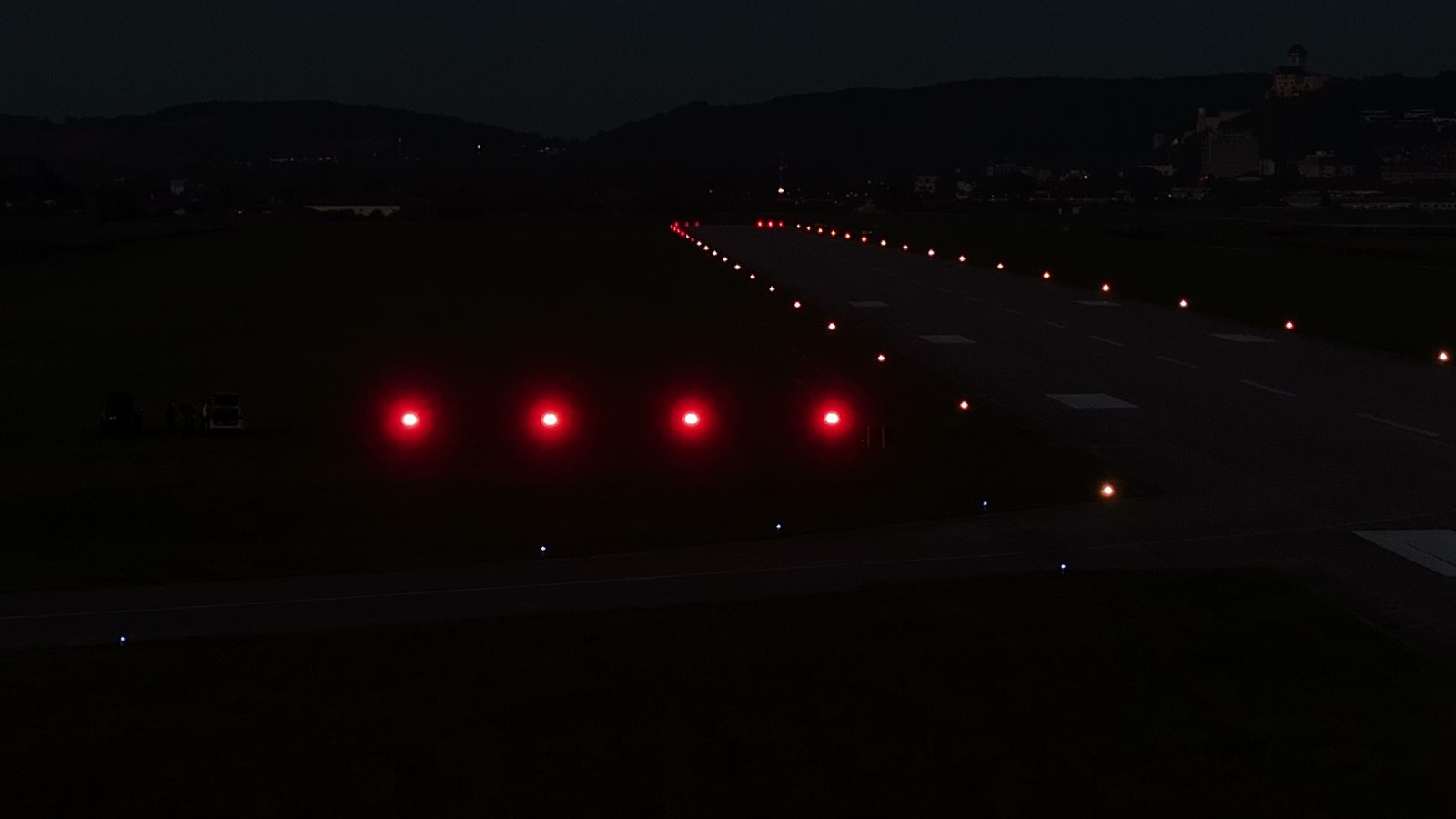
The aircraft also checks visual aids. In the EU, the acceptable means of compliance for lighting maintenance includes a flight check at least once a year. The check covers the approach, runway and taxiway lights, the visual approach slope indicators, the aerodrome beacon and the light intensity control system. The operator also arranges a special flight check after major maintenance or change, and before a new system enters service. This applies by day and by night.
For a precision approach runway the check is more frequent and more detailed than for other runways. It looks at failures and alignment, the approach slope of the indicator, and the balance of intensity at all settings. It also looks at the compatibility with the non-visual aids. By day, the crew also assesses the markings. The operator can combine the check with the calibration flights of the radio aids. EASA points to ICAO Doc 9137, Part 8, Chapter 5, and to Doc 9157, Part 4, Chapter 8, for how to do the check.
A flight check does not replace measurement on the ground. For a category II or III precision approach runway, EASA guidance asks for in-field measurement of the approach and runway lights. It covers intensity, beam spread and orientation. The measurement is at least twice a year for in-pavement lights and at least once a year for other lights.
During routine flights, the US order also asks the crew to watch the aerodrome. Examples are obscured or broken runway lights, new obstructions in the approach area, and tree growth that blocks the view of approach lights.
The PAPI flight check
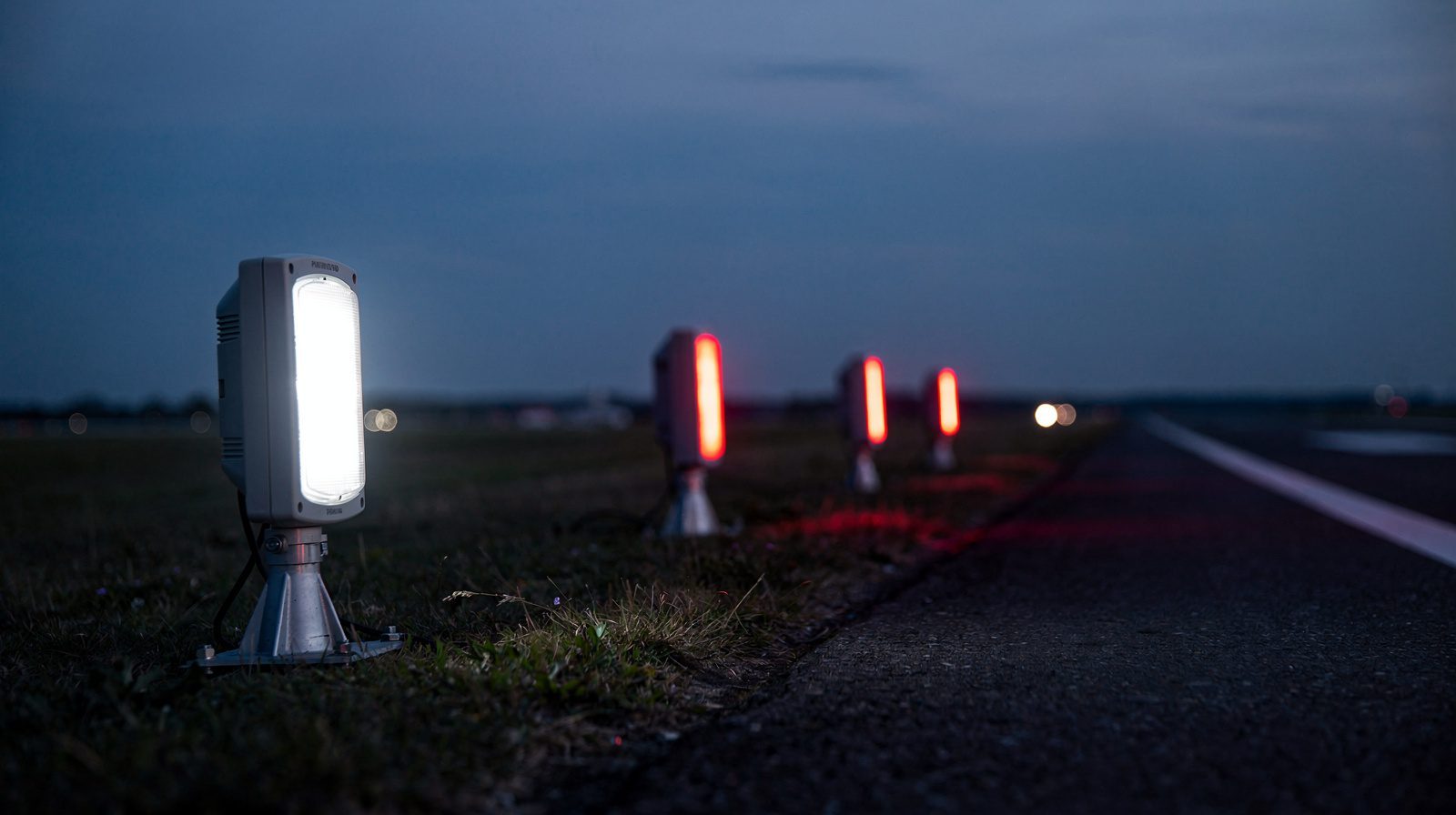
The US manual treats a precision approach path indicator (PAPI) as a type of visual glide slope indicator. It says that ground staff set the initial angles and that flight inspection verifies them. The ground staff first check that all lamps work, that the lamps are not blackened and that the lenses are clean. The flight check covers these items:
- light intensity
- glidepath angle
- angular coverage
- obstruction clearance
- system identification and contrast
- radio control
- coincidence with the electronic glide slope
Each light must work at the same relative intensity at each setting. The normal setting is 100 percent by day, 30 percent in twilight and 10 percent at night. For the glidepath angle, the crew measures the angle of all four light boxes of a 4-box PAPI. The effective glidepath angle must be within 0.20 degrees of the established or desired angle. The visual glidepath is normally 3.0 degrees. An unrestricted indicator must cover 10 degrees on each side of the extended runway centreline.
The level run method suits PAPI. The aircraft flies inbound in level flight at the slowest practical speed. The crew marks the transition points. For a commissioning inspection, the crew averages at least two runs. The US manual says that, if possible, the crew should not fly the check in bright sunlight, because it reduces the effectiveness of the indicator.
The US rule on the interval differs from the EU guidance. A commissioning inspection is required for a new indicator with an associated IFR procedure. The order and the FAA advisory circular both say that there is no periodic inspection requirement for these indicators. They ask the crew to check safe operation when it flies other inspections for the same runway. Table 4-1 of the order also lists VGSI among the facilities that follow the interval of the system or procedure they support. The EU guidance asks for a flight check of the lights at least once a year. UK CAA CAP 168 covers the UK daily, weekly and six-monthly PAPI checks.
Commissioning a new PAPI
The advisory circular requires a commissioning inspection for a new visual glide slope indicator with an associated IFR procedure, including circling approaches. An existing indicator that never had a flight inspection may stay in service until it is reconfigured or the runway gets electronic vertical guidance. The post PAPI commissioning flight check after an LED retrofit covers when the FAA requires the check and what an LED retrofit changes.
The FAA Flight Program Operations decision guide of 25 February 2026 says the same for a new or relocated PAPI. It names changes to an existing PAPI that may need commissioning:
- a new published angle
- a change of configuration, such as 2 boxes to 4 boxes
- the addition of electronic vertical guidance to the runway
Commissioning is mandatory if the PAPI mitigates an unlit 20:1 obstacle penetration. The guide does not set regulatory requirements. It refers the reader to Order 8200.1D and to the FAA Airport District Office for lighting questions. The advisory circular says that flight check staff evaluate PAPI obstacle clearance within the lateral limits of the visible light beam. This may exceed the standard obstacle clearance surface.
For the price of a PAPI flight check in Central Europe, see the PAPI calibration cost guide .
How it relates to a drone survey
A drone survey does not check radio navigation aids such as an ILS. The US order describes the inspection aircraft as an aircraft or helicopter and does not mention unmanned aircraft. TarmacView inspects PAPI and other airfield lighting. The aircraft check shows how the system looks to the pilot on the approach. A drone survey measures each light and compares it with its neighbours. For the comparison, see drone survey versus flight inspection . For what regulators say about drone PAPI checks, see the regulatory acceptance guide .
Frequently Asked Questions
- What is flight inspection?
- Flight inspection is the quality assurance program that verifies that air navigation services and their instrument flight procedures conform to prescribed standards. The US manual also describes it as flying a suitably equipped aircraft to calibrate ground-based navigation aids or to monitor how navigation systems work locally.
- Is flight inspection the same as flight validation?
- No. Flight inspection checks that a navigation aid or procedure meets its performance standards. Flight validation is part of the validation process for a new or revised instrument flight procedure. It checks safety, flyability, design accuracy, obstacles and the data, and it includes the runway markings and the approach and runway lights. An instrument flight procedure specifies standard routings, maneuvering areas, minimum altitudes and visibility minimums for instrument flight.
- Which navigation aids does flight inspection test?
- ICAO Annex 10, Volume I, requires periodic ground and flight tests for the radio navigation aids of the types in its Chapter 3. The US manual has separate chapters for VOR and TACAN, NDB, RNAV, surveillance radar, ILS and GBAS. It also covers visual aids, which are the lights that pilots see on the approach.
- How often is flight inspection done?
- It depends on the facility. In the US manual, the periodic interval for an ILS with a glide slope is 540 days. A new precision facility starts at 90, 180 and 270 days. The EU acceptable means of compliance for airfield lights asks for a flight check at least once a year. Foreign systems may have different intervals.
- Does flight inspection check airfield lights?
- Yes. In the EU, the acceptable means of compliance for lighting maintenance includes a flight check of the approach, runway and taxiway lights. It also covers the visual approach slope indicators. It asks for the check at least once a year. The check looks at failures, alignment, the slope of the indicator and the balance of light intensity at all settings.
- What does a flight inspection check on a PAPI?
- The US manual lists light intensity, glidepath angle, angular coverage, obstruction clearance, identification and contrast, radio control, and coincidence with the electronic glide slope. The effective glidepath angle must be within 0.20 degrees of the established angle.
- When is a commissioning flight inspection required for a new PAPI?
- In the US, a new or relocated PAPI on a runway with an associated instrument flight procedure needs a commissioning flight inspection. This includes circling approaches. A PAPI that mitigates an unlit 20:1 obstacle penetration also needs one. The order and the FAA advisory circular set no periodic inspection requirement for a PAPI.
- Can a drone survey replace a flight inspection?
- The US order does not name a drone survey as a way to do a flight inspection. It describes flight inspection as the operation of a suitably equipped aircraft and does not mention unmanned aircraft. A drone survey does not check radio navigation aids such as an ILS. TarmacView measures airfield lights one by one.
References
- faa-order-8200-1d
- Order 8200.1D, Change 2, United States Standard Flight Inspection Manual FAA
- icao-annex-10-vol-i
- Annex 10, Volume I, Radio Navigation Aids: Chapter 2, 2.2 Ground and flight testing ICAO
- easa-ear-aerodromes
- Easy Access Rules for Aerodromes (Regulation (EU) No 139/2014) EASA
- faa-ac-150-5340-30j
- AC 150/5340-30J, Design and Installation Details for Airport Visual Aids FAA
- faa-fpo-commissioning-guide
- Flight Inspection Commissioning Requirements Decision Guide, issued 25 February 2026 FAA Flight Program Operations
This is a reference entry. TarmacView provides drone inspection services and doesn't sell the equipment or materials described in this glossary.