What is a Commissioning Flight Inspection?
Commissioning Flight Inspection
Definition
A commissioning flight inspection is a flight inspection that measures system performance and shows that the system will support its operational requirements.
FAA Order 8200.1D defines it as a comprehensive flight inspection that gathers complete information on system performance. It names five types of flight inspection: site evaluation, commissioning, periodic, special and surveillance. The flight inspection page covers all five types, the intervals and the aircraft. This page covers the commissioning type only, with the focus on airfield lights and the PAPI.
When the FAA requires it
The FAA Flight Program Operations decision guide of 25 February 2026 lists the typical triggers. The guide is reference material. It does not set regulatory requirements, and its own text names Order 8200.1D and Order 8260.19 as the primary references.
- First IFR use of a runway or runway end, circle-to-land use included.
- A runway extension, or a change that affects IFR procedures or the lighting.
- A new, upgraded or relocated approach lighting system (ALS), runway end identifier lights (REIL), or visual glide slope indicator (VGSI) such as a PAPI.
- A change to an ALS or VGSI that affects the published angle, the configuration, or the use for obstacle mitigation.
- Establishing or restoring night minima.
For the first IFR use of a runway, the guide asks for the commissioning of all runway and approach lighting. This applies even for daytime IFR use only. It also asks for a night evaluation if night minima are to be published or if the night appearance of the lights changes significantly.
Several cases in the guide carry the proviso that ATO and ARP headquarters may determine otherwise.
When a PAPI needs it
AC 150/5340-30J requires a commissioning inspection for every new VGSI with an associated IFR procedure, circling approaches included (7.7.6.6.4). The decision guide gives the detail:
| Case | Commissioning inspection |
|---|---|
| New or relocated VGSI or PAPI for a runway with an IFR procedure | Required, regardless of previous commissioning status |
| PAPI relocated, for example after a runway extension | Required, regardless of previous commissioning status |
| Change from a 2-box to a 4-box PAPI, or major hardware change | May be required |
| New published angle, that is a new nominal approach slope | May be required |
| Electronic vertical guidance added to the runway | May be required |
| VGSI used to mitigate an unlit 20:1 obstacle penetration | Mandatory |
The guide says to ask the Airport District Office (ADO) about lighting questions and Mission Support about procedures.
For the first IFR use of a runway, the guide also asks to commission the VGSI or PAPI if the runway receives electronic vertical guidance. Temporary lighting follows the same rules as permanent lighting. The airport operator must submit the data for temporary systems to Aeronautical Information Services before the flight inspection.
An existing VGSI that never had a flight inspection can stay in service until it is reconfigured or the runway receives electronic vertical guidance. AC 150/5340-30J says that every VGSI that serves an IFR runway needs commissioning as soon as the survey data and funds are available.
What the crew checks on a PAPI
Order 8200.1D lists seven checks for a VGSI. All seven apply to a commissioning inspection.
- Light intensity. All lamps work at the same relative intensity on each setting. The normal setting is 100 percent by day, 30 percent in twilight and 10 percent at night. If possible, the crew avoids bright sunlight, because it reduces the effect of the VGSI.
- Glidepath angle. The crew measures and reports the angle of all four light boxes of a 4-box PAPI. The effective angle is the average of boxes 2 and 3. A level run needs at least two runs to be averaged for a commissioning inspection. The on-path method averages at least three colour changes in each direction.
- Angular coverage. The crew crosses the extended centreline at 90 degrees. An unrestricted VGSI covers 10 degrees on each side of the centreline.
- Obstruction clearance. The crew flies a below-path approach and evaluates obstacle penetrations to 8 nm from the threshold. The distance is 4 nm for a 2-box PAPI.
- System identification and contrast.
- Radio control. A commissioning check of the radio control applies when the VGSI needs a commissioning inspection.
- Coincidence with the electronic glide slope. The visual angle must be within 0.2 degrees of the design path angle of the instrument approach procedure.
The decision guide repeats the angle criterion as a performance criterion. The VGSI angle must be within ±0.2 degrees of the desired angle, and the obstacles must be cleared with a proper fly-up indication. See PAPI approach slope and elevation setting for how the angles are set and measured.
Initial settings come from ground adjustments, and the flight inspection verifies them. If the crew finds the angle out of tolerance, the ground staff may adjust the angles beyond the normal maintenance tolerances. The result becomes the reference setting for all later alignments (Order 8200.1D, Chapter 7, paragraph 3).
Other airfield lights
Order 8200.1D requires a commissioning flight inspection for all airport lighting systems that support a public-use or military instrument approach procedure. This covers approach lights, REIL, runway lights and the radio control of lights. Recurring inspections then follow the periodic inspection of the navigation facility that the lights support.
For approach lights and REIL, the crew checks light intensity, lamp alignment, inoperative lights and radio-controlled lights. For a commissioning inspection, all lights of each system must work and carry the proper filters.
Before the flight
- Request it. Authorized personnel must request commissioning inspections. A periodic inspection needs no request (Order 8200.1D, Chapter 4, paragraph 15).
- Notify the Flight Service Station. AC 150/5340-30J asks to tell the FSS when the PAPI is ready for commissioning. It also asks for a commissioning NOTAM.
- Report six items to the FSS. They are:
- the airport name and location
- the runway number and the PAPI side
- the PAPI type, L-880 or L-881
- the glide path angle
- the runway threshold crossing height
- the date of commissioning
- Supply the VGSI data. The AC says that every VGSI inspection except surveillance needs facility data from the National Flight Data Center. The crew must not use the data of other facilities on the runway, such as ILS data.
- Clear the obstacles. FAA Engineering Brief 95 records that the new obstacle criteria caused failed PAPI commissioning inspections. For a commissioning inspection, the operator must identify and mitigate the penetrations in the evaluation area. The operator need not mitigate obstacles beyond 4 nm from the threshold. A penetration beyond 4 nm typically restricts the usable distance of the PAPI.
- Finish the runway work. A commissioning inspection can take place before the runway work is complete. Then the crew requests a special inspection after the work and before service (Order 8200.1D, Chapter 4, paragraph 3).
The AC says that the installers and the engineer must know the requirements of Order 8200.1 before they request the flight check.
After the inspection
The flight inspector classifies the system from the results. The VGSI angle and the runway it serves go into the commissioning message for publication. If an obstacle penetrates the obstacle clearance surface, the crew may restrict the usable distance of the PAPI. The restricted distance keeps a buffer of at least 0.5 nm inside the penetration point. The AC lists “threshold crossing height” among the commissioning data. See minimum eye height over the threshold for the ICAO and EASA term for the same height.
The FAA sets no periodic inspection for VGSI. The crew checks safe operation during other flight inspections of the same runway.
The EU flight check
EASA does not use the word commissioning for this check. AMC1 ADR.OPS.C.015(b) and (f) asks for a flight check at least once a year. The check covers these systems:
- approach, runway and taxiway lights
- visual approach slope indicators
- the aerodrome beacon
- the light intensity control system
It also asks for special flight checks after major maintenance or changes to such systems. It asks for them before the commissioning of new systems too, by day and by night.
What it means on an airfield
A new PAPI for an IFR runway needs the commissioning steps above. The operator supplies the VGSI data, requests the inspection and clears the obstacles. Engineering Brief 95 records that failed inspections made airports delay PAPI commissioning.
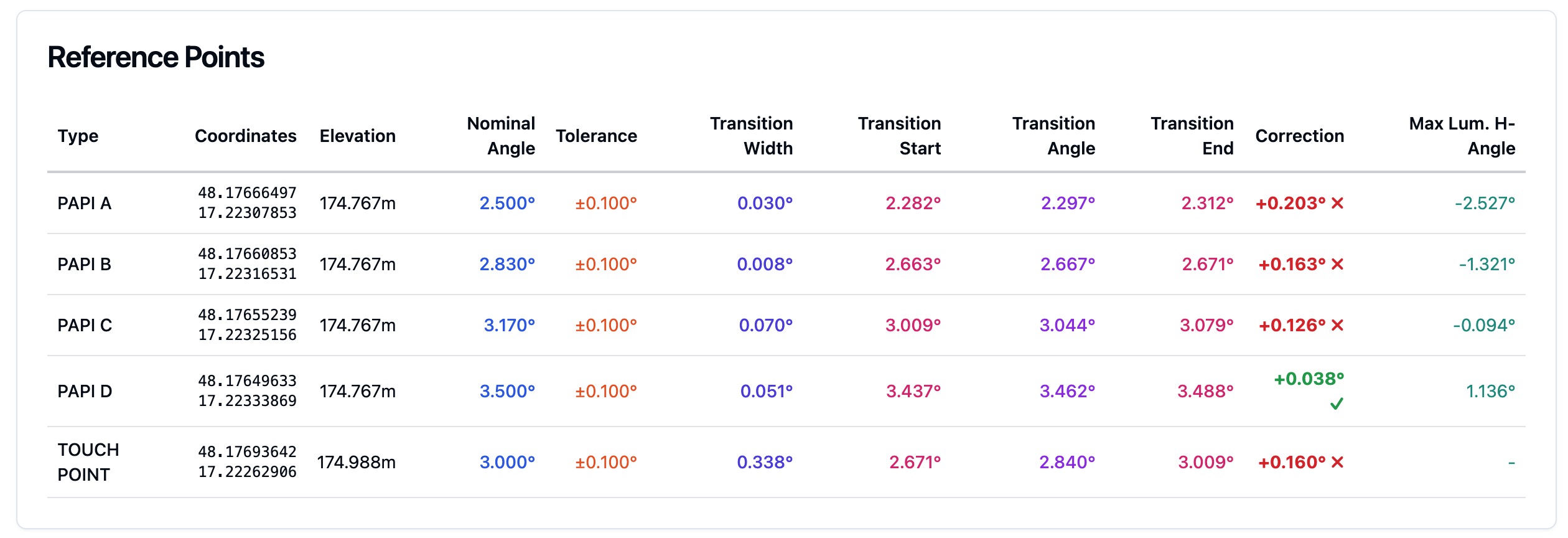
Ground crews set the initial angles, and the flight inspection verifies them. TarmacView’s PAPI inspection measures the transition angle of every PAPI unit with a drone. For the cost of the flight check, see the PAPI calibration cost guide . For what regulators say about drone checks, see the regulatory acceptance guide .
Frequently Asked Questions
- When is a commissioning flight inspection required for a new PAPI under FAA rules?
- A new visual glide slope indicator with an associated IFR procedure needs a commissioning inspection, circling approaches included. AC 150/5340-30J says this in 7.7.6.6.4. The FAA decision guide of 25 February 2026 adds that a new or relocated PAPI needs one regardless of its earlier commissioning status. The guide does not set regulatory requirements.
- What is a commissioning flight inspection?
- It is the type of flight inspection that follows the installation of a system. FAA Order 8200.1D defines it as a comprehensive flight inspection that gathers information on system performance. It also establishes that the system will support its operational requirements. The other four types are site evaluation, periodic, special and surveillance.
- What does the crew check on a new PAPI?
- The commissioning check covers seven items. They are light intensity, glidepath angle, angular coverage, obstruction clearance, system identification and contrast, radio control, and coincidence with the electronic glide slope. The crew measures the angles of all four light boxes of a 4-box PAPI. Order 8200.1D lists these items in Chapter 7.
- Does a PAPI need a flight inspection again after commissioning?
- The FAA sets no periodic inspection for visual glide slope indicators. Order 8200.1D and AC 150/5340-30J both say so. The crew checks safe operation during other flight inspections of the same runway. A later change to the PAPI can bring a new commissioning inspection.
- Does an LED conversion need a commissioning flight inspection?
- Not for runway edge lights when the change has no effect on the instrument procedure. The FAA decision guide lists one case with no flight inspection. It is the replacement of runway edge lights with the same capability or type, LED conversions included. The proviso is that ATO and ARP headquarters may decide otherwise.
- What does EASA require before a new lighting system enters service?
- EASA asks for a special flight check before the commissioning of a new lighting system, by day and by night. AMC1 ADR.OPS.C.015(b) and (f) says this. It also asks for a flight check of the approach, runway and taxiway lights at least once a year.
- What happens if the new PAPI fails the commissioning inspection?
- It depends on the finding. If the crew finds the glidepath angle out of tolerance, the ground crew can adjust the angles beyond the normal maintenance tolerances. The result becomes the reference setting for later checks. If an obstacle penetrates the obstacle clearance surface, the usable distance of the PAPI can be restricted.
References
- faa-order-8200-1d
- Order 8200.1D, United States Standard Flight Inspection Manual, including Change 2 (20 September 2024) FAA
- faa-fpo-decision-guide
- Flight Inspection Commissioning Requirements Decision Guide, issued 25 February 2026 FAA Flight Program Operations
- faa-ac-150-5340-30j
- AC 150/5340-30J, Design and Installation Details for Airport Visual Aids FAA
- faa-eb-95
- Engineering Brief No. 95, Additional Siting and Survey Considerations for Precision Approach Path Indicator (PAPI) and Other Visual Glide Slope Indicators (VGSI), 19 December 2017 FAA Airport Engineering Division
- easa-ear-aerodromes
- Easy Access Rules for Aerodromes (Regulation (EU) No 139/2014), including CS-ADR-DSN Issue 7 EASA
This is a reference entry. TarmacView provides drone inspection services and doesn't sell the equipment or materials described in this glossary.