What ICAO Annex 14 Actually Requires of Your PAPI
The tolerances behind a PAPI protocol, what an authority looks for in the evidence, and how often the system has to be verified to stay certifiable.
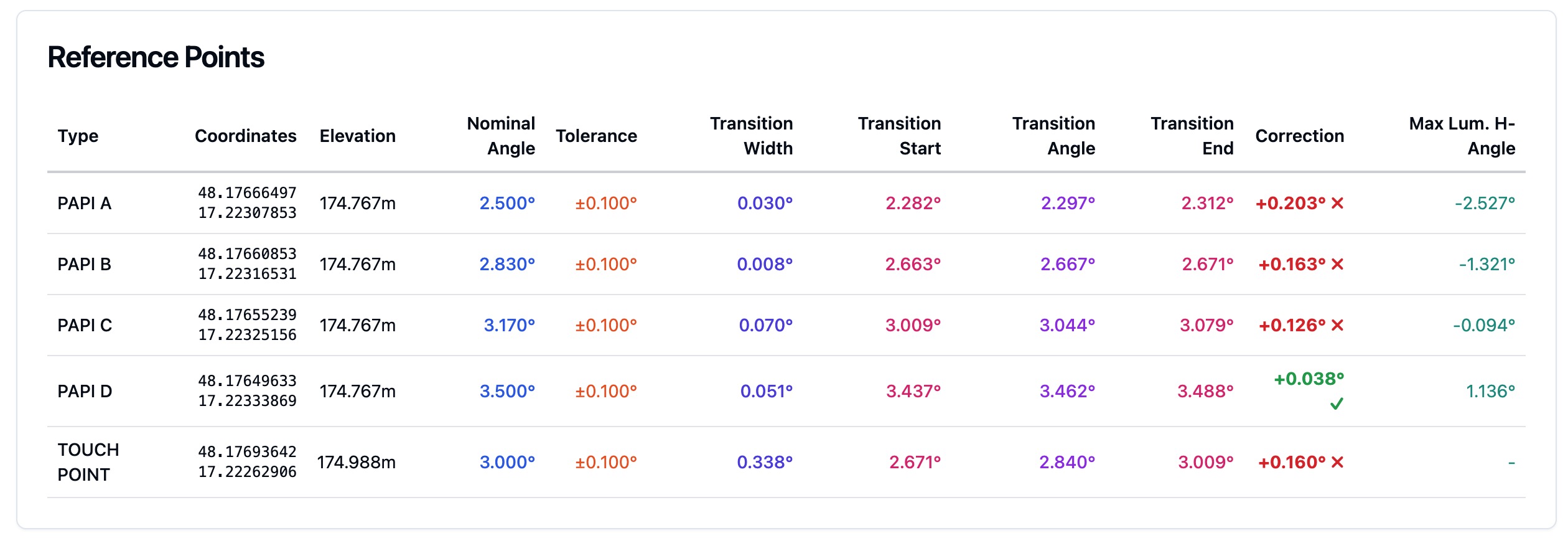 REPORT · MEASURED ANGLES PER UNIT
Two documents, one system
A PAPI installation is governed by two references that people tend to blur together.
Annex 14, Volume I specifies what the system must do: the light characteristics, the beam spread, and the transition angles that turn a red signal white as an aircraft crosses the glide path.
Doc 9157, Part 4, the Aerodrome Design Manual on visual aids, is where the measurement protocol lives. It is the document your report is formatted against.
Annex 14 says what correct looks like. Doc 9157 Part 4 says how you prove it.
The tolerance everything hangs on
The number that matters most is the vertical angle at which each unit transitions between red and white. That transition has to fall within ±3 minutes of arc, which is ±0.05° in decimal degrees.
Three arc-minutes is a small quantity. At a typical measurement distance of 350 m it is roughly the width of a hand held at arm’s length, and it is the entire budget within which a pilot’s glide path guidance must sit. It is also why judging the transition by eye from a moving aircraft was always the weakest link in the traditional method.
For context on what modern measurement can resolve, our own error budget sums to a theoretical worst case of ±0.0072°, and we conservatively guarantee ±0.017°, which is ±1 minute of arc. That is inside the ICAO tolerance by a factor of three.
What else the protocol has to show
The angle is the headline, not the whole document. A complete verification also covers:
- Beam spread, horizontal and vertical, so the signal is visible throughout the approach zone rather than only on the centreline.
- Chromaticity, confirming the red and white signals sit inside the ICAO coordinate boundaries. A red that has drifted toward orange is still red to a spectrometer and ambiguous to a pilot at 3 nm.
- Unit positioning, because a correctly aimed light in the wrong place still defines the wrong glide path.
- Correction values, the exact per-unit adjustment needed to bring anything out of tolerance back in.
That last one is what separates a measurement from a report an airport can act on. A pass or fail tells you there is a problem. An adjustment value tells your maintenance team what to turn.
How often
ICAO and most civil aviation authorities recommend annual inspection and calibration verification. That is the floor, not the ceiling.
The intervals that actually catch problems are the event-driven ones: after maintenance work on or near the units, after extreme weather, after any reported operational issue, and after ground works that could have disturbed the foundations. Annual cadence exists because aircraft-based verification had to wait for a calibration flight to be in the area, and paying to bring one in for the lights alone was more than most aerodromes would do twice a year. When verification is a crew that drives and 20 minutes between movements, the scheduling constraint that set that interval no longer applies.
What an authority wants to receive
Evidence, in its format. Measured values per unit, the tolerance each was checked against, the adjustment values for anything outside it, and the photo and video record behind the numbers, all traceable to a specific flight on a specific day.
Our reports are formatted to Doc 9157 Part 4 and built to ICAO, EASA or FAA, because which authority is asking depends on where the runway is, and the underlying measurement does not change with the letterhead.
More detail on the standards side is on the compliance page , and the measurement chain itself is broken down in the algorithm deep dive .
Founded by flight-inspection veterans who spent decades measuring PAPI lights for aviation authorities across Europe.
Learn more
Related terms
03 TERMSA-PAPI Abbreviated Approach Path Indicator
A-PAPI (Abbreviated Precision Approach Path Indicator) is a two-light visual glide path indicator system installed at airports to help pilots maintain the correct approach angle during landing, especially where space, cost, or operational constraints prevent installation of a full PAPI.
Precision Approach Path Indicator (PAPI)
A complete overview of the Precision Approach Path Indicator (PAPI), the globally standardized visual glide slope aid that enhances safe landings at airports, heliports, and airfields. Learn about its design, operation, calibration, maintenance, and role in aviation safety.
Color Transition
Color transition in airport lighting refers to the precise shift from one color to another, such as from white to red, in approach slope indicator systems like PAPI and VASI. This optical effect provides pilots with critical visual cues about their position relative to the ideal glide path during landing.
Further reading
03 ARTICLES
ICAO Compliance
Meeting the highest standards of aviation safety

Runway Edge Light Inspection: What ICAO Requires and How It Is Measured
What ICAO Annex 14 requires of runway edge lights, what it leaves open, and how intensity, colour and coverage are actually measured in the field.
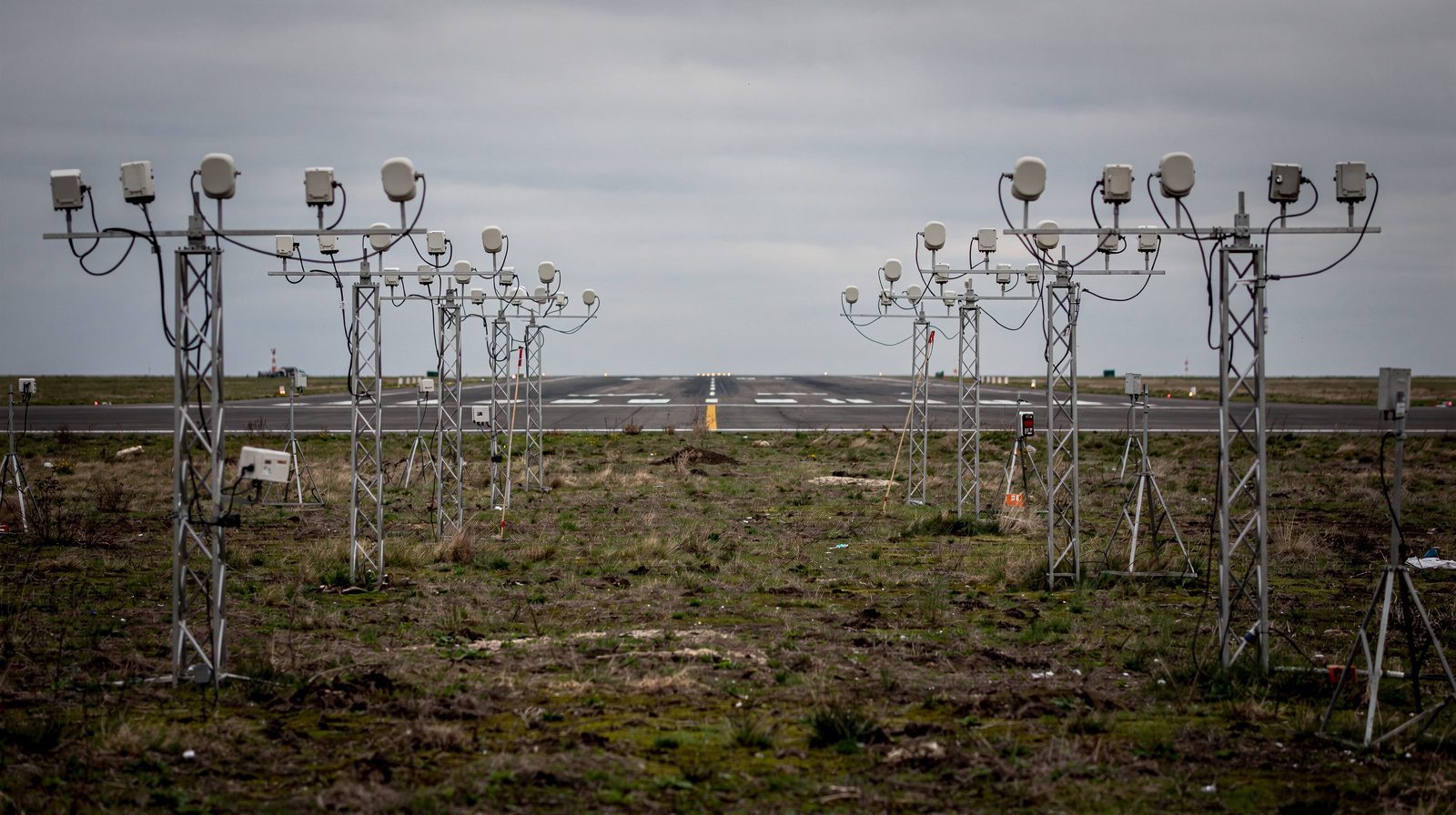
Approach Lighting System Inspection
What an approach lighting system does for the crew, what Annex 14 asks of it in service, and why 900 metres of array off the airport is hard to…