What is a Precision Approach Path Indicator (PAPI)?
Precision Approach Path Indicator (PAPI) – The Definitive Guide
Introduction
The Precision Approach Path Indicator (PAPI) is one of aviation’s most important visual landing aids, helping pilots maintain a safe, stabilized approach to the runway during the critical phase of landing. Found at airports large and small, as well as at heliports and military fields, the PAPI is a globally standardized system that provides unambiguous, easily-interpreted visual guidance on an aircraft’s glide slope. This comprehensive guide explores every facet of PAPI: from its design and operation to its impact on flight safety, recent technological developments, and best practices for installation and maintenance.
What Is a PAPI?
A PAPI is a row of bright lights, typically four, installed perpendicular to the runway centerline, about 300 meters (980 feet) beyond the runway threshold and 15 meters (49 feet) from the edge. Each unit projects a beam with a sharp transition between red (lower) and white (upper) light. When a pilot is on the correct approach path, two lights appear red and two appear white. Deviations above or below the ideal glide slope are instantly shown with a change in the color pattern.
Key Features:
- Visual Glide Slope: Shows if the aircraft is above, below, or on the glide path.
- Universal Meaning: Standardized color patterns for intuitive, rapid decisions.
- Global Standard: Prescribed by ICAO and FAA for precision and non-precision runways.
How Does a PAPI Work?
When approaching the runway, pilots observe the PAPI’s four lights:
- On Slope: 2 white, 2 red.
- Too High: 3 or 4 white.
- Too Low: 3 or 4 red.
The transition between red and white is sharp and unmistakable, thanks to precision optics and calibration. The system’s design ensures that, from far out on final approach up to the runway threshold, the pilot’s perspective on the color pattern changes predictably with vertical position.
Mnemonic:
Red on white, you’re all right, red on red, you’re dead, white on white, check your height.
PAPI Light Units – Design and Technology
Each PAPI light unit is a rugged, weatherproof box housing a high-intensity lamp or LED array, precision lenses, and a red filter. Each unit is set at a slightly different vertical angle, corresponding to a specific approach slope. Modern systems use:
- Halogen bulbs (older) or LEDs (modern, for longevity and efficiency)
- Red color filters for the lower beam segment
- Sharp optical cut-off between red and white (no more than 3 minutes of arc as per ICAO)
Mounting Angles for a 3° Glide Slope:
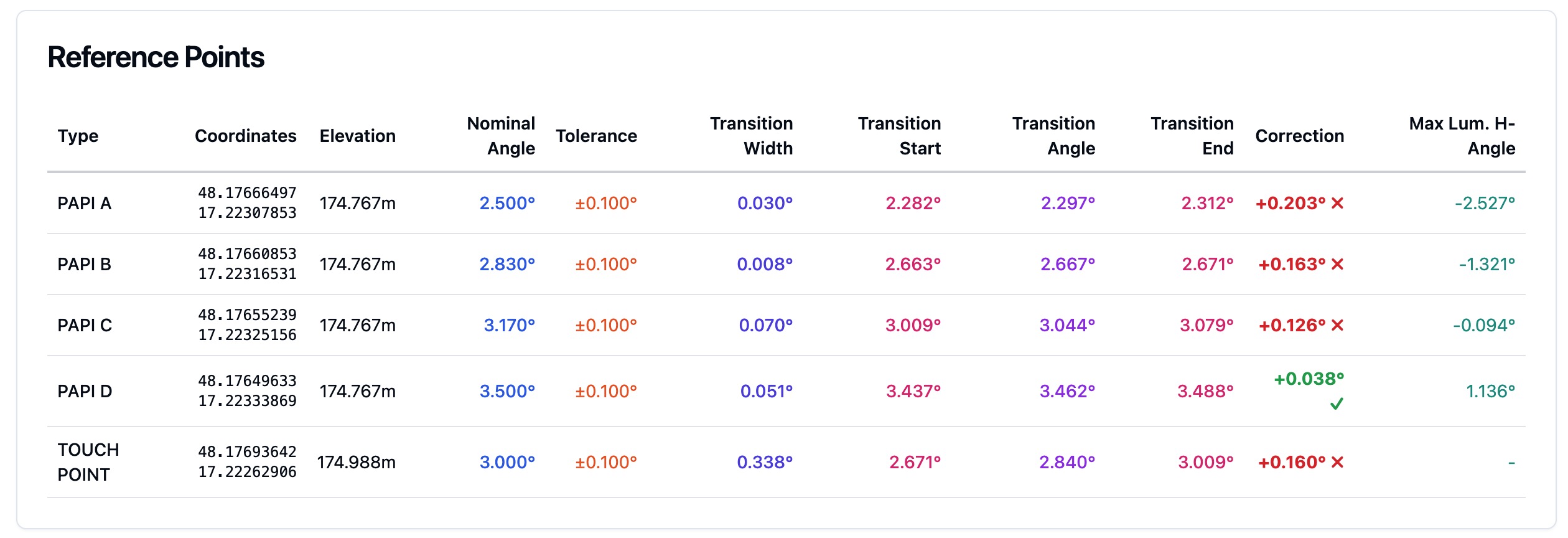
- Unit 1: 2.50°
- Unit 2: 2.83°
- Unit 3: 3.17°
- Unit 4: 3.50°
This stagger creates the five distinct PAPI indications.
Installation and Site Geometry
Proper PAPI installation is governed by ICAO Annex 14 and FAA standards. The lights are usually placed on the left side of the runway (right side if necessary for site reasons), at a standard offset and distance from the threshold. The units are spaced 9 meters (30 feet) apart, perpendicular to the runway.
Critical factors:
- Unobstructed light path in the service volume
- Stable, level foundation
- Frangible mounting for collision safety
- Accessible for maintenance
PAPI Service Volume
The service volume is the area where PAPI guidance is valid and obstacle clearance is ensured:
- Lateral: ±10° from runway centerline
- Longitudinal: Up to 3.4 NM (6.3 km) from threshold
Pilots should use PAPI only within this area to guarantee safe obstacle clearance.
Interpreting PAPI Indications
| Lights Displayed | Glide Path Position |
|---|---|
| 4 White | Well above slope |
| 3 White, 1 Red | Slightly above slope |
| 2 White, 2 Red | On correct slope |
| 1 White, 3 Red | Slightly below slope |
| 4 Red | Well below slope |
The system’s sharp transitions support quick, reliable corrections.
PAPI Variants
- Standard (4-Unit) PAPI: Most precise, five indications, recommended for busy/professional airports.
- Dual-Sided PAPI: For runways with complex approaches or redundancy needs.
APAPI, the abbreviated PAPI
The abbreviated precision approach path indicator, written APAPI in Annex 14 and also spelled A-PAPI, is a wing bar of two sharp transition units instead of four, on the left side of the runway unless that is physically impracticable.
It gives three indications. On or close to the slope, the unit nearer the runway shows red and the farther one white. Above the slope both show white, below it both show red.
Where a slope indicator is required, a Standard calls for a PAPI or an APAPI on code number 1 and 2 runways. For code number 3 and 4 the Standard does not list APAPI. For a temporarily displaced threshold, a Recommendation says a PAPI should be provided, with an APAPI allowed on code 1 and 2.
The approach slope is the mean of the two setting angles, (A + B) ÷ 2, where a PAPI uses its middle units, (B + C) ÷ 2. Figure 5-20 sets a 3° APAPI at 2°45′ and 3°15′. Obstacle clearance is set for the lowest on-slope signal, one white and one red, where a PAPI uses one white and three red.
Figure 5-19 places the inner unit 10 m from the runway edge, with 6 m between units, widened to 9 m for more range or a planned upgrade to a full PAPI (Annex 14, Volume I, 5.3.5).
The limitation is resolution. There is no “slightly high” or “slightly low” stage, and in Figure 5-20 the on-slope sector is 30′ wide against 20′ for a PAPI.
PAPI vs. Other Visual Slope Aids
| Feature | PAPI (4-Unit) | VASI (2/3-Bar) | Tri-Color VASI |
|---|---|---|---|
| Indications | 5 | 3 | Continuous |
| Precision | High | Moderate | Low |
| Usage | Global Std. | Less common | Rare |
PAPI provides finer resolution, easier interpretation, and is now the gold standard worldwide.
Calibration and Maintenance
Calibration must be performed regularly using precision theodolites or laser instruments to maintain the correct transition angles.
- Lamp/LED checks and replacement
- Cleaning lenses and housings
- Checking alignment and mounting security
- Inspecting for electrical faults or physical damage
LED PAPI systems reduce maintenance with their long life and resilience.
Integration and Automation
- Airport Lighting Systems: PAPIs are often linked to runway edge and approach lights.
- Pilot-Controlled Lighting (PCL): Allows pilots to activate PAPI at non-towered airports.
- Runway Safety Integration: Some airports use PAPI flashing as part of runway incursion alerts (e.g., FAROS).
PAPI System Innovations
LED-Based PAPI
- Up to 50,000-hour lifespan
- Sharper color transitions
- Lower energy use and heat output
Solar-Powered PAPIs
- Ideal for remote or temporary airfields
- Use photovoltaic panels and batteries
Environmental and Operational Considerations
PAPIs are built to withstand:
- Extreme temperatures
- Precipitation, frost, dust, and wildlife
- Vibration and jet blast
Some have heated lenses for snow/frost prevention. Pilots are trained to cross-check PAPI with other approach aids, especially under poor visibility.
Aircraft Eye Height and PAPI Calibration
Standard PAPI calibration assumes a typical pilot eye height at threshold. Large jets (e.g., B747, A380) or small aircraft may perceive the lights differently. Correction tables are available to adjust for cockpit height variations.
PAPI System Limitations
- Calibration Drift: Caused by settling, weather, or impact.
- Lamp/LED Failure: Reduces visibility or creates ambiguous patterns.
- Lens Contamination: Dirt, snow, or wildlife can block light.
- Electrical Faults: Loss of power or control system faults.
- Poor Weather: Fog, rain, or snow can reduce light effectiveness.
Regular maintenance and redundant approach aids are vital.
Pilot Procedures for Using PAPI
- Acquire PAPI visually on approach.
- Interpret color pattern for glide slope position.
- Adjust flight path to maintain 2 white, 2 red.
- Cross-check with instruments and other aids.
- Report any anomalies to ATC, do not use if NOTAM’d out of service.
Impact on Aviation Safety
PAPIs have been shown to significantly reduce Controlled Flight Into Terrain (CFIT) and unstable approach accidents. Their widespread use is a cornerstone of global aviation safety, supporting both professional and general aviation operations.
Case Studies
- Major Airports: London Heathrow and New York JFK use dual-sided, LED PAPIs for maximum visibility and redundancy.
- Challenging Terrain: Innsbruck (Austria) uses PAPI to supplement ILS in mountainous terrain.
- Small Airfields: On code number 1 and 2 runways, Annex 14 allows a two-unit APAPI in place of a full PAPI (Annex 14, Volume I, 5.3.5).
Recent Developments
- LED and solar PAPI adoption is accelerating, lowering maintenance and expanding deployment options.
- Integration with incursion warning systems and remote diagnostics enhances operational safety.
- ICAO/FAA standards continue to evolve, with guidelines for new aircraft types and environmental conditions.
Conclusion
The Precision Approach Path Indicator is a simple, robust, and universally recognized visual aid that has transformed approach safety for generations of pilots. Its sharp, unambiguous guidance is trusted by aviation professionals worldwide, whether flying a jumbo jet into a major hub, a turboprop into a regional field, or a helicopter to a hospital pad.
For airport operators, investing in modern PAPI technology, especially LED or solar-powered systems, delivers tangible improvements in safety, reliability, and operational efficiency.
Looking to upgrade or install a PAPI system? Contact us or schedule a demo to see how we can help you achieve world-class runway safety.
Further Reading
- ICAO Annex 14, Volume I – Aerodromes
- ICAO Doc 9157, Aerodrome Design Manual, Part 4
- FAA Advisory Circular AC 150/5345-28
- Flight Safety Foundation: Approach and Landing Accident Reduction
This guide is maintained by aviation safety and airfield lighting experts. For questions or technical consultations, please reach out via our contact page.
Frequently Asked Questions
- How does a PAPI system help pilots during landing?
- PAPI provides clear visual cues using red and white lights, showing pilots if they're above, below, or on the correct glide path. This helps maintain a safe descent profile, avoiding obstacles and ensuring a stabilized approach to the runway.
- What are the main differences between PAPI and VASI?
- While both are visual approach slope indicators, PAPI uses four light units for more precise five-stage guidance, while VASI uses two or three bars and offers three-stage (above, on, or below slope) indications. PAPI is now the global standard due to its accuracy and clarity.
- How often does a PAPI system require calibration or maintenance?
- PAPI systems must be regularly calibrated to maintain accuracy, typically at intervals prescribed by ICAO or FAA. Maintenance includes lamp or LED checks, cleaning, alignment verification, and prompt repair of any faults.
- Can PAPI systems operate in all weather conditions?
- PAPIs are designed to be robust against weather, but visibility can be reduced in fog, heavy rain, or snow. Heated lenses and weather-resistant construction help maintain performance, but pilots must always cross-check with instruments in adverse conditions.
This is a reference entry. TarmacView provides drone inspection services and doesn't sell the equipment or materials described in this glossary.