Runway Pavement Check Between Full Assessments
The recurring surface check between condition assessments: what to look at, how often, what a drone finds that a drive-round does not, and where it stops.
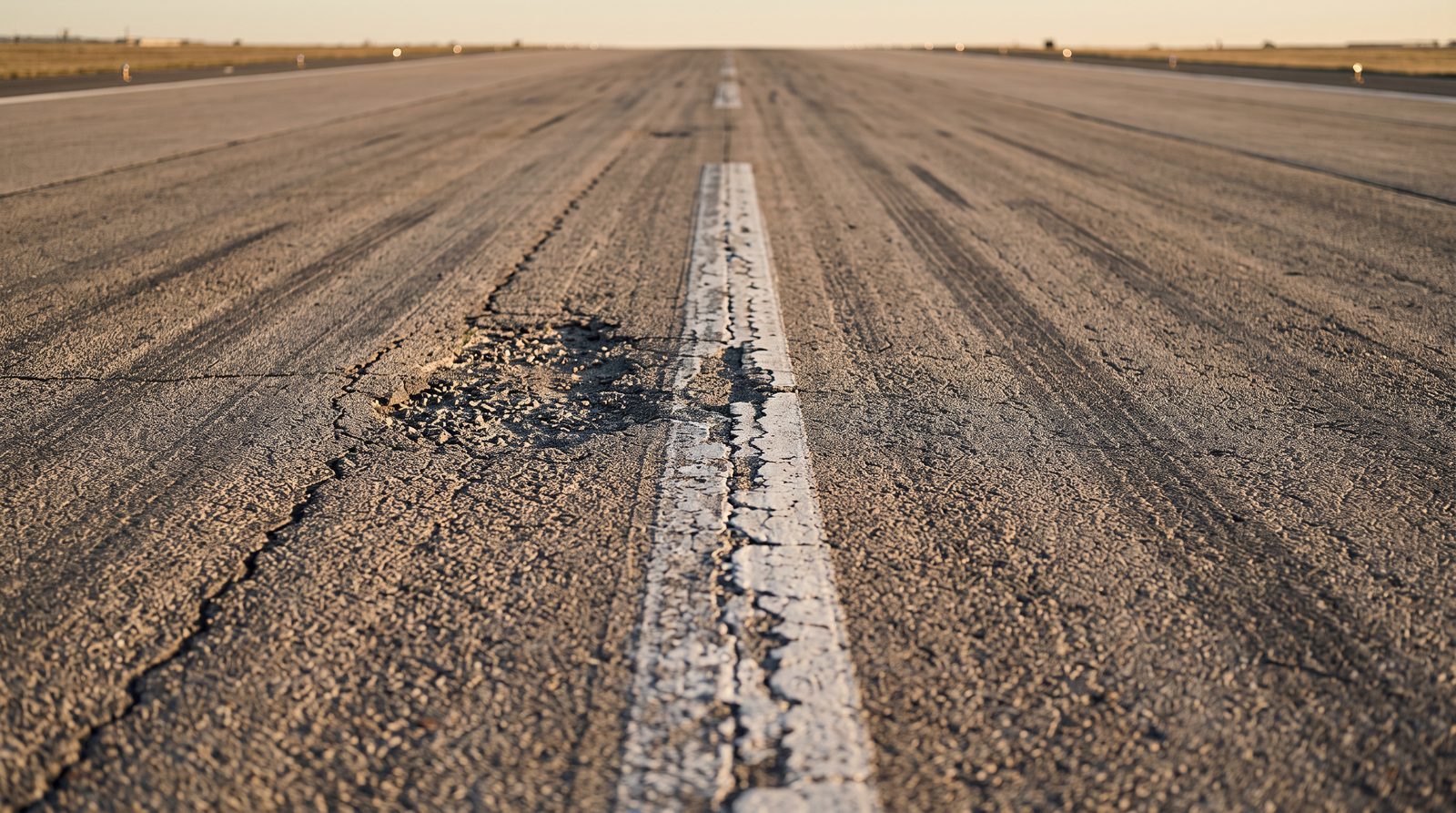
- 01 The daily inspection finds failures. The check looks for the distress that becomes one, which is what a maintenance budget can still act on cheaply.
- 02 A check is worth having only if it repeats the same way, because its product is the difference between two visits.
- 03 It covers the whole surface at one resolution, where a drive-round samples a strip at driving speed.
- 04 It is not the condition assessment: it captures the surface and leaves the rating to the assessment it feeds.
- 05 The season matters: after the thaw and before the rubber removal are the two moments a check pays for itself.
Who runs into this
The aerodrome has two ways of looking at its pavement and a gap between them. The daily inspection drives the runway and finds what has failed. The condition assessment, every few years, rates everything and produces the repair list. Between the two, nobody looks at the surface systematically, and that is where the money goes.
It shows up in four ways.
- A pothole appears in the touchdown zone in March. The crack it grew from was there in October, and nobody measured it.
- The resurfacing case goes to the board with one condition figure and no rate, so the board asks whether it can wait a year, and nobody can say.
- The rubber removal contractor arrives and the surface under the deposits is worse than anyone expected, because nobody had seen it since the last assessment.
- An auditor asks how the aerodrome monitors pavement condition between assessments, and the honest answer is the daily drive-round.
What they share is the absence of a comparable, whole-surface look at the pavement at a useful interval. The pavement condition assessment is the right instrument for the rating. This page is about what runs between two of them.
Where this applies, and where it does not
This applies to any paved runway, taxiway or apron with a maintenance budget that has to be planned a year ahead, and most of all to ageing asphalt, where deterioration accelerates and the difference between a seal and a mill-and-fill is measured in seasons. It applies whether or not a pavement management system is in use, because the check supplies imagery such a system can draw on.
It does not replace the daily serviceability inspection, which is a regulatory duty with its own purpose. It does not produce a condition rating. That is the assessment. It does not measure friction or texture, which need equipment on the surface, and it says nothing about structural capacity.
What makes a check worth repeating
- Whole surface
- Every square metre imaged at one resolution, not a strip seen from a vehicle.
- Same way each time
- The mission is regenerated from the aerodrome profile, so the next check lines up with the last.
- Positioned
- Every frame is captured with a positioning fix, so imagery from two visits can be matched.
- Raking light
- Flown at low sun where possible, because texture change shows in shadow before it shows in colour.
- Compared by eye
- Imagery is retained, so an engineer can set one check beside the last. There is no automated change report.
- No closure
- Flown between aircraft movements, taking about an hour of flying per kilometre of a 45 m wide runway, plus battery changes.
- Feeds the assessment
- The retained imagery goes into the next full assessment, so the rating starts from a series.
What the aerodrome is trying to achieve
Lead time on the budget
A crack sealed in autumn costs a fraction of the patch it becomes by spring. The check exists to see the crack in autumn. That is the whole economic argument, and it is the one that survives a budget meeting.
A rate, not only a state
A single condition figure says how bad the pavement is. Two checks a season apart, read side by side, show how fast it is getting worse, and that is what decides whether resurfacing can wait a year. The rate is what the board is actually asking for.
No surprises under the rubber
Rubber deposits hide the touchdown zone for months. A check flown before removal tells the contractor and the operator what they will find, and a check after it records the surface that was exposed.
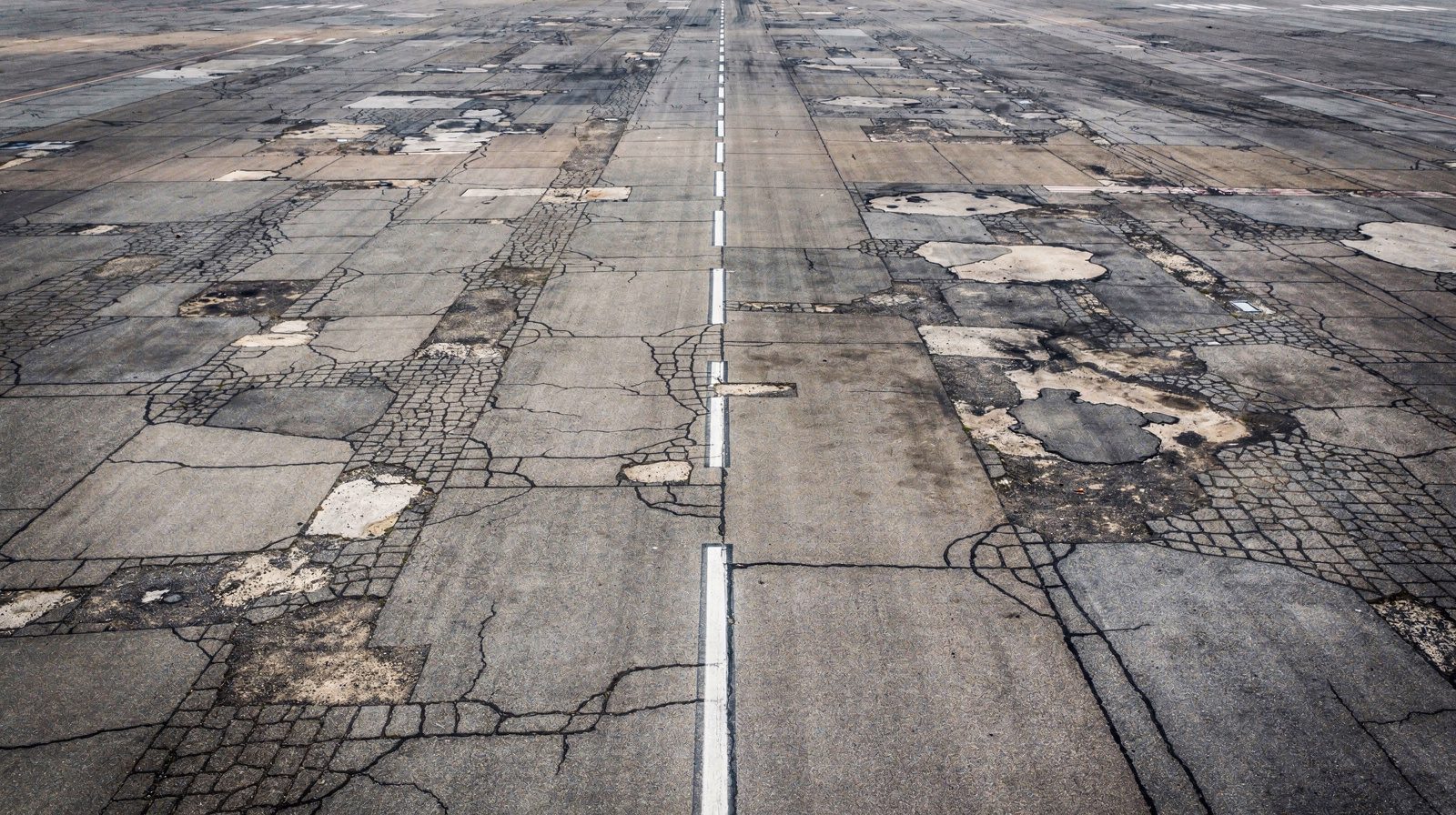
The surface at check resolution. Raveling reads as texture loss and cracking as a shadow line long before either is a failure.
How the check runs
The check is a cycle, and its value compounds with each repetition. The service is in active development and not yet offered, so this is the cycle it is designed around, and early access is the way to try it.
One check, repeated
- 01
Agree the surfaces and the section map
List the runway, taxiways and aprons to be checked and agree the section boundaries, ideally the same ones the condition assessment uses. Fix them.
WhyA check is compared with the last one, so what is covered and how it is divided must not change between visits.
Done whenA section map exists that both the check and the next assessment will use.
If notIf no assessment has been done, divide by construction and use, and keep the map for the assessment later.
- 02
Fix the interval and the season
Put the checks in the maintenance calendar: at least after the spring thaw and before autumn rubber removal, plus midsummer for old or heavily loaded surfaces.
WhyThe comparison only works at a constant interval, and the two moments that pay are after the thaw and before rubber removal.
Done whenThe dates are in the programme and the tower knows a capture window is coming.
If notA missed check is flown late rather than skipped. The series matters more than the exact date.
- 03
Fly the surface between movements
Fly the full width of each surface in overlapping passes at the resolution the check needs, in coordination with the tower, in raking light where the day allows.
WhyThe mission is generated from the aerodrome profile, so the next flight reproduces the last one and the imagery lines up.
Done whenEvery surface is covered at the planned resolution with a positioning fix on every frame.
If notStanding water, snow or heavy contamination hide the surface. The pass is reflown rather than rated through it.
- 04
Keep the imagery and read it against the last check
File the imagery with the section map. An engineer reads it against the previous check and notes what appeared, what grew and what was repaired. Crack detection with ASTM D5340 coding is in development, close to a first MVP.
WhyThe retained imagery is what makes the series worth keeping, because any visit can be read again later, including on a newer detection model.
Done whenThe notes name the sections that moved and the distresses that drove it.
If notA reading in doubt is checked against the retained frames before anyone acts on it.
- 05
Act on the change, and feed the assessment
Hand the engineer's notes to the maintenance team as the seasonal sealing list, and file the check with the section map for the next condition assessment.
WhyA check whose findings nobody acts on is a photograph with a date. The sealing list and the assessment are where it goes.
Done whenEach treated distress carries the check identifier it came from, and the next assessment starts from the series.
If notAnything that reads as an immediate hazard was already reported on the day of the flight. It does not wait for the report.
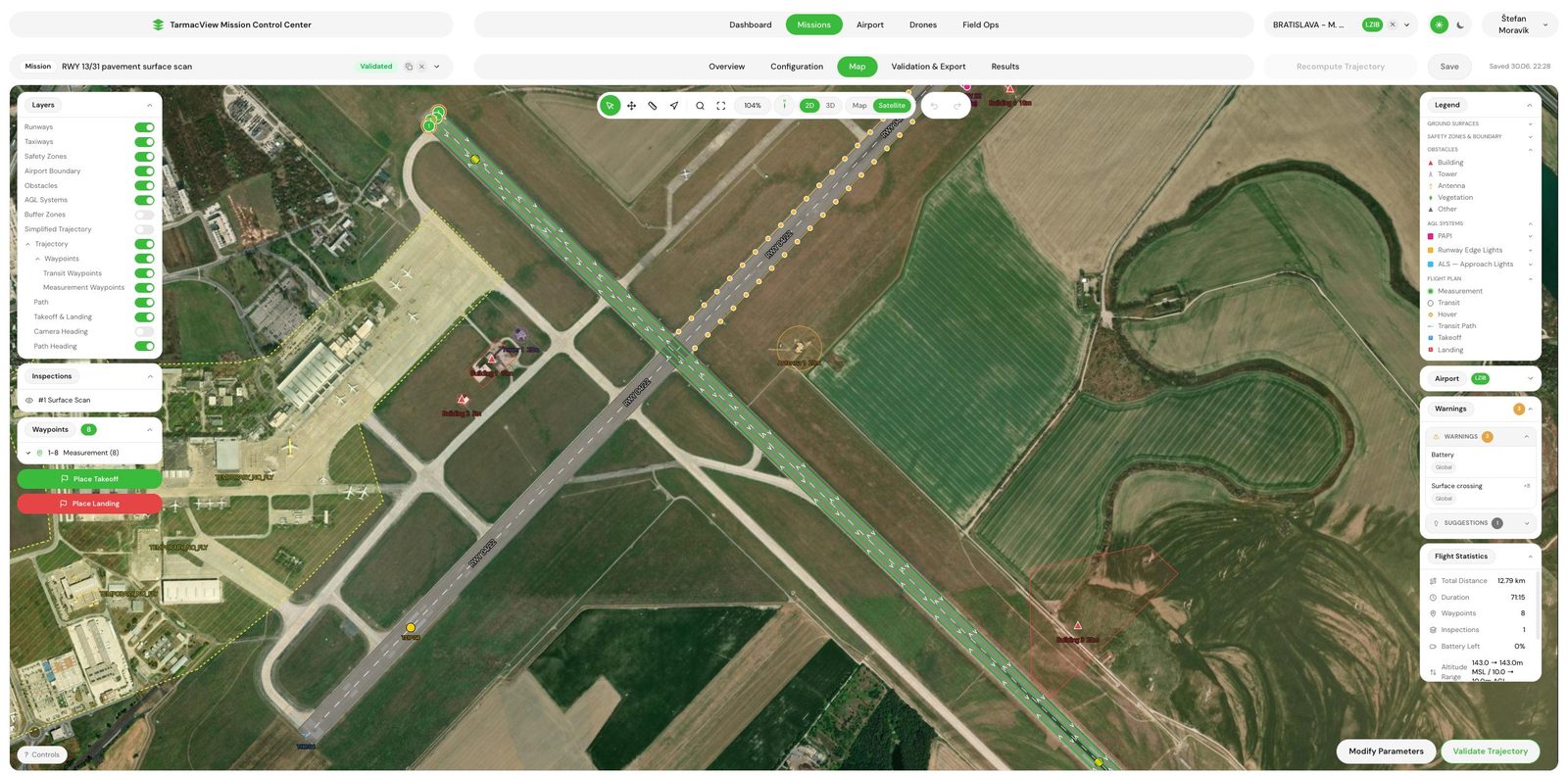
Full-width coverage in overlapping passes, regenerated from the same profile each time, so the comparison is between like and like.
Three ways to look at a runway, and what each one is for
| Method | What it finds | Evidence it leaves | Where it stops |
|---|---|---|---|
| Daily drive-round | Failures and hazards on the day: holes, loose material, damage | A checklist entry | Samples a strip at speed, records no positions, and cannot compare with last month |
| Drone pavement check | Imagery of the whole surface, read by an engineer for visible distress and its change since the last check | Retained, positioned imagery of each visit | No rating, no friction, nothing below the surface, no automated detection yet |
| Condition assessment | A trained inspector classifies and rates every distress section by section, by the standard method | A formal condition index for each section and the inventory behind it | Every few years, expensive to repeat, and sample-based if walked |
Governance and the record
The regulatory duty is to maintain the surface in a condition that does not endanger aircraft, and to be able to show how the aerodrome knows. A series of dated checks with retained, positioned imagery is that record, and it is a stronger answer to an auditor than a drive-round log and an assessment from three years ago.
Evidence and the honest limits
The strong claim is that surface distress is visible from the air before it fails. Cracking, raveling, spalling and lifting patches are all surface phenomena, and the runway surface scan captures the imagery in which they show. The resolution the check flies at sets the smallest crack it can see, and that number is stated, not implied.
The weaker claim is causation. The imagery shows that a crack grew. It does not say why, and it does not show the base or the drainage that may be driving it. A comparison of two visits is a prompt for an engineer, not a diagnosis. And on the day, water, snow or contamination hide the surface, so a check is flown around the weather rather than through it.
The condition index, when the aerodrome wants one, comes from a formal assessment by the standard method. The check produces no index, feeds the assessment and does not pretend to be it.
Where the product stands: the service is in active development and not yet offered. The platform already plans the flights and captures the imagery. Crack detection on the orthomosaic, with rules that turn cracks into ASTM D5340 codes, is in development and close to a first MVP. Those codes are 41 alligator, 43 block, 48 longitudinal and transverse cracking on asphalt, and 63 linear cracking on concrete. The system also recognises grass, patches and debris, all in development and short of training data. No other distress is classified, and there is no change report between checks.
Objections worth raising early
“We inspect the runway every day.” For failures, yes, and keep doing it. Ask what the daily inspection recorded about fine cracking in the touchdown zone last October. If the answer is nothing, that is the gap the check fills.
“We just had an assessment.” Then the check has a baseline to compare against, which is the best start it can have. The assessment says where the pavement is. The check’s imagery will show how fast it is moving.
“The surface is due for resurfacing anyway.” Then the question is when, and the rate of change is the answer. A check series is the cheapest way to defend a date, in either direction.
“A drone cannot see what a walking inspector sees.” An inspector on foot sees texture and hears hollow spots that a camera does not, over the sample units they walk. The camera covers every square metre at one resolution and keeps it for comparison next time. The assessment is where the inspector’s judgment belongs. The check is coverage and change.
Related tasks
If the question is the rating and the repair list, the pavement condition assessment is the service behind this page. If it is the debris the surface is shedding, FOD that comes from the pavement itself takes that angle. If it is what a scan actually resolves, what a drone scan sees sets out the resolution and its limits. And if you want to talk about the development or early access at your field, get in touch .
Frequently Asked Questions
- How is a check different from the condition assessment?
- A condition assessment rates the pavement by the standard method, with every distress classified, a condition index worked out for each section and a repair list built from it, and it is what a funding case or a management system consumes. The check is lighter and more frequent. It images the whole surface the same way each time and keeps the imagery, so visits can be compared. Crack detection with ASTM D5340 coding is in development, close to a first MVP. The check produces no rating. Think of the assessment as the audit and the check as the monthly accounts: the second exists so the first holds no surprises.
- How often should a runway be checked?
- The daily serviceability inspection stays daily. That is a regulatory duty and a different job. For the check, two moments matter on most European aerodromes: after the spring thaw, when freeze and water have done their work, and before the autumn rubber removal, when the surface is most exposed. Aerodromes with an old surface or heavy traffic add one in midsummer. A check that is not repeated is a photograph. The value is in the comparison, so the interval matters less than keeping it constant.
- What does the check actually find?
- The imagery shows the distress a surface carries before it fails: cracking and the way it is joining up, raveling where the binder is losing the aggregate, joint sealant that has gone, spalling at concrete joints and patches that are lifting. Today an engineer reads it. Automatic crack detection is in development, close to a first MVP, and it will code only alligator, block, longitudinal and transverse cracking on asphalt and linear cracking on concrete. Nothing else is classified automatically. The check does not see anything below the surface, or anything the surface is hiding under water or contamination on the day.
- Why not just drive the runway more often?
- Because the drive-round is designed to find failures, and it does that well. It sees a strip of pavement at driving speed, from a seat, in whatever light there is. It does not see fine cracking, it cannot compare with last month, and it produces no positions. A check images every square metre at one resolution in raking light, so a crack that opened since spring is there in the imagery to be compared rather than something a driver would have to notice. The two are complementary, and the check is the one that gives the maintenance budget its lead time.
- Does the runway have to close?
- No closure is booked. The capture is flown between aircraft movements in coordination with the tower, the aircraft always has priority, and flying takes about an hour per kilometre of a 45 m wide runway, plus battery changes. Taxiways and aprons add time in proportion to their area. Processing happens afterwards, off site.
- What do we get?
- The service is in active development and not yet offered. The platform already plans the flights and captures the imagery of the whole surface at one resolution, kept so that one visit can be set beside the previous one. Crack detection with ASTM D5340 coding and a section inventory are in development, close to a first MVP. Anything that reads as an immediate operational hazard is reported on the day. When the next full assessment is due, the retained imagery goes into it, so the assessment starts from a series rather than from zero.
References
- icao-annex-14-v1
- Annex 14 to the Convention on International Civil Aviation, Volume I: Aerodrome Design and Operations International Civil Aviation Organization
- faa-ac-150-5380-6
- AC 150/5380-6, Guidelines and Procedures for Maintenance of Airport Pavements Federal Aviation Administration
- astm-d5340
- ASTM D5340, Standard Test Method for Airport Pavement Condition Index Surveys ASTM International