Airfield Lighting Inspection Without Closing the Runway
How an aerodrome verifies its lighting each year without a runway closure: what must be checked, what evidence an authority accepts, where a drone stops.
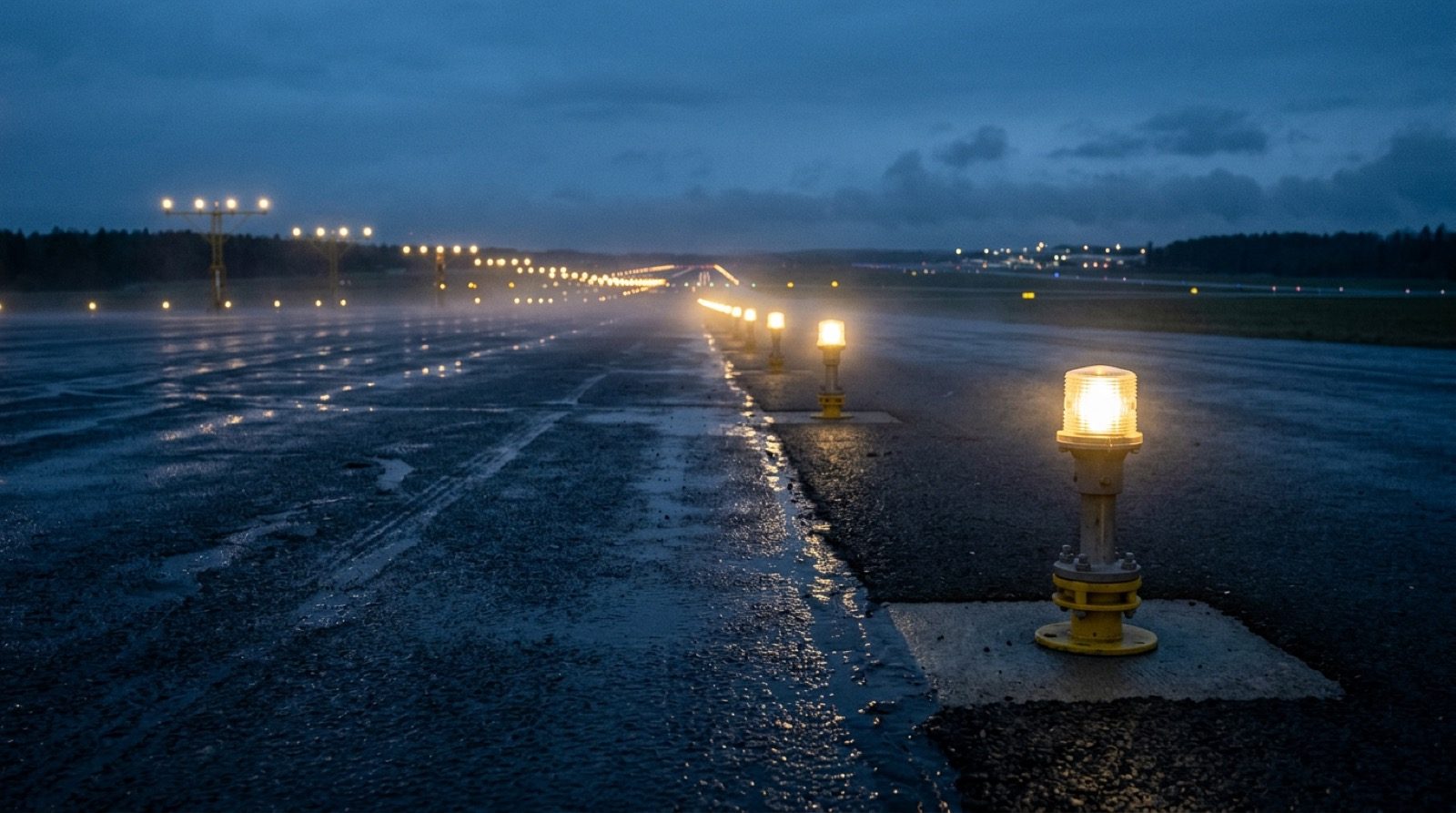
- 01 The regulatory duty is to maintain and verify visual aids, and the standards name the parameters rather than the instrument used to check them.
- 02 Most of an inspection year is spent proving that nothing changed, which is why repeatability matters more than a single very precise reading.
- 03 A drone survey measures geometry and relative photometry well, and needs an external anchor for absolute intensity in candelas.
- 04 Runway occupancy, not the inspection fee, is usually the largest real cost of a lighting check at a busy aerodrome.
- 05 Evidence that survives an audit is retained raw data plus a fixed method, not a report with a conclusion in it.
On this page · 10 sections
Who runs into this
The person who buys airfield lighting inspection is rarely shopping for an inspection. They are trying to close a gap that has become visible, and the gap opens in four familiar ways.
- A regulator asks for the record behind the maintenance programme, and the answer turns out to be a spreadsheet of fixture replacements.
- A resurfacing project moves the geometry, and nobody is certain the approach aids still agree with it.
- A conversion to LED changes the beam characteristics of half the field, and the old acceptance figures no longer describe what is out there.
- A flight crew reports something that does not look right, and the last documented verification of that system is older than anybody wants to admit in writing.
In every case the aerodrome is not short of lights that work. It is short of proof that they perform. Airfield lighting is a system whose failure mode is drift rather than darkness, and drift is invisible to the person driving past it at night.
Where this applies, and where it does not
This applies to an aerodrome that owns its visual aids and owes somebody a record of their condition. Whether the field is a single-runway regional operation with a PAPI at each end or a two-runway airport with a full approach lighting system, the parameters that have to be verified are the same. Only the count changes.
It does not apply when the problem is fixtures failing. That is a maintenance contract, and an inspection will tell you what you already know. It does not apply to radio navigation aids, which are verified under a separate programme with separate instruments. And it is a poor fit for an aerodrome with no maintenance programme at all, because a measurement with no programme to feed is an expensive photograph.
What has to hold true across the field
- Aiming
- Each directional fixture sits at the angle it was set to, and the set produces the intended signal pattern together.
- Intensity
- Output meets the minimum for the fixture class, and units in one array match each other rather than drifting apart.
- Colour
- Emitted colour stays inside the chromaticity boundaries, including where a red filter has aged.
- Coverage
- The beam remains visible across the horizontal and vertical sector the standard requires.
- Control
- Every fixture follows the commanded intensity step, together, across the full range of steps.
- Supply
- The system comes up on the standby source inside the switch-over time the runway category requires.
- Obstruction
- Nothing new blocks the approach view of the aids, and no nearby light can be mistaken for them.
- Record
- Each of the above has a dated measurement, a stated method and a retained data set behind it.
What the aerodrome is trying to achieve
Three outcomes. They are bought together and judged separately, so it is worth naming each.
Regulatory defensibility
The operator needs to hand an inspector a record that answers questions rather than asserts a conclusion. In Europe the binding instrument is the operator’s own approved maintenance programme, written under Regulation (EU) 139/2014, which requires a system of preventive and corrective maintenance for visual aids and electrical systems rather than naming a frequency. The design specifications the aids were built against sit in ICAO Annex 14 and, for European certified aerodromes, in EASA CS-ADR-DSN. The measurement is judged against those. The programme is what says when.
Operational availability
Every hour of inspection is an hour the surface is not fully available, unless the method does not need the surface. At a busy field the occupancy cost dominates the inspection fee by a wide margin, and it is the number the operations director actually cares about.
A trend rather than a snapshot
A single verification tells you the state of a fixture on one afternoon. It cannot tell you whether a unit is drifting, because there is nothing to compare it against. The outcome worth paying for is a series in which each visit reproduces the last one closely enough that a change of a few minutes of arc means something.
An approach lighting array seen from the pilot eye position. Pattern integrity is judged on the whole array at once, not unit by unit from the ground.
How the inspection year runs
The programme is not one event. It is a cycle, and most of it is spent proving that nothing changed. The five steps below recur every year whichever method does the measuring, from the long runway edge light and taxiway light arrays down to the constant current regulator in the vault.
The verification cycle
- 01
Reconcile the programme with what is installed
Walk the programme document system by system and correct the fixture classes, counts, verification intervals and parameter sets against the as-built field.
WhyThe maintenance programme is usually older than the lighting it describes. LED conversions, runway extensions and approach lighting upgrades all leave a programme listing equipment that is no longer there.
Done whenEvery system on the field appears in the programme with a current fixture class, an interval and a named parameter set.
If notIf the programme cannot be reconciled from records, treat the first survey as the as-built baseline and write the programme from it.
- 02
Keep routine attendance separate from verification
Log every replacement and adjustment with the date and the unit, so the next verification pass knows which units have changed since the last one.
WhySomebody drives the field at night, notes outages, and the maintenance contractor replaces what has failed. That is necessary and it is not verification. A replaced fixture is a fixture whose aiming and output nobody has measured.
Done whenThe verification team receives a list of changed units before the pass, not after it.
If notIf the log does not exist, the survey covers every unit and the comparison starts from this visit.
- 03
Verify each system against its parameter set
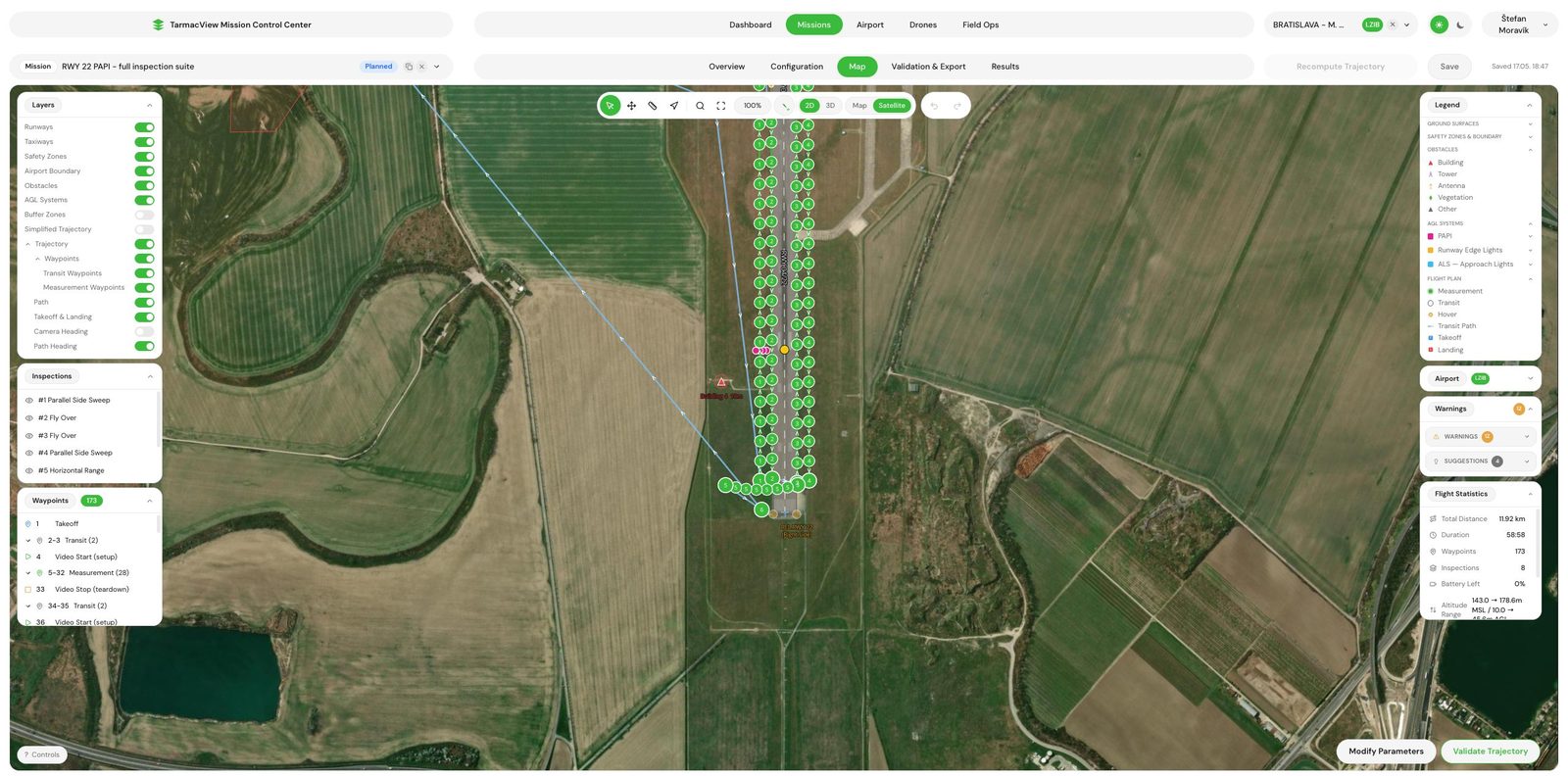
Fly the aerodrome profile between aircraft movements, covering every unit of each array, the transition angle of each glide slope indicator and the full approach pattern, at each commanded intensity step.
WhyFor runway edge and taxiway arrays the question is output and colour across long rows, which is why sampling was the traditional compromise. For glide slope indicators the question is angle. For the approach lighting system it is pattern integrity, intensity build-up and sequenced flashing.
Done whenEvery unit on the field has a dated measurement for each parameter in its set, and units that drifted from their neighbours are listed.
If notStanding water, snow or heavy contamination hide the surface and the fixtures. The pass is reflown rather than rated through the obstruction.
- 04
Test the electrical side on the ground
Measure regulator output per step at the vault, insulation resistance per circuit, and the switch-over time at the supply, and file them alongside the optical record.
WhyThe constant current regulator has to deliver each commanded step, the series circuit has to hold its insulation, and the standby supply has to take over inside the switch-over time. None of that is visible from the air.
Done whenThe record for the year carries both the optical and the electrical measurements for every circuit.
If notA dark unit with no electrical finding behind it is re-inspected as a fixture fault. A dark unit with a circuit finding is a maintenance work order.
- 05
Close the loop with a re-check
Re-fly only the adjusted units with the same mission profile, and compare against the pre-adjustment record.
WhyFindings become work orders and work orders become adjustments. A verification pass after an adjustment is the cheapest measurement in the programme, because the mission already exists and the comparison is against a known previous state.
Done whenEvery finding in the year's record has a closing measurement dated after the work order.
If notIf the re-check still fails, the finding stays open in the record and the programme, not the report, decides what happens next.
Every unit in a runway edge array covered in one set of passes. A method that covers the whole array changes the answer rather than speeding it up.
What a drone survey answers, and where it stops
| Need in the programme | What the survey does | Evidence produced | Where it stops |
|---|---|---|---|
| Glide slope indicator aiming | Flies the approach and fits the colour transition across hundreds of frames rather than reading one | Transition angle per unit, the set angle, and the spacing between neighbouring units | Adjustment itself, which is the maintenance team's work |
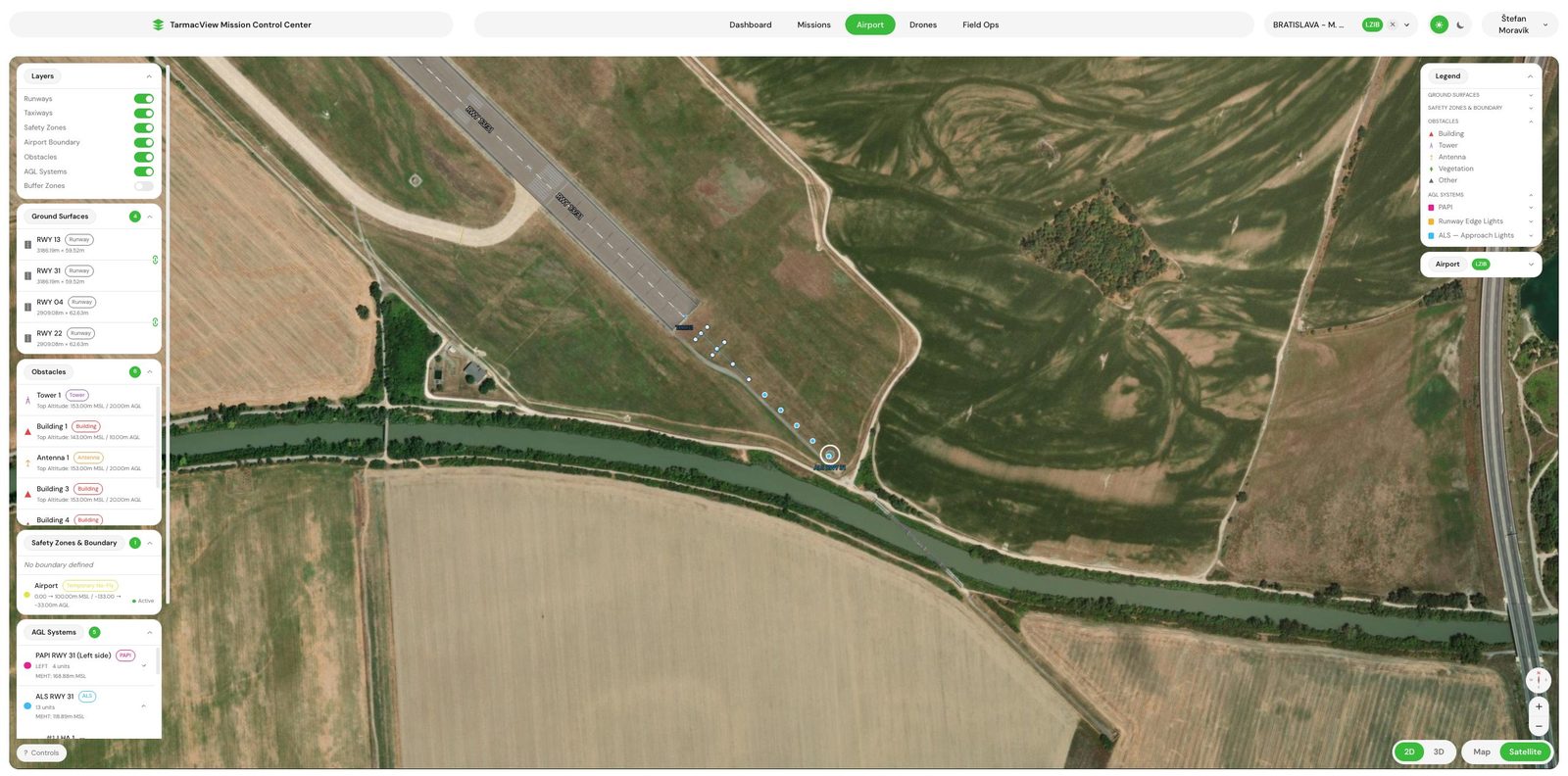
| Approach lighting pattern | Images the full array from the pilot eye position along the approach | Missing or misaligned units, pattern integrity, sequenced flashing behaviour | Cable faults behind a dark unit, which need an electrical test |
| Runway edge and threshold arrays | Covers every unit in the array rather than a sample | Relative output unit to unit, colour, and units that have drifted from their neighbours | Absolute output in candelas against a published minimum |
| Colour and chromaticity | Measures channel ratios, which are independent of exposure and of absolute response | Whether emitted colour has moved toward a boundary, including aged red filters | A formal chromaticity acceptance test against the standard's coordinates |
| Intensity in candelas | Records relative intensity across units on one flight under one exposure | A strong statement about symmetry and drift within the array | Absolute photometry, which needs a calibrated photometer as an anchor |
| Dimming steps | Repeats the pass at each commanded step | Whether every unit changes together and by the commanded amount | Regulator output measurement, which is an electrical test at the vault |
| Obstruction of the approach | Flies the protection surface and images what is under it | New penetrations and lights near the approach that could be mistaken for the aids | A formal obstacle limitation surface survey, which is a separate deliverable |
| Standby power switch-over | Records the field optically while the supply is switched | Which circuits came back and in what order | The switch-over time itself, which is measured at the supply |
| Repeatability between visits | Regenerates the same autonomous mission from the aerodrome profile | A directly comparable data set, so change is measured rather than recalled | Nothing, this is the method's strongest property |
| Runway occupancy | Flies between aircraft movements with no closure booked | A record obtained without a surface booking | Ground-based photometry, which requires a vehicle on the surface |
Governance and the record
The inspection is only half the purchase. The other half is what the aerodrome can still prove in eighteen months.
An auditor asks a small number of questions, and they are all reconstruction questions. Where did this number come from. How was it computed, and with which version of the method. What state was the instrument in, and when was it last calibrated. Who took the reading, on what date, in what weather. Which tolerance was it judged against. A report that answers the last question and none of the others is a conclusion, not evidence.
That is why retained raw data matters more than report formatting. If the video and the positioning log survive, a disputed number can be recomputed. If they do not, the only response to a challenge is to fly again and hope the fixture has not moved in the meantime.
Evidence and the honest limits
Two claims on this page carry weight, and each deserves its qualification stated out loud.
The geometric chain is strong
Positions come from RTK GNSS tied to a base station and to a geodetic frame. Camera intrinsics come from a target-based calibration recorded with a date. An elevation angle between two known positions is a geometry problem rather than a brightness problem, which is why a transition angle can be reported with a bound on it.
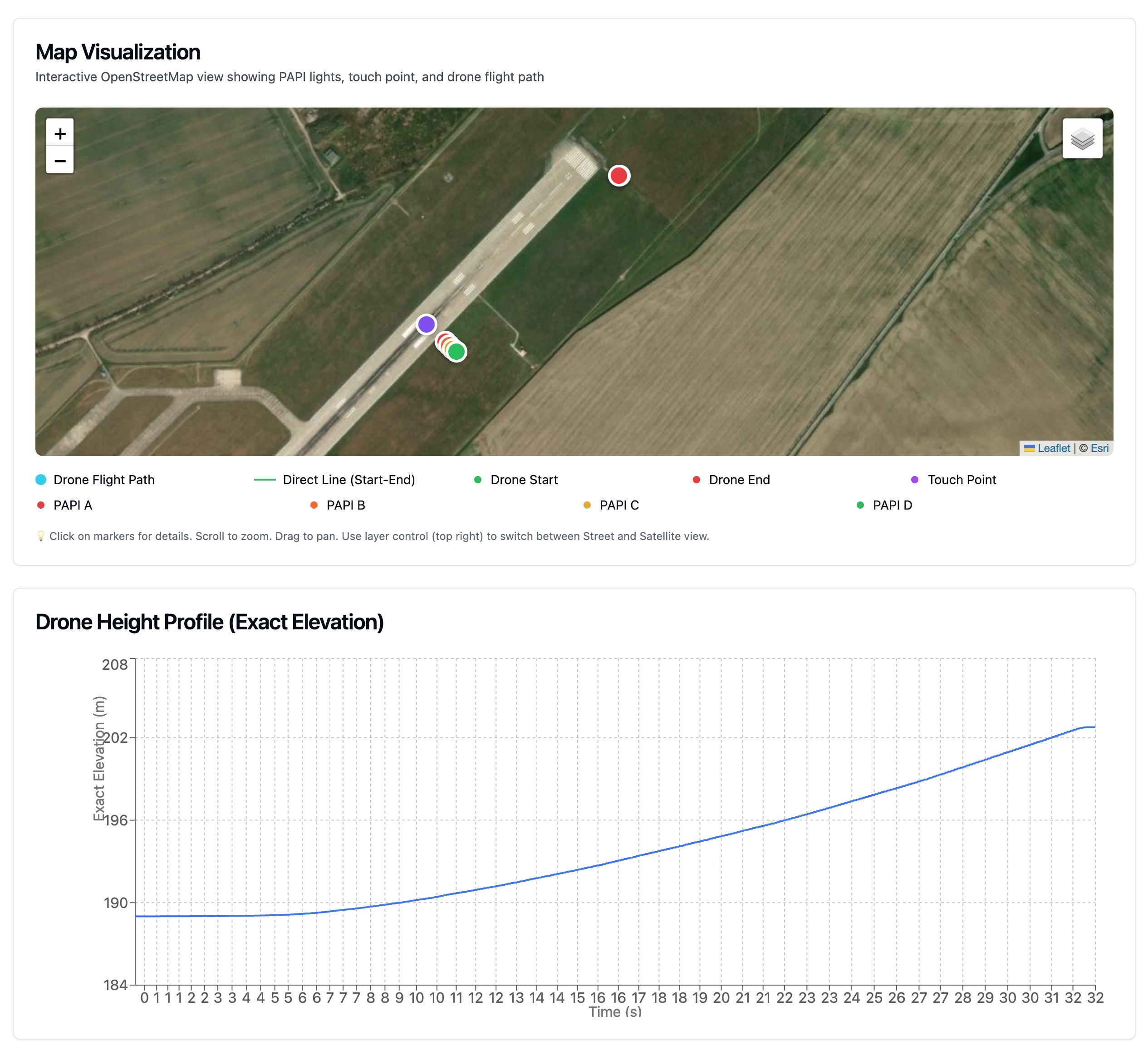
Transition angle per unit, fitted across hundreds of frames on the approach. The angle is geometry, and geometry survives an audit.
The optical chain is weaker
An airborne camera records counts, not candelas, and those counts depend on the lens, the exposure and the distance. Ratios between channels normalise away most of that, which is why colour and transition measurements survive the weakness. Absolute light intensity does not. Stating a value in candelas needs either a reference reading taken on site or a cross-calibration against an instrument that carries a calibration certificate . Any supplier claiming its drone camera is a certified photometer has skipped that step.
Ground photometric systems are the counterpart, and they are good at exactly what the drone is weak at. A vehicle-mounted photometer measures intensity directly and produces the absolute figures an acceptance test wants. Vendor material for those systems describes covering a full precision approach runway in both directions in under two hours, which is a real occupancy of a surface that is otherwise earning money. Neither method dominates. The programme decides which question is being asked, and the method follows.
Objections worth raising before you buy
“Our authority has not accepted drone methods.” Ask, in writing, and ask about the parameter rather than the platform. The standards describe what has to be verified and the tolerances it is judged against. They are largely silent on the instrument. The visual aids manual, ICAO Doc 9157 Part 4, paragraph 8.3.43, has for some years pointed at unmanned aircraft as one of the methods available for checking glide slope indicator settings, which is a useful thing to have in the conversation.
“We already pay for a flight inspection.” Then the useful question is what the aircraft is there for. If it is calibrating radio aids, it is doing something a drone cannot do, and the visual aids may be riding along on a visit that is happening anyway. That comparison is the subject of drone survey versus flight inspection .
“We only need the lights that failed.” Failed lights are a maintenance problem. Drifted lights are a safety problem, and they look fine from the perimeter road. The whole reason verification exists as a separate activity is that the failure mode is invisible.
“We cannot give up the runway.” That is the constraint the method was built around, and it is the reason a survey flown between movements is worth more at a busy field than at a quiet one.
Related tasks
If the immediate question is procedural rather than commercial, the photometric measurement procedure sets out how a campaign is planned and run, including where a calibrated instrument has to enter the chain. If the question is which method to buy, the comparison above is the page for it. If the question is what a single system costs, the PAPI calibration cost guide is the honest state of a market where nobody publishes a rate. And if the field is due for a full visit, the shape of one is on the pricing page .
If a PAPI has already been reported out of tolerance, PAPI out of tolerance covers the visit that confirms, re-aims and re-checks it. If the runway has just come out of resurfacing or other works, runway lighting checks after works covers its return to service. And if the question is how many lights a system may lose before it stops counting as serviceable, the serviceability limits guide sets out the figures system by system.
Frequently Asked Questions
- How often does airfield lighting have to be inspected?
- The interval is set nationally rather than globally, and it depends on the runway category and on what the aerodrome's own maintenance programme commits to. European operators work under Regulation (EU) 139/2014, which requires a system of preventive and corrective maintenance for visual aids and electrical systems rather than naming a frequency. In the United States, FAA guidance for maintenance of airport visual aid facilities is the document that sets expectations for precision approach runways, and photometric testing at least twice annually is the figure usually cited for them. The practical answer is that your approved maintenance programme is the binding document, and it is worth reading before assuming an annual cycle.
- What actually gets measured in a lighting inspection?
- Six families of parameter. Aiming, which is the angle a directional fixture is set to. Intensity, which is how much light comes out and in which direction. Colour, judged against the chromaticity boundaries the standard defines. Coverage, meaning the beam is still visible across the sector it is supposed to serve. Control behaviour, which is whether every fixture follows the commanded intensity step together. And supply, meaning the lighting still comes up on the standby source within the required time. A survey that reports only the first two is not an inspection of the system.
- Can a drone replace a mobile photometric vehicle?
- Not for everything. A towed or vehicle-mounted photometric system carries a calibrated photometer and measures intensity in candelas directly, which is what a chromaticity and intensity acceptance test against the standard needs. A drone measures geometry very well, measures colour ratios well, and needs an external anchor to state absolute intensity. Where the question is aiming, transition angle, pattern integrity, coverage and whether anything has moved since last time, the drone answers it without occupying the surface. Where the question is candelas against a published minimum, a calibrated instrument still has to be in the chain.
- Does the runway have to close?
- For a drone survey, no closure is booked. The work is coordinated with the tower and flown in the gaps between aircraft movements, and the aircraft always has priority. A ground photometric run is different, because a vehicle has to traverse the surface, and that is a booked occupancy. Published vendor material for mobile ground photometry describes covering a full precision approach runway in both directions in under two hours, which gives a sense of the occupancy involved.
- What evidence does an authority actually want?
- Something that can be reconstructed. An inspector's real question is not whether a number is impressive but whether it can be traced: where the reading came from, what method produced it, what state the instrument was in, who took it and under what conditions, and which tolerance it was judged against. A report that states a conclusion and retains nothing behind it cannot answer any of those. Retained raw data, a fixed and versioned method, and a stated uncertainty are what turn a measurement into evidence.
- Where does a drone survey stop being enough?
- In three places. Absolute photometric intensity in candelas needs a calibrated photometer somewhere in the chain, either as a reference reading on site or as a cross-calibration. Anything below the surface, such as cable insulation, series circuit condition and constant current regulator behaviour under load, is an electrical test rather than an optical one. And radio navigation aids are outside the method entirely. An inspection programme that knows where its method stops is more useful than one that claims to cover everything.
References
- icao-annex-14-v1
- Annex 14 to the Convention on International Civil Aviation, Volume I: Aerodrome Design and Operations International Civil Aviation Organization
- icao-doc-9157-p4
- Doc 9157, Aerodrome Design Manual, Part 4: Visual Aids International Civil Aviation Organization
- easa-cs-adr-dsn-7
- Certification Specifications and Guidance Material for Aerodrome Design, CS-ADR-DSN Issue 7 European Union Aviation Safety Agency
- eu-139-2014
- Commission Regulation (EU) No 139/2014 laying down requirements and administrative procedures related to aerodromes Publications Office of the European Union
- faa-ac-150-5340-26
- AC 150/5340-26, Maintenance of Airport Visual Aid Facilities Federal Aviation Administration
- adbsafegate-photometric
- Photometric Testing and Performance of AGL Assets ADB SAFEGATE