How to Run a Photometric Measurement of Airfield Lighting
A procedure for planning and running a photometric measurement campaign on airfield ground lighting, from circuit preparation to a reconstructable record.
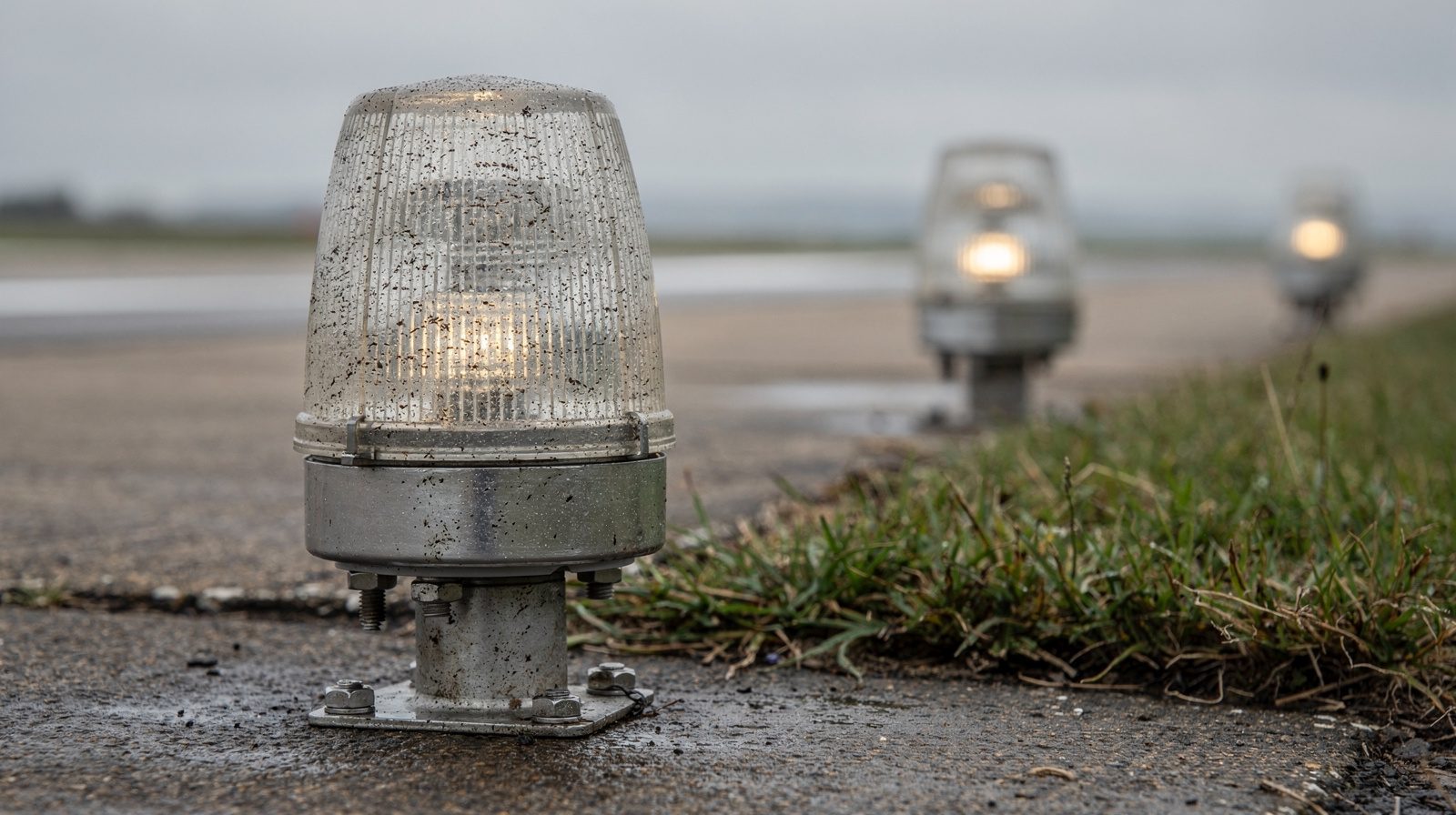
- 01 Photometric measurement answers what a fixture emits, which is a different question from whether it is lit, and only the first one detects slow degradation.
- 02 Absolute intensity in candelas needs a calibrated photometer in the chain, whether the carrier is a vehicle, a tripod or an aircraft.
- 03 Measure at a fixed, recorded intensity step, because a reading without the step it was taken at cannot be compared with anything.
- 04 The record is the deliverable. A number that cannot be traced back to a method, a date and an instrument state is not evidence.
What you need before you start
A photometric campaign fails on preparation far more often than on measurement. Everything in this list has to exist before a date is booked, and none of it is a step in the procedure.
The specification the fixtures were installed to. Intensity minima and colour boundaries are properties of the fixture class, and they live in the fixture specification and in the aerodrome design standards. Without them there is no criterion to judge a reading against, and the campaign produces numbers with no verdict attached.
A calibrated instrument with a current record. Whatever the carrier, an absolute value of light intensity in candelas has to trace back to a calibrated photometer with a valid calibration. Check the certificate date before the visit rather than after the report is written.
Control of the intensity steps. Somebody has to be able to drive the constant current regulator to a commanded step and hold it there for the duration of a run. If that person is not available, the campaign cannot happen.
An agreed fixture inventory. A list of the fixtures to be measured, such as the runway edge lights of one circuit, with identifiers that will still mean the same thing next year. Measuring a row and reporting positions rather than identifiers makes the second campaign incomparable with the first.
Airside access and coordination. Tower coordination, an escort where required, and a window. For a ground run this is a booked occupancy of the surface.
A dark enough sky, if the method needs one. Some photometric methods require low ambient light, which pushes the work into a night window and changes the staffing.
What the campaign produces
A dated record for one runway’s lighting in which every measured fixture carries an intensity value, a colour assessment, the intensity step the reading was taken at, the instrument that took it, and the criterion it was judged against. Fixtures outside their criteria are named with the margin by which they miss. The record is the deliverable, and the verdict is a line inside it rather than the whole of it.
Running the measurement campaign
- 01
Fix the scope and the criteria
List the circuits and fixture classes to be measured, and write next to each the intensity minimum and colour boundary from its specification and from the aerodrome design standard the field is certified against. Record which standard and which edition you used.
WhyA photometric reading means nothing until there is a published criterion to judge it against, and criteria differ by fixture class and by runway category.
Done whenEvery fixture class on the list has a numeric criterion beside it and a named source for that criterion.
If notIf a criterion cannot be found for a class, exclude that class from the campaign and record why, rather than measuring it and inventing a threshold later.
- 02
Confirm the instrument state
Check the photometer's calibration certificate is current, record its identifier and calibration date in the campaign log, and perform whatever pre-use check the instrument manual specifies.
WhyAn absolute value that cannot be traced to a calibrated instrument is not usable as evidence, no matter how carefully it was taken.
Done whenThe campaign log carries the instrument identifier, its calibration date and the result of the pre-use check, before any reading is taken.
If notIf the calibration has lapsed, stop. Recalibrate or substitute an instrument. Do not proceed and annotate, because the annotation will not survive an audit.
- 03
Book the window and the clearance
Agree the window with the tower, confirm the escort and the access route, and brief every person involved on the stop procedure and the frequency they will be listening on.
WhyThe measurement occupies the surface or the airspace above it, and both belong to air traffic control rather than to the maintenance team.
Done whenA clearance exists for a defined window and every person on the team can state how the run stops.
If notIf the window shrinks, cut the scope rather than the procedure. Measuring half the circuits properly beats measuring all of them in a hurry.
- 04
Set and hold the intensity step
Have the panel operator drive the circuit to the step the campaign specifies, confirm on the panel that the step is held, and write the step into the log before the first reading of the run.
WhyLight output follows the commanded current step, so a reading without a recorded step cannot be compared with any other reading.
Done whenThe step is recorded in the log and the panel confirms it is being held for the whole run.
If notIf the regulator will not hold the step, log the fault, stop the run for that circuit and treat the regulator as a finding in its own right.
- 05
Run the measurement pass
Traverse or fly the array at the geometry the method specifies, keeping speed, distance and alignment inside the tolerances the method states, and capture every fixture in the agreed inventory in one continuous pass per circuit.
WhyA pass that covers every fixture in an array is what turns a sample into a record, and consistency across the pass is what makes two campaigns comparable.
Done whenEvery fixture on the inventory has a reading, and the pass parameters are inside the stated tolerances throughout.
If notIf the geometry drifts outside tolerance, repeat that circuit rather than correcting the numbers afterwards. A corrected reading is a modelled one.
- 06
Anchor the absolute values
For any carrier that is not itself a calibrated photometer, take a reference reading on at least one fixture per circuit with the calibrated instrument, at the same step and in the same conditions, and use it to anchor the relative values.
WhySome carriers measure relative output very well and cannot state candelas on their own, and the difference between those two claims is where overclaiming happens.
Done whenEach circuit has at least one anchored reading and the anchoring relationship is written into the log.
If notIf no anchor can be taken, report the circuit's results as relative values and say so explicitly. Do not convert them to candelas.
- 07
Close the record
Assemble the readings, the criteria, the instrument state, the step, the conditions, the operator and the raw data into one record, name every fixture outside criteria with its margin, and retain the raw data alongside the report.
WhyThe campaign exists to produce something reconstructable months later, and the reconstruction depends on the log rather than on anyone's memory.
Done whenAn independent reader can take the record and re-derive every verdict in it without asking a question.
If notIf a required element is missing, mark the affected fixtures as not assessed rather than assessed and unsupported.
Checking the campaign actually worked
The completion check is not whether the report arrived. It is whether the record answers the reconstruction questions on its own.
Pick one fixture from the middle of the inventory, at random, and try to answer five questions from the record alone. What did it measure. At which intensity step. With which instrument, calibrated when. Under what conditions and taken by whom. And against which criterion was it judged. If any answer requires asking somebody, the record is incomplete and the gap should be closed while the team is still assembled.
Then do the same for a fixture reported as outside criteria, and check that the margin is stated rather than the verdict alone. A record that says a fixture failed is less useful than one that says by how much, because the second one tells a maintenance team whether it is chasing a cleaning job or a replacement.
When it goes wrong
Readings vary along the array with no pattern. Suspect the pass geometry before the fixtures. Distance, alignment and speed all change what the instrument sees, and drift in any of them scatters results in a way that looks like fixture variation. Re-run one circuit deliberately holding geometry and compare.
Everything reads low. Check the intensity step first and the instrument second. A circuit sitting one step lower than the campaign specified produces a uniformly low set of readings that looks alarming and means nothing.
Colour readings disagree with the eye. The eye is a poor absolute judge and a good relative one. If measured chromaticity says a red unit is drifting while the eye says it looks fine, trust the instrument, because filter ageing moves colour slowly and perception adapts to it.
One fixture reads far above its neighbours. Check for a replaced unit of a different class or a different age in an otherwise uniform row. A new fixture among old ones is not an error, and it is a useful indication of how far the rest have degraded.
The regulator will not hold a step. That is a finding, not an obstacle. Log it, stop the affected circuit, and pass it to the electrical team. A campaign that measures through an unstable supply produces numbers nobody can defend.
The window closes early. Stop cleanly at a circuit boundary and log where you stopped. A campaign completed across two windows with clean boundaries is fine. A campaign with a circuit measured half in one window and half in another is not comparable with itself.
Variations on the method
Ground-based mobile measurement. A photometer on a vehicle traverses the surface and measures fixtures directly in candelas. This is the method the acceptance criteria were written for, and it is a booked runway occupancy. Published vendor material describes covering a full precision approach runway in both directions in under two hours.
Airborne measurement. An airborne camera flown between aircraft movements measures colour ratios and per-unit output across a whole array without booking a closure. Whether it can state candelas depends on the camera. One that has not been characterised against a calibrated source reports relative output and needs step 6 above to anchor it, while one that has been characterised reports candelas directly, corrected for the measured range to each unit and the atmospheric transmission on the day. Either way it covers more fixtures per hour than a ground traverse, which is the trade set out in airfield lighting inspection .
Fixture-by-fixture tripod measurement. The most controlled option and the slowest. Useful for resolving a disputed result on a small number of units, and impractical as a way to cover a whole array.
Approach aid measurement. Glide slope indicators are a special case, because the parameter that matters most is an angle rather than an intensity, and an angle is geometry. The procedure for those is closer to the one on the PAPI inspection page than to this one.
Whichever variation you use, the record requirements do not change. If you would rather have the campaign run for you, TarmacView scopes one against your runway and circuit count.
Frequently Asked Questions
- What is photometric measurement of airfield lighting?
- It is the measurement of the light each fixture actually emits, in intensity and in colour, across the directions it is supposed to serve, judged against the criteria the fixture class was installed to. It is not the same as a serviceability check. A fixture can be lit, drawing current and visible from the perimeter road while emitting a fraction of its specified intensity, because the lens has clouded, the filter has aged or the optic has shifted. Only a measurement finds that.
- What instrument is needed?
- A calibrated photometer somewhere in the chain, and a carrier for it. The common carriers are a vehicle-mounted or towed mobile system that traverses the surface, a tripod-based instrument used fixture by fixture, and an airborne camera, which reports relative output unless the camera has itself been characterised against a calibrated source, in which case it can state candelas. The carrier changes the coverage and the occupancy cost. It does not change the requirement that an absolute value in candelas traces back to an instrument with a valid calibration record.
- How often should this be done?
- The binding document is the aerodrome's own approved maintenance programme, not a general rule. In the United States, FAA guidance on maintenance of airport visual aid facilities is the reference for precision approach runways, and photometric testing at least twice annually is the figure usually cited for them. In Europe the regulation requires a maintenance system for visual aids without naming a frequency, so the programme sets it. Whatever the interval, an out-of-cycle measurement after a lighting replacement or a resurfacing is worth budgeting for.
- Can this be done without closing the runway?
- Partly. A ground-based photometric run needs a vehicle on the surface, which is a booked occupancy, and published vendor material describes covering a full precision approach runway in both directions in under two hours. An airborne survey can be flown between aircraft movements with no closure, and it measures geometry and colour ratios well while needing an external anchor for absolute intensity. Many aerodromes end up combining the two, using the airborne survey for coverage and frequency and the calibrated instrument for the absolute anchor.
- Why does the intensity step matter so much?
- Because a constant current regulator drives the circuit at a commanded step, and the light output of every fixture on that circuit follows it. A reading taken at step 3 and a reading taken at step 5 are measurements of different things. If the step is not recorded with the reading, the number cannot be compared against the previous campaign or against the fixture specification, and the campaign has produced data that cannot be used.
- What does a finished campaign have to contain?
- Six things, and they are the six an auditor asks for. The measured values with their units. The method and its version. The instrument, its calibration state and the date of that calibration. The conditions, meaning date, time, weather, intensity step and circuit configuration. The person who performed the work. And the criterion each value was judged against. A report containing only the last item and a verdict is a conclusion rather than a record.
References
- icao-annex-14-v1
- Annex 14 to the Convention on International Civil Aviation, Volume I: Aerodrome Design and Operations International Civil Aviation Organization
- icao-doc-9157-p4
- Doc 9157, Aerodrome Design Manual, Part 4: Visual Aids International Civil Aviation Organization
- easa-cs-adr-dsn-7
- Certification Specifications and Guidance Material for Aerodrome Design, CS-ADR-DSN Issue 7 European Union Aviation Safety Agency
- faa-ac-150-5340-26
- AC 150/5340-26, Maintenance of Airport Visual Aid Facilities Federal Aviation Administration
- faa-ac-150-5345-46
- AC 150/5345-46, Specification for Runway and Taxiway Light Fixtures Federal Aviation Administration
- adbsafegate-photometric
- Photometric Testing and Performance of AGL Assets ADB SAFEGATE