What is Light Intensity?
Light Intensity – Luminous Power per Solid Angle – Photometry
Light intensity, more precisely called luminous intensity, is at the heart of photometry, the science of measuring visible light as perceived by the human eye. It describes how much visible light power a source emits in a given direction per unit solid angle. Understanding light intensity and its related quantities is crucial in fields such as aviation, lighting engineering, display technology, safety signaling, and photometric calibration.
What is Luminous Intensity?
Luminous intensity is measured in candelas (cd), one of the seven base units in the International System of Units (SI). The candela is defined by the power emitted by a light source at a particular wavelength (555 nm, the peak of human eye sensitivity under photopic conditions) and the perception of that power by the human eye.
The mathematical definition: $$ I_v = \frac{d\Phi_v}{d\Omega} $$
- $I_v$ = luminous intensity (cd)
- $d\Phi_v$ = luminous flux (lm)
- $d\Omega$ = solid angle (sr)
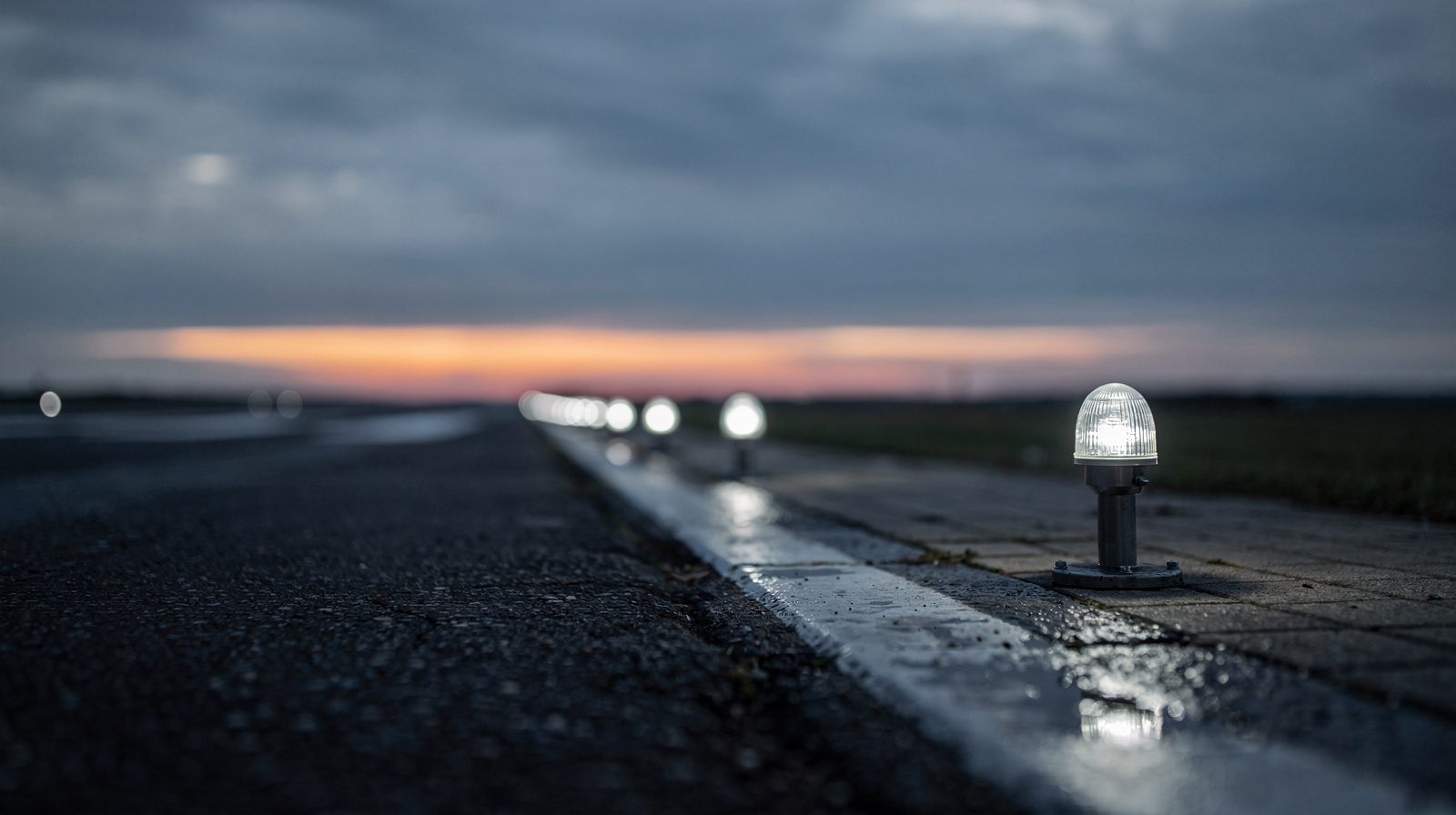
Luminous intensity is directional, it quantifies light output in a specific direction. This is essential for applications like aviation lighting, where runway lights, approach lights, and beacons must deliver precise light levels within controlled beams to ensure visibility and safety.
Key properties:
- Intensity (cd) is independent of distance (if the medium between source and observer is clear).
- Illuminance (lux), the light received per unit area, decreases with the square of the distance (inverse square law).
Example Luminous Intensities
| Source | Luminous Intensity (cd) |
|---|---|
| Standard candle | ~1 |
| LED indicator | 1–100 |
| Car headlamp (beam) | 15,000–60,000 |
| Runway edge light | 100–10,000 |
| Aircraft landing light | 50,000–200,000 |
ICAO Annex 14 and FAA standards specify minimum and maximum luminous intensities for aviation lights to ensure operational safety in all weather and visibility conditions.
The Electromagnetic Spectrum and Visible Light
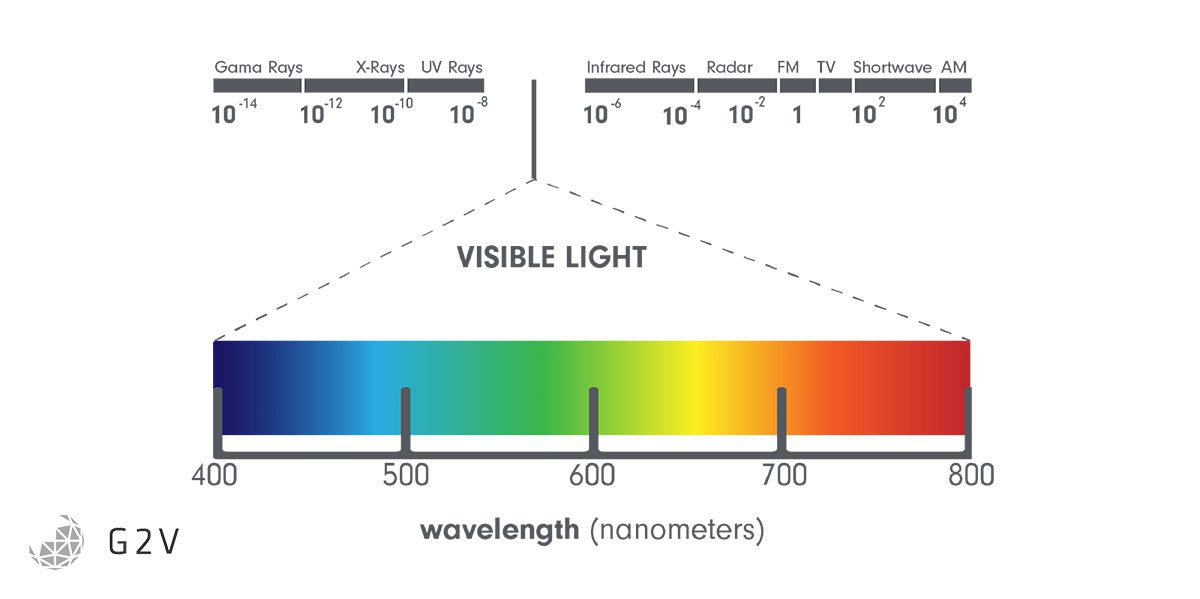
Electromagnetic radiation covers a vast spectrum, from radio waves to gamma rays. Visible light is the narrow band (about 380–780 nm) to which human eyes are sensitive. Light in this range produces color vision: violet (~380 nm), blue (~450 nm), green (~550 nm), yellow (~580 nm), orange (~600 nm), and red (~700 nm).
Photometry only considers this visible spectrum, weighting each wavelength by the human eye’s sensitivity curve, called the photopic luminosity function ($V(\lambda)$), which peaks at 555 nm. This is fundamentally different from radiometry, which measures all electromagnetic radiation regardless of human perception.
Radiometry vs. Photometry
| Radiometric Quantity | Photometric Quantity | SI Unit (Radiometric) | SI Unit (Photometric) |
|---|---|---|---|
| Radiant flux | Luminous flux | Watt (W) | Lumen (lm) |
| Radiant intensity | Luminous intensity | Watt/steradian (W/sr) | Candela (cd) |
| Irradiance | Illuminance | Watt/m² | Lux (lx) |
| Radiance | Luminance | Watt/m²/sr | Candela/m² (cd/m²) |
- Radiometry: measures all electromagnetic energy, regardless of wavelength or visibility.
- Photometry: measures only visible light, weighted for human vision.
Conversion between radiometric and photometric units requires the source’s spectrum and the $V(\lambda)$ function. At 555 nm, 1 watt of radiant flux equals 683 lumens.
Luminous Flux (Φv)
Luminous flux is the perceived power of visible light emitted by a source in all directions, weighted by the eye’s sensitivity.
- Unit: lumen (lm)
- Formula: $$ \Phi_v = 683,\mathrm{lm/W} \cdot \int_{380,\mathrm{nm}}^{780,\mathrm{nm}} \Phi_e(\lambda),V(\lambda),d\lambda $$ ($\Phi_e(\lambda)$: spectral radiant flux in W/nm, $V(\lambda)$: eye sensitivity)
Typical Values:
| Source | Luminous Flux (lm) |
|---|---|
| Standard candle | ~12 |
| 100 W incandescent lamp | ~1340 |
| 11 W LED bulb | ~815 |
| Airport taxiway edge light | 20–200 |
ICAO standards set minimum luminous flux requirements for airfield lighting to ensure visibility.
Luminous Intensity (Iv) in Depth
Luminous intensity measures how concentrated the luminous flux is in a particular direction.
- For an isotropic point source (emitting equally in all directions): $I_v = \frac{\Phi_v}{4\pi}$
- For directional sources (e.g., spotlights): Intensity is higher within the beam.
Measurement: Place a photometer at a known distance and measure the illuminance, use the inverse square law ($I_v = E_v \cdot r^2$).
ICAO Use: Aviation standards specify intensity distribution patterns, e.g., approach lights must provide high intensity along the runway axis but reduced intensity to the sides.
Solid Angle (Ω)
A solid angle measures how “wide” a beam is in three dimensions, analogous to planar angle in two dimensions.
- Unit: steradian (sr)
- Formula: $\Omega = \frac{A}{r^2}$ (A = area on sphere, r = radius)
- Full sphere: $4\pi$ sr, hemisphere: $2\pi$ sr
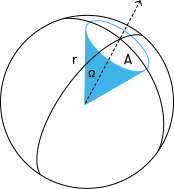
Use in Lighting: Determines how much luminous flux is concentrated into a particular direction (solid angle).
Illuminance (Ev)
Illuminance quantifies how much visible light falls on a surface.
- Unit: lux (lx), 1 lx = 1 lm/m²
- Formula: $E_v = \frac{d\Phi_v}{dA}$
Example Illuminances:
| Environment | Illuminance (lx) |
|---|---|
| Full sunlight | 100,000 |
| Overcast daylight | 10,000 |
| Office lighting | 300–500 |
| Aircraft cabin (reading) | 100–200 |
| Runway threshold (ICAO) | 10–50 |
| Full moon | 0.3 |
Measurement: With a luxmeter (calibrated for human vision).
Relationship to intensity: $E_v = \frac{I_v}{r^2}$ (inverse square law).
Luminance (Lv)
Luminance describes how bright a surface appears to the eye from a specific direction.
- Unit: candela per square meter (cd/m², “nit”)
- Formula: $L_v = \frac{d^2\Phi_v}{dA,d\Omega,\cos\theta}$
Example Luminances:
| Surface | Luminance (cd/m²) |
|---|---|
| Sun (surface) | 2 × 10⁹ |
| Sunlit cloud | 30,000 |
| Clear sky | 3,000 |
| Overcast sky | 300 |
| Mobile display | 500 |
| ICAO sign (min) | 80–200 |
ICAO Use: Sets limits for illuminated airport signs and displays to ensure readability and avoid glare.
Photometric & Radiometric Relationships
| Quantity | Radiometric | SI Unit | Photometric | SI Unit |
|---|---|---|---|---|
| Power per solid angle | Radiant intensity | W/sr | Luminous intensity | cd |
| Power per area | Irradiance | W/m² | Illuminance | lux (lx) |
| Power per area per sr | Radiance | W/m²/sr | Luminance | cd/m² (nit) |
- $1$ cd $= 1$ lm/sr
- $1$ lux $= 1$ lm/m²
- $1$ nit $= 1$ cd/m²
Conversion to photometric units depends on the light spectrum and the eye’s sensitivity.
Photometric Measurement Techniques
Key Instruments
- Photometers: Measure light intensity or illuminance, calibrated to match the eye’s spectral response.
- Integrating spheres: Capture total luminous flux from a source.
- Luminance meters: Assess brightness of surfaces for standards compliance.
- Goniophotometers: Measure intensity distribution over solid angles for directional sources.
Calibration
Photometric calibration ensures traceability to national standards and the candela. Calibration lamps with known luminous intensities are used to check measurement accuracy.
ICAO and Industry Standards
ICAO Annex 14 and CIE (International Commission on Illumination) documents specify:
- Photometric requirements for airfield lighting (runway, taxiway, approach, obstruction)
- Color requirements (spectral limits)
- Measurement procedures and angles
- Minimum and maximum intensities and luminances
Aviation and Safety Applications
- Runway and taxiway lighting: Must meet strict intensity and distribution requirements to ensure safe aircraft movement in all weather.
- Obstruction and beacon lights: Require high intensity in defined directions for visibility from long distances.
- Cockpit and cabin lighting: Designed for optimal illuminance and luminance for pilot and passenger comfort.
- Display technology: Luminance and color standards ensure readability under variable lighting.
Summary
Light intensity (luminous intensity) and its related photometric quantities (flux, illuminance, luminance) are at the core of lighting science, safety engineering, and visual ergonomics. The candela, lumen, lux, and nit are the building blocks for designing and regulating effective, efficient, and safe lighting systems in aviation, transportation, displays, and architecture.
ICAO, FAA, and CIE standards embed these quantities into global safety regulations, ensuring that lighting systems serve their purpose, guiding, warning, and informing, under all conditions.
For expert guidance on photometric compliance, system design, or measurement, contact our team or schedule a demo.
Frequently Asked Questions
- What is light intensity in photometry?
- Light intensity, or luminous intensity, is the measure of visible light power emitted by a source in a specific direction per unit solid angle. Its SI unit is the candela (cd), and it forms the basis for evaluating the brightness of light sources in lighting design, aviation, and safety applications.
- How is luminous intensity different from luminous flux?
- Luminous intensity quantifies light in a specific direction (cd), while luminous flux (lm) is the total visible light output in all directions. Intensity is crucial when directionality matters, such as in runway edge lights or signaling, whereas flux indicates total light produced.
- Why does the aviation industry use candelas instead of lumens?
- Aviation lighting often needs to control not just the total amount of light, but its distribution in specific directions to ensure visibility and avoid glare. The candela measures directional light output, aligning with these requirements as specified by ICAO and FAA standards.
- How does distance affect luminous intensity and illuminance?
- Luminous intensity (cd) is independent of distance, describing the source’s output in a given direction. Illuminance (lux), the light received per area, decreases with the square of the distance due to the inverse square law.
- What are the main photometric quantities besides light intensity?
- Key photometric quantities are luminous flux (lumen, lm), illuminance (lux, lx), and luminance (candela per square meter, cd/m² or nit). Each describes light in different contexts: total output, received light per area, and apparent brightness.
This is a reference entry. TarmacView provides drone inspection services and doesn't sell the equipment or materials described in this glossary.