What is the Visible Spectrum?
Visible Spectrum – Range of Visible Wavelengths
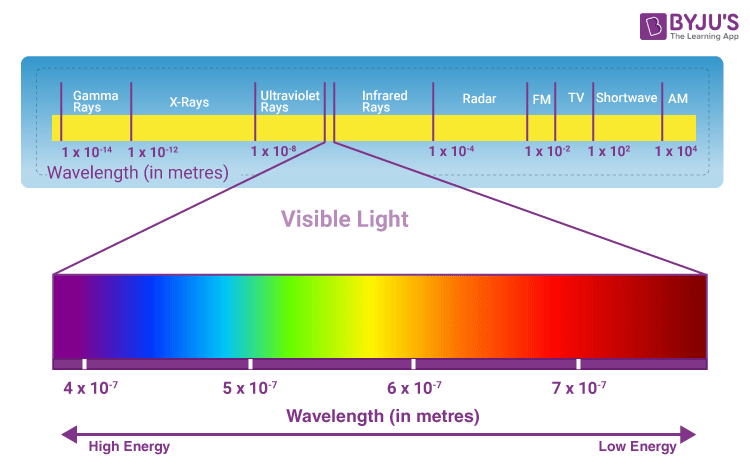
Overview
The visible spectrum is the segment of the electromagnetic spectrum that the human eye can detect, generally spanning wavelengths from 380 nanometers (nm) to 750 nanometers (nm). This narrow band of electromagnetic radiation enables the rich world of color we experience and is foundational to vision, color science, lighting, imaging systems, and many technologies across industries.
Within this range, light is perceived as colors that transition smoothly from violet at the shortest wavelengths, through blue, green, yellow, and orange, to red at the longest wavelengths. The visible spectrum is bounded on one side by ultraviolet (UV) radiation and on the other by infrared (IR) radiation, both of which are invisible to the unaided human eye.
The Electromagnetic Spectrum
The electromagnetic spectrum encompasses all types of electromagnetic radiation, classified according to wavelength or frequency. It stretches from very long-wavelength radio waves (kilometers in length) to extremely short-wavelength gamma rays (picometers).
Major divisions of the electromagnetic spectrum:
| Type | Wavelength Range | Frequency Range |
|---|---|---|
| Radio Waves | > 1 mm | < 3 × 10¹¹ Hz |
| Microwaves | 1 mm – 25 μm | 3 × 10¹¹ – 1 × 10¹³ Hz |
| Infrared | 25 μm – 750 nm | 1 × 10¹³ – 4 × 10¹⁴ Hz |
| Visible Light | 750 nm – 380 nm | 4 × 10¹⁴ – 7.9 × 10¹⁴ Hz |
| Ultraviolet | 380 nm – 1 nm | 7.9 × 10¹⁴ – 1 × 10¹⁷ Hz |
| X-rays | 1 nm – 1 pm | 1 × 10¹⁷ – 1 × 10²⁰ Hz |
| Gamma Rays | < 1 pm | > 1 × 10²⁰ Hz |
Note: The visible spectrum occupies only a narrow slice of this continuum, yet is vitally important due to its unique interaction with biological and technological systems.
Wavelength Range of Visible Light
The visible spectrum is commonly defined as the range of electromagnetic wavelengths perceptible by the average human eye, from approximately 380 nm to 750 nm. These boundaries are approximate and can vary due to individual biology, environmental conditions, and technical requirements in different fields. For operational simplicity, some standards (e.g., ICAO Annex 14) may use rounded boundaries such as 400–700 nm.
| Boundary | Wavelength (nm) | Micrometers (μm) | Frequency (THz) |
|---|---|---|---|
| Violet | ~380 | 0.38 | 789 |
| Red | ~750 | 0.75 | 400 |
The relationship between wavelength (λ) and frequency (f) is given by the equation:
[ c = \lambda f ]
where ( c ) is the speed of light in vacuum (( 3 \times 10^8 ) m/s).
Colors and Wavelengths
Colors result from the stimulation of photoreceptor cells in the human eye by different wavelengths within the visible spectrum. The mapping of colors to specific wavelength ranges is approximate and forms a continuum:
| Color | Wavelength Range (nm) | Frequency Range (THz) | Perceived Hue |
|---|---|---|---|
| Violet | 380 – 450 | 668 – 789 | Deep blue/purple |
| Blue | 450 – 495 | 606 – 668 | Blue |
| Green | 495 – 570 | 526 – 606 | Green |
| Yellow | 570 – 590 | 508 – 526 | Yellow |
| Orange | 590 – 620 | 484 – 508 | Orange |
| Red | 620 – 750 | 400 – 484 | Red |
Transitions between colors are gradual, influenced by light intensity, background colors, observer biology, and environmental context.
The Science of Color Perception
Color perception arises from the interaction of physical light properties with the human visual system:
- Retina photoreceptors: The retina contains rods (for low-light vision) and three types of cones responsible for color vision:
- S-cones (short wavelengths, peak ~420 nm – blue)
- M-cones (medium wavelengths, peak ~534 nm – green)
- L-cones (long wavelengths, peak ~564 nm – red)
- Trichromatic theory: The brain interprets signals from these cones, enabling the perception of millions of colors via additive mixing.
- Individual differences: Genetics, age, and health can affect color perception. Color vision deficiencies (e.g., red-green color blindness) occur when one or more cone types are absent or malfunctioning.
- Contextual effects: Perceived color can be altered by intensity, surroundings, and lighting conditions.
Importance and Applications
Biological Applications
- Photosynthesis: Visible light powers photosynthesis in plants, especially in the blue (430–450 nm) and red (640–680 nm) regions.
- Vision and adaptation: Visual systems in animals are tuned to the spectral composition of sunlight at Earth’s surface, maximizing survival and ecological fitness.
- Circadian rhythms: Blue light (~480 nm) regulates circadian rhythms by influencing melatonin production in humans and animals.
Technological Applications
- Lighting: Artificial lights (incandescent, fluorescent, LED) are engineered to emit within the visible spectrum, with color temperature and rendering properties tailored to human needs.
- Displays and imaging: All modern screen technologies use additive mixing of red, green, and blue subpixels to reproduce colors. Cameras use sensors with matched spectral responses.
- Optical fiber communication: Visible and near-infrared light transmit high-speed data over long distances with minimal loss.
- Spectroscopy: Analysis of materials by measuring absorption, emission, or reflection of visible light reveals chemical composition and properties.
- Aviation lighting: Runway and taxiway lights are engineered to strict chromaticity and intensity standards (e.g., ICAO Annex 14) to ensure maximum visibility and safety.
Art, Design, and Communication
- Color theory: Artists and designers use knowledge of the visible spectrum to create harmonious color schemes and visual effects.
- Branding and signage: Color is a key element in communication, with psychological associations influencing behavior and perception.
- Architectural lighting: Selection of light sources with specific spectral qualities creates desired ambiance and supports occupant well-being.
Example Problems and Calculations
1. Wavelength Calculation
A light source emits at a frequency of (6.24 \times 10^{14}) Hz. What is its wavelength?
[ \lambda = \frac{c}{f} = \frac{3.00 \times 10^8}{6.24 \times 10^{14}} = 4.81 \times 10^{-7} \text{ m} = 481 \text{ nm} ] Interpretation: 481 nm is in the blue-green range.
2. Frequency Calculation
What is the frequency of red light with a wavelength of 700 nm?
[ f = \frac{c}{\lambda} = \frac{3.00 \times 10^8}{700 \times 10^{-9}} = 4.29 \times 10^{14} \text{ Hz} ]
3. Spectroscopy Application
A biologist uses a spectrophotometer to measure the absorption of blue light (450 nm) by plant pigments. High absorption indicates efficient photosynthetic activity, as blue and red wavelengths are most effectively used by chlorophyll.
4. Aviation Lighting Chromaticity
ICAO Annex 14 specifies that runway edge lights must emit white light with chromaticity coordinates corresponding to wavelengths between 400 nm and 700 nm, maximizing visibility in all weather conditions.
Further Resources
- International Commission on Illumination (CIE): cie.co.at , Standardized colorimetric data and chromaticity diagrams.
- ICAO Annex 14: icao.int , Requirements for visual aids, including light color, chromaticity, and intensity for aviation safety.
- Physics of Light and Color: HyperPhysics – Light and Vision
The visible spectrum bridges the physical world of electromagnetic radiation and the vibrant subjective world of human color perception. Its understanding is essential not only in science and engineering, but also in art, design, and daily life.
Frequently Asked Questions
- What is the visible spectrum?
- The visible spectrum is the range of electromagnetic wavelengths (about 380–750 nanometers) that the human eye can detect. It enables color vision and forms the basis for lighting, imaging, and display technologies.
- What determines the colors we see?
- Colors are determined by the wavelength of light and the response of three types of cone cells in the human retina. Each cone type is sensitive to different wavelength ranges, and their combined stimulation produces the perception of different hues.
- Why can't humans see ultraviolet or infrared light?
- Human photopigments in cone cells do not absorb wavelengths shorter than about 380 nm (ultraviolet) or longer than about 750 nm (infrared), so these regions are invisible to us.
- Are there variations in visible spectrum sensitivity among individuals?
- Yes. Age, genetics, and health can cause slight shifts in the sensitivity of the eye, leading to individual variations in the visible spectrum's exact boundaries.
- What is the significance of visible light in aviation?
- Visible light is critical for pilot vision and for the effectiveness of runway, taxiway, and signaling lights. Aviation regulations specify exact chromaticity and intensity standards for these systems to ensure safety and visibility.
- Can animals see beyond the human visible spectrum?
- Some animals, like bees and birds, can see ultraviolet, while others, such as certain snakes, can sense infrared. Their visual systems are adapted to their environments and often use different photopigments.
- How do cameras and sensors detect visible light?
- Digital imaging sensors use color filters or micro-lens arrays to separate incoming visible light into red, green, and blue channels, simulating human color perception for accurate image capture.
- What is a spectrophotometer?
- A spectrophotometer is an instrument that measures the intensity of light at different wavelengths. It's widely used in chemistry, biology, environmental monitoring, and material analysis.
- What is the relationship between wavelength and frequency?
- Wavelength and frequency are inversely related: as wavelength increases, frequency decreases, according to the equation c = λf, where c is the speed of light.
This is a reference entry. TarmacView provides drone inspection services and doesn't sell the equipment or materials described in this glossary.