What is White Light?
White light is light that contains the visible wavelengths together, which a prism splits into the colours of the rainbow.
What white light is
NASA says the human eye detects wavelengths from 380 to 700 nanometers (nm). Violet is near 380 nm and red is near 700 nm. Each colour of the rainbow is a different wavelength.
A prism bends visible light and separates the wavelengths into the colours. Isaac Newton showed this in 1665. A second prism recombines the colours into white light.
White light therefore has no single wavelength. It is a mix of the visible range.
How the eye sees white
The retina has three cone types. They are sensitive to short, medium or long wavelengths of light, and the signals go to the brain (National Eye Institute).
Aerodrome rules do not model cones. They define colour with the CIE 1931 standard observer, as the next sections show.
Colour temperature
Colour temperature describes the colour of a white light source. The Illuminating Engineering Society defines correlated colour temperature as the absolute temperature of a blackbody whose chromaticity most nearly resembles that of the light source. The International Commission on Illumination (CIE) defines it as the temperature of the Planckian radiator with the nearest chromaticity.
ICAO Annex 14 uses the idea in one place. The limits of aerodrome white assume that the colour temperature of the source stays substantially constant.
Light units
Photometric units weight light by the response of the eye. NIST gives the luminous efficacy at 555 nm as 683.002 lumens per watt, normally rounded to 683. In short, one watt corresponds to 683 lumens at that wavelength.
The candela is the SI unit of luminous intensity. One candela is the intensity of a source that emits 540 x 10^12 Hz radiation with a radiant intensity of 1/683 watt per steradian. In standard air, 540 x 10^12 Hz is a wavelength of 555.016 nm. Airfield light intensity is specified in candela, for example on the isocandela diagrams of ICAO Annex 14.
White on an airfield
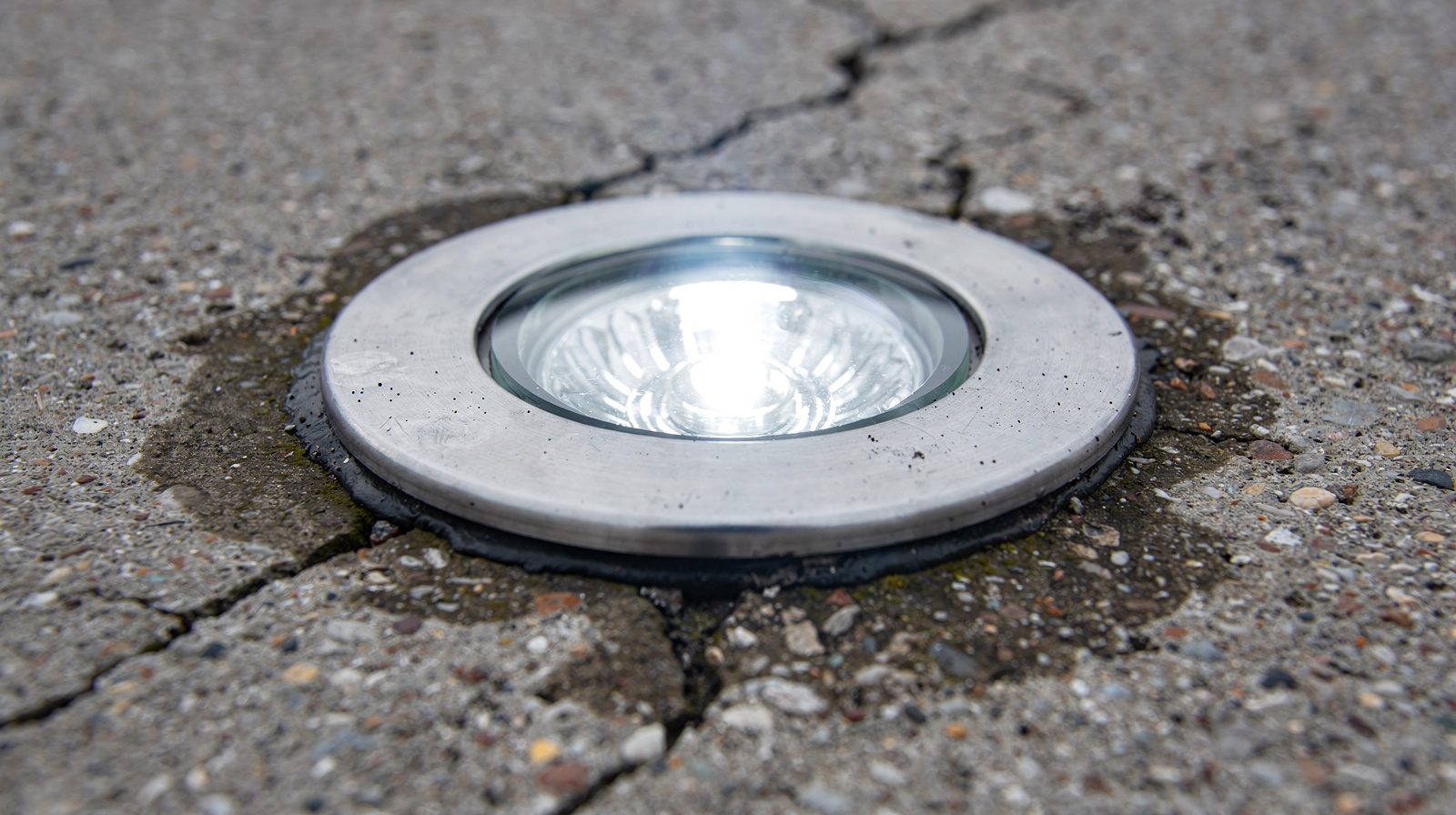
Aerodrome rules define the colour of ground lights by chromaticity. A light is white if its colour coordinates on the CIE 1931 diagram fall inside the white boundaries. The spectrum of the source does not matter.
For filament lamps, the white region lies between x = 0.285 and x = 0.500, with further limits on y. For LEDs it is narrower, between x = 0.320 and x = 0.440. ICAO Annex 14 states both as requirements. EASA CS ADR-DSN.U.930 gives the same boundaries as a certification specification.
Variable white is the colour for lights that are varied in intensity, for example to avoid dazzling. ICAO recommends it only for such lights. For filament lamps its yellow boundary lies further toward yellow than that of white. For LEDs, variable white has the same boundaries as white.
To tell yellow from variable white, ICAO recommends that the x coordinate of the yellow is at least 0.050 greater. ICAO also recommends that the yellow and white lights show together and close to each other.
Where airfield lights show white
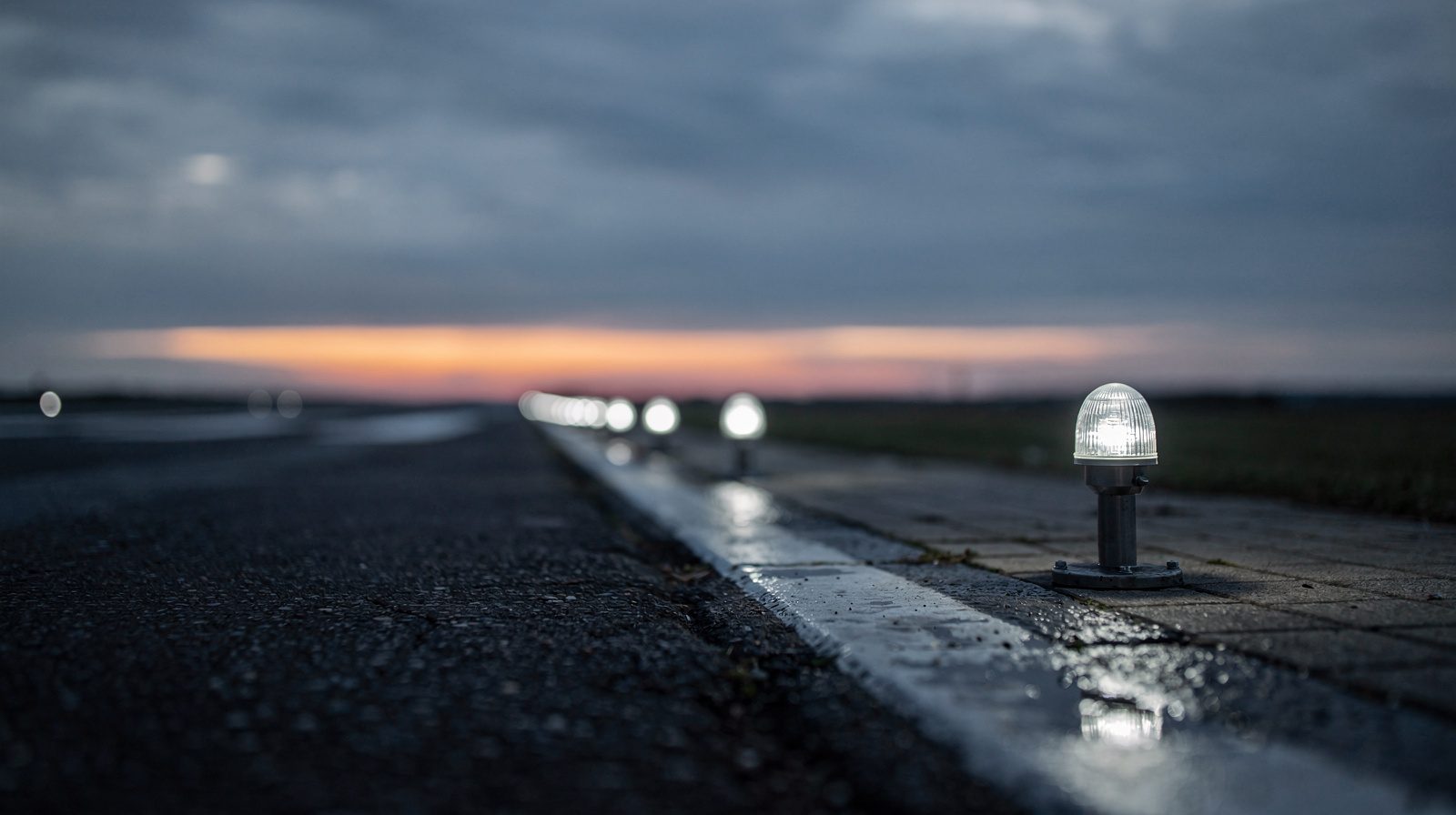
- Runway edge lights. ICAO Annex 14 paragraph 5.3.9.7 and EASA CS ADR-DSN.M.675 call for variable white. A section at the remote end may show yellow. The FAA AIM describes them as white. On instrument runways, yellow replaces white on the last 2,000 feet (610 m) or half the runway, whichever is less.
- Runway centre line lights. EASA CS ADR-DSN.M.690 calls for variable white to 900 m from the runway end. Then red and white alternate, and the last 300 m is red. The FAA describes white until the last 3,000 feet (914 m).
- Touchdown zone lights. The FAA describes steady-burning white lights.
- Aerodrome beacon. It shows white flashes, or coloured flashes that alternate with white. It gives 20 to 30 flashes per minute (ICAO Annex 14 paragraph 5.3.3.6).
- Precision approach path indicator (PAPI). White is half of the signal. On the approach slope, the pilot sees the two units nearest the runway as red and the two farthest as white. Above the slope the pilot sees more white. Below it the pilot sees more red. The change from red to white must occur within a vertical angle of 3 arc minutes, seen from at least 300 m away. The red light must have a y coordinate of 0.320 or less.
Checking the colour
The colour of a light is measured at five points inside the innermost isocandela curve, at rated current or voltage. It is also checked at the outermost curve for any colour shift that could confuse the pilot.
ICAO Annex 14 says this shall be done. EASA CS ADR-DSN.U.930 says it should. The measurement shows whether the light stays inside the white boundaries across its beam.
Frequently Asked Questions
- What is white light?
- White light is light that contains the visible wavelengths together. A prism splits it into the colours of the rainbow, and a second prism recombines them into white light.
- What is the wavelength of white light?
- White light has no single wavelength. It combines the visible range, which NASA gives as 380 to 700 nanometers. Violet is near 380 nanometers and red is near 700 nanometers.
- How does aerodrome regulation define a white light?
- By its colour coordinates, not by its spectrum. A ground light is white if its chromaticity falls inside the white boundaries on the CIE 1931 diagram. ICAO Annex 14 gives one set of boundaries for filament lamps and a narrower set for LEDs.
- What is variable white?
- Variable white is the colour for aerodrome lights whose intensity is varied, for example to avoid dazzling. For filament lamps its region extends further toward yellow than white does. For LEDs the boundaries are the same as for white.
- Which airfield lights show white?
- Runway edge lights show variable white, with yellow near the runway end on instrument runways. Runway centre line lights show white too. The PAPI shows white and red units, so the pilot sees white above the approach slope.
- How does the eye see white light?
- Through three cone types in the retina. NIH says they are sensitive to short, medium or long wavelengths of light. Aerodrome rules do not use this model. They use the CIE 1931 standard observer.
- How is the colour of an aerodrome light checked?
- The colour is measured at five points inside the innermost isocandela curve at rated current or voltage. It is also checked at the outermost curve, to find any colour shift that could confuse the pilot. Annex 14 says this shall be done. EASA's CS ADR-DSN.U.930 says it should.
References
- nasa-visible-light
- Visible Light NASA Science
- nei-cone-types
- Are these newly found rare cells a missing link in color perception? National Eye Institute, NIH
- doe-cct-method
- Recommended method for determining the correlated color temperature and distance from the Planckian locus of a light source US Department of Energy, Solid-State Lighting program (paper by Smet and others)
- nist-candela
- Realization of the candela NIST
- bipm-candela
- Candela BIPM, SI base units
- icao-annex-14-v1
- Annex 14 to the Convention on International Civil Aviation, Aerodromes, Volume I, 9th edition (consolidated copy hosted by Swiss FOCA) ICAO
This is a reference entry. TarmacView provides drone inspection services and doesn't sell the equipment or materials described in this glossary.