LED Airfield Lighting: What Changes for Inspection
How LED airfield lighting changes photometric inspection: LEDs fade instead of burning out, colour can drift and ice can stay, so each light needs measuring.
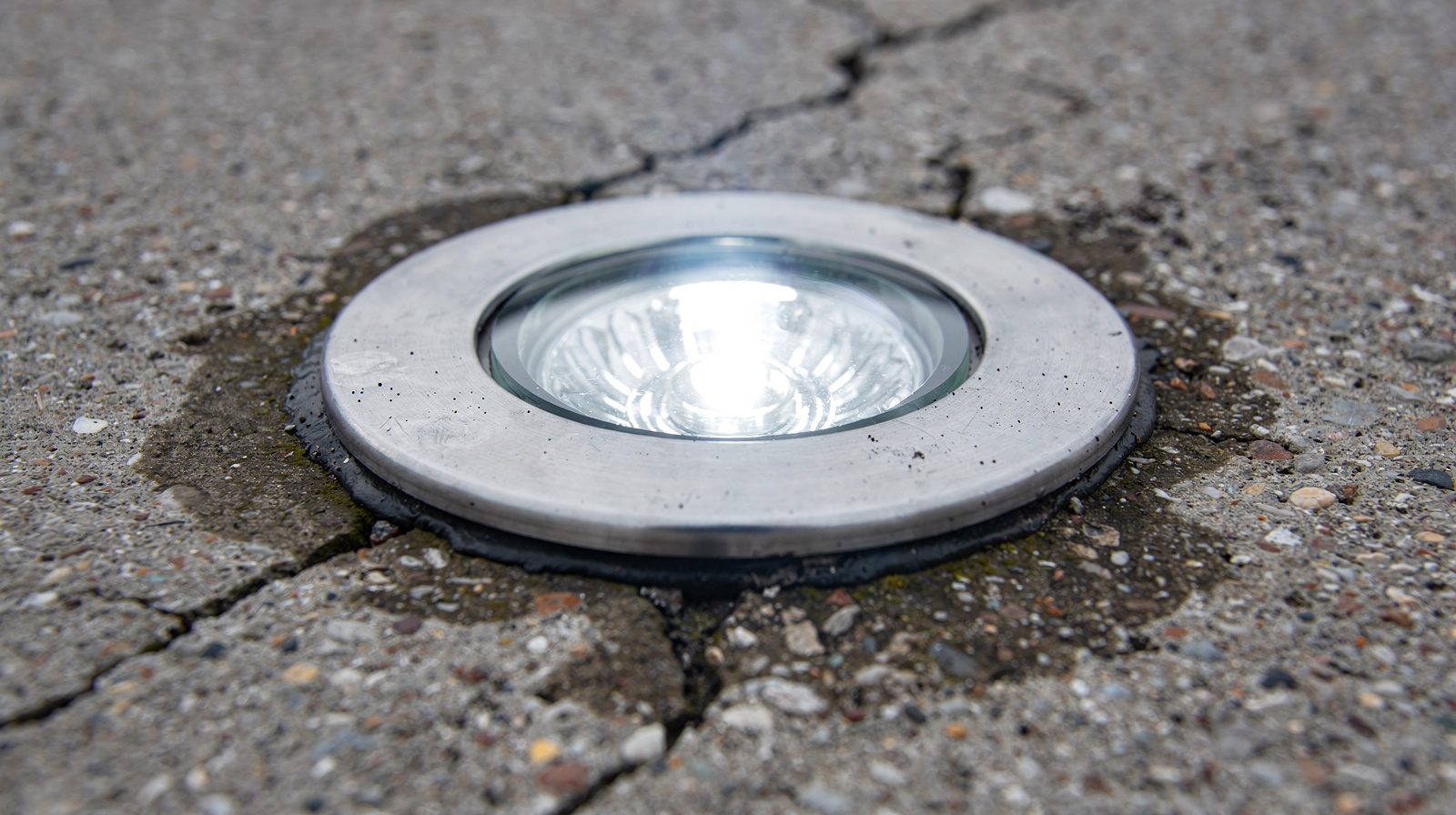 INSET FIXTURE · PRISM LENS · DAYLIGHT
LED airfield lighting changes photometric inspection in four ways. An LED fades slowly and does not burn out, so each fixture’s output has to be measured. Its colour can shift. It makes little heat, so ice can stay on the lens. The 50 percent intensity limit applies to LED and incandescent lights alike.
How LED lights fail differently
An incandescent lamp reaches the end of its life with a complete failure. The FAA review of LEDs in airfield lighting (AM-22/08) says that LEDs instead tend to become slowly less bright until a failure. It concludes that a maintenance schedule must check the brightness of each fixture.
EASA gives the reason. An LED has no filament that breaks. Its light output decreases and its colour shifts over time, and the rate increases at higher operating temperatures. At some point the source falls outside the specification for its use. It may still be lit, but it is no longer useful. EASA concludes that the long life of an LED is no reason to “install and forget”, and that a system of preventive maintenance is necessary.
Fixtures with several light devices
Many fixtures use several LEDs to make one light. FAA Engineering Brief 67D requires such a fixture to meet its output specification while it is on and to turn off if more than 25 percent of the light devices fail. That is a design rule for new fixtures. It does not show how a fixture in service ages, so the output of each installed light still needs checking. The sources checked do not say how many devices a typical airfield fixture holds or how often a partial failure happens.
Why the eye is a weak check
A single dark unit stands out against its neighbours. A row that ages together has no brighter neighbour to give it away. The loss is gradual, so a night walk-around sees lit lights and cannot tell a light at full output from one at a lower output. This is the basis of the FAA advice to check the brightness of every fixture.
What the limit is and how it is measured
Annex 14, paragraph 10.5.1, deems a light unserviceable when its main beam average intensity is less than 50 per cent of the value in Appendix 2. EASA ADR.OPS.C.015(c) has the same 50 percent limit. Neither text sets a different limit for an LED light. Annex 14 Note 1 says these are maintenance performance objectives and do not define whether a lighting system is operationally out of service.
For a Category II or III precision approach runway, Annex 14 recommends in-field measurement of the intensity, beam spread and orientation of the lights (10.5.3 to 10.5.5), with a mobile measuring unit of sufficient accuracy. Paragraph 10.5.6 sets the frequency at no less than twice a year for in-pavement lights and once a year for other lights. The paragraph does not say that LED lights change these intervals. Photometric testing of the luminous intensity of each light is the check that finds a light that is lit but weak.
Colour needs a measurement as well
Chromaticity is the colour of a light as a pair of coordinates. FAA Engineering Brief 67D tests it with a spectroradiometer in steps of 2 nm or less and gives boundaries for aviation white LEDs. The FAA review notes two consequences. The allowed ranges are wide, so LEDs from different makers may differ. And the chromaticity of a set of lights can drift as lenses age and discolour. It adds that incandescent lights shift in chromaticity with brightness.
Colour is a serviceability matter. Under EASA ADR.OPS.C.015(c) a light that does not produce the correct colour beam is unserviceable, whatever its intensity. A colour error in a lit light is hard to judge by eye.
Heat, ice and snow
An LED does not produce the infrared heat of an incandescent lamp. Annex 14 Note 2 to 10.5 and EASA GM2 ADR.OPS.C.015(b) say the same. Operators who count on that heat to melt ice and snow need to evaluate a modified maintenance schedule or fixtures with heating elements. EASA notes that the low temperature can help, because drifting snow does not melt and stick to the lens. It adds that an LED PAPI is likely to need some form of lens heater to avoid condensation and icing. EB 67D allows an optional arctic kit.
The same lack of heat matters for pilots who use enhanced flight vision systems. EASA requires the operator to report the LED parts of the lighting system to the AIS.
Contamination on the lens of an in-pavement fixture also reduces performance (EASA). Monitoring is electrical. EB 67D 2.7 requires monitored fixtures to fail open, and the sources checked do not describe optical output monitoring. A dirty lens and a faded LED both show up as low output, and only a measurement tells them apart from a good light.
Incandescent and LED compared
| Factor | Incandescent lamp | LED light |
|---|---|---|
| End of life | Complete failure | Slow loss of brightness until a failure (FAA AM-22/08) |
| Colour | Chromaticity shifts with brightness | Colour shifts over time, and lens ageing can change it (EASA, FAA AM-22/08) |
| Heat on the lens | Infrared heat can melt ice and snow | No infrared heat signature, so a modified schedule or heating may be needed (Annex 14, EASA) |
| Serviceability limit | 50 percent of the specified intensity | 50 percent of the specified intensity (Annex 14 10.5.1) |
| Preventive maintenance | Required | Required, and long life is no reason to install and forget (EASA) |
What a drone survey adds
A drone survey does not set the intensity limit. It finds the lights that need a closer look. TarmacView flies airfield lighting inspection between aircraft movements. Each unit is reported lit or dark, with its colour against its position, its output relative to its neighbours and to the commanded dimming step, and an RTK-surveyed position. The runway edge light inspection works this way.
That is a relative result. A drone survey does not report absolute candela. TarmacView does not yet have a calibrated camera, and a verdict against the 50 percent limit needs a calibrated photometer. A repeated survey does show which lights fall behind their neighbours from one inspection to the next. The photometric measurement guide sets out how to anchor readings to a calibrated instrument. See also when runway lights drift out of tolerance .
For the life rating of an LED, see the glossary page on LED lifespan .
Conclusion
An LED airfield light does not announce its end. It fades and its colour can move while it stays lit, so inspection moves from looking at the lights to measuring each one. The limits of Annex 14 and EASA stay the same.
Frequently Asked Questions
- How does LED airfield lighting change photometric inspection?
- It makes measurement the main way to find a fading light. An LED loses output slowly and its colour can shift, so a light can be lit and still be below its specified intensity or colour. The 50 percent intensity limit of ICAO Annex 14 and the EASA rules apply to LED lights in the same way as to incandescent ones.
- Does LED lighting change how often airfield lights must be inspected?
- No. The sources checked give no separate LED interval. Annex 14 recommends measuring Category II and III runway lights at least twice a year for in-pavement lights and once a year for other lights, and the paragraph does not distinguish the light source. EASA adds that a long LED life is no reason to install and forget.
- Why does colour matter more with LED airfield lights?
- Because the allowed chromaticity ranges are wide and the colour can move over time. FAA research notes that LEDs from different makers may differ within the allowed range and that the colour of a set of lights can drift as lenses age. EASA also lists a light that shows the wrong colour as unserviceable.
- Do LED runway lights melt snow and ice?
- Not by their own heat. EASA and ICAO state that LEDs do not produce the infrared heat of incandescent lamps, so operators in ice and snow should check whether they need a modified maintenance schedule or fixtures with heating elements. EASA adds that an LED PAPI is likely to need a lens heater.
- How long does an LED airfield light last?
- Many thousands of hours, but no fixed figure applies. EASA states that the life of the luminaire depends on system integration, temperature, on-off cycling and humidity, and that the light output decreases and the colour shifts over time. The glossary page on LED lifespan explains how makers rate it.
- Can a camera on a drone measure LED light intensity in candela?
- Not without a calibrated instrument. A drone survey can show each unit lit or dark, its colour against position and its output relative to its neighbours and to the commanded step. Absolute candela needs a calibrated photometer.
References
- easa-ear-aerodromes
- Easy Access Rules for Aerodromes (Regulation (EU) No 139/2014) EASA
- icao-annex-14-vol-i
- Annex 14 to the Convention on International Civil Aviation, Aerodromes, Volume I, 9th edition (July 2022) ICAO
- faa-am-22-08
- DOT/FAA/AM-22/08, Light-Emitting Diodes in Airfield Lighting Applications: A Review and Annotated Bibliography FAA Civil Aerospace Medical Institute
Founded by flight-inspection veterans who spent decades measuring PAPI lights for aviation authorities across Europe.
Learn more
Related terms
03 TERMSLED Lifespan
LED lifespan is the time an LED light source keeps the light output and colour its application needs. How L70, LM-80 and TM-21 rate it, what shortens it, and what the aerodrome rules say.
Lamp Failure
A lamp failure leaves an airfield light unserviceable. How lights fail, the 50 percent test, how many may fail per system, monitoring, repair, and effects on NOTAMs and landing minima.
LED Lamp
An LED lamp in airfield lighting is a light source that uses light emitting diodes. Where airports use LED lights, how they differ from incandescent lamps, CCR and PAPI effects, ageing, and what is re-checked after a retrofit.
Further reading
03 ARTICLES
How Often Does Airfield Lighting Need Photometric Testing?
How often airfield lighting is photometrically tested: no Part 139 interval, a twice-yearly floor on precision runways, monthly FAA tables and what a…
When Runway Lights Drift Out of Tolerance
Runway lights do not fail suddenly. They drift. What moves a fixture out of tolerance, why nobody sees it happen, and how a measured baseline catches…
Runway Edge Light Inspection: What ICAO Requires and How It Is Measured
What ICAO Annex 14 requires of runway edge lights, what it leaves open, and how intensity, colour and coverage are actually measured in the field.