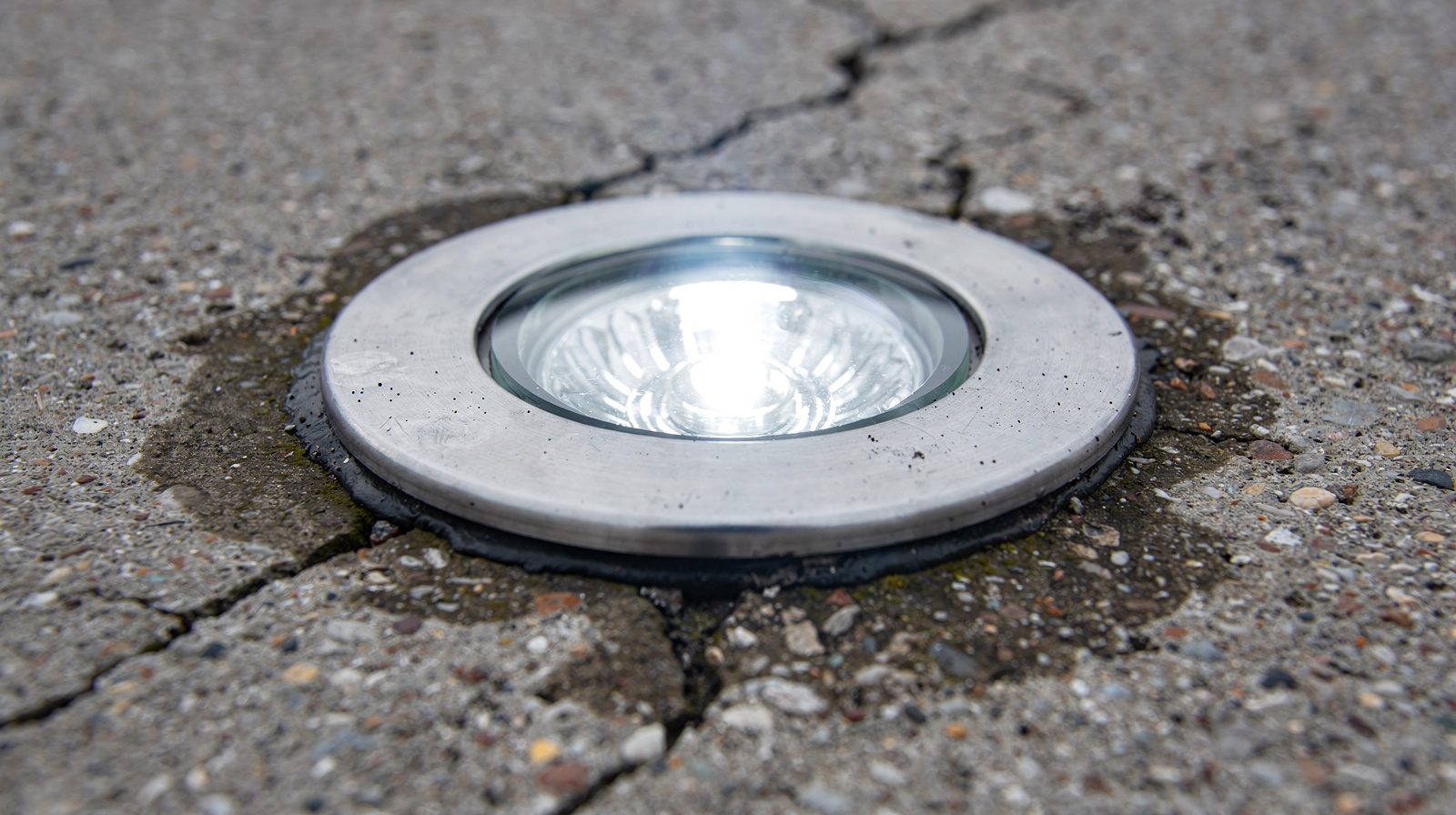
What is a Light Emitting Diode (LED)?
A light emitting diode (LED) is a semiconductor component that emits light when current flows through it.
LED stands for light emitting diode. The component is not a lamp. A lamp or light fixture can hold one LED or many. The LED lamp page covers the airfield fixture and the retrofit. This page covers the component.
LED, LED lamp and incandescent lamp
The International Commission on Illumination (CIE) defines an LED as a solid-state device with a p-n junction. It emits incoherent optical radiation when an electric current excites it. The definition does not depend on an enclosure or on terminals. The LED is therefore the component.
The CIE calls an electric light source that is based on LED technology an LED light source. It can take the form of an LED module or an LED lamp. An LED lamp is an electric lamp based on LED technology. An LED module has at least one LED package and either a printed circuit board cap or no cap.
An incandescent lamp is a different kind of lamp. It is an electric lamp in which an element heated to incandescence by an electric current produces the light. An LED has no heated element. The incandescent lamp page covers the filament lamp.
How an LED makes light
An LED has a p-n junction, where a p-type semiconductor meets an n-type semiconductor. When the junction has a forward voltage, electrons move from the n-side to the p-side. Holes move the other way. The electrons recombine with the holes and release their energy as photons. This process is called electroluminescence.
The energy that an electron needs to cross the band gap of the semiconductor sets the colour of the light. An efficient LED needs a semiconductor with a direct band gap. An indirect band gap needs phonon-assisted recombination, which limits the efficiency.
What sets the colour
The material sets the band gap, and the band gap sets the wavelength. Gallium arsenide (GaAs) has a band gap of 1.4 eV and gives infrared light. Gallium nitride (GaN) has a band gap of 3.4 eV, which is ultraviolet. Blue light needed GaN alloys, p-doping of GaN and layered structures such as heterojunctions and quantum wells. The first LEDs of the 1950s and 1960s emitted from the infrared to the green. Blue light took three more decades. GaN p-doping came only at the end of the 1980s.
An LED emits nearly monochromatic light, so its light looks like a saturated colour. The small size of an LED and its bright output give good optical control.
How white light is made
An LED is not a white source by itself. There are three methods:
- A blue LED excites a phosphor, and the phosphor emits green and red light. Together with the blue light, the result looks white.
- Red, green and blue LEDs together give white.
- A hybrid method uses both a phosphor and LEDs of single colours.
The efficient blue LED led to white light sources for illumination. The 2014 Nobel Prize in Physics honours its inventors, I. Akasaki, H. Amano and S. Nakamura.
Efficiency and life
The US Department of Energy reports LED lighting efficacies up to 150 lumens per watt or more. The department describes useful life as the hours until the LED emits 70 percent of its initial light output. It expects good white LED products to last 30,000 to 50,000 hours or longer. These are figures for general lighting, not for airfield fixtures.
The life of the luminaire also depends on its electronics and its use. EASA names the temperature of operation, on-off cycling and humidity as factors.
What LEDs are used for
LEDs replace light bulbs and fluorescent tubes in general lighting. The Nobel Prize background of 2014 also names the back light of liquid crystal displays in phones, tablets and monitors. On an airfield, LEDs are the light source in fixtures for runway, taxiway and approach lights, signs and PAPI units.
LED and incandescent airfield lights
Airfield lights now use both light sources. Four differences matter to the operator.
- Appearance. An LED fixture can look different from an incandescent fixture in colour and brightness. FAA AC 150/5340-30J does not allow LED fixtures among incandescent lights of the same type. One example is a runway centerline. A defective incandescent fixture gets a replacement of the same technology.
- Heat. LEDs give no infrared heat signature. Ice and snow melt less on an LED fixture, and an LED PAPI is likely to need a lens heater.
- Ageing. An LED has no filament that breaks. Its light output decreases and its colour shifts, faster at higher temperature. EASA states that the long life of an LED is no reason for install and forget, and that preventive maintenance is necessary.
- Control. FAA AC 150/5340-30J says a 5-step constant current regulator is necessary to control LED high intensity lighting systems.
Standards
The colour of an aeronautical ground light stays inside the chromaticity limits of the standard, whatever the light source. Chapter U of CS-ADR-DSN has separate limits for solid state light sources. ICAO Annex 14 Appendix 1 does the same. FAA Engineering Brief 67D sets boundaries for aviation white LED fixtures.
The EU rules also require the aerodrome operator to report the LED parts of its lighting system to the aeronautical information services. The reason is that enhanced vision systems rely on the infrared signature of incandescent lights.
Use in airfield inspection
The maintenance, replacement and heater rules above depend on the light source technology of each system, so an inspector needs to know it. On a heliport, some night vision goggle systems may not detect specific LED colors.
Frequently Asked Questions
- What does LED stand for?
- LED stands for light emitting diode. A diode is a semiconductor component, and in an LED the current through the semiconductor makes light. The abbreviation names the component, not a lamp. A lamp or a light fixture can use one or many LEDs.
- What is the difference between an LED, an LED lamp and an incandescent lamp?
- An LED is a component, and the other two are lamps. The CIE defines an LED as a solid-state device with a p-n junction that emits optical radiation when current excites it. An LED lamp is an electric lamp based on LED technology. An incandescent lamp makes light from a heated element.
- How does an LED make light?
- A current flows through a semiconductor. Electrons in the semiconductor recombine with electron holes and release their energy as photons. The size of the band gap of the semiconductor sets the colour of the light. The process is called electroluminescence.
- What does forward voltage mean for an LED?
- A forward voltage across the p-n junction injects electrons from the n-side to the p-side and holes the other way. The electrons then recombine with holes and the junction emits light.
- How is white LED light made?
- An LED is not a white source by itself. White light comes from a phosphor that a blue LED excites, or from a mix of red, green and blue LEDs. Some products use both methods. Aviation white LED fixtures must meet the chromaticity boundaries in FAA Engineering Brief 67D.
- What are LEDs used for?
- General lighting is one use, and the LED replaces incandescent and fluorescent lamps there. The Nobel Prize background of 2014 also names the back light of liquid crystal displays. On an airfield, LEDs are the light source in fixtures for runway, taxiway, approach and PAPI lights.
- Can an LED fixture replace an incandescent fixture on a runway?
- Not one at a time. FAA AC 150/5340-30J says LED fixtures must not be interspersed with incandescent lights of the same type. A defective incandescent fixture must get a replacement of the same technology. The two can differ in perceived colour and brightness. This can distort what the pilot sees.
- Do LED airfield lights melt snow?
- Less than incandescent lights. LEDs do not produce the infrared heat signature of incandescent lamps. Where ice and snow occur, EASA says to evaluate a modified maintenance schedule. The alternative is fixtures with heating elements. An LED PAPI is likely to need a lens heater to prevent condensation and icing.
References
- cie-ilv-led
- ILV 17-27-050 light emitting diode, 17-27-053 LED light source, 17-27-054 LED lamp, 17-27-058 LED module, 17-27-008 electric lamp, 17-27-011 incandescent lamp CIE (International Commission on Illumination)
- nobel-2014-scientific-background
- Scientific Background on the Nobel Prize in Physics 2014: Efficient blue light-emitting diodes leading to bright and energy-saving white light sources Royal Swedish Academy of Sciences (Nobel Prize)
- doe-led-basics
- LED Basics US Department of Energy
- easa-ear-aerodromes
- Easy Access Rules for Aerodromes (Regulation (EU) No 139/2014), March 2026 EASA
- faa-ac-150-5340-30j
- AC 150/5340-30J, Design and Installation Details for Airport Visual Aids FAA
- faa-eb-67d
- Engineering Brief No. 67D, Light Sources Other Than Incandescent and Xenon for Airport and Obstruction Lighting Fixtures FAA
- icao-annex-14-vol-i
- Annex 14 Volume I, Aerodrome Design and Operations, 9th edition (July 2022) ICAO (copy hosted by Swiss FOCA)
- faa-ac-150-5390-2d
- AC 150/5390-2D, Heliport Design FAA
This is a reference entry. TarmacView provides drone inspection services and doesn't sell the equipment or materials described in this glossary.