What is White?
White is a colour that standards define for aeronautical ground lights by chromaticity limits and for runway markings by paint colour.
What white is
In physics, white is the equal mixture of all visible wavelengths. Black is the absence of light. White is not a single wavelength. The eye detects about 380 to 700 nm, and white light contains a mix across that range. ISO 20473 gives 380 to 780 nm for the same range, so the limit depends on the source.
NASA describes the proof. A prism splits sunlight into its colours, and a second prism recombines them into white light.
How the eye sees white
The eye has three types of cone cells, named for the wavelengths to which each is most sensitive. Rods are about 1,000 times more sensitive than cones and do not give colour information.
Red, green and blue light added together give white. A colour television uses this mixing, with equal numbers of red, green and blue dots on the screen.
Why white objects reflect light
The colour of an object comes from what it absorbs and reflects. A white surface reflects most of the visible wavelengths that fall on it. NASA notes that snow and clouds reflect strongly across all visible wavelengths. A black surface absorbs them instead.
The colour of the surface also depends on the light. A pure blue object under pure red light looks black, because it absorbs the red light.
White light sources
An LED emits nearly one colour. The US Department of Energy lists three ways to make white:
- Phosphor conversion. A phosphor on or near the LED converts its colour to white.
- Colour mixing. Red, green and blue LEDs combine to white.
- Hybrid. Phosphor LEDs combine with single-colour LEDs.
White lights at an airfield
Chromaticity is the colour of a light, given in the coordinates of the CIE standard observer. Chapter U of CS-ADR-DSN and Appendix 1 of ICAO Annex 14 give an area for each colour of aeronautical ground light. The areas cover red, yellow, green, blue, white and variable white. Variable white is for lights that change in intensity, for example to avoid dazzling.
Filament lights and solid state (LED) lights have different areas. A filament light has these limits for white:
- yellow boundary: x = 0.500
- blue boundary: x = 0.285
- green boundary: y = 0.440 and y = 0.150 + 0.640x
- purple boundary: y = 0.050 + 0.750x and y = 0.382
For an LED light, four boundaries limit the white area:
- yellow boundary: x = 0.440
- blue boundary: x = 0.320
- green boundary: y = 0.150 + 0.643x
- purple boundary: y = 0.050 + 0.757x
For solid state lights, variable white uses the same area as white. Annex 14 recommends a margin to tell variable white from yellow. The x coordinate of the yellow should be at least 0.050 greater than that of the white. The yellow lights should show close to the white lights.
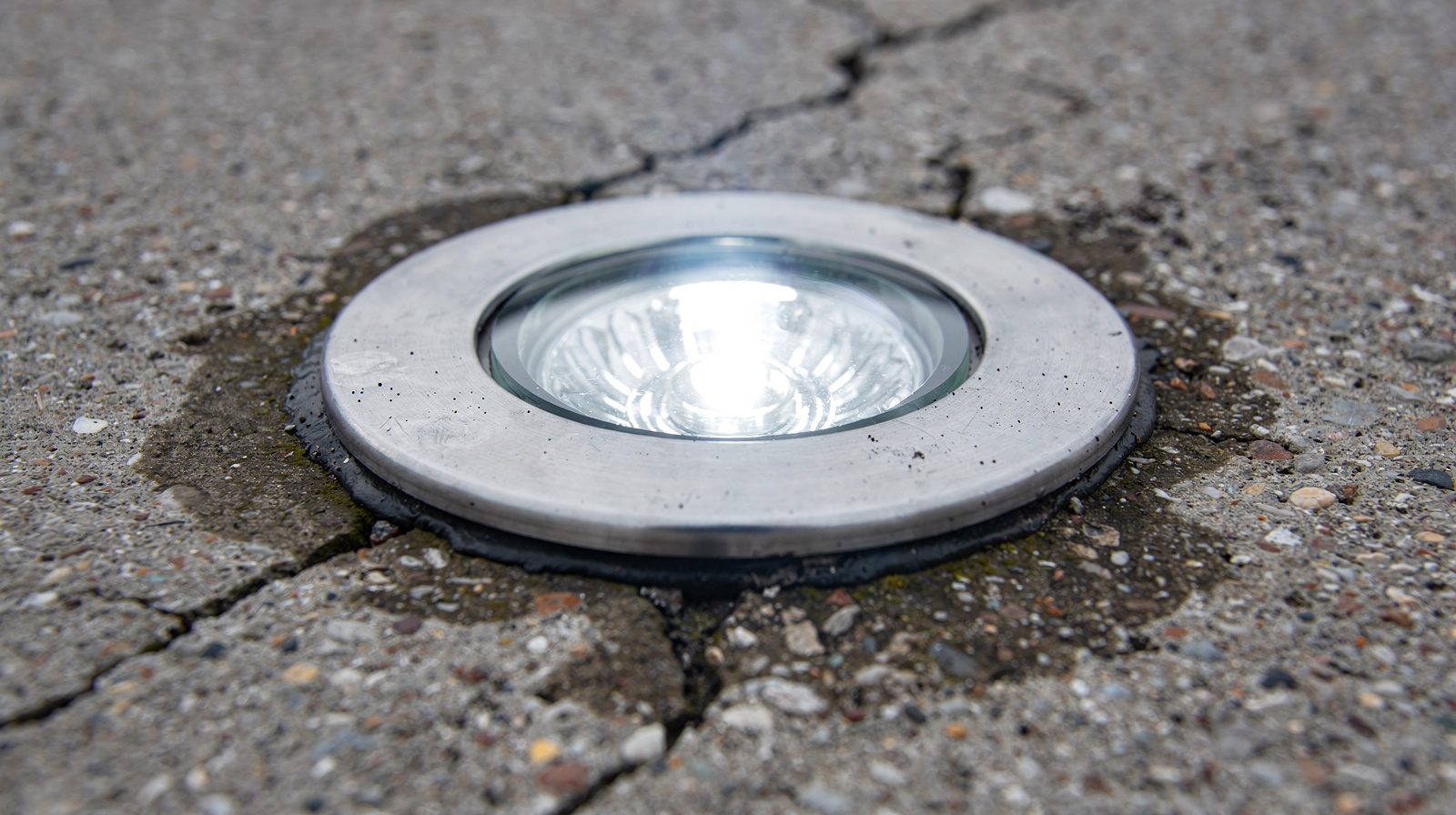
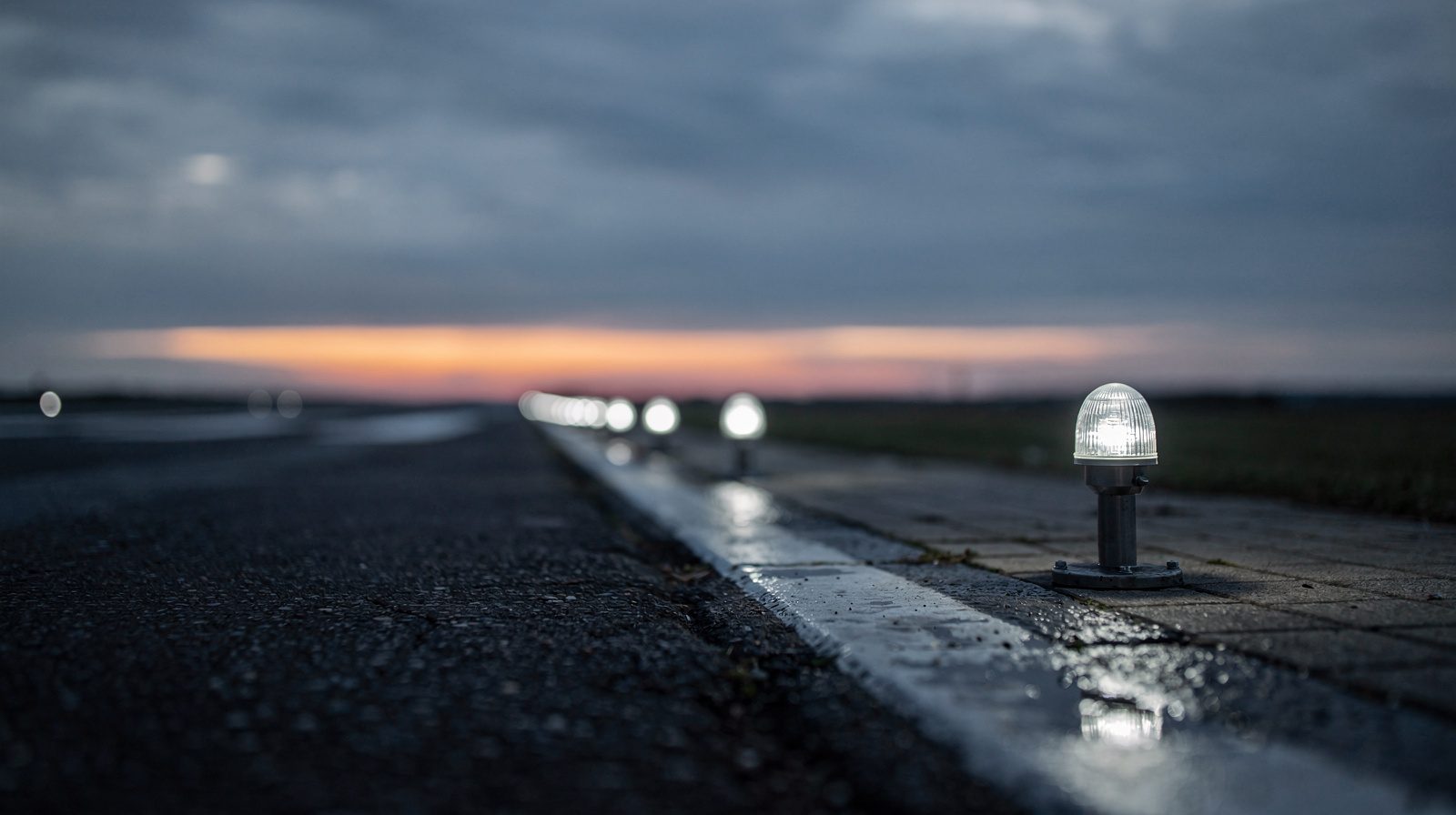
White lights on a runway include the edge lights, the centreline lights and the touchdown zone lights. Approach lights also show variable white in Annex 14. See runway lighting and light colour .
Why a PAPI shows red and white lights
A precision approach path indicator (PAPI) has a wing bar of four light units. ICAO Annex 14 sets what the pilot sees (5.3.5.26):
- On or close to the approach slope. The two units nearest the runway are red and the two farthest are white.
- Above the slope. One unit is red and three are white. Further above, all four are white.
- Below the slope. Three units are red and one is white. Further below, all four are red.
The pattern tells the pilot where the aircraft is relative to the slope. The sources opened for this page do not say why the designers chose white for high and red for low.
White markings
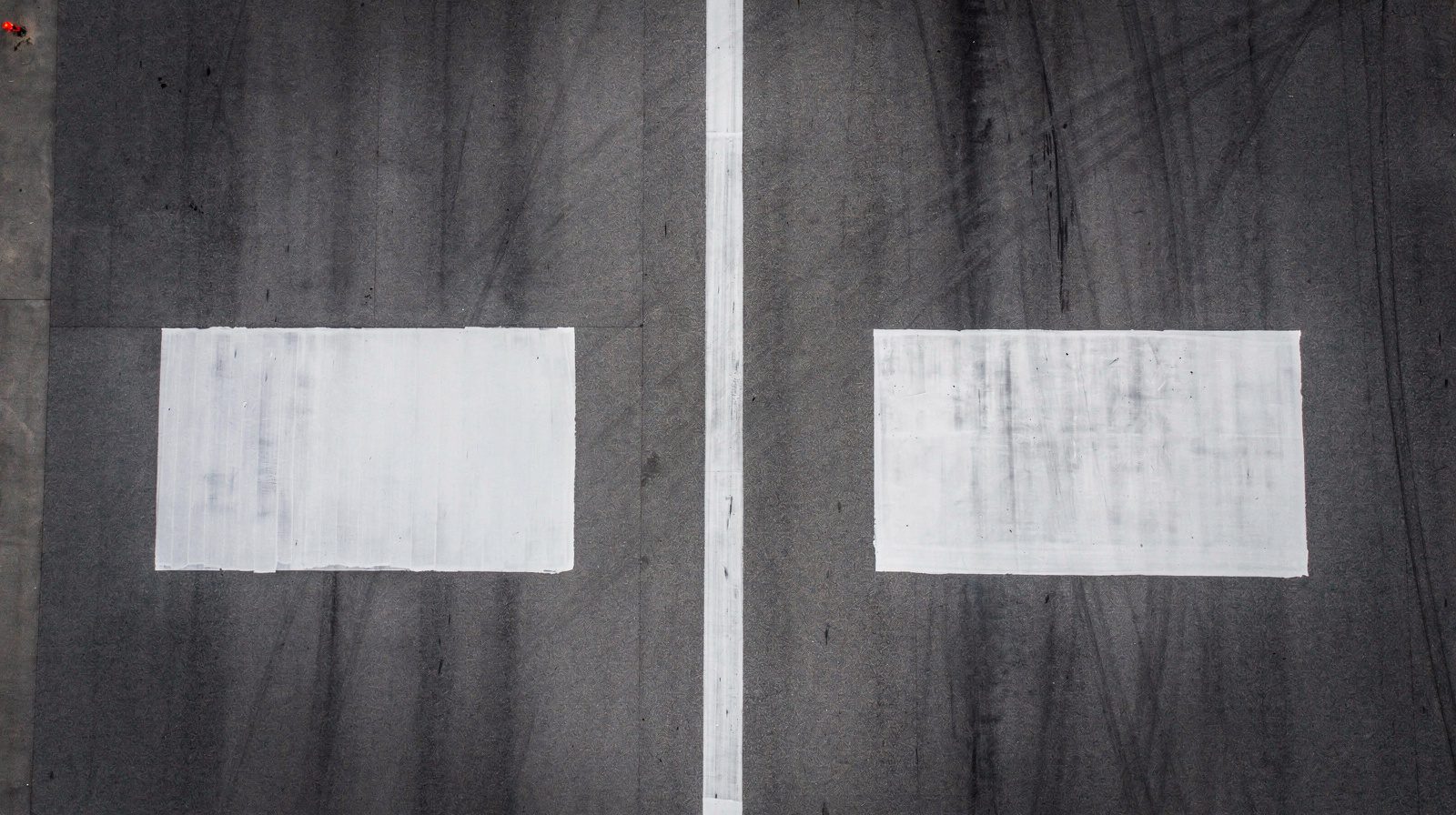
EASA specifies that runway markings are white and taxiway markings are yellow. In the FAA specification, white paint is Federal Standard 595 colour number 37925. For preformed thermoplastic markings, the FAA requires at least 225 mcd/m2/lux on white markings at installation. A portable retroreflectometer measures it to ASTM E1710. See taxiway markings .
How white is checked
The standards check the colour of a light at five points within the innermost isocandela curve. The light runs at rated current or voltage. They also check the colour at the outermost curve, to make sure no colour shift can confuse a pilot. The FAA checks marking retroreflectivity with a retroreflectometer.
Common mistakes
- White has no wavelength. Quote a range, not a single value.
- A standard white is an area. Two white lights can differ in chromaticity and both can pass.
Frequently Asked Questions
- What is white?
- White is the equal mixture of all visible wavelengths. OpenStax defines black as the absence of light. White is not one wavelength. It is a mix across the visible range of about 380 to 700 nm.
- What is the wavelength of white light?
- White light has no single wavelength. It contains many wavelengths across the visible range, which NASA gives as 380 to 700 nm. A prism splits white light into its colours, and a second prism can recombine them.
- Does white reflect or absorb light?
- A white surface reflects most of the visible light that falls on it. NASA notes that snow and clouds reflect strongly across all visible wavelengths. A black surface absorbs most visible light instead.
- Is white a colour?
- Yes, as a perceived colour. Standards for light treat white as a region of chromaticity, so a light is white when its colour coordinates fall inside a defined area. Science also treats white as a mixture of all visible colours.
- How do LEDs make white light?
- An LED emits nearly one colour, so white needs a trick. A phosphor can convert the LED colour to white, red, green and blue LEDs can mix to white, or the two methods can be combined. The US Department of Energy lists these three.
- Are all runway lights white?
- No. Runway edge lights are white. On an instrument runway, yellow lights replace them in the last 2,000 ft or half the runway length, whichever is less. Runway centreline lights are white, then alternate red and white, and at the runway end all lights show red. Touchdown zone lights are white.
- How does a standard define the white of an LED light?
- It defines white as an area of chromaticity coordinates. For solid state lights, four boundaries limit the area. They are x = 0.440, x = 0.320, y = 0.150 + 0.643x and y = 0.050 + 0.757x. Annex 14 and CS-ADR-DSN give the same limits.
- What do the red and white lights of a PAPI mean?
- A PAPI has four light units. On the slope, the two units nearest the runway show red and the two farthest show white. Above the slope more units show white. Below it more show red. All white means too high and all red means too low (ICAO Annex 14, 5.3.5.26).
References
- easa-cs-adr-dsn-7
- Easy Access Rules for Aerodromes (Regulation (EU) No 139/2014), CS-ADR-DSN Issue 7 EASA
- icao-annex-14-vol-i
- Annex 14 to the Convention on International Civil Aviation, Volume I, Aerodrome Design and Operations, 9th edition (July 2022) ICAO
- faa-ac-150-5340-1m
- AC 150/5340-1M Chg 1, Standards for Airport Markings FAA
- faa-ac-150-5370-10h
- AC 150/5370-10H, Standard Specifications for Construction of Airports FAA
- openstax-color-vision
- College Physics 2e, 26.3 Color and Color Vision OpenStax
- nasa-visible-light
- Visible Light NASA Science
- doe-led-basics
- LED Basics US Department of Energy
This is a reference entry. TarmacView provides drone inspection services and doesn't sell the equipment or materials described in this glossary.