FAA AC 150/5340-26: Maintaining Airport Visual Aid Facilities
What FAA AC 150/5340-26C asks of airport lighting maintenance: check cadence per system, photometric testing frequency, PAPI aiming and where drones fit.
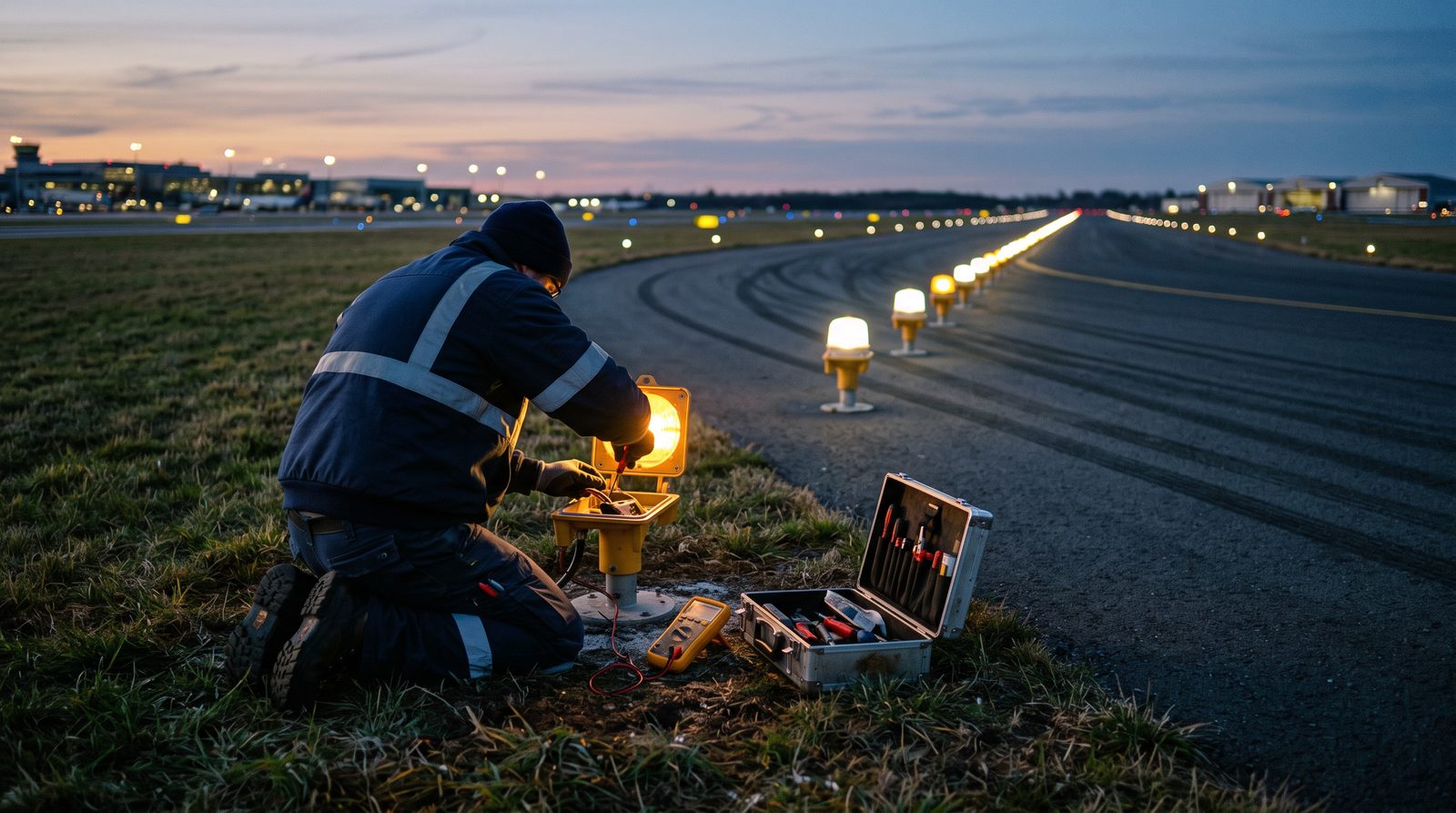
- 01 Paragraph 2 makes the circular mandatory only for projects funded through the Airport Improvement Program or Passenger Facility Charges. Otherwise it is recommended guidance.
- 02 Chapter 5 gives a separate preventive maintenance schedule for each system, from daily outage patrols to annual oil dielectric tests, and expects each airport to tune the intervals with experience.
- 03 Tables 5-5 and 5-6 list photometric testing of runway lights as a monthly item, and the text sets a floor of twice a year on a precision approach runway.
- 04 A light measuring below 70 percent of its minimum required output at maximum intensity should be targeted for cleaning or maintenance.
- 05 The circular never mentions drones or Part 139. Insulation, regulator and vault checks are electrical work that stays on the ground.
On this page · 10 sections
The FAA has one advisory circular for keeping airport lighting working after it is installed. AC 150/5340-26C, dated 20 June 2014 initiated by AAS-100 and signed by the FAA Director of Airport Safety and Standards, cancels the 2009 edition, 26B. It covers the lighting vault and series circuits, constant current regulators , elevated and in-pavement runway and taxiway lights, guard lights and stop bars, signs, beacons, wind cones, PAPI, VASI, REIL and ODALS, MALS and MALSR, control and monitoring systems, runway status lights, obstruction lights and standby generators. It also carries a long safety chapter and a troubleshooting chapter for series circuits.
What the circular is, and who it binds
Paragraph 1 says the circular “provides recommended guidelines for maintenance of airport visual aid facilities.” Paragraph 2 sets the status precisely. In general, use of the circular is not mandatory. It is mandatory for all projects funded with federal grant money through the Airport Improvement Program (AIP) and with revenue from the Passenger Facility Charges (PFC) Program. The link is made through Grant Assurance No. 34, Policies, Standards, and Specifications, and PFC Assurance No. 9, Standards and Specifications.
That is the whole of what the circular says about its own status. It does not mention 14 CFR Part 139, airport certification or the self-inspection programme anywhere in its text. The link runs the other way. 14 CFR 139.311 (Marking, signs, and lighting) and 139.327 (Self-inspection program) each point to FAA advisory circulars for acceptable methods, and AC 150/5210-22, Airport Certification Manual, lists AC 150/5340-26 in its Appendix 4 under marking, signs and lighting.
The text is also clear about its own tone. Paragraph 1.0 calls the content “the minimum requirements for establishing a maintenance program” and says the programme “must be tailored to suit each airport’s particular needs.” Paragraph 3.0 calls its procedures “minimum guidelines.” Paragraph 5.0 says the inspection schedules “establish a recommended routine which may be altered to suit local conditions.” So the schedules are a starting point that the airport owns and adjusts, not a fixed calendar the FAA audits line by line.
AC 150/5340-26C at a glance
- Issuer
- Federal Aviation Administration, initiated by AAS-100. Dated 20 June 2014.
- Status
- Recommended guidance. Mandatory for AIP-funded and PFC-funded projects through Grant Assurance No. 34 and PFC Assurance No. 9 (paragraph 2).
- Timeframes
- Quarterly means not more than three consecutive calendar months, semi-annually not more than six, annually not more than twelve (paragraph 5.0).
- Runway edge lights
- Daily twilight or night outage patrol, monthly photometric testing (HIRL) and alignment, semi-annual elevation and moisture, annual fixture and gasket checks (Table 5-5).
- In-pavement lights
- Daily patrol, weekly replacement of defective units, monthly cleaning and photometric testing, bi-monthly bolt torque, semi-annual check for water in shallow bases (Table 5-6).
- PAPI
- Daily lamp check, monthly aiming and alignment check, quarterly obstacle clearance surface check, semi-annual cable insulation and grounding tests (Table 5-9).
- Regulators and vault
- Daily control check on every brightness step, monthly output current per step and field circuit insulation resistance, annual oil dielectric test (Tables 5-1 and 5-4).
- Photometric floor
- Not less than twice a year on a precision approach runway (paragraphs 5.3.2.1.2 and 5.3.4.1.3).
- Output threshold
- Below 70 percent of the minimum output required at maximum intensity under AC 150/5345-46, a light should be targeted for maintenance.
The preventive maintenance programme
Chapter 3 frames everything that follows. Paragraph 3.0 starts from availability against cost and admits both are relative. Its own example is that a CAT I runway may still be considered operational with 15 percent of its edge lights out, while a PAPI may be unserviceable with more than one lamp out per box. Heavy traffic may justify more frequent servicing than light traffic.
Paragraph 3.3 names four elements of a preventive maintenance programme. The first is high quality, properly installed equipment. The second is trained personnel, present or on call during operating hours. The third is tools, test equipment, spares and manuals. The fourth is a preventive maintenance inspection (PMI) schedule for each visual aid, including the cables associated with it. Paragraph 3.3.5 allows the schedule to run on calendar or on hours of use, and tells the airport to adjust the frequency of any PMI once local experience is gained.
Records carry the adjustment. Paragraph 3.2 expects records detailed enough for a manager to see whether a task is done too often or not often enough. Paragraph 3.2.1 asks for maintenance logs on every non-federal PAPI, VASI, REIL and ODALS. After scheduled maintenance, the sponsor or owner should write in the log that the work followed Chapter 5, that the facility meets the manufacturer’s specifications, and that it meets Appendix A, Tables 3, 6 and 7. Paragraph 3.7 covers the case where the FAA declares a lighted aid out of service as suspect in an accident. The airport should inspect it at once and record all functional parameters as found against Appendix A, then file a written as-found statement before the NOTAM is cancelled.
The schedule for each system
Chapter 5 gives one PMI table per system. Read together they show a pattern. Daily checks are about whether the light is on. Monthly checks add measurement. Semi-annual and annual checks go to the cable, the ground and the hardware.
Lighting vault (paragraph 5.1, Table 5-1). Daily, check every control, including remote control from the maintenance shop where fitted. Weekly, check cleanliness, moisture and ventilation. Monthly, run insulation resistance tests on all airfield circuits “as a minimum” and check input voltage. Paragraph 5.1.3.1 suggests weekly tests for circuits that fail regularly, and stresses that a single reading means little until it is trended over time. Semi-annually, check ground resistance, buses, relays, oil fuse cutouts, switches, photoelectric and astronomic time switches and lightning arresters. Annually, test the oil dielectric strength in transformers and regulators.
Constant current regulators (paragraph 5.2, Table 5-4). Daily, check control circuits on every brightness step. Weekly, visit each vault while circuits run, listening and smelling for trouble. Monthly, record vault input voltage and current, and measure each regulator’s output current on each brightness step with a true RMS ammeter against the 3-step and 5-step tolerance tables. Semi-annually, measure output load if overloading is suspected and inspect connections with the regulator locked out. Annually, test the cooling oil and perform short-circuit and open-circuit tests.
Elevated runway and taxiway edge lights (paragraph 5.3.2, Table 5-5). Daily, drive a patrol at twilight or night for dim, dark and misaligned lights, and check lens cleanliness. Monthly, check lens orientation and perform photometric testing on high intensity runway edge lights (HIRL). Semi-annually, check light elevation against grade and look for moisture in bases and housings. Annually, inspect each fixture for cracking and corrosion, clean contacts and check gaskets. Paragraph 5.3.3.6 adds that each light should be cleaned thoroughly at least once a year.
In-pavement runway and taxiway lights (paragraph 5.3.4, Table 5-6). Daily, a twilight patrol records dark and dim lights. Weekly, an electrician replaces defective units with refurbished spares. Monthly, clean dirty lenses and perform photometric testing of runway lighting. Bi-monthly, check mounting bolt torque with a calibrated torque wrench. Semi-annually, check shallow bases for water.
MALSR (paragraph 5.10, Table 5-12). Daily, record burned-out lamps. Weekly, ask the tower to cycle every brightness step while a technician watches, replace lamps and clean optics. Monthly, record control cabinet voltages and clear vegetation. Semi-annually, check the elevation angle of the lights at each station, structures, the approach area for new obstructions and photoelectric controls. Annually, check distribution equipment, cable insulation resistance, fuse holders and contacts.
Other systems. Rotating beacons have daily, bi-monthly, semi-annual and annual checks in paragraph 5.5.2, starting with a daily flash count. ODALS in paragraph 5.15 runs from monthly visual checks to a cable insulation and conductor resistance test every three years. VASI in paragraph 5.8 follows the same pattern as PAPI, and standby generators in paragraph 5.14 have weekly, quarterly and annual checks.
Photometric testing: how often
This is the question the circular gets asked most, and its answer has three layers.
The tables put photometric testing of runway lights in the monthly column. Table 5-5 lists “Perform photometric testing (HIRL) and check light alignment and orientation” as monthly and unscheduled. Table 5-6 lists “Perform photometric testing of runway lighting systems” the same way. For elevated lights, paragraph 5.3.2.1.2(c) says this testing applies primarily to HIRL.
The text then makes the interval a local decision. Paragraphs 5.3.2.1.2(e) and 5.3.4.1.3(d) say the necessary frequency will vary from facility to facility and from runway to runway with traffic and fixture age, and may be adjusted once experience is gained.
The text also sets a floor. For a precision approach runway, both paragraph 5.3.2.1.2(f) and the opening of 5.3.4.1.3 say the frequency should be based on traffic density, local pollution, equipment reliability and the continuing assessment of measured results, “but in any case should not be less than twice a year.” Paragraph 5.3.4.1.3(e) adds that runway centreline lights collect rubber, so weekly checks may be necessary, especially on CAT II and CAT III runways. Paragraph 5.3.4.1.1(b) notes that nightly photometric testing is not practical, so an airport can set its own definition of “dim” for the daily patrol.
Testing has a purpose in the sequence of work. The circular asks for a measurement before cleaning, relamping or realignment to decide whether maintenance is needed, and another afterwards to confirm it worked. The trigger is 70 percent. A light whose output falls below 70 percent of the minimum required at maximum intensity under AC 150/5345-46 is described as ineffective for high background brightness and low visibility, and should be targeted for cleaning or maintenance (paragraphs 4.1.12, 5.3.2.1.2(f) and 5.3.4.1.3(f)).
On equipment, paragraph 4.1.12 is blunt. A hand-held spot meter “has proven to be very ineffective” and cannot account for alignment errors. Mobile systems can test individual fixtures at speed, some produce isocandela diagrams and flag misaligned fixtures, and some give GPS coordinates for each light. Whatever is used “must be of the highest quality and be proven capable of high accuracy and repeatability.” The photometric measurement guide covers what that means in practice.
PAPI aiming checks
PAPI gets one of the busier schedules in Table 5-9. Daily, every lamp should burn at equal brightness, and a dark or darkened lamp should be replaced at once. Monthly, paragraph 5.7.1.2(h) asks for a check of the horizontal and lateral alignment of the light boxes and of the vertical aiming angle with the PAPI aiming instrument. The angle and the date go in the maintenance log. The same paragraph says aiming should be checked frequently whenever the soil freezes, thaws or changes moisture, clay especially. Paragraph 5.7.1.2(i) adds a check after any contact with mowing or farm equipment, and item (k) covers the tilt switch.
Quarterly, paragraph 5.7.1.3 asks for a check of the obstacle clearance surface for tree growth, new towers and pole lines. It describes the surface as extending 10 degrees either side of the runway centreline to 4 miles (6.44 km) from its point of origin. Semi-annually, the underground cables get an insulation resistance test and the grounding system a resistance test.
The adjustment itself is a ground procedure. Paragraph 5.7.2.1 uses the clinometer supplied with the units, and has the technician stand about 50 feet in front of each box to confirm the colour changes simultaneously across its width. Table A-7 gives the reference settings for a 3 degree glide path, unless a different standard is set locally: 3° 30′ for unit D nearest the runway, then 3° 10′, 2° 50′ and 2° 30′ for unit A. The tolerance is ±2 minutes at installation and ±6 minutes in operation, with horizontal alignment parallel to the centreline within ±½ degree and not more than one lamp out per box. The circular says nothing about flight inspection of PAPI. The regulatory acceptance guide looks at how measured transition angles relate to these settings.
Electrical checks and optical checks
The schedules mix two kinds of work, and it helps to separate them.
The electrical side keeps power reaching the lights at the right current. It covers insulation resistance of field circuits, regulator output current on each step, input voltage, ground resistance, oil dielectric strength, relays, fuses and switches, lightning arresters and standby power. Table A-8 sets the current bands: on a 3-step 6.6 A regulator, 6.50 to 6.70 A at full step, for example. None of this can be seen from outside the vault or the cable.
The optical side checks what the pilot sees. It covers outages, lens cleanliness, orientation, measured output, PAPI aim, MALSR elevation angles and anything blocking the view. Table A-8 also sets serviceability per system for operation. Runway edge lights need 85 percent on, rising to 95 percent serviceable on CAT II and CAT III runways. Centreline lights need 95 percent serviceable and touchdown zone lights 90 percent. Threshold lights on VFR and non-precision IFR runways need 75 percent on, and so do end lights. Note 1 adds that unserviceable lights should not form a pattern that alters the system, and should not be adjacent except where a barrette or crossbar allows it.
Where a drone survey fits
Most of the optical column is about measuring light from where a pilot would see it, which is what a drone survey does. The electrical column is not. The table below sets each scheduled check against both.
What each AC 150/5340-26C check verifies, and what a drone survey can supply
| Scheduled check | What the circular asks for | What a drone survey can supply | What stays a ground or electrical task |
|---|---|---|---|
| Outage patrol (daily) | Drive at twilight or night, record dark, dim and misaligned lights | A per-unit record of lit or dark, and output relative to neighbours, with a surveyed position for each light | The daily cadence itself, which a patrol vehicle already covers |
| Photometric testing (monthly, at least twice a year on a precision approach runway) | Measure output of HIRL and in-pavement runway lights against AC 150/5345-46, before and after maintenance | Output per unit relative to neighbours and to the commanded dimming step, colour against position. Absolute candela needs a calibrated anchor | Bench testing of refurbished fixtures in the shop |
| Alignment and orientation (monthly) | Find lenses knocked out of alignment, which appear dimmer or brighter than their neighbours | Flag units whose output stands out from the row, as a pointer for inspection | Straightening, levelling and realigning the fixture |
| PAPI aiming (monthly) | Check box alignment and vertical angle with the aiming instrument, record angle and date | Measured transition angles of each unit as seen from the approach | Clinometer adjustment of the box, tilt switch and levelling |
| Approach light elevation (semi-annual) | Check elevation angle settings at each MALSR station | Lit or dark and relative output across the bars and stations | Setting the angles at the station and checking structures for corrosion |
| Insulation, ground and regulators (monthly to annual) | Insulation resistance, ground resistance, CCR output current per step, oil dielectric, short and open-circuit tests | Nothing. These are not visible from the air | All of it, in the vault and on the cable |
| Bases, bolts and water (bi-monthly to annual) | Bolt torque, water in shallow bases, gaskets, corrosion, elevation against grade | Nothing below the lens | All of it, by hand at the fixture |
TarmacView flies airfield lighting inspection for PAPI, approach lights , runway edge lights , threshold and end lights , centreline and touchdown zone lights and taxiway lights . Each unit gets lit or dark, colour against position, output relative to its neighbours and to the commanded step, and an RTK-surveyed position. Flights run between movements in coordination with the tower, with no closure booked. Regulator output, insulation resistance, standby power switch-over and anything underground are not measured. The comparison with flight inspection sets out what each method covers.
How it compares with the EASA and ICAO texts
The European framework puts maintenance of visual aids in Regulation (EU) No 139/2014, under ADR.OPS.C.015, with the detail in AMC and GM. AMC1 ADR.OPS.C.015(b) and (f), paragraph (c)(4), says measurement on a CAT II or III precision approach runway should be based on traffic density, pollution, equipment reliability and past results, and in any event not less than twice a year for in-pavement lights and once a year for other lights. That is an acceptable means of compliance, not the rule itself. ICAO Annex 14, Volume I, 9th edition, has the same structure as Recommendations 10.5.4 to 10.5.6. Amendment 18, applicable from 27 November 2025, may have changed that text, and EASA has not yet transposed it.
The FAA wording is close to this, with two differences. It applies the floor to “a precision approach runway” without naming a category, and it applies the same twice a year to elevated and in-pavement lights. The EASA CS-ADR-DSN page and the ICAO Annex 14 page set out those frameworks in their own terms.
Frequently Asked Questions
- Is AC 150/5340-26C mandatory?
- Only in part. Paragraph 2 states that use of the circular is in general not mandatory. It becomes mandatory for all projects funded with federal grant money through the Airport Improvement Program and with revenue from the Passenger Facility Charges Program, through Grant Assurance No. 34 and PFC Assurance No. 9. Everywhere else the FAA recommends it, and the text calls its procedures minimum guidelines that each airport should tailor.
- How often must airport lights be photometrically tested?
- The circular gives no single interval for every airport. Tables 5-5 and 5-6 list photometric testing of high intensity edge lights and runway in-pavement lights as a monthly check, and the text says the frequency should depend on traffic, pollution, equipment reliability and past results. For a precision approach runway it should in any case not be less than twice a year. Busy CAT II and CAT III runways may need weekly checks of centreline lights because of rubber deposits.
- How often should a PAPI be checked?
- Table 5-9 sets four cadences. Daily, confirm all lamps burn with equal brightness. Monthly, check controls, clean lamps and filters, check for damage, and check the alignment and vertical aiming of each light box with the aiming instrument, recording the angle and the date. Quarterly, check the obstacle clearance surface. Semi-annually, test the insulation resistance of the underground cables and the resistance of the grounding system.
- What does Part 139 require for airport lighting?
- AC 150/5340-26C does not say. The circular never mentions 14 CFR Part 139, so its applicability paragraph is the only status it gives itself. What Part 139 requires of lighting, and how FAA certification guidance treats this circular, has to be read in Part 139 and that guidance directly rather than inferred from the circular.
- Does AC 150/5340-26C allow drones for lighting inspection?
- The circular is silent on drones. Paragraph 4.1.12 describes mobile photometric measurement systems that test individual fixtures at speed, and requires that the equipment be proven capable of high accuracy and repeatability. It names no platform. Whether a drone-based measurement meets a particular airport's programme is a question for that programme and its FAA contacts, not something the circular settles.
- How does it compare with ICAO Annex 14 and the EASA rules?
- The FAA floor of twice a year on a precision approach runway mirrors wording in the European and ICAO texts, with a difference. EASA's AMC to ADR.OPS.C.015 and Annex 14 Recommendation 10.5.6 apply the measurement interval to CAT II and III runways and split it into twice a year for in-pavement lights and once a year for other lights. The FAA circular applies one floor to both elevated and in-pavement runway lights.
References
- faa-ac-150-5340-26c
- AC 150/5340-26C, Maintenance of Airport Visual Aid Facilities Federal Aviation Administration
- easa-ear-aerodromes
- Easy Access Rules for Aerodromes (Regulation (EU) No 139/2014) European Union Aviation Safety Agency
- icao-annex-14-vol-1
- Annex 14 to the Convention on International Civil Aviation, Volume I, Aerodrome Design and Operations International Civil Aviation Organization
- faa-ac-150-5210-22
- AC 150/5210-22, Airport Certification Manual Federal Aviation Administration
- 14-cfr-part-139
- 14 CFR Part 139, Certification of Airports Federal Aviation Administration