PAPI Out of Tolerance: Confirm, Re-aim, Re-check
What to do when a PAPI looks out of tolerance: confirm which unit is off and by how much, decide on a NOTAM, re-aim it and prove the fix without a flight check.
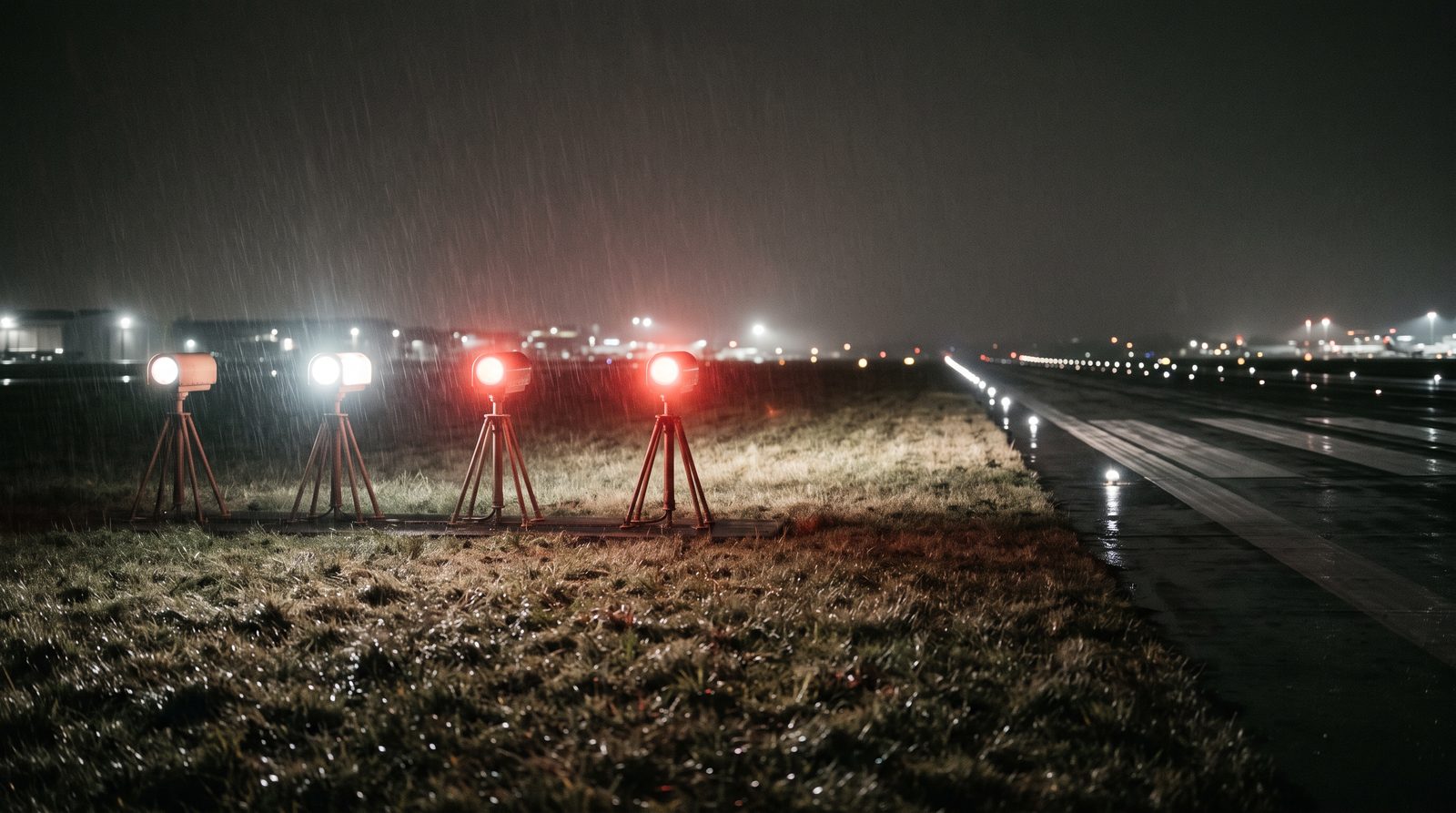
- 01 A suspicion is not a finding. The first job is to measure every unit's transition angle, so the decision is about a named unit and a known error rather than an impression.
- 02 In the EU, AMC1 ADR.OPS.C.015(b) and (f) says errors in excess of one minute of arc should be corrected, and asks for an extra alignment check after an aircraft occurrence.
- 03 ADR.OPS.A.057 ties the NOTAM to what the operator does with the PAPI. Switching it off, or changing it significantly, is a NOTAM case. A unit being slightly off is a maintenance finding first.
- 04 The clinometer sets the box against its datum. A measurement from the approach shows what the crew sees. The two answer different questions, and a fix is proven by both.
- 05 Re-aiming and re-measuring can happen in the same visit, because the angles are known on site. More often the technicians are called after the report and the re-check follows.
On this page · 10 sections
Who runs into this
Nobody plans for this page. The PAPI was set at commissioning, checked at the last flight inspection and has been showing two red and two white ever since. Then something makes someone doubt it, and the doubt usually arrives in one of four ways.
- A pilot report. A crew tells the tower the PAPI showed them high on a stable approach, or that one unit changed colour out of step with the others. The report is specific about the feeling and vague about the cause.
- A flight check finding. The flight inspection aircraft reports an angle outside the limit, or a mismatch with the ILS glide path. The finding is authoritative, and the aircraft has already gone home.
- A routine check. The technician’s monthly aiming check reads a box off its setting, or the daily check sees a unit whose red-to-white change is not coincident across its lamps.
- A visible defect. A mower has clipped a box, frost has lifted a foundation, or a wet season has softened the ground under one unit.
In every case the operator has the same short list of questions. Is it really out. Which unit. By how much. Does it need a NOTAM , or switching off. Who re-aims it. And how is the fix proven without waiting weeks for the next flight check slot.
Where this applies, and where it does not
This applies to any runway with a PAPI or APAPI, at any aerodrome that owns the units and answers for what they show. It applies to one wing bar or two, and to the case where the PAPI is harmonised with an ILS and has to agree with it.
It does not apply when the doubt is about what sits under the approach. A new crane or a grown tree in the obstacle protection surface is a different problem, covered by the PAPI protection surface check . It does not apply when the fault is obvious from the ground, such as a dark box or a broken filter, where the answer is a maintenance job and not a measurement. And it is not the yearly verification programme, which sits under airfield lighting inspection . This page is about one moment: somebody thinks the PAPI is wrong, and the operator has to find out quickly and close it properly.
What has to be known before deciding
- Which unit
- The finding names a unit, A to D, on a named wing bar, rather than describing the PAPI as a whole.
- Direction
- Whether the unit's transition sits above or below its set angle, which decides whether the crew is led high or low.
- Size
- The difference between measured and set angle, in minutes of arc, set against the limit the maintenance programme uses.
- Pattern
- Whether the four angles together still give the intended on-slope signal and the spacing between neighbouring units.
- ILS agreement
- Where the runway has an ILS, whether the visual slope still conforms as closely as possible with the glide path.
- Cause
- Whether the box moved, the ground moved or the optics moved against the datum plate, found before anyone turns an adjuster.
- Status
- Whether the PAPI stays in service, is switched off or is withdrawn, and whether that status has been reported for a NOTAM.
- Closure
- A measurement after the adjustment, dated, filed and matched to the original finding.
What the aerodrome is trying to achieve
Three things, in this order. The order matters, because a fast fix to the wrong unit is worse than a slow fix to the right one.
Turn a suspicion into a finding
A pilot report and a flight check finding are both valid reasons to act, and neither tells the technician which adjuster to turn. The operator needs each unit’s transition angle measured against its set angle, so the decision is about a named unit and a number. It may also turn out that the PAPI is fine and something else misled the crew. That is a finding too, and it is worth having in writing.
Keep the approach honest while it is being fixed
The PAPI either stays in service, because the error is small and is about to be corrected, or it is switched off and reported, because crews cannot rely on it. That call belongs to the operator, made against its own procedures. It is easier to make with a measured error in front of it than with a report saying the lights looked high.
Close it with evidence
An adjustment is not a fix until it has been measured. The operator needs a record that the corrected units now show the right angle from the approach, so the maintenance file, the safety team and the authority all see the same closure.
How a PAPI finding is closed
Five steps. The second and fourth are measurements, and the third is the one where the aerodrome’s people make the decisions.
From report to closed finding
- 01
Log the report or the suspicion
Record who saw what, on which runway end and wing bar, at what time and intensity step, and pass it to the lighting team and the operations manager the same day.
WhyA pilot report, a flight check finding or a technician's reading is the trigger, and the EU acceptable means of compliance ask for an additional alignment check after an aircraft occurrence. The detail of the trigger tells the measurement what to look for.
Done whenThe finding has a date, a runway end, a source and a description, and the operator has decided whether the PAPI stays in service while it is checked.
If notIf the report is vague, measure all units on that runway end rather than guessing which one the crew meant.
- 02
Measure every unit's transition angle from the approach
Fly a vertical profile in front of the wing bar between aircraft movements, in coordination with the tower, with the PAPI switched on at the step being checked. The field laptop computes each unit's transition angle offline, on site.
WhyThe setting check at the box shows where the box sits. The crew sees the beam from the approach. Measuring from the approach confirms or rules out the report in the terms the crew experienced it.
Done whenEvery unit has a measured transition angle and a difference from its set angle before the team leaves the field, with the frames behind each one.
If notFog, low cloud or heavy rain at the wing bar hide the transition. The profile is reflown rather than read through the weather.
- 03
Decide with the aerodrome's technician
Agree whether to re-aim now, in the same visit, or to call the technicians after the report, and whether the PAPI stays in service in the meantime. If it is switched off or withdrawn, start the NOTAM through the operator's procedure.
WhyThe measurement names the unit and the error. The technician knows the box, the adjuster and the ground it stands on, and has to find the cause before correcting the angle.
Done whenEach unit outside the limit has an owner, a planned correction and a status for the PAPI that the tower and the AIS know about.
If notIf the cause is a moved foundation or a misaligned optic, the setting angle is not touched until that is fixed, as the EASA guidance asks.
- 04
Re-measure after the adjustment
Fly the same profile again over the adjusted units, at the same step, and compare each angle with the set angle and with the first measurement.
WhyThe technician's aiming device confirms the box was set. Only a measurement from the approach confirms the crew now sees the right signal, and the comparison with the first pass shows the change.
Done whenEvery corrected unit is within the programme's limit from the approach, and the pattern gives the intended on-slope signal.
If notIf a unit is still outside the limit, it goes back to the technician with the new figure, and the PAPI status stays as decided in step three.
- 05
Record it for the maintenance file and the authority
File the trigger, both measurements, the technician's adjustment and the return-to-service decision together, and close any NOTAM through the operator's procedure.
WhyADR.OPS.C.015(g) requires records of maintenance activity, and the FAA circular asks for the angle and date of each aiming check in a maintenance log. A closed finding is one the file can show.
Done whenAnyone opening the file later can see what was reported, what was measured, what was changed and what it measured afterwards.
If notIf the authority requires a flight check before the PAPI returns to normal use, the measurements go with the request rather than replacing it.
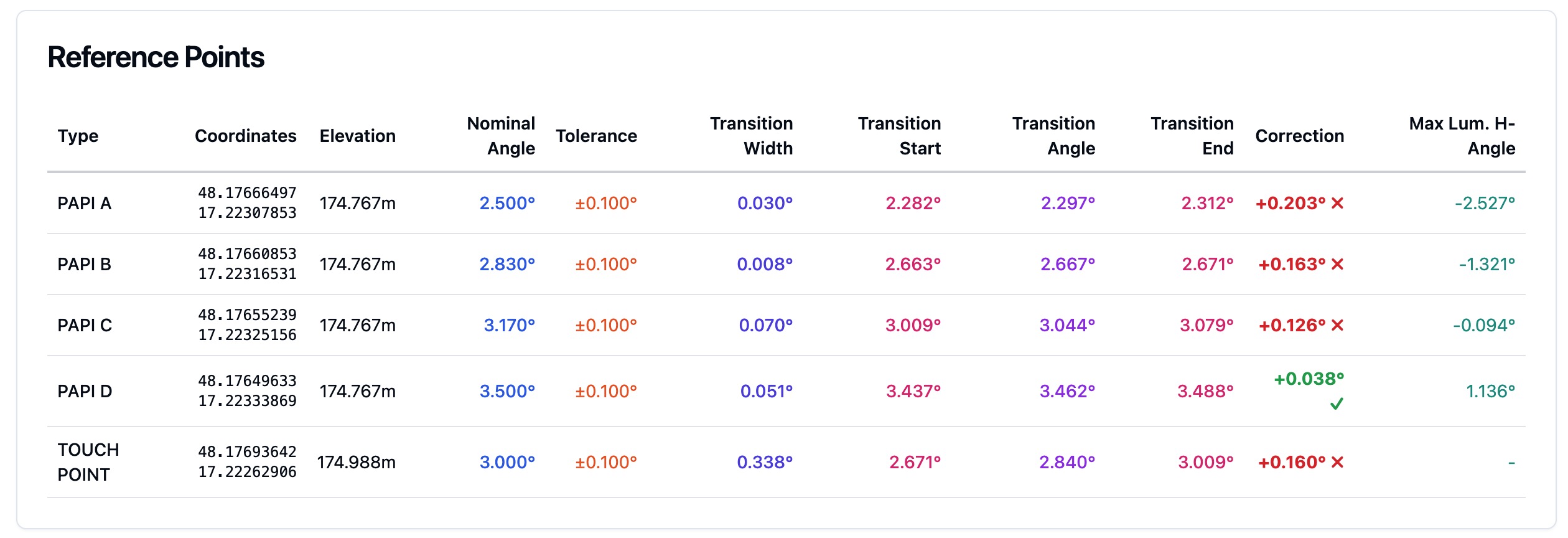
Measured transition angle per unit against its set angle. A finding names the unit, the direction and the size of the error.
Three ways to check a suspect PAPI
| Method | What it shows | Evidence produced | Where it stops |
|---|---|---|---|
| Waiting for the flight check aircraft | The PAPI as a crew sees it on the approach, checked for the correct slope and for compatibility with the ILS, alongside the approach and runway lighting | A flight inspection report from the organisation the authority recognises | The slot depends on the flight inspection schedule, so the PAPI may sit unverified between the report and the visit. It does not adjust anything either |
| Technician's clinometer or aiming device at the unit | Each box's setting angle against its datum, read with the device supplied for those units, following the manufacturer's procedure | A setting angle and date per unit in the maintenance log | It measures the box, not the beam. A misalignment between the optics and the datum plate can leave the box reading right while the crew sees it wrong |
| Drone measurement from the approach | The transition angle of each unit as the approach sees it, the spacing between units and the colour seen from each unit, flown between movements | A dated angle per unit with the source frames, known on site and reported afterwards | It does not adjust units, measure output in candela or test the electrical side. It does not replace a flight check where the authority requires one |
The fair reading of the table is that the clinometer and the drone answer two halves of one question. The clinometer is how the unit is set. The approach measurement is how the setting is proven. Flight inspection remains the authority’s check of the system as a whole, and where it is required after a change, it is still flown.
Governance and the record
Three layers of rule touch a PAPI finding, and it helps to keep them apart.
The EU maintenance rule. ADR.OPS.C.015(b) requires a preventive and corrective maintenance programme for the lights, and point (b)(9) sets the objective for a runway with visual approach slope indicators: during any period of operations, all units are serviceable. A unit counts as unserviceable when enough of its lights have failed that it no longer gives the intended guidance. Point (f) requires corrective action on identified defects, and (g) requires records. The acceptable means, AMC1 ADR.OPS.C.015(b) and (f), go further. Alignment is checked at defined intervals, taking account of conditions such as rain or drought, with additional checks after an aircraft occurrence. Errors in excess of one minute of arc should be corrected. A red filter that is missing, damaged or the wrong colour means its lights should be extinguished until it is fixed. A flight check of the lighting, including the PAPI, should be made at least yearly, with special flight checks after major maintenance or changes. The guidance material, GM1 to the same point, says setting angles are checked by angular measurement following the manufacturer’s instructions, and that a misalignment between the optics and the datum plate has to be found and corrected before the setting angles are adjusted.
The NOTAM rule. ADR.OPS.A.057(b) lists when the operator originates a NOTAM. The cases that touch a PAPI are point (5), the establishment, withdrawal or significant change of visual aids, and point (6), the interruption of, or return to operation of, major components of the lighting. Under (c)(2), a NOTAM for an unserviceability gives an estimate of how long it will last or when service is expected back. The guidance to point (b) lists cases where no NOTAM is originated, among them a partial lighting failure that does not directly affect aircraft operations. The rule does not mention an angle error by name. The NOTAM follows the operator’s decision about the PAPI, and the operator’s own procedure, agreed with its AIS provider, settles the cases in between. ICAO’s framework is the same in principle: Annex 14 2.9.1 and 2.13.1 require the operational status of aerodrome facilities to be reported to the aeronautical information service without delay.
Design and guidance. CS ADR-DSN.M.650 and Annex 14 5.3.5.36 to 5.3.5.41 set what the settings must achieve. The slope suits the aeroplanes using it, it conforms as closely as possible with the ILS glide path where there is one, a pilot seeing one white and three red clears all objects in the approach area by a safe margin, and corresponding units on two wing bars are set at the same angle. Annex 14 5.3.5.30 requires each unit’s red-to-white change to appear within no more than 3 minutes of arc to an observer 300 m or more away, and 5.3.5.34 requires each unit to be adjustable in elevation between 1°30′ and at least 4°30′. Annex 14 10.5.2 requires a system of preventive maintenance of visual aids, without PAPI-specific angle limits. ICAO Doc 9157 Part 4, in paragraphs 8.3.43 to 8.3.46, describes how an unmanned aircraft system can be used to check PAPI settings and notes that a State may require special authorisation. That is guidance on method. It is not a Standard, and it does not approve any particular drone.
In the United States, AC 150/5340-26C asks for a monthly check of each box’s aiming with the PAPI aiming instrument, with the angle and date recorded in a maintenance log (5.7.1.2), and describes the vertical adjustment by clinometer in 5.7.2.1. Table A-7 gives the vertical aiming tolerances. Paragraph 3.7 covers a lighting aid declared out of service after an accident: an as-found inspection, a retained record and the NOTAM cancelled once the aid is functional again.
Evidence and the honest limits
The measurement is strong where a PAPI finding needs it, and it is worth being plain about where it stops.
What it answers well
The transition angle is a geometry measurement. The drone’s position comes from RTK positioning, the unit’s position is surveyed, and the angle is the elevation at which the unit’s colour changes from red to white across many frames, not a single reading. Because it is geometry rather than brightness, it holds up when the result is challenged. It also covers every unit in one profile, so the finding names the unit and shows the pattern of all four together.
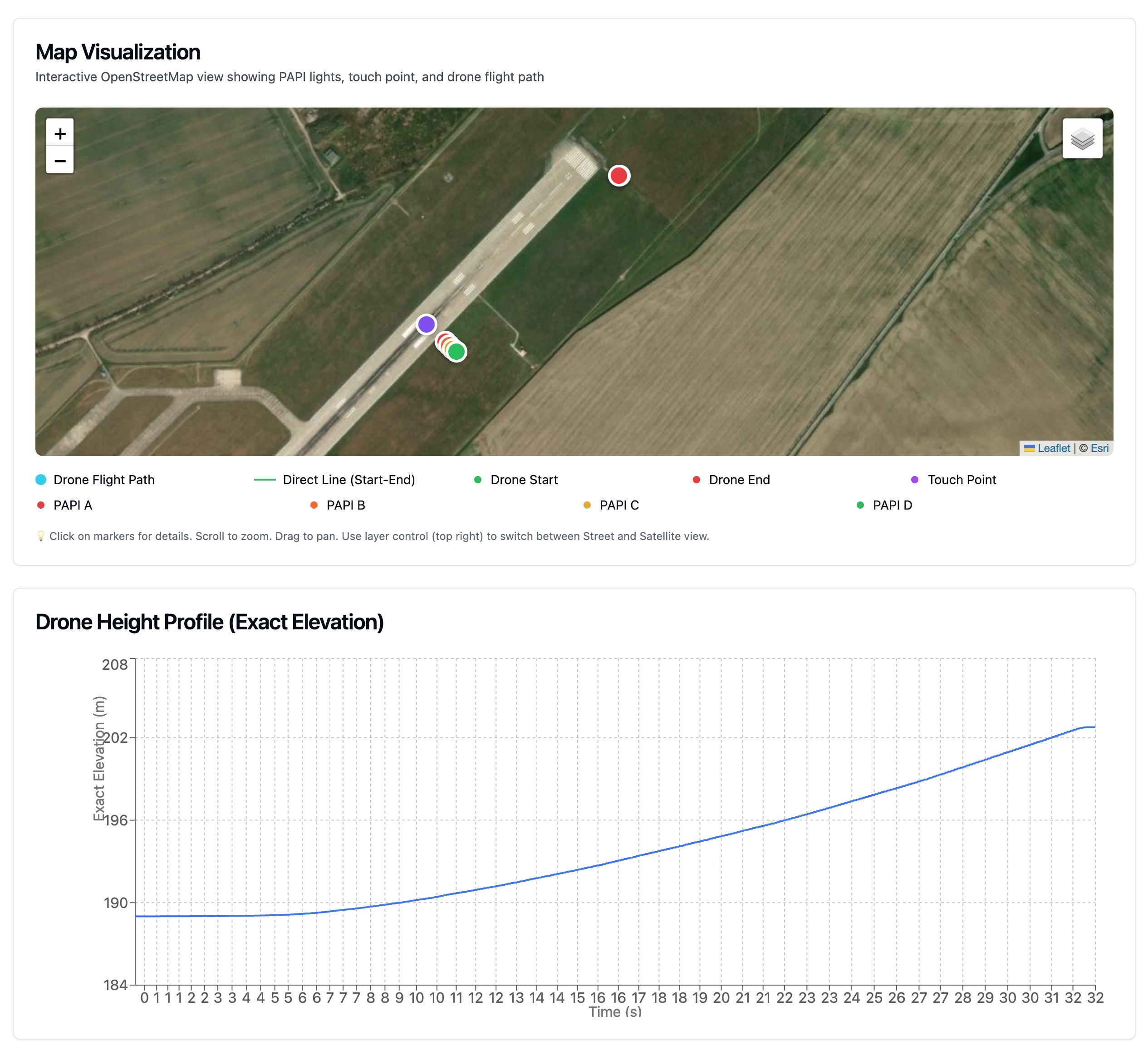
Transition angle per unit, fitted across the colour change rather than read from one frame. The same profile flown after the adjustment closes the finding.
What it does not answer
The drone does not adjust anything, and it does not certify the PAPI. It does not measure light output in candela, and it does not test lamps, the chromaticity coordinates of the filters, the regulator or the cabling. The PAPI has to be switched on at the step being checked, which is a request to the lighting control room. And it does not stand in for a flight check where the authority requires one after the PAPI has been changed. Its job is to make sure that when the aircraft does come, it is checking a PAPI that has already been confirmed and corrected.
Objections worth raising before you buy
“The flight check will catch it.” It will, at the next slot. A pilot report in between means the operator either leaves the PAPI in service on trust or switches it off and waits. A measurement from the approach shortens that wait to the time it takes to fly a profile.
“Our technician already has a clinometer.” Good, and the re-aiming will be done with it. The clinometer shows the box is set. It cannot show a misalignment between the optics and the datum plate, and it cannot show what the crew sees. The two together close the finding better than either alone.
“It is probably nothing.” Probably. The operator still has to say why, in writing, after a pilot report. A dated set of four angles within limit is a better answer than a technician’s assurance, and it takes less time to get.
“Our authority has not accepted drone methods.” Ask about the parameter, not the platform. The rules name what has to be checked and the limits it is judged against. Doc 9157 Part 4 describes unmanned aircraft as a way to check PAPI settings and notes that States may require special authorisation. The regulatory acceptance guide sets out what each authority says.
Related tasks
The PAPI inspection is the service this page draws on, with the full set of what is measured per unit. If the finding traces back to something under the approach, the PAPI protection surface check is the page for it. If a threshold has moved, the lighting checks after works cover the PAPI being set against the new geometry. For how a drone measurement and the flight check aircraft divide the work, see drone survey versus flight inspection . And for what a PAPI check costs, the PAPI calibration cost guide sets out the market as it stands.
Frequently Asked Questions
- What happens if a PAPI is out of tolerance and do we need a NOTAM?
- First, confirm it. Measure the transition angle of every unit and compare it with the set angle, so you know which unit is off and by how much. In the EU, the acceptable means of compliance say errors in excess of one minute of arc should be corrected. The NOTAM depends on what you then do. ADR.OPS.A.057(b) requires the operator to originate a NOTAM for significant changes to visual aids and for the interruption of, or return to operation of, major components of the lighting, and a NOTAM for an unserviceability has to give the expected restoration time. So if the PAPI is switched off or withdrawn while it is fixed, a NOTAM is originated. If a unit is slightly off and is corrected before it affects the guidance, it is a maintenance finding recorded in the file. Your own NOTAM procedure and your authority decide the cases in between.
- How do you verify PAPI transition angles in the field?
- Two ways, and they check different things. The technician uses the aiming device or clinometer supplied with the units to check each box's setting angle against its datum, following the manufacturer's procedure. That is how the unit is set. The second way is to look from the approach, where the crew is. A drone flies a vertical profile in front of the wing bar and records the height at which each unit changes from red to white, which gives the transition angle of each unit as the approach sees it. The flight check aircraft also checks the PAPI from the approach, as part of its scheduled programme.
- How far out does a unit have to be before it must be corrected?
- It depends on which framework you work under. In the EU, AMC1 ADR.OPS.C.015(b) and (f) says errors in excess of one minute of arc should be corrected. In the United States, AC 150/5340-26C Table A-7 gives each unit's vertical aiming tolerance as plus or minus 2 minutes at installation and plus or minus 6 minutes in operation, for a 3 degree glide path unless a local standard says otherwise. Your approved maintenance programme is the binding document, and it is worth reading which figure it has adopted.
- Can the technician re-aim the unit during the same visit?
- Yes. The angles are computed on site, on a laptop that runs offline at the field, so the technician can adjust a unit and the drone can measure it again before the team leaves. In practice the aerodrome is often not sure the PAPI is really wrong until it sees the numbers, so it calls its technicians after TarmacView reports the finding, and the re-check is flown once the units have been adjusted. Either way, TarmacView measures and does not adjust. The re-aiming is done by the aerodrome's technician or its lighting contractor.
- Does a drone measurement replace the flight check?
- No. In the EU, the acceptable means of compliance ask for a flight check of the lighting systems, including the PAPI, at least yearly, and for special flight checks after major maintenance or changes. Flight inspection checks the PAPI angles and the approach and runway lighting, and it checks the PAPI against the ILS. Where the authority requires it, it stays. What a drone measurement changes is the wait. A suspected fault can be confirmed and a fix re-measured within days of the report, without the PAPI sitting unverified until the next slot.
- Why would a PAPI unit go out of tolerance in the first place?
- Mostly because the ground or the box moved. The FAA maintenance circular asks for the aiming to be checked frequently whenever the soil freezes, thaws or changes moisture, especially in clay, and after any contact with mowing or farm equipment. EASA guidance names frost, heavy rain and drought as reasons to check more often where the ground is less stable. The guidance also warns that the optics inside a unit can be misaligned with its datum plate, and that the cause has to be found and corrected before anyone touches the setting angle.
References
- easa-ear-aerodromes
- Easy Access Rules for Aerodromes (Regulation (EU) No 139/2014), including CS-ADR-DSN Issue 7 European Union Aviation Safety Agency
- eu-139-2014
- Commission Regulation (EU) No 139/2014 laying down requirements and administrative procedures related to aerodromes Publications Office of the European Union
- icao-annex-14-v1
- Annex 14 to the Convention on International Civil Aviation, Volume I: Aerodrome Design and Operations International Civil Aviation Organization
- icao-doc-9157-p4
- Doc 9157, Aerodrome Design Manual, Part 4: Visual Aids International Civil Aviation Organization
- faa-ac-150-5340-26
- AC 150/5340-26C, Maintenance of Airport Visual Aid Facilities Federal Aviation Administration