ICAO Annex 14: Aerodrome Visual Aids and Their Maintenance
What ICAO Annex 14 Volume I says about aerodrome lighting: the visual aids in Chapter 5, power and monitoring in Chapter 8, and serviceability in Chapter 10.
- 01 Annex 14 binds Contracting States, not airports. An aerodrome meets it through national rules, which in the EU means Regulation (EU) No 139/2014 and CS-ADR-DSN.
- 02 Chapter 10 counts a light as unserviceable when its main beam average intensity falls below 50 per cent of the value in Appendix 2, or of a higher required value.
- 03 Serviceability objectives are set per system and per operation: CAT I, CAT II and III, and take-off in low visibility each have their own percentages and an adjacency rule.
- 04 The measurement interval is a Recommendation for CAT II and III runways only: at least twice a year for in-pavement lights and once a year for the others.
- 05 The objectives in 10.5 describe maintenance performance. By the Annex's own note, they do not decide whether a lighting system is operationally out of service.
On this page · 9 sections
Most airfield lighting requirements a European engineer works to trace back to one ICAO document. The lighting chapters of the national rules, CS-ADR-DSN in the EU and the FAA advisory circulars in the United States all share a lineage with Annex 14 Volume I, and much of the wording on serviceability is close to identical. This page reads the Annex as it bears on visual aids and on keeping them in service. Paragraph numbers are from the 9th edition, in the copy read for this page, which carries Amendment 18.
What Annex 14 is and who it binds
Annex 14 is one of the annexes to the Chicago Convention. Volume I covers aerodrome design and operations, and Volume II covers heliports. Its content is a set of Standards and Recommended Practices , and the foreword defines the difference. A Standard is a specification whose uniform application is necessary for safety or regularity, and Contracting States will conform to it. A State that cannot must notify ICAO under Article 38. A Recommended Practice is desirable, and States will endeavour to conform. In the text, a Recommended Practice carries the prefix “Recommendation” and a Standard uses “shall”. Notes, introductory notes and attachments explain or illustrate and are not part of the Standards or Recommended Practices. The appendices, and the tables and figures a specification refers to, do form part of them.
That structure decides who the Annex binds. It binds States. An aerodrome operator never signs up to Annex 14. It is bound by whatever national or regional rule the State uses to carry the Annex into law, and by any difference the State has filed.
How it reaches an EU aerodrome
In the European Union the carrying instruments are Regulation (EU) No 139/2014 and the certification specifications EASA issues under it. CS-ADR-DSN covers aerodrome design, with lights in Chapter M, electrical systems in Chapter S and the colours and isocandela diagrams in Chapter U. The maintenance obligation for visual aids is not in a CS at all. It is in the Regulation, at ADR.OPS.C.015, with acceptable means of compliance and guidance material beneath it. The sibling page on CS-ADR-DSN covers the EU texts in their own right.
The texts are close but not identical. The EU rule applies its stop bar and taxiway centre line objectives below 550 m runway visual range, where the 9th edition of the Annex says 300 m. The EU adds an objective for approach slope indicator units, which the Annex’s 10.5 does not have. It also adds a colour ground to the definition of an unserviceable light. Where the two differ, an EU aerodrome follows the EU text.
Chapter 5: the visual aids it specifies
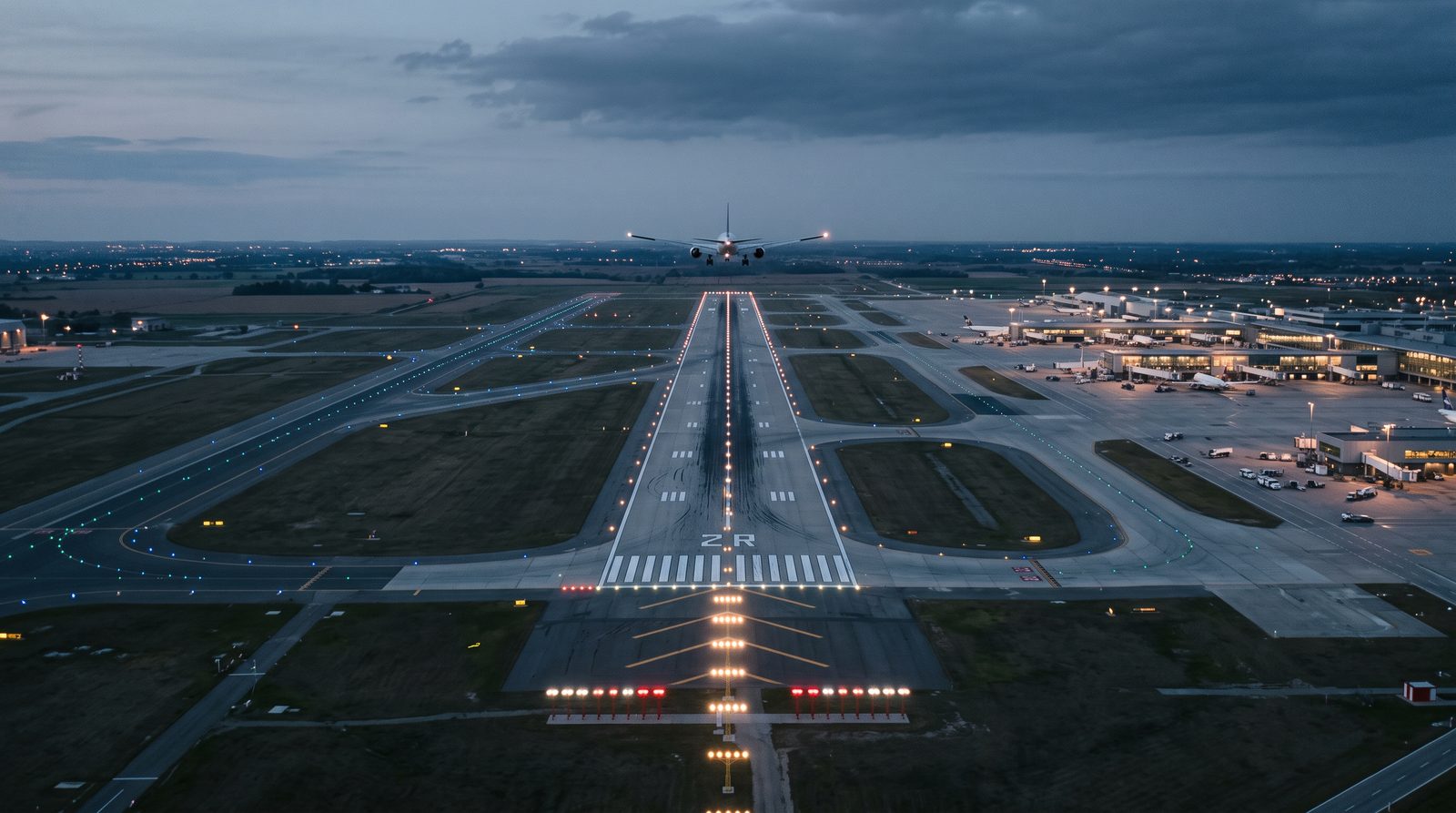
Section 5.3 is the lighting section. It specifies, system by system, what a light must be, where it goes and what it must emit. The systems that matter for runway operations are these:
- approach lighting systems (5.3.4), simple and precision category I, II and III
- visual approach slope indicator systems (5.3.5), including PAPI and APAPI from 5.3.5.24
- runway edge lights (5.3.9)
- runway threshold and wing bar lights (5.3.10) and runway end lights (5.3.11)
- runway centre line lights (5.3.12) and touchdown zone lights (5.3.13)
- taxiway centre line and edge lights (5.3.17 and 5.3.18)
- stop bars (5.3.20) and runway guard lights (5.3.23)
The same section also covers aeronautical beacons, circling guidance, runway status lights and apron lighting. For each light, the Annex sets a small number of characteristics. Colour is defined against the chromaticity limits in Appendix 1. Intensity and beam coverage are defined by the isocandela diagrams in Appendix 2, and each light type points to its own figure. Runway edge lights on a precision approach runway follow one figure, centre line lights another, PAPI units their own. No single intensity figure applies to every light.
A few general rules in 5.3.1 sit above the individual figures. Runway lighting intensity has to suit the minimum visibility and ambient light the runway is used in, and be compatible with the nearest section of the approach lights (5.3.1.9). A high-intensity system needs an intensity control, with separate controls or another method keeping the approach, edge, threshold, end, centre line, touchdown zone and taxiway centre line lights at compatible intensities (5.3.1.10). Inside the main beam, the maximum intensity may not exceed three times the minimum (5.3.1.11 and 5.3.1.12). That uniformity limit is one reason a measurement light by light matters more than a single reading per circuit.
This page deliberately does not reproduce spacing, colour coordinates or isocandela values. They are long, they changed with amendments, and in the EU the governing values are the ones in CS-ADR-DSN.
Chapter 8: power, switch-over and monitoring
Chapter 8 deals with the electrical side. A precision approach runway must have a secondary power supply that meets Table 8-1 for its category, with automatic connection on failure of the primary source (8.1.6). A runway used for take-off below 800 m RVR must have one too (8.1.7). For non-precision and non-instrument primary runways, secondary power is a Recommendation (8.1.8 and 8.1.9).
Switch-over time has a defined meaning in Chapter 1. It is the time for a light’s intensity, measured in a given direction, to fall from 50 per cent and recover to 50 per cent during a power changeover, with the light at 25 per cent intensity or above. The maximum times per system are in Table 8-1, as a Recommendation in 8.1.4.
Monitoring is in 8.3. Where lighting is used for aircraft control, it must be monitored automatically, with any fault affecting control relayed automatically to the air traffic services unit (8.3.2). The rest is Recommendations. An indication should appear within two seconds for a stop bar and five seconds for other visual aids (8.3.3). For runways used below 550 m RVR, the systems in Table 8-1 should be monitored so that the maintenance crew is told when any element falls below the serviceability levels of 10.5.7 to 10.5.11 (8.3.4). Chapter 8 is where the link between the electrical system and the Chapter 10 percentages is made.
Chapter 10: maintenance of visual aids
Chapter 10 opens with a Standard that every aerodrome needs a maintenance programme, including preventive maintenance where appropriate (10.1.1). A note makes clear that visual aids and electrical systems are among the facilities it covers. Section 10.5 then deals with visual aids specifically.
Annex 14 Chapter 10 at a glance
- Unserviceable light
- Main beam average intensity below 50 per cent of the Appendix 2 value, or of a higher value where one is required (10.5.1, Standard).
- Preventive maintenance
- A system of preventive maintenance of visual aids is required to ensure lighting and marking reliability (10.5.2, Standard).
- CAT II and III
- 95 per cent in the inner 450 m of the approach lights and in centre line, threshold and edge lights. 90 per cent in touchdown zone lights. 85 per cent in approach lights beyond 450 m. 75 per cent in runway end lights (10.5.7).
- CAT I
- At least 85 per cent in each of the approach lights, threshold, edge and runway end lights (10.5.10).
- Take-off below 550 m RVR
- 95 per cent in centre line (where provided) and edge lights, 75 per cent in runway end lights (10.5.11).
- Take-off at 550 m RVR or more
- 85 per cent in edge and runway end lights (10.5.12).
- Adjacency
- An unserviceable light may not sit next to another unserviceable light, with stated exceptions for barrettes and crossbars.
- Measurement interval
- Recommendation for CAT II and III only: at least twice a year for in-pavement lights and once a year for other lights (10.5.6).
When a light counts as unserviceable
Paragraph 10.5.1 gives the test, and it is photometric. A light is unserviceable when its main beam average intensity is below 50 per cent of the value in the appropriate Appendix 2 figure. Where a light unit is required to have a higher main beam average than Appendix 2 gives, the 50 per cent is taken from that higher value instead. A note points to Doc 9157 Part 4 for guidance on maintenance criteria and on using a site standard.
Two things follow. A lamp that is lit is not necessarily serviceable, and a daily visual check cannot tell the difference between a light at 60 per cent and one at 40 per cent. And the test is absolute. It is set against a figure in candela, so a measurement that shows a light is dimmer than its neighbours finds candidates but does not by itself prove the 50 per cent line has been crossed.
Serviceability objectives, system by system
The percentages in 10.5.7 to 10.5.12 are Standards, written as the objective of the preventive maintenance system. Each one names a type of operation and then sets a serviceability figure for each lighting system separately. None of them is a single figure for “the lights”.
For a precision approach runway in category II or III , the objective is that all approach and runway lights are serviceable during CAT II or III operations, and in any event at least the percentages in the table above. For category I , the objective is again all lights serviceable during CAT I operations, with at least 85 per cent in each of four systems. The take-off objectives depend on the runway visual range the runway is used in, with 550 m as the dividing line.
Two further objectives cover the ground movement side in low visibility. For a stop bar at a runway-holding position used with a runway for operations below 300 m RVR, the objective is no more than two unserviceable lights, and not two adjacent ones unless the spacing is much closer than specified (10.5.8). For a taxiway used below 300 m RVR, the objective is that no two adjacent unserviceable taxiway centre line lights are unserviceable (10.5.9). As noted above, the EU puts both at 550 m.
The adjacency rule
A percentage on its own would allow a run of dead lights. The Annex closes that off. For CAT II and III, the allowed failures may not alter the basic pattern of the system, and an unserviceable light may not be adjacent to another, except in a barrette or crossbar, where two adjacent failures are allowed. A note defines adjacent: consecutive within the same barrette or crossbar, or consecutive in the same row of edge lights or barrettes. For CAT I, adjacent failures are not allowed unless the spacing is significantly less than specified, and a note says guidance is not lost with two adjacent failures in a barrette or crossbar. Both take-off objectives forbid adjacent failures outright.
This is what turns a serviceability check into a positional one. Knowing that 4 of 120 edge lights are out is not enough. The record has to say which four.
What it recommends on measurement, and how often
On how to maintain, section 10.5 has one Standard. Paragraph 10.5.2 requires a system of preventive maintenance to ensure lighting and marking reliability. The detail is all Recommendations, and all of it is written for CAT II and III runways.
Paragraph 10.5.3 recommends at least three kinds of check: visual inspection with in-field measurement of intensity, beam spread and orientation of approach and runway lights, measurement of the electrical characteristics of each circuit, and a check that the intensity settings used by air traffic control work correctly. Paragraph 10.5.4 recommends measuring all lights, as far as practicable, against Appendix 2. Paragraph 10.5.5 recommends a mobile measuring unit accurate enough to analyse individual lights.
The interval is in 10.5.6. Measurement frequency should follow traffic density, local pollution, the reliability of the installed equipment and a continuing assessment of the measured results. In any event, it should be at least twice a year for in-pavement lights and at least once a year for other lights. For CAT I and visual runways the Annex sets no measurement interval. That is left to the State and to the operator’s programme, which is where the photometric measurement guide picks the question up.
The other notes to 10.5 concern LEDs. LED fittings lack the infrared heat of incandescent lamps, so they do not melt snow and ice the same way, and enhanced vision systems that rely on that heat signature need to be told when a system is converted. An operator moving to LED may need a changed maintenance schedule in winter.
Annex 14 next to the EU and US texts
The three frameworks answer the same questions in different places and with different force. The table compares where each one puts the maintenance and serviceability content, read from the 9th edition of the Annex, the March 2026 Easy Access Rules and AC 150/5340-26C.
Annex 14 compared with the EU and FAA texts on lighting maintenance
| Dimension | ICAO Annex 14 Vol I | EU: Reg 139/2014 and CS-ADR-DSN | US: FAA AC 150/5340-26C and Part 139 |
|---|---|---|---|
| Status | Standards and Recommended Practices under the Chicago Convention | Binding EU regulation, with certification specifications, AMC and GM beneath it | The AC is guidance, not mandatory in general but mandatory for projects funded through AIP or PFC. Part 139 (14 CFR) is federal regulation, and 139.311 covers marking, signs and lighting |
| Who it binds | Contracting States, which file differences under Article 38 | The aerodrome operator, for example in ADR.OPS.C.015 | Under 139.1, US airports serving scheduled passenger operations of air carrier aircraft with more than 9 seats, or unscheduled ones with at least 31 seats |
| Where serviceability lives | Chapter 10, 10.5.1 and 10.5.7 to 10.5.12, as Standards | The rule text itself, ADR.OPS.C.015(b) and (c) | Lights below 70 per cent of the AC 150/5345-46 minimum at full intensity are targeted for maintenance (5.3.2.1.2 and 5.3.4.1.3) |
| Unserviceable light | Main beam average below 50 per cent of the Appendix 2 value or a higher required value | Below 50 per cent of the CS value or of a higher design value, or a missing or damaged filter, or the wrong colour | No 50 per cent definition in the paragraphs read. The 70 per cent figure is a maintenance trigger |
| Measurement interval | Recommendation for CAT II and III: twice a year in-pavement, once a year others | AMC: the same for CAT II and III, photometric measurement at appropriate intervals on every runway type | Precision approach runways: not less than twice a year. Weekly checks of centre line lights may be needed on CAT II and III |
| Flight check | No flight check interval in Chapter 10 | AMC: flight check of the lighting at least yearly, and after major work | Not covered in the paragraphs read |
The EU column follows the Annex closely in substance. ADR.OPS.C.015(b) carries the same percentages as 10.5.7 to 10.5.12, and the AMC to points (b) and (f) carries the 10.5.3 to 10.5.6 recommendations almost word for word, including the twice-a-year and once-a-year interval. Where the EU goes further, it is in the AMC. Daily checks for light failures, breakage, gross misalignment and intensity control, and photometric measurement at appropriate intervals “irrespective of the runway type”. The FAA AC 150/5340-26 page covers the US checks schedule in its own terms.
Amendment 18 and the edition you are reading
The 9th edition came out in July 2022 and superseded all earlier editions on 3 November 2022. Amendment 18 was adopted on 28 March 2025 and became applicable on 27 November 2025, with some provisions applying from 26 November 2026 and 21 November 2030. The Annex’s own table of amendments lists its subjects, which include harmonised lighting requirements for CAT II operations, the main beam average intensity of lights, closed runway lighting and unserviceability signs.
The copy read for this page has Amendment 18 entered, and the Chapter 10 pages carry its date. A paragraph number or wording quoted from an older consolidation may no longer match. EASA has not yet transposed Amendment 18 into CS-ADR-DSN, so for now the EU text and the Annex can differ on live requirements. An EU operator should work from the EU text and watch the transposition.
Where a drone survey fits
None of these texts requires a drone, and none approves one. What they ask for is evidence: which lights are serviceable, where the unserviceable ones are, and, on CAT II and III runways, measured intensity, beam spread and orientation for as many lights as practicable. ICAO’s own visual aids manual, Doc 9157 Part 4 (5th edition, 2021), describes in 8.3.43 to 8.3.46 how an unmanned aircraft system can be used to check PAPI settings, and notes that a State may require special authorisation. It covers the angle settings, not photometry. That is guidance, not a Standard.
TarmacView’s airfield lighting inspection records each light in the approach, edge, threshold, end, centre line, touchdown zone and taxiway systems. For each unit it records whether the light is lit, whether its colour matches its position, its output relative to its neighbours and to the commanded dimming step, and an RTK-surveyed position. That covers the adjacency rule and the per-system percentage directly, because each failure has a place in the pattern. For PAPI it measures the transition angles. An absolute candela value against the 10.5.1 threshold needs a calibrated anchor, so relative output flags candidates rather than settling the 50 per cent question alone. The survey is flown between movements in coordination with the tower, without a closure.
It does not measure what 10.5.3 b) and Chapter 8 ask for on the electrical side: constant current regulator output, insulation resistance, secondary power switch-over or anything underground. Flight inspection checks the approach and runway lights as well as PAPI transition angles, and the two answer different questions. Whether a drone survey is accepted as part of a maintenance programme is for the State’s authority, and the regulatory acceptance guide sets out how to ask. For low-visibility runways, where the 10.5.7 objectives and the 10.5.6 interval bite hardest, see low visibility lighting serviceability .
Frequently Asked Questions
- Does Annex 14 say how often aerodrome lights must be measured?
- Only for precision approach runways of category II or III, and only as a Recommendation. Paragraph 10.5.6 of the 9th edition says the frequency should rest on traffic density, local pollution, equipment reliability and the trend of earlier results, and should in any event be at least twice a year for in-pavement lights and once a year for other lights. The Standard in 10.5.2 asks only for a system of preventive maintenance. For CAT I and visual runways the interval is left to the State and the operator's programme.
- What counts as an unserviceable light under Annex 14?
- Paragraph 10.5.1 deems a light unserviceable when its main beam average intensity is less than 50 per cent of the value in the relevant Appendix 2 figure. Where a light unit is required to have a higher main beam average intensity than Appendix 2 gives, the 50 per cent is taken from that higher value. The EU rule, ADR.OPS.C.015(c), adds a second ground: a missing or damaged filter, or a light that does not show the correct colour.
- Does Annex 14 bind an airport directly?
- No. Annex 14 is addressed to ICAO Contracting States. A State conforms to the Standards and must notify ICAO of any difference under Article 38 of the Chicago Convention, and it endeavours to conform to the Recommended Practices. An airport is bound by the national or regional rules that carry the Annex, which in the EU are Regulation (EU) No 139/2014 and the certification basis built from CS-ADR-DSN.
- What is the difference between Annex 14 and CS-ADR-DSN?
- Annex 14 is the ICAO baseline. CS-ADR-DSN is EASA's certification specification for aerodrome design, used to set the certification basis of an EU aerodrome, and the maintenance obligations sit in the Regulation itself at ADR.OPS.C.015. The texts track each other closely but are not identical. The EU rule applies its stop bar and taxiway centre line objectives below 550 m RVR where the 9th edition of the Annex says 300 m, and the EU adds a serviceability objective for approach slope indicator units.
- Does Annex 14 require flight inspection, or allow drones?
- Chapter 10 of the 9th edition does not set a flight check or name an instrument. It recommends in-field measurement with a mobile measuring unit of sufficient accuracy on CAT II and III runways. The EU AMC to ADR.OPS.C.015 recommends a flight check of the lighting at least yearly. ICAO's visual aids manual, Doc 9157 Part 4, mentions unmanned aircraft as one method for checking approach slope indicator settings. That is guidance, and no standard approves drones as such.
- What changed with Amendment 18?
- Amendment 18 to the 9th edition was adopted on 28 March 2025 and became applicable on 27 November 2025, with some provisions applying from 26 November 2026 and 21 November 2030. The Annex's own table of amendments lists, among its subjects, harmonised lighting requirements for CAT II operations and the main beam average intensity of lights. EASA has not yet transposed it into CS-ADR-DSN, so the EU texts and the Annex can differ on live requirements.
References
- icao-annex-14-vol-i
- Annex 14 to the Convention on International Civil Aviation, Aerodromes, Volume I: Aerodrome Design and Operations, 9th edition International Civil Aviation Organization
- easa-ear-aerodromes
- Easy Access Rules for Aerodromes (Regulation (EU) No 139/2014), including CS-ADR-DSN Issue 7 European Union Aviation Safety Agency
- faa-ac-150-5340-26c
- AC 150/5340-26C, Maintenance of Airport Visual Aid Facilities Federal Aviation Administration
- 14-cfr-part-139
- 14 CFR Part 139, Certification of Airports Federal Aviation Administration