What is Photometric Testing?
Photometric Testing – Comprehensive Glossary
Introduction
Photometric testing is the science and practice of measuring the visible light attributes of a source, as interpreted by the human visual system. Unlike radiometric measurements, which quantify all forms of electromagnetic radiation, photometric testing is weighted according to human eye sensitivity, ensuring that lighting systems deliver effective, efficient, and safe illumination in environments where human vision is critical.
For the airfield case, the step-by-step campaign is in the photometric measurement procedure for airfield lighting .
In the context of aviation, automotive, architectural, and industrial lighting, photometric testing ensures compliance with international standards (ICAO, CIE, ISO) and supports safety, quality, and regulatory requirements. This glossary provides a comprehensive overview of photometric testing principles, methods, instrumentation, and real-world applications.
Fundamentals of Photometry
Photometry is the measurement and quantification of light as perceived by the human eye, focusing exclusively on the visible spectrum (wavelengths 380–780 nm). Unlike radiometry, which measures all electromagnetic radiation regardless of its visibility, photometry applies the photopic luminosity function (V(λ)) to account for the variable sensitivity of the human eye to different wavelengths.
Key photometric quantities include:
- Luminous Flux (Φv): Total visible light emitted, measured in lumens (lm).
- Luminous Intensity (Iv): Light emitted in a particular direction per unit solid angle, measured in candelas (cd).
- Luminance (Lv): Perceived brightness of a surface from a specific viewpoint, measured in candelas per square meter (cd/m²).
- Illuminance (Ev): Amount of luminous flux incident on a surface per unit area, measured in lux (lx).
These quantities are defined by the International Commission on Illumination (CIE) and referenced in ICAO and ISO standards for regulatory and engineering purposes.
Photometric Quantities and Units
Photometric quantities allow for the objective assessment of lighting systems, using SI units:
- Luminous Flux (Φv): The total quantity of visible light, in lumens (lm). 1 lm = light emitted by a source of 1 candela in a 1 steradian solid angle.
- Luminous Intensity (Iv): Directional light output, in candelas (cd). 1 cd = 1 lm per steradian.
- Luminance (Lv): Surface brightness, in candelas per square meter (cd/m²).
- Illuminance (Ev): Incident light level, in lux (lx), where 1 lux = 1 lumen per square meter.
Luminous efficacy (lm/W) measures how efficiently a light source converts electrical power into visible light, while luminous efficiency expresses this as a percentage of the theoretical maximum (683 lm/W).
Human Eye Sensitivity and Visual Response
The human eye’s response to light is central to photometry, with sensitivity varying across the visible spectrum:
- Photopic Vision: Daylight vision, mediated by cone cells, peaks at 555 nm (green).
- Scotopic Vision: Night vision, mediated by rod cells, peaks at 507 nm (blue-green).
- Mesopic Vision: Transitional vision at dawn/dusk, a mix of rods and cones.
The photopic luminosity function (V(λ)) is the standard weighting curve for most lighting applications, ensuring that measurements reflect perceived brightness.
This sensitivity underpins why certain colors (e.g., green) are chosen for critical safety lighting in aviation and automotive applications.
Photometric Measurement Methods
Photometric testing employs standardized methods and mathematical relationships:
Transmission & Absorbance: Quantify how much light is transmitted or absorbed by a medium. Absorbance is logarithmic and directly related to concentration, per Lambert-Beer’s Law:
[ A = ελ \cdot c \cdot d ] where A = absorbance, ελ = molar absorption coefficient, c = concentration, d = path length.Calibration: Instruments must be calibrated against known standards to ensure traceability and accuracy.
Measurement Geometry: Proper setup (distance, angle, aperture) is critical for valid, reproducible results.
Advancements such as automated goniophotometry and spectroradiometry have increased the accuracy and speed of these measurements.
Photometric Instruments and Setups
Accurate photometric testing requires specialized instruments:
- Photometers: Measure illuminance, luminance, or intensity, often using optical filters matched to the human eye’s response.
- Spectrophotometers: Measure light intensity across wavelengths, essential for color and spectral analysis.
- Integrating Spheres: Provide uniform distribution of light for total luminous flux measurement, independent of emission direction.
- Goniophotometers: Map angular intensity distribution, critical for regulatory compliance in aviation and automotive lighting.
All instruments require regular calibration, traceable to national or international standards (e.g., NIST), as stipulated by ISO/IEC 17025.

Practical Applications and Use Cases
Photometric testing is essential in multiple sectors:
Aviation:
Testing ensures runway, taxiway, and approach lights meet ICAO/FAA standards for intensity, color, and distribution, vital for safe aircraft operations in all conditions.
Lighting Industry:
Manufacturers test lamps and luminaires for luminous flux, efficacy, color rendering, and chromaticity to meet international standards and optimize energy efficiency.
Display Technology:
Displays are tested for luminance, uniformity, and color accuracy, critical in aircraft cockpits and control towers.
Environmental & Water Analysis:
Photometric methods assess water quality by measuring absorbance after reagent addition, determining contaminant concentrations rapidly.
Medical Diagnostics:
Photometric assays measure concentrations of substances in biological fluids via colorimetric changes (e.g., ELISA tests).
Safety & Transport:
Photometric testing ensures compliance and safety for vehicle headlamps, traffic signals, and tunnel lighting.
Example – Aviation Runway Lighting:
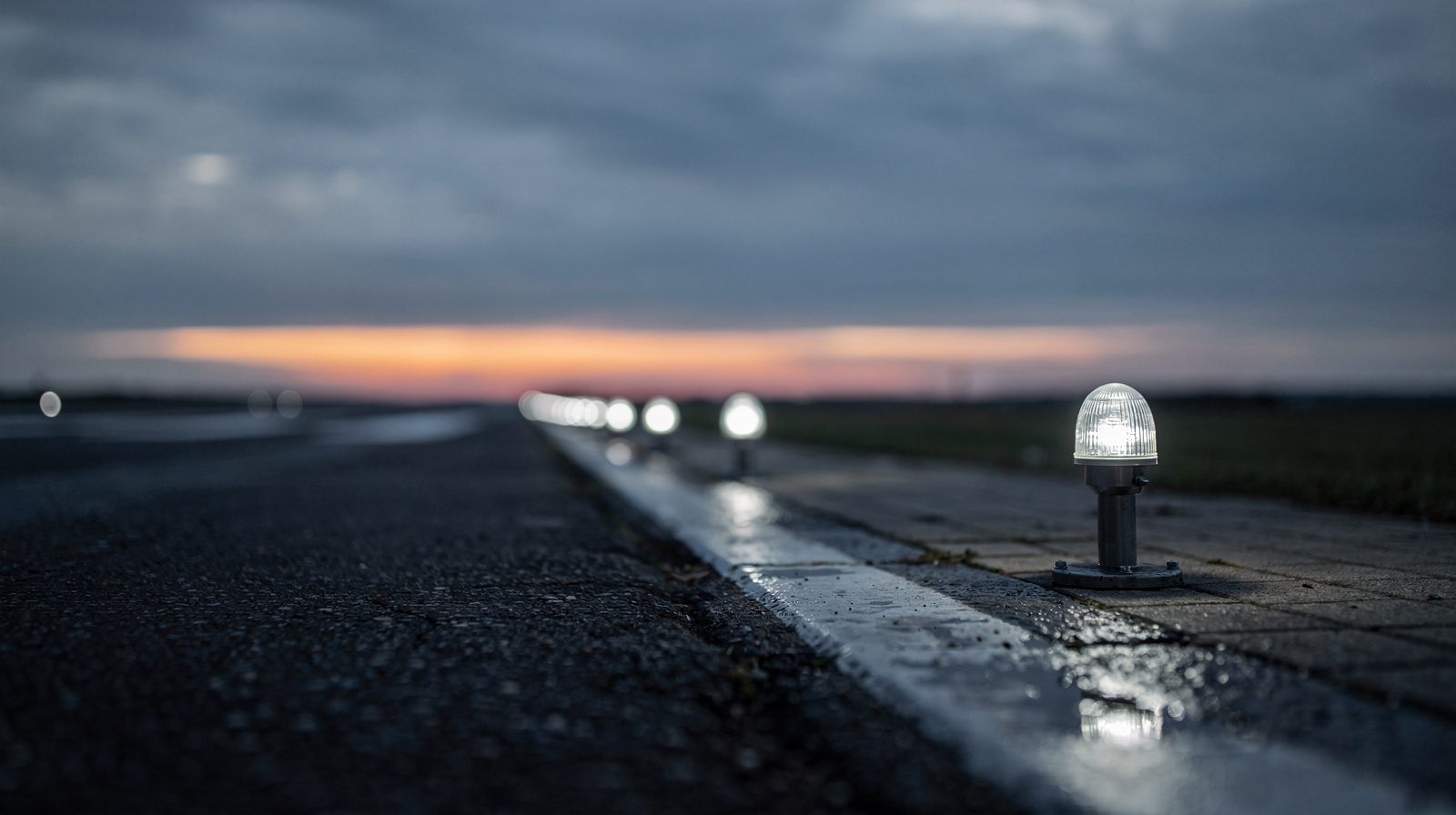
Each runway edge light is tested using a goniophotometer to ensure it meets ICAO standards for intensity and color. Only compliant fixtures are installed, ensuring safety and regulatory adherence.
Comparison: Photometry vs. Radiometry
| Aspect | Photometry | Radiometry |
|---|---|---|
| What is measured? | Visible light, weighted by eye sensitivity | All electromagnetic radiation |
| Spectral range | 380–780 nm (visible) | UV, visible, IR, etc. |
| Reference function | Luminosity function, V(λ) | None |
| Units | Lumen, candela, lux, cd/m² | Watt, W/m², W/sr, W/m²/sr |
| Typical applications | Human-centric lighting | Energy transfer, remote sensing |
Photometric testing is used for lighting humans interact with, while radiometry is for scientific and technical applications outside human vision.
Common Photometric Formulas
Luminous Flux (Φv): [ Φ_v = 683 \int_{380}^{780} V(\lambda) , Φ_{e,λ}(\lambda) , d\lambda ] where (Φ_{e,λ}(\lambda)) is the spectral radiant flux at wavelength λ.
Luminous Intensity (Iv): [ I_v = \frac{dΦ_v}{dΩ} ] where dΩ is the differential solid angle (steradian).
Luminance (Lv): [ L_v = \frac{d^2Φ_v}{dA \cdot dΩ \cdot \cosθ} ] where dA is area, θ is angle from normal.
Conclusion
Photometric testing is vital for ensuring lighting systems are effective, efficient, and safe in any application where human vision is critical. By measuring and reporting light attributes in terms meaningful to our visual perception, and following rigorous international standards, photometric testing delivers the data needed for compliance, product development, and ongoing safety assurance in aviation, industry, and beyond.
If you need to ensure your lighting systems meet regulatory requirements or seek expert guidance on photometric testing, contact us or schedule a demo today.
Frequently Asked Questions
- What is photometric testing used for?
- Photometric testing measures how light sources perform as perceived by the human eye, focusing on parameters like intensity, color, distribution, and efficiency. It is crucial for ensuring lighting systems in aviation, automotive, architectural, and industrial applications meet regulatory and safety standards, such as those outlined by ICAO and CIE.
- What are the main photometric quantities?
- The main photometric quantities include luminous flux (lumens), luminous intensity (candelas), luminance (cd/m²), and illuminance (lux). Each assesses a different aspect of light relevant to human vision, with standards defining how they are measured and reported.
- How does photometric testing differ from radiometric testing?
- Photometric testing measures only visible light, applying a weighting function that matches the human eye’s sensitivity. Radiometric testing measures all electromagnetic radiation (including UV and IR) without regard to human perception. Photometry is used for lighting applications affecting humans, while radiometry is used for energy and scientific applications.
- Why is calibration important in photometric testing?
- Calibration ensures that photometric instruments give accurate, traceable results, matching national or international standards. It is vital for regulatory compliance and guarantees that lighting systems are tested reliably and reproducibly.
- What equipment is used in photometric testing?
- Common equipment includes photometers, spectrophotometers, goniophotometers, and integrating spheres. Each instrument serves specific measurements: photometers for intensity and illuminance, spectrophotometers for spectral data and color, integrating spheres for total flux, and goniophotometers for angular distribution.
This is a reference entry. TarmacView provides drone inspection services and doesn't sell the equipment or materials described in this glossary.