What is Luminance?
Luminance – Glossary and Deep Dive
Luminance is the cornerstone photometric quantity for assessing how bright a surface, display, or light source appears to a human observer. It is defined as the luminous intensity (in candelas) emitted, reflected, or transmitted from a surface per unit area in a given direction. Luminance is a directional and area-based measurement, making it the go-to metric for applications where visibility, safety, and legibility are paramount, such as in aviation, display technology, lighting design, and visual ergonomics.
Luminance forms the bridge between the physical measurement of light and the perceptual experience of brightness. It is the key value for evaluating runway lights, cockpit displays, signage, and any visual signal where the observer’s viewpoint and the surface orientation both matter.
SI Units, Formulae, and Parameters
Luminance is measured in candelas per square meter (cd/m²), also called a nit in display contexts.
Mathematical Definition
[ L_v = \frac{d^2\Phi_v}{dA \cdot d\Omega \cdot \cos\theta} ]
- (L_v): Luminance (cd/m²)
- (d^2\Phi_v): Differential luminous flux (lm)
- (dA): Differential area (m²)
- (d\Omega): Differential solid angle (sr)
- (\theta): Angle between surface normal and observation direction
Or alternatively: [ L_v = \frac{I_v}{A_{proj}} ]
- (I_v): Luminous intensity (cd)
- (A_{proj}): Projected area = (A \cos\theta)
Key Photometric Quantities
| Quantity | Symbol | SI Unit | Description |
|---|---|---|---|
| Luminous flux | Φv | lumen (lm) | Total visible light emitted |
| Luminous intensity | Iv | candela (cd) | Light per unit solid angle in a given direction |
| Illuminance | Ev | lux (lx) | Light arriving at a surface per unit area |
| Luminance | Lv | cd/m² (nit) | Intensity per unit area in a direction (source) |
ICAO and CIE standards specify that luminance must be measured and reported in cd/m², with observer geometry and environmental conditions strictly defined.
Physical Principles and Measurement
Luminance quantifies the spatial and angular distribution of visible light leaving a surface, whether by emission, reflection, or transmission. It is inherently directional and based on the cosine law, which accounts for how surfaces appear dimmer when observed at oblique angles.
Conservation of Luminance
In a lossless, non-scattering medium, luminance along a ray remains constant regardless of distance, an essential property for aviation lighting, as pilots must recognize signals from afar.
Measurement Techniques
- Spot luminance meters: Measure small areas, ideal for displays and signage.
- Imaging photometers: Capture spatial luminance distributions over scenes, useful for complex environments.
All instruments are calibrated to match the photopic response of human vision (the V(λ) curve), so measurements correspond to perceived brightness.
Human Perception
The human eye adapts to luminance across a vast range, from starlight ((~10^{-6}) cd/m²) to sunlight on snow ((10^8) cd/m²). However, glare, adaptation, and contrast influence perceived brightness, so both absolute and relative luminance are regulated in safety-critical applications.
Distance Invariance
For extended (non-point) sources, luminance remains constant with distance, a property vital for the design of runway and taxiway lighting.
Typical Luminance Values and Aviation Examples
Luminance values span many orders of magnitude in real-world settings:
| Example | Luminance (cd/m²) |
|---|---|
| Sun (at zenith) | 1.6 × 10⁹ |
| Tungsten lamp filament | 1 × 10⁷ |
| Full Moon (clear atmosphere) | 2,500 |
| White paper under office lighting (500 lx) | ~130 |
| Typical LCD monitor (standard brightness) | 200–350 |
| Premium smartphone display (peak) | 900–2,000 |
| Organic LED (maximum tested) | 31,000 |
| Candle flame | 1,000–2,000 |
| Overcast sky | 1,000–5,000 |
| Taxiway centerline light (ICAO min. at 6°) | 200–400 |
| Runway threshold bar (ICAO min.) | 5,000–10,000 |
Aviation Applications:
- Runway/taxiway lighting: ICAO standards require minimum and maximum luminance values. For instance, runway edge lights must reach at least 2,000 cd/m² for visibility in all conditions.
- Cockpit displays: Must achieve high luminance (often >1,000 cd/m²) for daylight readability.
- Signage: Emergency and informational signs require regulated luminance for legibility during power failure or heavy smoke.
Relationship to Other Photometric Quantities
Luminance is central in photometry:
| Quantity | Formula | SI Unit | Description |
|---|---|---|---|
| Luminous flux (Φv) | – | lumen (lm) | Total visible light output |
| Luminous intensity (Iv) | Φv / dΩ | candela (cd) | Light per unit solid angle |
| Illuminance (Ev) | Φv / A | lux (lx) | Light received per unit area |
| Luminance (Lv) | Iv / A_proj or as above | cd/m² (nit) | Intensity per unit area in a direction |
Radiometry vs. Photometry
Radiance is the radiometric counterpart, measured in W·sr⁻¹·m⁻² (all wavelengths). Luminance restricts measurement to visible light, weighted by human sensitivity.
Luminance vs. Illuminance
| Aspect | Luminance (Lv) | Illuminance (Ev) |
|---|---|---|
| What it measures | Brightness as seen from a direction | Light incident on a surface |
| SI unit | cd/m² (nit) | lux (lm/m²) |
| Source/receiver? | Source property | Receiver property |
| Example | Display brightness, signage | Runway surface, desk |
Special Topics and Advanced Considerations
Luminance and Surface Properties
- Emission: Displays, LEDs, and lamps have luminance set by design and operating current.
- Reflection: Markings, signs, and panels reflect incident light, their luminance depends on both illuminance and reflectance.
- Transmission: Backlit signs and displays transmit light, with luminance determined by transmitted intensity and area.
Surface Types
- Lambertian (diffuse): Uniform luminance in all directions, typical for matte surfaces.
- Specular (glossy): Luminance varies with angle, relevant for evaluating glare.
Luminance Factor and Reflectance
- Luminance Factor: The ratio of a sample’s luminance to that of a perfect reflecting diffuser under the same conditions, used to quantify markings and coatings.
- Reflectance ((\rho)): For diffuse surfaces, (L = E \times \rho / \pi).
Solid Angle and Projected Area
- Solid angle ((d\Omega)): 3D angular extent for measurement, in steradians.
- Projected area ((A_{proj})): Apparent area as seen by observer, (A \cos\theta).
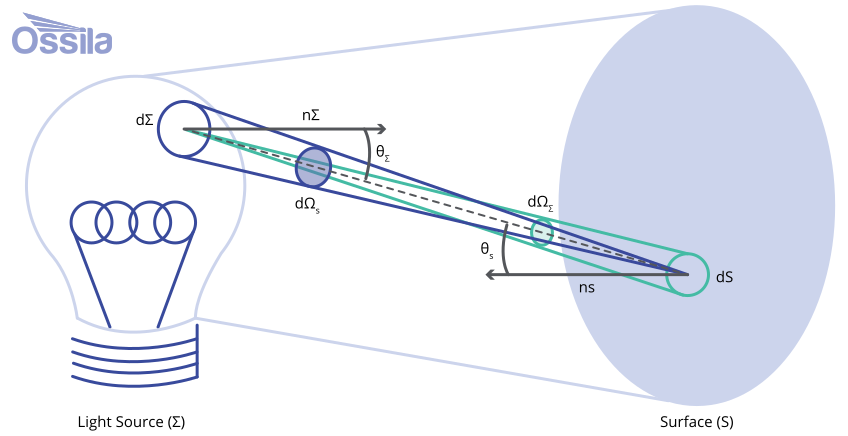
Illustrative Diagrams
Key Elements:
- (dA): Surface area element
- (d\Omega): Solid angle
- (\theta): Angle between surface normal and observer
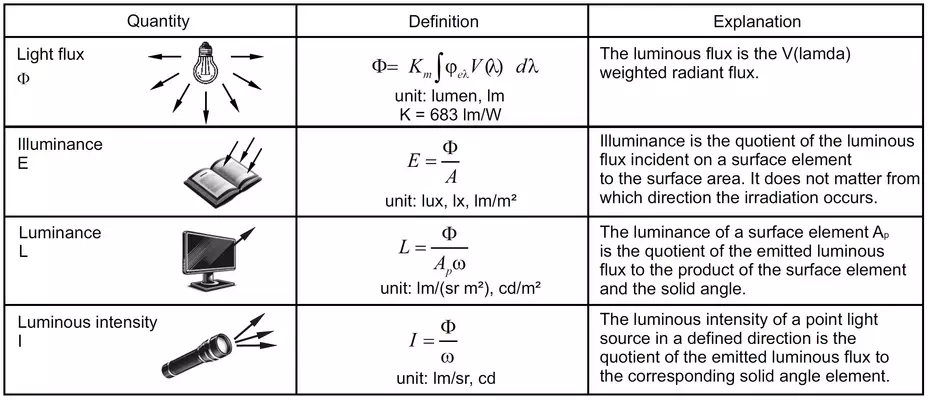
This diagram shows the relationships among luminous flux, intensity, illuminance, and luminance.
Glossary Quick Reference
| Term | Definition | SI Unit |
|---|---|---|
| Luminance | Luminous intensity per unit area in a direction | cd/m² (nit) |
| Luminous intensity | Luminous flux per unit solid angle | candela (cd) |
| Luminous flux | Total visible light output | lumen (lm) |
| Illuminance | Luminous flux incident on a surface | lux (lx) |
| Radiance | Radiometric equivalent of luminance | W·sr⁻¹·m⁻² |
| Nit | Common name for cd/m² | cd/m² |
| Reflectance | Fraction of light reflected | (dimensionless) |
| Luminance factor | Luminance ratio to reference white | (dimensionless) |
Summary Table: Typical Luminance Values
| Object / Source | Luminance (cd/m²) |
|---|---|
| Sun (at zenith) | 1.6 × 10⁹ |
| Incandescent lamp filament | 1 × 10⁷ |
| Full Moon (clear night) | 2,500 |
| White paper under office lighting | 130 |
| Standard LCD monitor | 200–350 |
| High-brightness smartphone display | 900–2,000 |
| Organic LED (max tested) | 31,000 |
| Candle flame | 1,000–2,000 |
| Overcast sky | 1,000–5,000 |
Luminance is the definitive metric for quantifying and specifying brightness, whether for aviation safety, electronic displays, or architectural lighting. It is foundational to standards, design, and human visual experience. For advice on measurement, compliance, or optimization of luminance in your application, contact our experts .
Frequently Asked Questions
- What is luminance?
- Luminance is the photometric measure of visible light intensity per unit area in a specific direction, representing how bright a surface or display appears to the human eye. It is measured in candelas per square meter (cd/m²), also called a nit in display technology.
- Why is luminance important in aviation?
- Luminance is crucial in aviation to ensure that runway and taxiway lighting, cockpit displays, and signage are visible and readable under all conditions. ICAO Annex 14 sets strict luminance requirements for safety and navigation.
- How is luminance measured?
- Luminance is measured using a luminance meter or spot photometer, which records the intensity of light per unit area in a given direction, typically calibrated to the human eye’s photopic response.
- What is the difference between luminance and illuminance?
- Luminance is a property of a surface or emitter, indicating its brightness as seen from a particular direction. Illuminance, measured in lux, is the amount of light arriving at a surface, indicating how much it is lit.
- How does luminance relate to human perception?
- Luminance closely matches human brightness perception. Displays and lighting are specified by luminance to ensure they are readable and comfortable for users across various lighting conditions.
- Does luminance decrease with distance?
- No, the luminance of an extended source remains constant with distance as long as the object is resolved by the eye. This property is critical for aviation signals and runway lights.
- What are typical luminance values for common objects?
- The sun at zenith is about 1.6 × 10⁹ cd/m², a computer monitor is typically 200–350 cd/m², white paper under office lighting is ~130 cd/m², and ICAO minimum runway threshold bars are 5,000–10,000 cd/m².
This is a reference entry. TarmacView provides drone inspection services and doesn't sell the equipment or materials described in this glossary.