What is background luminance?
Background Luminance in Aviation and Photometry
Background luminance is a foundational concept in aviation, lighting design, and photometry, playing a pivotal role in the visibility, legibility, and safety of visual information. Whether it’s the edge lights on a runway, cockpit displays, or airport signage, understanding and managing background luminance is essential for both human performance and regulatory compliance.
Definition and Photometric Context
Background luminance quantifies the luminous intensity per unit area emitted or reflected by surfaces surrounding a visual target, from a specific viewing direction. It is measured in candela per square meter (cd/m²). Crucially, it is the background, not the target itself, that determines how visible and legible a signal, display, or light source will be to the human observer.
In aviation, background luminance is central to the assessment of:
- Cockpit displays
- Airfield signage
- Runway and taxiway lighting
- Control tower panels and windows
The International Civil Aviation Organization (ICAO) and other regulatory bodies set strict luminance standards to ensure that visual cues remain discernible under a variety of ambient conditions, day, night, fog, snow, or rain.
Physical Principles and Human Visual Response
Human vision is relative: we perceive objects not by their absolute brightness, but by their brightness in contrast to their background. This is encapsulated by Weber’s Law, which states that the just-noticeable difference in luminance is proportional to the background luminance.
When the background is bright, a signal must be much brighter to be seen, when it is dark, only a small difference is needed. The human eye adapts through visual adaptation, the retina adjusts to prevailing luminance, affecting visual acuity, comfort, and reaction times.
- High background luminance can cause disability glare, making it harder to see signals or displays.
- Low background luminance can cause afterimages or discomfort if the target is too bright.
Mathematical Formulation
The core formula for luminance ((L)):
[ L = \frac{d^2\Phi_v}{dA_p \cdot d\Omega} ]
Where:
- (L): Luminance (cd/m²)
- (d^2\Phi_v): Differential luminous flux (lumens)
- (dA_p): Projected area (m²)
- (d\Omega): Solid angle (steradians)
Luminance contrast ((C)), the key metric for visibility, is:
[ C = \frac{L_t - L_{bg}}{L_{bg}} ]
- (L_t): Target luminance
- (L_{bg}): Background luminance
Example Table
| Visual Scenario | Target Luminance (cd/m²) | Background Luminance (cd/m²) | Contrast (C) |
|---|---|---|---|
| Daytime runway sign | 300 | 100 | 2.0 |
| Night taxiway light | 8 | 0.8 | 9.0 |
| Foggy approach light | 50 | 25 | 1.0 |
Measurement Techniques
Accurately measuring background luminance involves:
- Luminance meters (photometers): Spot measurement devices, often telescopic.
- Imaging luminance meters: Calibrated cameras mapping luminance across a scene.
- Spectroradiometers: For color- and spectrum-sensitive applications.
Best Practice Steps:
- Define the measurement region (excluding the target).
- Align the instrument perpendicular to the surface.
- Shield from stray light/reflections.
- Take multiple readings for accuracy.
Field Example:
Real-World Aviation Applications
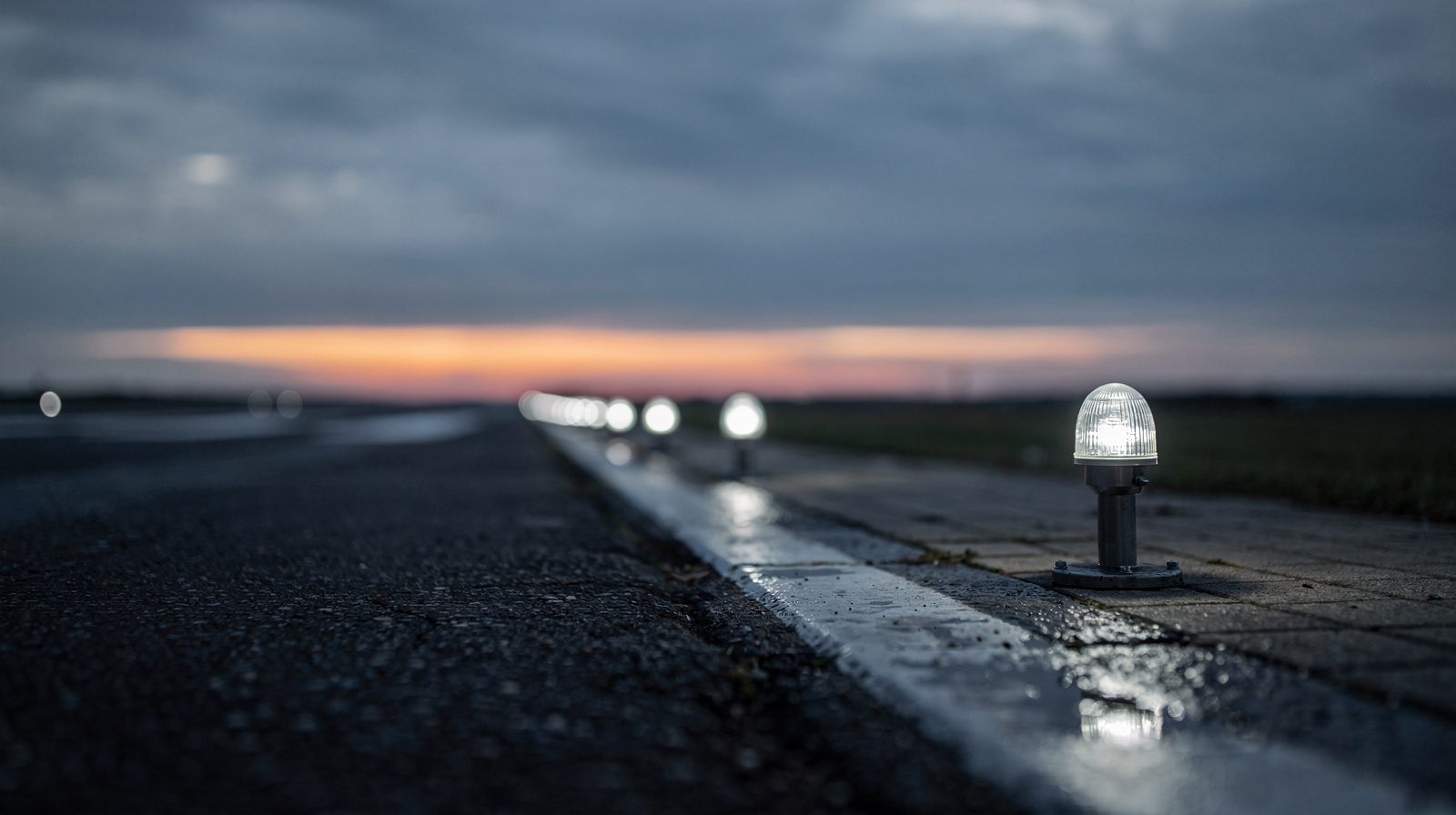
- Airfield Lighting: Ensuring runway/taxiway lights are visible against backgrounds of grass, asphalt, snow, or concrete, day or night.
- Cockpit Displays: Calibrating displays so they remain legible against varying cockpit backgrounds under sunlight or darkness.
- Signage: Guaranteeing that airport and heliport signs remain readable under shifting ambient and background luminance.
- Visual Guidance: Adaptive lighting systems modulate output based on measured background luminance, vital in fog, rain, or snow.
- Control Towers: Interior lighting is designed to minimize reflections and maintain optimal background luminance for controllers.
Comparison with Related Terms
| Concept | Unit | What It Measures | Where Used |
|---|---|---|---|
| Luminance | cd/m² | Light emitted/reflected per area | Displays, signage, lighting |
| Background Luminance | cd/m² | Light from the area around a target | Lighting, aviation, displays |
| Illuminance | lux (lm/m²) | Light received per area | Lighting design, safety |
| Luminous Flux | lumen | Total emitted visible light | Lamps, lighting |
| Luminous Intensity | candela | Light in a given direction | Signal lights, beacons |
| Brightness | (subjective) | Perceived visual intensity | Human factors, ergonomics |
Standards and Regulatory Framework
- ICAO Annex 14: Minimum/maximum luminance for airfield lighting and signage.
- FAA AC 150/5340-30: Measurement and maintenance procedures.
- EN 12464-1: Indoor lighting requirements (e.g., control towers).
- CIE Publications: International standards on lighting and photometry.
Factors Influencing Background Luminance
- Surface reflectance: Light-colored or snow-covered surfaces have much higher background luminance.
- Lighting conditions: Sunlight, artificial lighting, and weather (cloud, fog, rain).
- Surface texture: Wet or glossy surfaces increase specular reflection and glare.
- Obstructions/shadows: Buildings, aircraft, and vehicles create local luminance variation.
- Atmospheric scattering: Fog, dust, and precipitation can elevate background luminance by scattering light.
Human Factors and Ergonomics
- Contrast thresholds: Pilots and controllers need higher target luminance when the background is bright.
- Visual ergonomics: Proper luminance balance reduces fatigue and error rates.
- Glare management: Lighting design and anti-glare coatings prevent dangerous reflections.
- Safety: Poor background luminance management can cause missed signals or slower responses.
Practical Aviation Examples
1. Runway Edge Light at Night
- Target: 8 cd/m², Background: 0.5 cd/m²
- Contrast: (8-0.5)/0.5 = 15
- Result: Excellent visibility for pilots.
2. Apron Sign in Sunlight
- Target: 350 cd/m², Background: 150 cd/m²
- Contrast: (350-150)/150 = 1.33
- Result: Marginal visibility, may need adjustment.
3. Cockpit Display at Night
- Target: 60 cd/m², Background: 2 cd/m²
- Contrast: (60-2)/2 = 29
- Result: Display is clear and comfortable.
Measurement Challenges and Solutions
| Situation | Recommended Approach |
|---|---|
| Daytime, bright sun | Use shading hoods, polarization filters |
| Nighttime, low light | Increase integration time, avoid stray light |
| Mixed lighting | Take multiple readings, use HDR imaging |
- Dynamic lighting: Use HDR imaging and multiple samples.
- Instrument calibration: Follow ICAO/CIE protocols.
- Continuous monitoring: Automated logging systems.
Summary Table: Aviation Values
| Application | Target Luminance (cd/m²) | Background Luminance (cd/m²) | Ideal Contrast Ratio |
|---|---|---|---|
| Runway edge lights | 10 – 20 | 0.5 – 2 | >5 |
| Taxiway signs | 200 – 400 | 30 – 100 | >2 |
| Cockpit displays | 30 – 100 | 2 – 20 | >3 |
| Tower consoles | 100 – 300 | 30 – 80 | >2 |
Industry Insights and Trends
- Adaptive Lighting: Modern systems adjust light output in real time based on measured background luminance.
- Human-Centered Design: New cockpits and towers feature adjustable lighting and anti-glare surfaces.
- Emerging Technologies: OLED panels and dynamic glass modulate background luminance for comfort and safety.
- Ongoing Research: Adaptive photometry for anticipatory lighting control.
Downloadable Resources
Conclusion
Background luminance is a critical, measurable factor in visibility, safety, and efficiency across aviation and photometric applications. Its careful measurement and control ensure that displays, lights, and signage remain visible under all conditions, supporting safety and optimal human performance.
For technical details, consult ICAO Annex 14, CIE publications, or lighting design handbooks.
Frequently Asked Questions
- Why is background luminance important in aviation?
- Background luminance directly impacts the visibility and legibility of critical visual cues such as runway lights, taxiway signs, and cockpit displays. Maintaining appropriate background luminance ensures that these cues remain visible in varying lighting and weather conditions, thereby supporting operational safety.
- How is background luminance measured?
- Background luminance is measured using photometric instruments such as luminance meters or imaging luminance devices. Measurements are performed by targeting the area surrounding the visual target, following established procedures to ensure accuracy and consistency as recommended by authorities like ICAO and CIE.
- What are typical background luminance values in aviation?
- | Environment | Typical Background Luminance (cd/m²) | |--------------------------|--------------------------------------| | Night, unlit area | 0.003 – 0.01 | | Taxiway edge (night) | 0.5 – 2 | | Apron (day, concrete) | 100 – 300 | | Snow-covered runway | 500 – 2,000 |
- How does background luminance affect contrast and visibility?
- The contrast between a visual target and its background, calculated as (Target Luminance - Background Luminance) / Background Luminance, determines how easily the target can be detected. High background luminance can reduce this contrast, making targets harder to see, especially in safety-critical environments.
- Are there standards regulating background luminance in aviation?
- Yes. ICAO Annex 14, FAA Advisory Circulars, and CIE publications specify luminance requirements and measurement methods for various aviation applications, ensuring visibility of lights, signage, and displays under operational conditions.
This is a reference entry. TarmacView provides drone inspection services and doesn't sell the equipment or materials described in this glossary.