What is Illuminance?
Illuminance: The Complete Glossary for Aviation, Architecture, and Engineering
Definition
Illuminance (symbol: E) is a photometric quantity that measures the total luminous flux (Φ) incident on a given surface area (A). In simple terms, it quantifies how much visible light falls onto a specific surface, regardless of what the surface does with that light. The SI unit for illuminance is lux (lx):
[ E = \frac{\Phi}{A} ]
- E = Illuminance (lux, lx)
- Φ = Luminous flux (lumens, lm)
- A = Area (square meters, m²)
1 lux (lx) = 1 lumen (lm) per square meter (m²)
Illuminance is strictly photometric, it is weighted by the human eye’s response to visible wavelengths, making it directly relevant to human visual tasks.
Illuminance in Photometry
Photometry deals with measuring visible light as perceived by human vision. Illuminance is one of the core photometric quantities:
| Quantity | Symbol | SI Unit | Description |
|---|---|---|---|
| Luminous Flux | Φ | lumen (lm) | Total visible light emitted by a source |
| Illuminance | E | lux (lx = lm/m²) | Amount of light incident on a surface |
| Luminous Intensity | I | candela (cd) | Light emitted in a specific direction |
| Luminance | L | cd/m² | Brightness of a surface in a specific direction |
Illuminance measures light arriving at a surface, making it the basis for nearly all lighting standards and regulations in workplaces, aviation, and architecture.
Measurement of Illuminance
Instruments
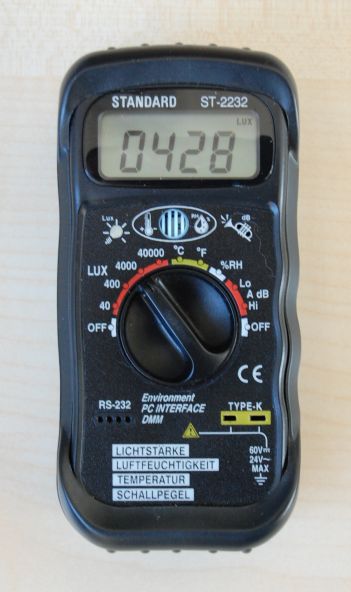
Illuminance is measured using luxmeters or photometers fitted with:
- A photodiode sensor
- Filters matching the human eye’s spectral sensitivity (CIE V(λ) curve)
- Cosine diffusers for accurate angular response
Calibration is essential for accuracy, professional meters are referenced to national or international standards.
Procedure
- Place the sensor parallel to the surface being measured (usually at working height)
- Avoid shadows or reflections from the operator
- Orient the sensor towards the main light source or keep it horizontal for general lighting
- Ensure all relevant lights are on and conditions are stable
Instrument Classes
| Class | Tolerance | Usage |
|---|---|---|
| A | ±5% | Laboratory, calibration, reference measurements |
| B | ±10% | Field, compliance, technical lighting design |
| C | ±20% | Indicative, education, non-critical measurements |
Class A/B meters are required for professional and regulatory work.
Calculation of Illuminance
General Formula
[ E = \frac{\Phi}{A} ]
Point Source
For a point source emitting flux Φ:
[ E = \frac{\Phi}{4\pi d^2} ]
Where d is the distance from the source.
Using Luminous Intensity
[ E = \frac{I}{d^2} ]
Where I is luminous intensity (candela) and d is distance.
Angle of Incidence (Lambert’s Cosine Law)
[ E = \frac{I \cdot \cos\theta}{d^2} ]
Where θ is the angle between the light and surface normal.
Additivity
Total illuminance from multiple sources is the sum of each source’s contribution:
[ E_{\text{total}} = \sum_{i=1}^n E_i ]
Typical Illuminance Values
| Environment / Task | Illuminance (lx) | Notes |
|---|---|---|
| Direct sunlight | 100,000 | Outdoor, midday |
| Overcast daylight | 10,000–20,000 | Outdoor, cloudy |
| Office work | 500 | Reading, writing |
| Technical drawing | 750 | High visual acuity |
| Fine assembly | 1,000 | Precision manufacturing |
| Archives, storage | 200 | Minimal visual task |
| Retail sales area | 300 | Customer visibility |
| Checkout area | 500 | Enhanced accuracy |
| Living room | 100–300 | Home environment |
| Full moon (clear night) | ~1 | Outdoor, moonlight |
| Starlight | ~0.001 | Outdoor, no moon |
Based on EN 12464, ASR A3.4, ICAO, and industry guidelines.
Standards and Recommendations
Office and Workplace (EN 12464-1)
| Task / Area | Minimum Illuminance (lx) |
|---|---|
| Filing, copying | 300 |
| Writing, reading, data processing | 500 |
| Technical drawing | 750 |
| Fine assembly | 1,000 |
| Canteens, break rooms | 200 |
| Archives | 200 |
| Sales area | 300 |
| Checkout | 500 |
Aviation (ICAO Annex 14, FAA AC 150/5370-2G)
- Apron floodlighting: ≥ 20 lx at pavement
- Runway markings: 50–100 lx on markings
- Maintenance hangars: 500–1,000 lx
Surrounding areas must meet at least half the mean illuminance of task areas. These standards ensure safety and minimize eye strain.
Applications
- Lighting Design: Determines luminaire number/type for compliance and comfort
- Regulatory Compliance: Proof of adequate lighting for audits and certifications
- Quality Assurance: Verifies ongoing performance as lamps age or layouts change
- Scientific Research: Sets standard lighting for experiments
- Architecture/Daylighting: Balances daylight and artificial lighting for efficiency and comfort
Illuminance vs. Related Quantities
| Quantity | Definition | SI Unit | Use Case |
|---|---|---|---|
| Illuminance | Light arriving at a surface | lux (lx) | Lighting design |
| Luminance | Brightness of a surface (reflected/emitted) | cd/m² | Visual appearance |
| Irradiance | Total radiant power per area (not weighted) | W/m² | Physics, plant growth |
| Luminous Intensity | Flux per solid angle in a direction | candela (cd) | Source specification |
- Illuminance is about light received by a surface.
- Luminance is about the brightness of a surface as seen from a direction.
- Irradiance is total power (not eye-weighted).
- Luminous Intensity is a source’s directional output.
Technical Laws
Inverse Square Law
[ E = \frac{I}{d^2} ]
Illuminance decreases with the square of the distance from a point source.
Lambert’s Cosine Law
[ E = \frac{I \cdot \cos\theta}{d^2} ]
Illuminance is highest when light strikes perpendicularly.
Best Practices for Measurement
- Use a calibrated, class A or B luxmeter
- Position the sensor parallel to the surface and facing main light sources
- Minimize operator shadows/reflections
- Measure under representative lighting conditions (include daylight if relevant)
- Use additive principle for multiple light sources
- Rely on objective measurement, visual estimation is unreliable
Common Misconceptions
- Illuminance is not “brightness”: Brightness is subjective, illuminance is objectively measured.
- Luminance ≠ Illuminance: Luminance depends on both illuminance and surface reflectivity.
- Smartphone apps are not accurate for professional use.
- More light is not always better: Excessive illuminance can cause discomfort and glare.
Summary
Illuminance is the key photometric quantity for assessing and designing lighting in aviation, architecture, and engineering. It ensures that environments are safe, comfortable, and meet regulatory requirements. Accurate measurement and understanding of illuminance are critical for quality lighting solutions.
For expert guidance on illuminance assessments and lighting design, contact us or schedule a demo .
Frequently Asked Questions
- What is the difference between illuminance and luminance?
- Illuminance measures the amount of light arriving at a surface (in lux) and is independent of the surface’s properties. Luminance measures how bright a surface appears from a specific direction (in cd/m²), it depends on both the incident illuminance and the surface’s reflectivity.
- How is illuminance measured in practice?
- Illuminance is measured using a calibrated luxmeter or photometer, which has a sensor matching the eye’s sensitivity curve (V(λ)) and cosine correction. The sensor is placed at the surface of interest, oriented properly, and measurements are taken under stable lighting conditions.
- Can I use my smartphone to measure illuminance?
- No. Smartphone sensors lack calibration, cosine correction, and accurate spectral sensitivity matching. Only professional luxmeters provide reliable measurements for regulatory or design purposes.
- How does distance from a light source affect illuminance?
- Illuminance from a point source drops with the square of the distance (inverse square law). If you double the distance from a source, the illuminance decreases to one quarter.
- What are typical illuminance recommendations for aviation and offices?
- Aviation: Cockpit panels 150–300 lx, maintenance bays 500–1,000 lx, apron areas 20–50 lx. Offices: General tasks 300–500 lx, technical drawing 750 lx, fine assembly 1,000 lx. Refer to EN 12464-1, ICAO Annex 14, and local standards for specifics.
- Why is illuminance important in design?
- Proper illuminance ensures safety, comfort, and productivity. It helps prevent accidents, eye strain, and errors, and is required by workplace and aviation regulations.
This is a reference entry. TarmacView provides drone inspection services and doesn't sell the equipment or materials described in this glossary.