What is Photometric Accuracy?
Photometric accuracy is the closeness of agreement between a measured photometric quantity, such as luminous intensity, and its true value.
Photometric quantities
Photometry measures light as the human eye responds to it. The eye response is the photopic function V(λ). It is normalized to 1 at its peak, which is at 555 nm (NIST SP 250-95, section 1.1). These are the common quantities:
- Luminous intensity in a given direction. The unit is the candela (cd).
- Luminous flux. The unit is the lumen (lm), equal to cd sr.
- Illuminance. The unit is the lux (lx), equal to lm/m2.
- Luminance. The unit is cd/m2.
The candela is defined by fixing the luminous efficacy of radiation at 540 × 10^12 Hz to 683 lm/W. In standard air, 540 × 10^12 Hz is a wavelength of 555.016 nm (NIST SP 250-95, section 1.1).
What accuracy means
The International Vocabulary of Metrology defines measurement accuracy as the closeness of agreement between a measured value and a true value. Accuracy is not a quantity and has no numerical value. A measurement is more accurate when its measurement error is smaller.
Accuracy is not precision, and it is not trueness. A result carries a measurement uncertainty . The VIM defines this as a non-negative parameter that characterizes the dispersion of the values attributed to the measurand. NIST states its photometric uncertainties as an expanded uncertainty with a coverage factor k = 2. In NIST’s worked example, a lamp has 1079 cd with an expanded uncertainty of 6.4 cd, or 0.60 % (NIST SP 250-95, section 3.5.5).
What limits photometric accuracy
A photometric result depends on the instrument, the light and the set-up. These are the main limits.
- Calibration and traceability. A result is traceable if it relates to a reference through a documented unbroken chain of calibrations. Each calibration adds to the uncertainty. Traceability does not show that the uncertainty is small enough for the purpose (VIM 2.41, definition and note 5).
- Spectral match. A photometer must respond to light like V(λ). The index f1’ describes how well it does. If the match is poor, the error depends on two spectra. These are the spectrum of the light measured and the spectrum of the calibration lamp. A correction factor can remove this error when both spectra are known (NIST SP 250-95, section 3.4.3).
- Distance. A photometer measures illuminance, and the intensity follows from it and the distance. A real lamp may not follow the inverse square law exactly, so NIST includes this in its uncertainty budget (NIST SP 250-95, section 3.5.4).
- Lamp supply. In NIST’s example, the lamp voltage and the lamp current are uncertainty components (NIST SP 250-95, section 3.5.5, Table 9). The FAA gives an example at a maximum output of 6.6 A at the lamp. A 1 percent change in current can change the light output by as much as 5 percent (AC 150/5340-26C, section 4.0).
- Alignment. The FAA says a hand held spot meter detects only gross differences and cannot account for alignment errors (AC 150/5340-26C, paragraph 4.1.12).
LED lights and the spectral match
The EMPIR RevStdLED report D5 says that good incandescent calibration sources are becoming harder to obtain. Both the devices under test and the calibration sources may soon be LED-based. The report finds that the reliability of the f1’ index depends on two spectra. These are the spectrum of the device under test and the spectrum of the calibration lamp. It also finds that an LED calibration source can decrease the expected error.
Photometric checks of airfield lights
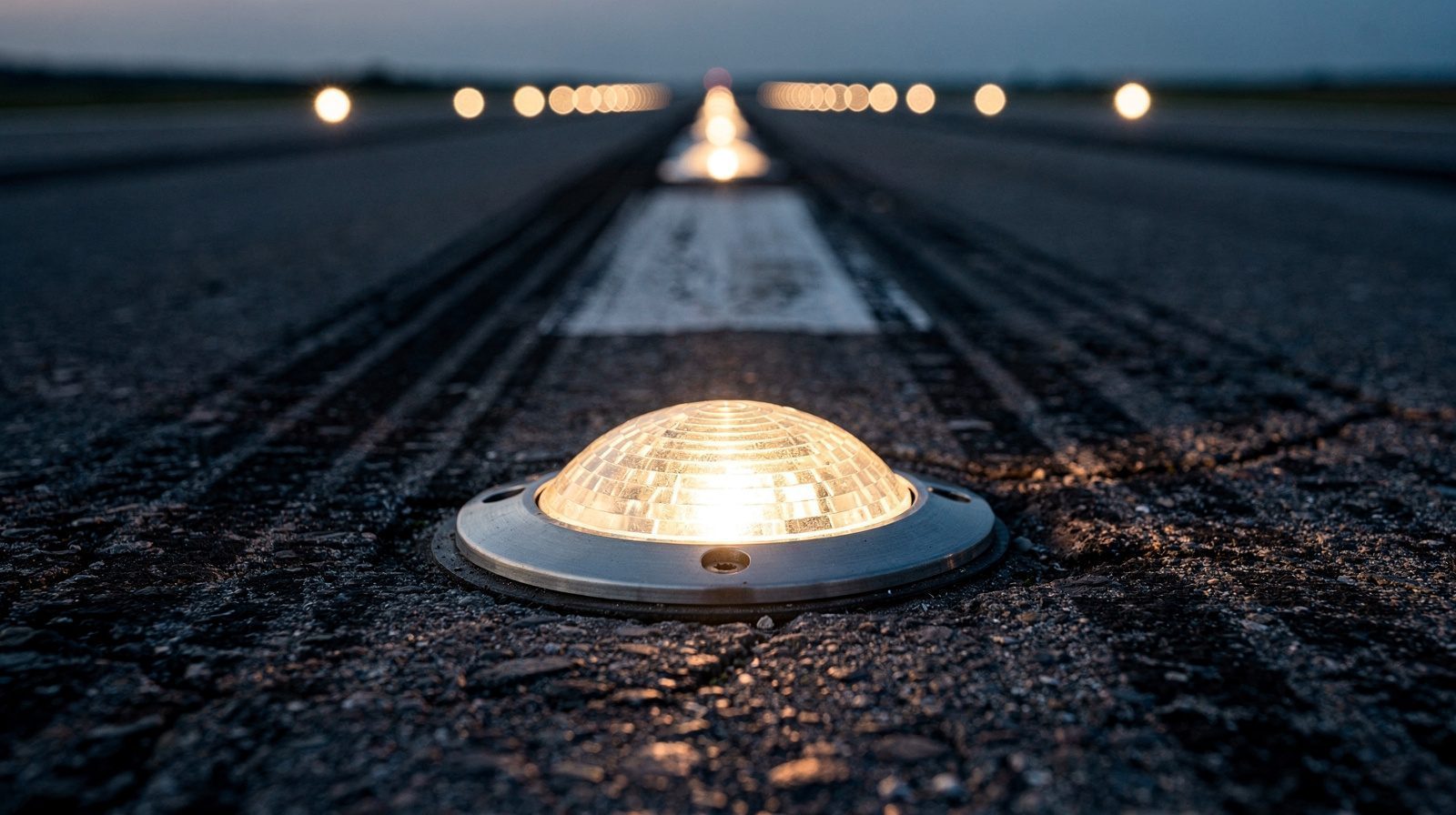
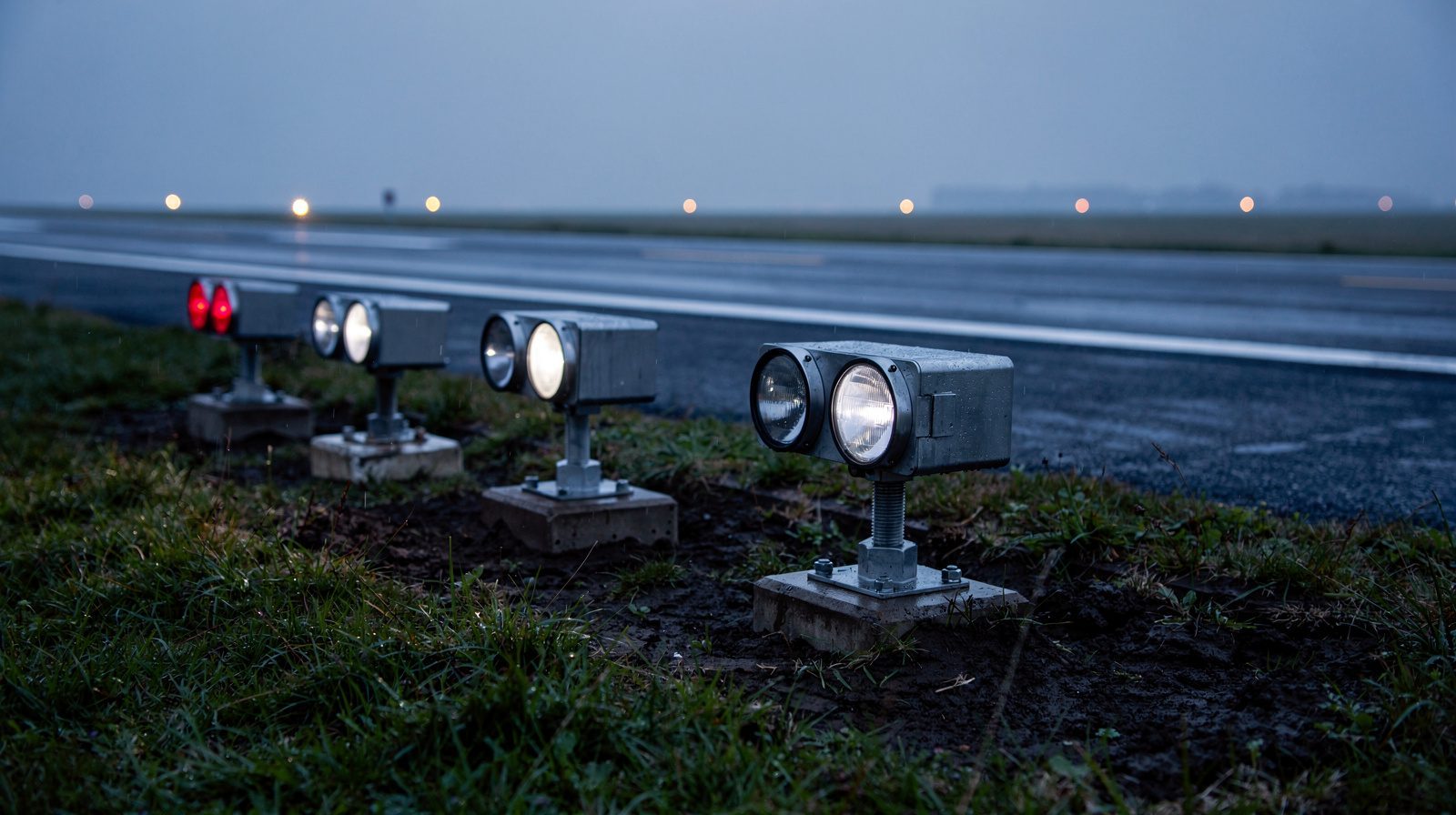
In the EU, the aerodrome operator should ensure the serviceability of lights by photometric measurements at appropriate intervals (EASA AMC1 ADR.OPS.C.015 (b) and (f)). This applies irrespective of the runway type. It is a photometric testing task in the maintenance programme.
For a precision approach runway of category II or III, the checks include in-field measurement of intensity, beam spread and orientation. The measurement should use a unit of sufficient accuracy to analyse the individual lights. It should happen at least twice a year for in-pavement lights and at least once a year for other lights. This applies to the approach and runway lights.
The FAA gives a similar minimum. For a precision approach runway, the frequency of measurement should not be less than twice a year. The FAA also says to test before and after cleaning, re-lamping or realignment (AC 150/5340-26C, paragraph 5.3.2.1.2). For its equipment, it asks for the highest quality and proven high accuracy and repeatability (paragraph 4.1.12).
Why accuracy matters at the limit
EASA classes a light with an output below 50 per cent of the specified intensity as failed (GM1 ADR.OPS.C.015 (b) and (c)). CS ADR-DSN.U.940 gives the figures for each light. The FAA targets a light for maintenance when its output is below 70 percent of the minimum that AC 150/5345-46 requires at maximum intensity. The measured value is compared with this specification, so measurement error affects the result. A light that reads near the limit can fall on either side of it if the measurement is not accurate.
What a drone adds
An absolute value in candela needs a calibrated photometer. TarmacView does not report candela today. It compares each light with its neighbours and with the commanded dimming step. The guide to photometric measurement of airfield lighting describes a full photometric run.
Frequently Asked Questions
- What is photometric accuracy?
- Photometric accuracy is the closeness of agreement between a measured photometric quantity, such as luminous intensity, and its true value. A measurement is more accurate when its measurement error is smaller. Accuracy itself has no numerical value.
- Is photometric accuracy the same as precision?
- No. The International Vocabulary of Metrology says that accuracy should not mean trueness, and that precision should not mean accuracy. Accuracy is, however, related to both concepts. A measurement is more accurate when its measurement error is smaller.
- What is photometric testing of airfield lights?
- It is the measurement of what a light emits, such as its intensity, beam spread and orientation. The result is compared with the specification. EASA AMC1 ADR.OPS.C.015 says the aerodrome operator should ensure the serviceability of lights by photometric measurements at appropriate intervals.
- Do EU rules require photometric measurements of airfield lights?
- EASA AMC1 ADR.OPS.C.015 (b) and (f) says the aerodrome operator should ensure the serviceability of the lights by photometric measurements. The measurements are part of the maintenance programme, at appropriate intervals. The text says should, not shall. It fixes no interval for most runways, but it fixes a minimum for a category II or III runway.
- Why can a photometer read wrongly on LED light?
- A photometer is meant to respond to light in the same way as the photopic V(λ) function of the human eye. If its response differs, the error depends on the spectrum of the light measured and on the spectrum of the lamp that calibrated it. The mismatch index f1' describes how well the response fits V(λ).
- How accurate must a photometer be for airfield lights?
- The EASA and FAA texts named on this page give no percentage. EASA says to use a measuring unit of sufficient accuracy to analyse the individual lights. The FAA says the equipment must be of the highest quality and proven capable of high accuracy and repeatability.
- What is photometric data?
- Photometric data are measured values of photometric quantities, such as the luminous intensity at each angle. Some mobile photometric systems for runway lights show them as an isocandela diagram of each light.
- Can a drone measure the photometric accuracy of airfield lights?
- No. An absolute value in candela needs a calibrated photometer. TarmacView does not report candela today. It compares each light with its neighbours and with the commanded dimming step.
References
- bipm-candela
- SI base unit: candela (cd) BIPM
- bipm-si-brochure-9
- The International System of Units (SI Brochure), 9th edition (2019) BIPM
- cie-eilv-luminance
- CIE S 017:2020, ILV: International Lighting Vocabulary, 2nd edition, entry 17-21-050 luminance CIE
- jcgm-vim-2-13
- International Vocabulary of Metrology (VIM), JCGM 200, entry 2.13 measurement accuracy JCGM / BIPM
- jcgm-vim-2-26
- International Vocabulary of Metrology (VIM), JCGM 200, entry 2.26 measurement uncertainty JCGM / BIPM
- jcgm-vim-2-41
- International Vocabulary of Metrology (VIM), JCGM 200, entry 2.41 metrological traceability JCGM / BIPM
- nist-sp-250-95
- NIST Special Publication 250-95, Photometric Calibrations NIST
- ptb-revstdled-d5
- 19NRM02 RevStdLED, Report D5: Evaluation of a complementary general V(λ) mismatch index EMPIR RevStdLED / PTB
- easa-ear-aerodromes
- Easy Access Rules for Aerodromes (Regulation (EU) No 139/2014), Issue March 2026 EASA
- faa-ac-150-5340-26c
- AC 150/5340-26C, Maintenance of Airport Visual Aid Facilities (2014) FAA
This is a reference entry. TarmacView provides drone inspection services and doesn't sell the equipment or materials described in this glossary.