How Often Does Airfield Lighting Need Photometric Testing?
How often airfield lighting is photometrically tested: no Part 139 interval, a twice-yearly floor on precision runways, monthly FAA tables and what a test is.
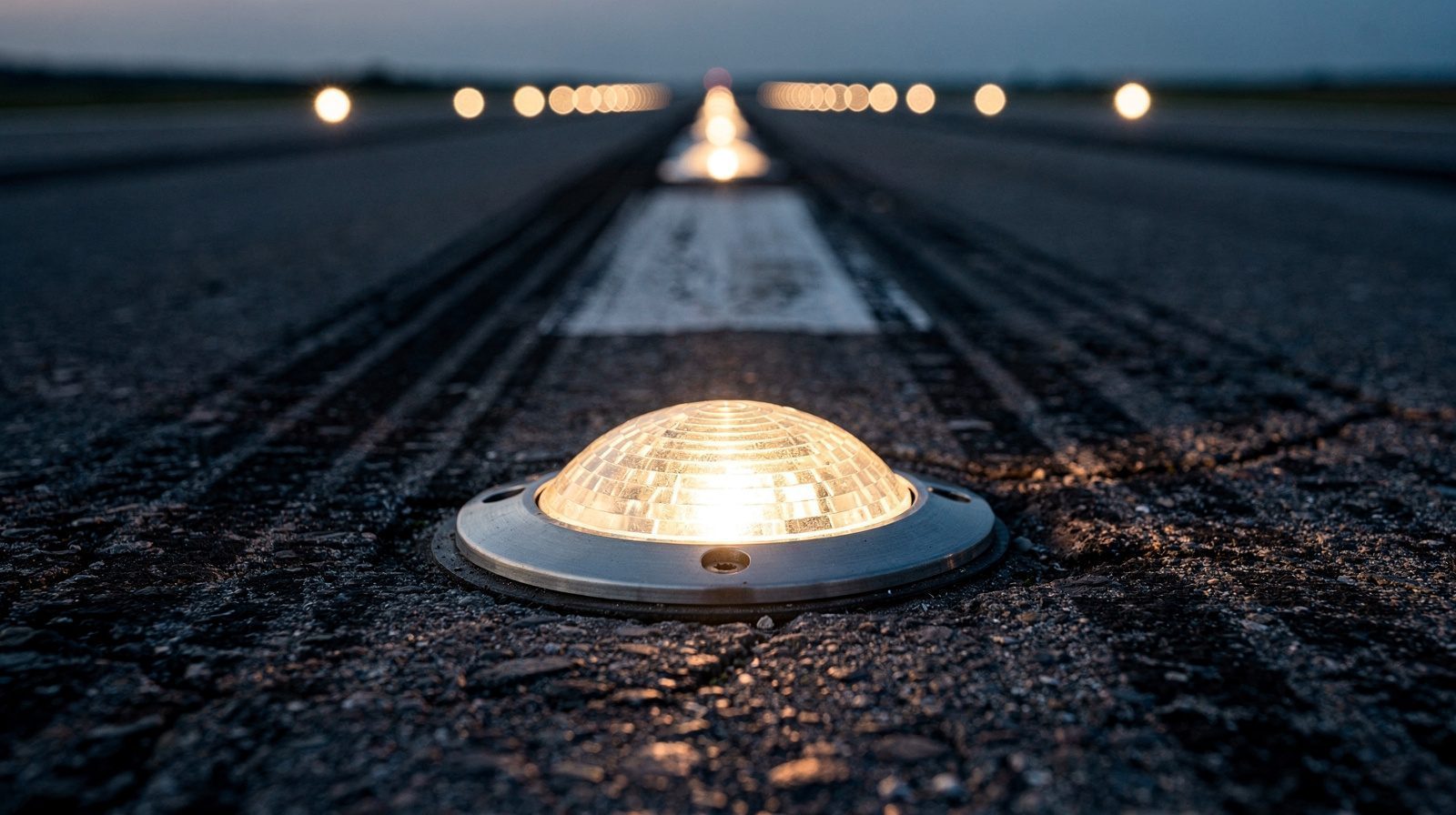 IN-PAVEMENT LIGHT · DUSK
There is no single interval. For a CAT II or III runway, EU guidance and ICAO recommend measuring in-pavement lights at least twice a year and other lights once a year. The FAA circular says not less than twice a year on a precision approach runway and lists monthly testing in its tables. Part 139 sets none.
Part 139 itself names no photometric testing interval. The FAA interval comes from AC 150/5340-26C , which is mandatory only on projects funded through AIP grants or PFC revenue and recommended guidance everywhere else. A test means measuring what each fixture emits with equipment proven accurate and repeatable. Looking at the lights at night does not count.
What photometric testing of runway lights is
Photometric testing measures the light a fixture gives out, in the field, and compares it with the specification. Annex 14 10.5.3 and 10.5.4 describe it as in-field measurement of the intensity, beam spread and orientation of the lights, covering all lights as far as practicable. 10.5.5 asks for a mobile measuring unit accurate enough to analyse each light. In the FAA circular, the result is judged against the output required for the fixture in AC 150/5345-46.
What Part 139 says and does not say
14 CFR 139.311 is the lighting rule. Paragraph (c) requires a certificate holder to provide and maintain lighting for air carrier operations, including runway lighting that meets the specifications for the minimums authorised for each runway. Paragraph (d) says to “properly maintain” means cleaning, replacing or repairing anything faded, missing or non-functional, keeping it unobscured and clearly visible, and making sure it gives the user an accurate reference.
Neither paragraph names photometric testing or an interval. Paragraph (f) points to FAA advisory circulars as containing methods and procedures that are acceptable to the Administrator. Section 139.327 adds the daily self-inspection, with a record of the conditions found and the corrective action taken, kept for at least 12 consecutive calendar months. It does not call for photometric measurement.
Where does your interval live, then? In the Airport Certification Manual. Section 139.203 lists, among its required contents, a description of and procedures for maintaining the marking, signs and lighting systems.
What the circular asks for
The status matters first. Paragraph 2 says use of the circular is in general not mandatory, and mandatory for projects funded through the Airport Improvement Program and the Passenger Facility Charges Program. The circular calls itself recommended guidelines. Everything below is guidance unless your funding makes it binding.
| Where in AC 150/5340-26C | What it says about photometric testing |
|---|---|
| Table 5-5, elevated edge lights | Photometric testing (HIRL) and alignment check, marked monthly and unscheduled |
| Table 5-6, in-pavement lights | Photometric testing of runway lighting systems, marked monthly and unscheduled |
| 5.3.2.1.2(e) | Frequency varies by facility and runway with traffic and age of fixtures, adjustable once experience is gained |
| 5.3.2.1.2(f) and 5.3.4.1.3 | For a precision approach runway, based on traffic density, local pollution, equipment reliability and the results so far, and in any case not less than twice a year |
| 5.3.4.1.3 | Until a schedule is established, monthly or even weekly at busy facilities |
| 5.3.4.1.3(e) | Weekly checks of centreline lights may be needed because of rubber deposits, especially on CAT II and CAT III runways |
Two readings follow. The tables treat photometric testing as monthly work, and the text treats twice a year as a floor for a precision approach runway, with the real interval set by local conditions. Both say the interval may be tuned once the airport has data. The text is guidance in the form of “should”, so the floor is not a regulation unless your manual or grant makes it one.
On HIRL the circular says regular photometric measurements are the only practical way to learn whether elevated runway edge lights emit the specified light and to find misalignment. For in-pavement lights it calls photometric measurement the most direct way to check output.
What counts as a test
Paragraph 4.1.12 describes the method. In the past, in situ measurements were possible only with a hand-held spot meter, and the circular says that method proved very ineffective: it detects only gross differences between lights and cannot account for alignment errors. It points instead to mobile systems that test individual fixtures at high speed and high accuracy. Some produce an isocandela diagram per light, flag misaligned fixtures or give a GPS position for each light. The equipment must be proven capable of high accuracy and repeatability so that no erroneous data is collected.
So a qualifying test has three parts.
- An instrument that measures output per fixture. A calibrated photometer reports intensity in candela , and the fixture is judged against the output required for it in AC 150/5345-46.
- A reading before and after maintenance. The circular asks for testing before cleaning, relamping or realignment, to learn whether work is needed, and after, to show the work had an effect.
- A criterion. A light measuring below 70 percent of the minimum output required when operated at maximum intensity should be targeted for cleaning or maintenance, and the circular calls it ineffective in high background brightness and low visibility. For elevated lights the circular states this for high intensity runway edge lights.
Viewing the lights at night is a different check. The circular offers it as a way to spot lenses out of orientation, with testing as the alternative. The daily twilight drive looks for burned-out or dimly burning lamps. For in-pavement lights the circular says nightly photometric testing is not practical, so an airport can develop its own guidance on what “dim” means on a daily check.
Do not mix the 70 percent figure with the serviceability limits. Table A-8 counts how many lights are on or serviceable, for example 85 percent of runway edge lights on, and 95 percent serviceable on CAT II and CAT III runways. That is a count of lights. The 70 percent figure is a measure of output and a trigger for maintenance.
How the EU and ICAO compare
For a European aerodrome the order is different. ADR.OPS.C.015(b) requires a preventive and corrective maintenance programme for the individual lights and does not print an interval. AMC1 to ADR.OPS.C.015(b) and (f) says that, irrespective of runway type, the operator should ensure serviceability by photometric measurements at appropriate intervals set in the programme. For a category II or III precision approach runway, it adds the floor. Annex 14 carries the same floor as a Recommendation in 10.5.6.
| Status | Runways covered | Floor | |
|---|---|---|---|
| EASA AMC1 to ADR.OPS.C.015(b) and (f) | Acceptable means of compliance | CAT II and III precision approach | Twice a year for in-pavement lights, once a year for other lights |
| ICAO Annex 14 Vol I, 10.5.6 | Recommendation | CAT II and III precision approach | Same as EASA |
| FAA AC 150/5340-26C, 5.3.2.1.2(f) | Guidance, mandatory only on AIP and PFC projects | Precision approach runway | Not less than twice a year |
The FAA text applies one floor to elevated and in-pavement lights, where the European text splits them. It also says precision approach runway where the European text says category II or III. Annex 14 10.5.2, a Standard, requires a system of preventive maintenance and names no interval. The interval sits in the Recommendation 10.5.6.
Testing outside the calendar
Some tests do not wait for a date. The circular asks for testing before cleaning, re-lamping or realignment, and again after. It says weekly checks of centreline lights may be needed where rubber builds up, especially on CAT II and CAT III runways. When the FAA declares a lighted navigation aid out of service as suspect in an aircraft accident, paragraph 3.7 asks the operator to inspect it at once and record the as-found functional parameters against Appendix A. It does not say photometric.
What the results feed
A test is only useful if the number changes what happens next. The circular ties the two together in its cleaning paragraphs. Its general cleaning schedule in 5.3.3.6 asks for each light to be cleaned thoroughly at least once a year and says regular photometric measurements may show a need for a more aggressive schedule. For in-pavement lights it names rubber deposits and runway de-icing fluids as having an extremely detrimental effect on light output, and asks for cleaning when output falls below 70 percent of the minimum required. A light that keeps showing output below that level after cleaning should be scheduled for removal and servicing.
That is the practical meaning of “regular”. A fixed calendar date tells you when to measure. The results tell you whether that date was right, and the circular expects the interval to move once the airport has experience with its own equipment and traffic.
What this means for a programme
Write the interval into the maintenance procedures your manual describes, with the reason: traffic, pollution, fixture age and what earlier results showed. Test before and after cleaning, so the record shows whether the work helped. Keep the instrument, its calibration state and the intensity step with every reading.
A drone survey does not replace that test. The circular names no platform, and whether a drone-based method meets a particular programme is a question for the programme and its FAA contacts. TarmacView reports each unit as lit or dark, its colour, its output relative to its neighbours and to the commanded step, and its surveyed position. It does not measure candela, which needs a calibrated photometer. What it adds is a light-by-light look between measured campaigns, so the next test goes to the units that need it. The runway edge lights service describes that work.
For the procedure itself, see the photometric measurement guide . For the serviceability percentages, see runway light serviceability limits .
Frequently Asked Questions
- How often must airfield ground lighting be photometrically tested?
- No single interval applies everywhere. On a CAT II or III runway, EASA guidance and ICAO Annex 14 10.5.6 set a floor of twice a year for in-pavement lights and once a year for other lights. The FAA circular says the frequency on a precision approach runway should not be less than twice a year, and its tables mark photometric testing as monthly. The operator sets the real interval from traffic, pollution, equipment reliability and earlier results.
- What does FAA AC 150/5340-26C say about photometric testing frequency?
- It gives a floor of twice a year for a precision approach runway and a monthly entry in its tables. Paragraphs 5.3.2.1.2(f) and 5.3.4.1.3 say frequency should rest on traffic density, local pollution, equipment reliability and continuing results. Tables 5-5 and 5-6 mark photometric testing as monthly and unscheduled. After some experience the interval may be adjusted. The circular is mandatory only on AIP and PFC funded projects.
- What is photometric testing of runway lights?
- It is the in-field measurement of the light a fixture gives out, mainly its intensity, beam spread and orientation. Annex 14 10.5.3 and 10.5.4 describe it this way for CAT II and III runways. The FAA circular points to mobile systems that test each fixture at high speed and accuracy. A reading is judged against the specification, for example AC 150/5345-46. A look at the lights at night is not a test.
- Does 14 CFR Part 139 require photometric testing of airfield lights?
- No. Section 139.311 requires the operator to provide and maintain lighting and defines properly maintained, but it names no photometric test or interval. Section 139.327 requires a daily self-inspection with a record. The method and interval live in the Airport Certification Manual, and section 139.311(f) points to FAA advisory circulars as acceptable methods.
- When is photometric testing needed outside the regular schedule?
- Before and after cleaning, re-lamping, realignment or repair, so the record shows whether the work was needed and whether it helped. The FAA circular also says centreline lights may need weekly checks where rubber builds up, especially on CAT II and CAT III runways. After an aircraft accident that implicates a lighted aid, paragraph 3.7 asks for an immediate as-found inspection.
References
- faa-ac-150-5340-26c
- AC 150/5340-26C, Maintenance of Airport Visual Aid Facilities Federal Aviation Administration
- 14-cfr-part-139
- 14 CFR Part 139, Certification of Airports: sections 139.203, 139.311 and 139.327 Electronic Code of Federal Regulations (eCFR)
- easa-ear-aerodromes
- Easy Access Rules for Aerodromes (Regulation (EU) No 139/2014) European Union Aviation Safety Agency
- icao-annex-14-vol-1
- ICAO Annex 14, Volume I, Aerodrome Design and Operations, 9th edition International Civil Aviation Organization (copy hosted by the Swiss FOCA)
Founded by flight-inspection veterans who spent decades measuring PAPI lights for aviation authorities across Europe.
Learn more
Related terms
03 TERMSPhotometric Testing
Photometric testing is the measurement of visible light in units that match the human eye. The quantities, the instruments, laboratory and in-field tests, the 50 and 70 per cent limits, and how often to test airfield lights.
Runway Edge Light: HIRL, MIRL and LIRL Explained
Runway edge lights outline a runway at night. Colours, spacing, elevated and inset units, intensity, HIRL, MIRL and LIRL, and inspection per EASA, ICAO and FAA.
In-Pavement Light
An in-pavement light is an airfield light set flush in the pavement that aircraft can roll over. Which lights are in-pavement, the rules, the FAA fixture types, how they are fitted, and why they need more maintenance.
Further reading
03 ARTICLES
FAA 14 CFR Part 139: Airport Certification and Lighting Rules
14 CFR Part 139 sets no photometric testing interval for airfield lights. Section 139.311 requires proper upkeep. AC 150/5340-26C sets a twice yearly…
The Maintenance Schedule for CAT II and CAT III Runway Lighting
The CAT II and CAT III runway lighting maintenance schedule: a daily check, in-field measurement twice a year, a yearly flight check and the FAA…

Runway Edge Light Inspection: What ICAO Requires and How It Is Measured
What ICAO Annex 14 requires of runway edge lights, what it leaves open, and how intensity, colour and coverage are actually measured in the field.