The Maintenance Schedule for CAT II and CAT III Runway Lighting
The CAT II and CAT III runway lighting maintenance schedule: a daily check, in-field measurement twice a year, a yearly flight check and the FAA cadence.
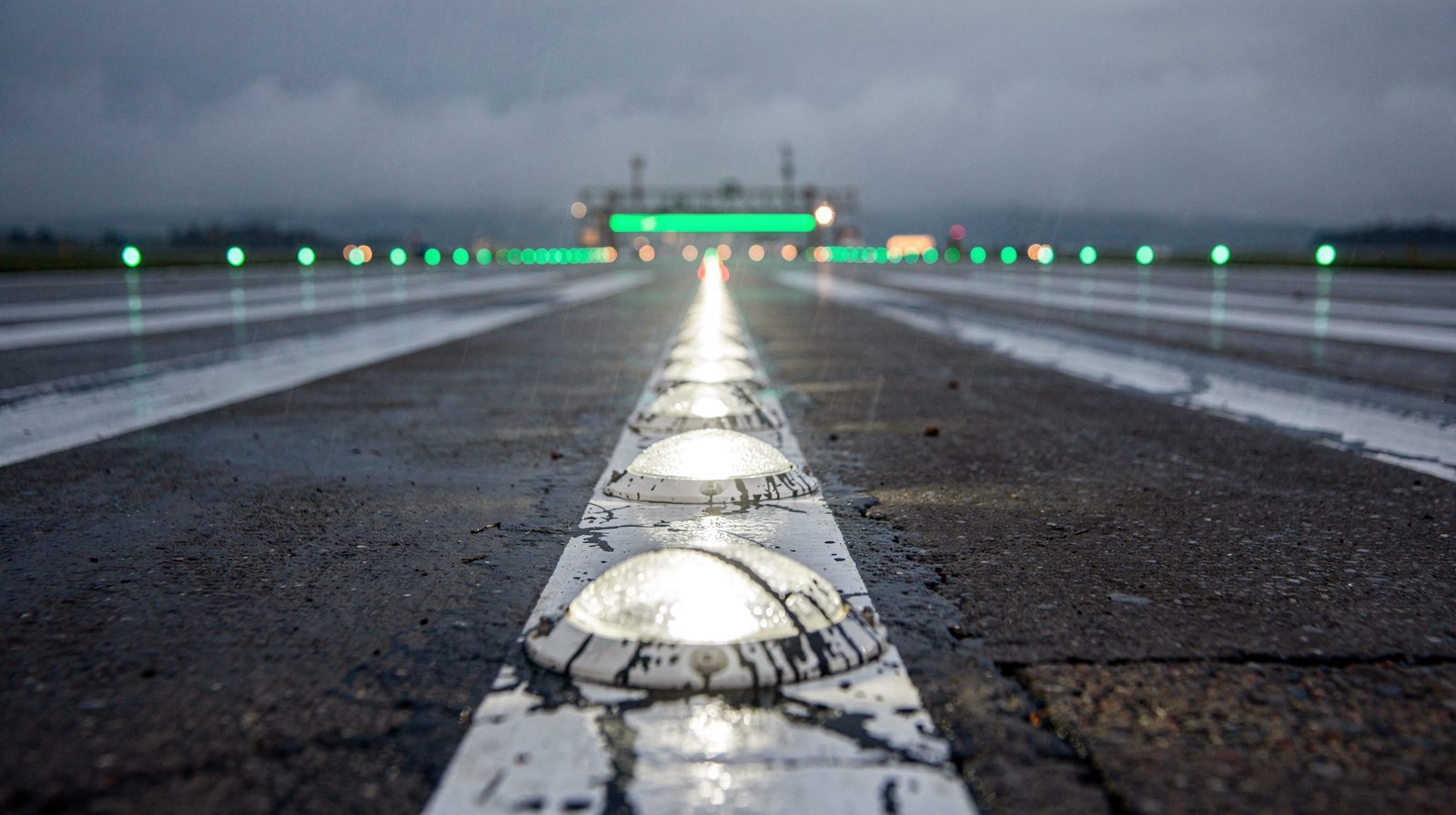 CENTRE LINE · INSET UNITS · DUSK RAIN
There is no single maintenance schedule for CAT II and CAT III runway lighting. The operator sets its own intervals in a maintenance programme. EASA guidance gives a daily ground check, in-field measurement at least twice a year for in-pavement lights and once a year for other lights, and a flight check at least yearly. ICAO recommends the same measurement floors.
The FAA sets a busier calendar, with checks of centre line lights as often as weekly where rubber builds up and monthly photometric testing in its tables. This post lays those cadences side by side. The percentages of lights that may be out are in the serviceability limits guide and summarised below. A CAT I runway has its own, lower objective of 85 % per system (Annex 14 10.5.10).
What is binding and what is guidance
In the EU the binding text is ADR.OPS.C.015 of Regulation (EU) No 139/2014 . Point (f)(1) requires the preventive maintenance programme to include inspections and checks of each element and of the system, done to established procedures and at defined intervals appropriate to the operation. It prints no interval. The intervals sit in an acceptable means of compliance, AMC1 to ADR.OPS.C.015(b) and (f), which is guidance an operator can follow or replace with something it can justify.
ICAO Annex 14, Volume I , splits the same ground in two. Section 10.5.7 is a Standard, the maintenance objective for a precision approach runway during CAT II or CAT III operations. Sections 10.5.3 to 10.5.6, which cover the checks, the measuring unit and the measurement frequency, are Recommendations. Note 1 to Section 10.5 adds that these specifications define maintenance performance objectives and not whether a lighting system is out of service.
In the United States, AC 150/5340-26C is recommended guidance in general. It is mandatory only on projects funded through the Airport Improvement Program or Passenger Facility Charges.
The cadence, source by source
| Interval | EASA, AMC1 to ADR.OPS.C.015(b) and (f) | ICAO Annex 14 | FAA, AC 150/5340-26C |
|---|---|---|---|
| Daily | Ground check for light failures, breakage, gross misalignment and the intensity control | No interval set | Twilight driving patrol for burned-out and dim in-pavement lights |
| Weekly | No interval set | No interval set | Defective in-pavement units replaced. Centre line checks may need to be weekly where rubber builds up |
| Monthly | No interval set. The programme names the other checks through the year | No interval set | In-pavement lights cleaned and photometrically tested |
| Twice a year | In-field measurement of in-pavement lights, at least | 10.5.6, Recommendation | Photometric testing on a precision approach runway, not less often |
| Yearly | In-field measurement of other lights, at least. Flight check | 10.5.6, Recommendation | Annual inspection of elevated edge light fixtures (Table 5-5) |
Read the table as three different kinds of statement. The EU and ICAO columns give floors for the measurement. The FAA column gives a working routine for an airport to adjust.
The daily check
AMC1 asks that the daily ground check cover at least light failures, breakage, gross misalignment and correct operation of the intensity control. That is a check of whether the lights are there and respond. It cannot show that a lit light has lost half its output, which is why the same AMC adds photometric measurement “at appropriate intervals” for every runway type.
GM1 to the same AMC lists what the ground checks include, to be done at different intervals: broken lights or parts, the condition of filters, corrosion, cleanness, tightening of fasteners, alignment, moisture, electrical connections, and the structure and foundation of each unit. It does not assign an interval to each item. The operator does that in its programme.
The measurement, twice a year at least
For CAT II and CAT III, AMC1 and Annex 14 10.5.3 ask for visual inspection and in-field measurement of intensity, beam spread and orientation of the approach and runway lights, a check of the electrical characteristics of each circuit, and a check that the intensity settings used by air traffic control work. All lights should be measured, as far as practicable, with a unit accurate enough to analyse each light.
The frequency should rest on traffic density, local pollution, the reliability of the installed equipment and the continuing results of earlier measurements. It should never fall below twice a year for in-pavement lights and once a year for other lights. That wording is the same in paragraph (c)(4) of AMC1 to ADR.OPS.C.015(b) and (f) and in Annex 14 10.5.6.
Both centre line lights and touchdown zone lights are required on a CAT II or CAT III runway (Annex 14 5.3.12.1 and 5.3.13.1), and both count in the 10.5.7 objective. The FAA circular names rubber deposits on the lens as the main cause of poor output in fixtures installed in the runway (paragraph 5.3.4). Our page on runway centre line lights sets out how we count them. How the measurement itself is done is in the photometric measurement guide .
GM1 to ADR.OPS.C.015(b) and (c) adds a useful step. The operator needs to consider defining two intensity levels in its programme, a maintenance level and the unserviceability level of 50 % of the specified value. The maintenance level is always above 50 %, so corrective work can be scheduled before a light has failed.
The yearly flight check
Paragraph (d) of AMC1 to ADR.OPS.C.015(b) and (f) calls for a flight check of the approach, runway and taxiway lighting, the visual approach slope indicators, the aerodrome beacon and the intensity control at least yearly. It checks that the pattern is correct and the lights work. Special checks follow major maintenance or changes to these systems and come before new systems are commissioned. They are flown by day and by night.
What the FAA asks of in-pavement lights
The FAA gives a calendar for each system. For in-pavement runway lights, Table 5-6 sets a daily patrol, weekly replacement of defective units, and monthly cleaning with photometric testing. Paragraph 5.3.4.1.3 notes that centre line lights may need weekly checks because of rubber deposits, especially on CAT II and CAT III runways where low-visibility operations are conducted. On a precision approach runway the frequency of measurement should not fall below twice a year, and an in-pavement light measuring below 70 % of the minimum output required at maximum intensity should be targeted for cleaning or maintenance. Output current of each constant current regulator is checked monthly on each brightness step, under Table 5-4.
How many lights may be out
The schedule exists to hold a maintenance objective. Annex 14 10.5.7 (a Standard) says the preventive maintenance system shall have as its objective that, during any period of CAT II or CAT III operations, all approach and runway lights are serviceable and, in any event, at least 95 % in the inner 450 m of the approach lighting, the centre line lights, the threshold lights and the edge lights. The touchdown zone lights need 90 %, the approach lights beyond 450 m need 85 % and the runway end lights need 75 %. The allowable unserviceable lights may not change the basic pattern of the system, and an unserviceable light may not sit next to another one, except in a barrette or crossbar where two adjacent lights may be out. These are objectives for the preventive maintenance system, as Note 1 to Section 10.5 says, and they are not a test of whether a runway is open. What follows when a system falls below them is for the operator, air traffic services and the flight operations rules. The full table by system is in the serviceability limits guide .
Events outside the calendar
Some work does not wait for an interval. ADR.OPS.C.015(e) bars construction or maintenance near aerodrome electrical systems while low-visibility procedures are in effect. Annex 14 10.5.13 makes the same point as a Recommendation to the authority. GM2 to ADR.OPS.C.015(b) says an operator with ice and snow should evaluate a modified schedule for LED lights, because LEDs lack the heat signature of incandescent lamps. The same GM says a long LED life is no reason to install and forget. Under point (g) the operator keeps records of the maintenance it does.
Live monitoring between visits
On a runway used below 550 m of runway visual range, CS ADR-DSN.S.890(d) recommends automatic monitoring that tells the maintenance crew when any element drops below its objective. Point (e) recommends a second indication to air traffic services when an element falls below the level where operations should not continue. GM1 says the competent authority sets that level. Monitoring does not replace the in-field measurement that AMC1 asks for.
Where a drone survey fits
A drone survey is not the measuring unit AMC1 describes. It records each light as lit or dark, its colour against its position, its output relative to its neighbours and to the commanded intensity step, and its surveyed position. That can screen the in-pavement units between measurement rounds and send the measuring crew to the ones that are low. A statement against the specified intensity still needs a calibrated photometer.
Building the schedule
Start from the daily check and the twice-yearly in-field measurement, then let traffic, contamination and the measured results move the intervals. Write the maintenance level into the programme, keep the records, and put the flight check on the calendar. Write down why any interval is longer than the guidance.
Frequently Asked Questions
- What is the maintenance schedule for CAT II and CAT III runway lighting?
- There is no single schedule, because the EU and ICAO leave the intervals to the operator's maintenance programme. EASA guidance asks for a daily ground check, in-field measurement of all approach and runway lights at least twice a year for in-pavement lights and once a year for the others, and a flight check at least yearly. Annex 14 10.5.6 recommends the same measurement floors. The FAA tables add monthly photometric testing and weekly checks of centre line lights where rubber builds up.
- What percentage of runway lights can be unserviceable before the runway is downgraded?
- Annex 14 10.5.7 sets an objective per system, not one figure. During CAT II or III operations at least 95 % of the inner 450 m approach, centre line, threshold and edge lights must be serviceable, 90 % of the touchdown zone lights, 85 % of the approach lights beyond 450 m and 75 % of the runway end lights. No unserviceable light may sit next to another, except two in a barrette or crossbar. The restriction that follows is set by the operator and the flight operations rules.
- How often must in-pavement runway lights be measured on a CAT II or CAT III runway?
- At least twice a year, and more often where traffic, pollution, equipment reliability or earlier results call for it. That floor is in paragraph (c)(4) of EASA AMC1 to ADR.OPS.C.015(b) and (f) and in Annex 14 10.5.6, which is a Recommendation. Other lights are measured at least once a year. The FAA asks for monthly photometric testing of in-pavement lights in its Table 5-6.
- Do runway centre line lights need extra attention on a CAT III runway?
- In FAA guidance, yes. AC 150/5340-26C paragraph 5.3.4.1.3 says rubber deposits on the lens can make weekly checks of centre line lights necessary, especially on CAT II and CAT III runways with low-visibility operations. EASA and ICAO print no weekly interval. Both require centre line lights on these runways, and both count them in the 95 % objective.
- Is a flight check part of the CAT II and CAT III lighting schedule?
- Yes, in the EASA guidance. A flight check of the approach, runway and taxiway lighting, the visual approach slope indicators, the aerodrome beacon and the intensity control is asked for at least yearly. Special checks follow major maintenance or changes to these systems and come before new systems are commissioned. They are flown by day and by night.
References
- easa-ear-aerodromes
- Easy Access Rules for Aerodromes (Regulation (EU) No 139/2014), including CS-ADR-DSN Issue 7 European Union Aviation Safety Agency
- icao-annex-14-v1
- Annex 14 to the Convention on International Civil Aviation, Volume I: Aerodrome Design and Operations International Civil Aviation Organization
- faa-ac-150-5340-26c
- AC 150/5340-26C, Maintenance of Airport Visual Aid Facilities Federal Aviation Administration
Founded by flight-inspection veterans who spent decades measuring PAPI lights for aviation authorities across Europe.
Learn more
Related terms
03 TERMSMaintenance
Maintenance at an aerodrome is the programme of preventive and corrective work that keeps pavements, lights and other facilities safe to use.
Precision Runway
A precision runway is an instrument runway for CAT I, II or III approaches. What the EU, ICAO and FAA rules require of its lights, power and markings.
Remote Monitoring
Remote monitoring is a system that shows the status of airfield lights at a place away from the lights. What ICAO, EASA and the FAA say about it.
Further reading
03 ARTICLES
How Often Does Airfield Lighting Need Photometric Testing?
How often airfield lighting is photometrically tested: no Part 139 interval, a twice-yearly floor on precision runways, monthly FAA tables and what a…
How Many Runway Lights Can Be Unserviceable?
How many runway lights may be unserviceable, per system and category, under ADR.OPS.C.015 and Annex 14, what happens below the limit and how often to…

Runway Edge Light Inspection: What ICAO Requires and How It Is Measured
What ICAO Annex 14 requires of runway edge lights, what it leaves open, and how intensity, colour and coverage are actually measured in the field.