What is a Precision Runway?
Precision Runway
A precision runway is an instrument runway that has visual aids and at least one non-visual aid for CAT I, II or III approaches.
Definition
Regulation (EU) No 139/2014 lists three types of precision approach runway: category I, II and III. Each has visual aids and at least one non-visual aid. Each serves a type B instrument approach of the matching category. ICAO Annex 14 gives the same three types and sets limits for each.
- CAT I: decision height of 60 m (200 ft) or more. Visibility of at least 800 m, or runway visual range of at least 550 m.
- CAT II: decision height from 30 m (100 ft) to below 60 m. Runway visual range of at least 300 m.
- CAT III: decision height below 30 m, or none. Runway visual range below 300 m, or no limit.
The FAA uses the same three categories, with limits in feet. Its precision instrument runway also has physical limits. It has a navigation system such as an ILS or a GLS. It is at least 4,200 ft (1,280 m) long and 75 ft (22.9 m) wide. It has high intensity runway lights and precision markings (AC 150/5300-13B, section 2.6.4).
Precision and other instrument runways
ICAO names two kinds of instrument runway. A non-precision approach runway serves a type A approach, with a visibility of not less than 1,000 m. A precision approach runway serves a type B approach in one of the three categories above.
The FAA sorts runways by visibility into four groups for airport design (AC 150/5300-13B, section 2.6.4):
- Visual. For visual flight rules only, or circling approaches.
- Non-precision approach. Course guidance but no glide path. Visibility of ½ statute mile (0.8 km) or more, and a height above touchdown of 250 ft (76 m) or more.
- Approach procedure with vertical guidance. Course and glide path guidance, but not to the ICAO Annex 10 precision standard. Down to 200 ft (61 m) and ½ statute mile.
- Precision approach. Course and glide path guidance. A height above touchdown below 250 ft (76 m) and a visibility below ¾ statute mile (1.2 km), down to CAT III.
See instrument runway and non-precision approach .
Approach categories and ILS minimums
The FAA lists the lowest authorized ILS minimums in the Aeronautical Information Manual. All required ground and airborne equipment must work (AIM 1-1-9).
| Category | Decision height | Runway visual range |
|---|---|---|
| CAT I | 200 ft (61 m) | 2,400 ft (about 730 m), or 1,800 ft (about 550 m) with touchdown zone and centerline lighting |
| CAT II | 100 ft (30 m) | 1,200 ft (about 366 m), or 1,000 ft (about 305 m) with autoland or head-up display to touchdown |
| CAT IIIa | None, or below 100 ft | At least 700 ft (about 213 m) |
| CAT IIIb | None, or below 50 ft (15 m) | Below 700 ft but at least 150 ft (about 46 m) |
| CAT IIIc | None | No limit |
Categories II and III need special authorization and equipment. See decision height , runway visual range , CAT I , CAT II and CAT III .
How the approach is guided
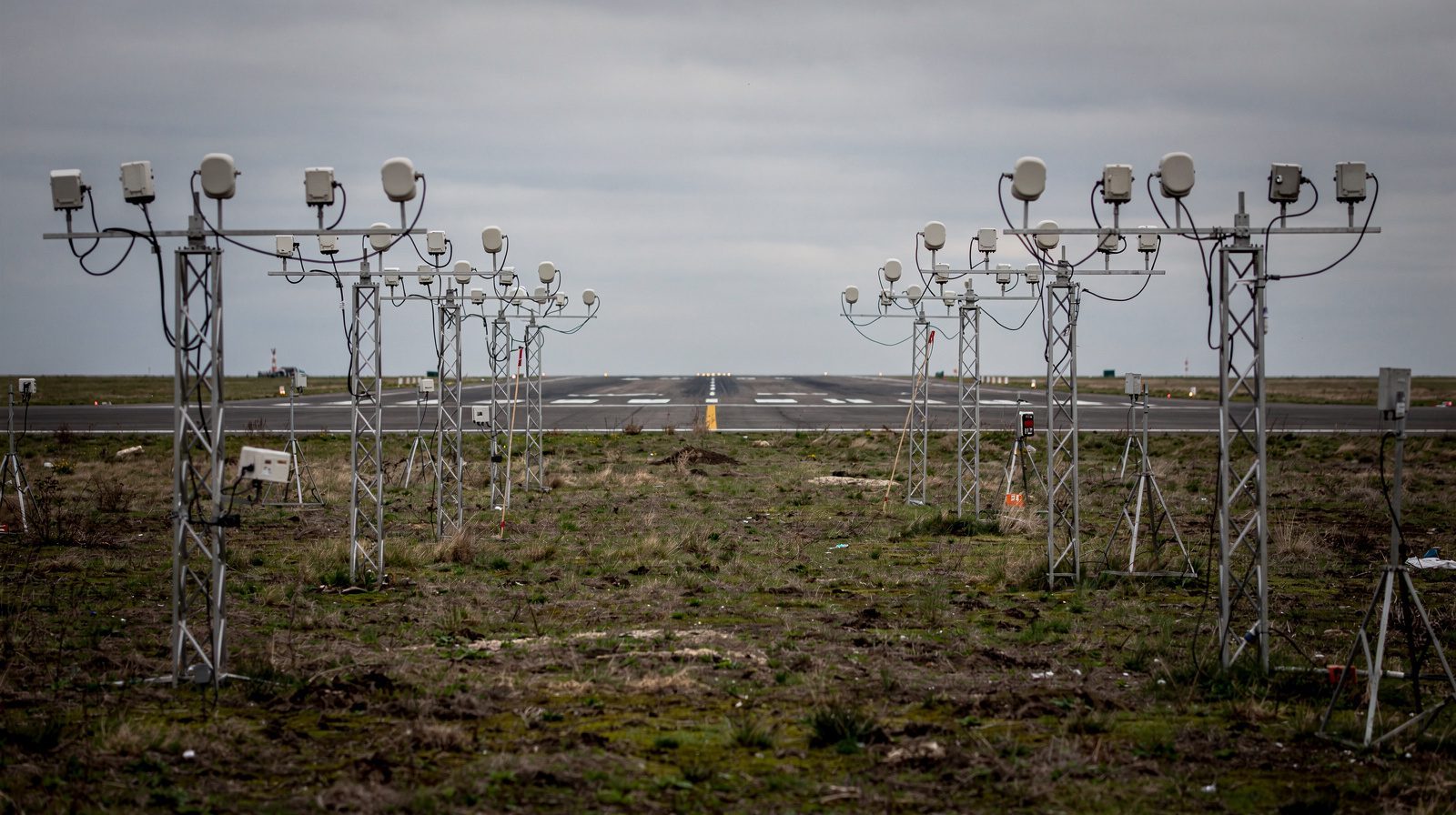
The basic parts of an ILS are the localizer, the glide slope and the outer marker. An inner marker is added for CAT II or III. The FAA splits the system into three parts (AIM 1-1-9):
- Guidance: the localizer and the glide slope .
- Range: the marker beacons and distance measuring equipment (DME).
- Visual: the approach lights, the touchdown and centerline lights, and the runway lights.
A GBAS landing system (GLS) can serve the same purpose. The FAA lists both ILS and GLS for a precision instrument runway. See ILS .
Strip and width
ICAO says that a strip with a precision approach runway extends wherever practicable at least 140 m on each side of the centre line. That is for code number 3 or 4. For code number 1 or 2 it is 70 m. The width of a precision approach runway should be at least 30 m for code number 1 or 2 (Annex 14, 3.4.3 and 3.1.10). See runway width .
Markings
A runway number is the magnetic azimuth of the centerline, divided by 10 and rounded to the nearest whole number. The opposite end of the runway has a number that differs by 18. Runway 6/24 is one runway: pilots call it 6 from one end and 24 from the other (AC 150/5340-1M).
The FAA sets a minimum marking scheme for each approach category (AC 150/5340-1M, Table 2-1). A precision approach has these markings:
- landing designator
- centerline
- threshold
- aiming point
- touchdown zone
- edge markings
The centerline stripes are 120 ft (36.5 m) long with 80 ft (24.3 m) gaps. They are at least 36 in (90 cm) wide on a precision runway and 18 in (45 cm) on a non-precision runway. The touchdown zone marking identifies the zone in 500 ft (152 m) steps.
ICAO says that a paved precision approach runway of code number 2, 3 or 4 has a touchdown zone marking. It recommends side stripes on a precision approach runway, whatever the contrast with the shoulders. Where two runways cross, the precision approach runway has first order of importance for the display of its markings (Annex 14, 5.2.1.2, 5.2.6.1 and 5.2.7.2). The FAA order is CAT III, CAT II, CAT I, non-precision, visual.
Lighting
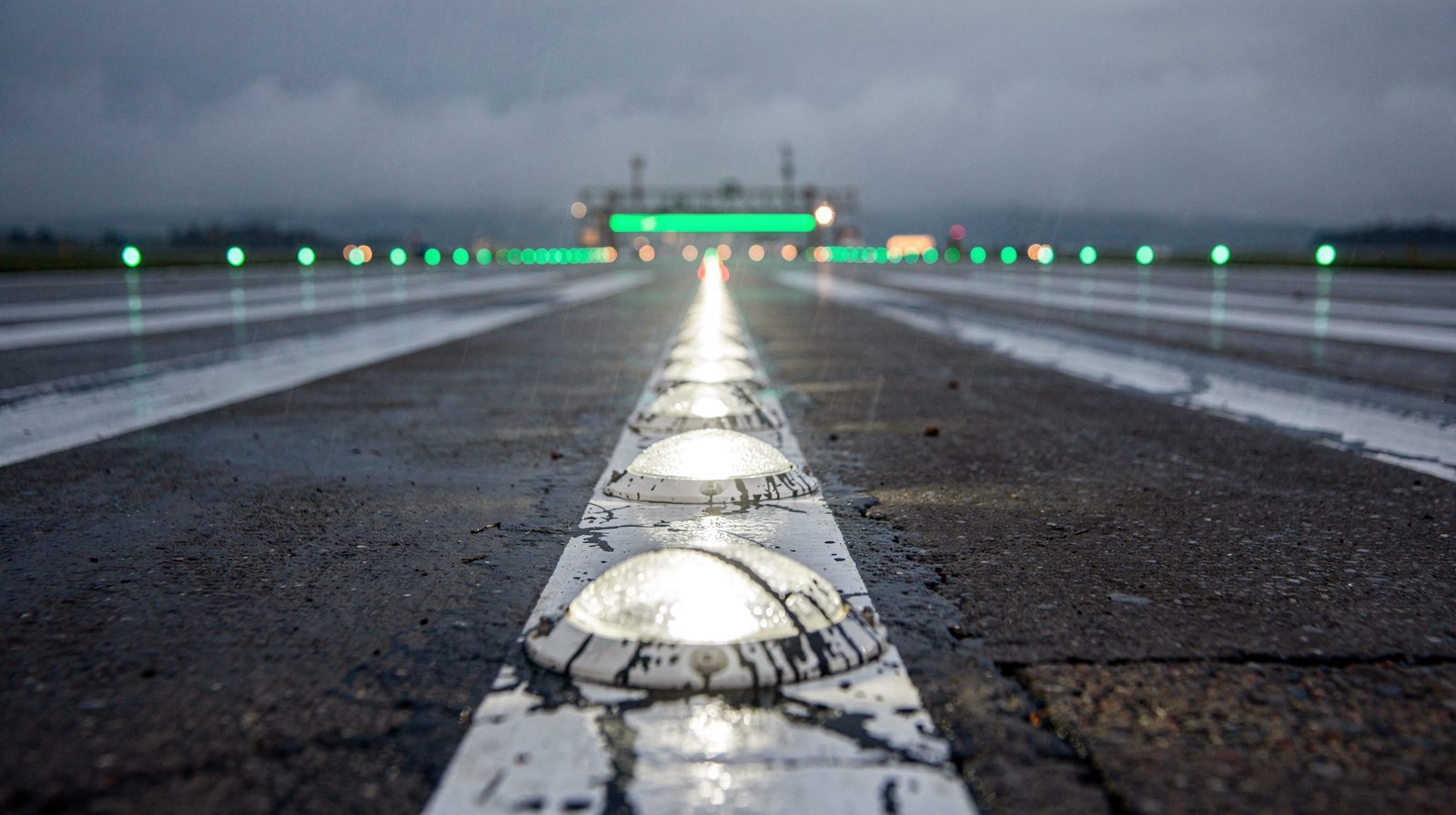
ICAO Annex 14 says that a CAT I runway has a precision approach category I lighting system where physically practicable. A CAT II or III runway has a category II and III lighting system. It also says that CAT II and III runways have runway centre line lights and touchdown zone lights. A precision approach runway has runway edge lights, by day or night (Annex 14, 5.3.4.1, 5.3.9.1, 5.3.12.1 and 5.3.13.1).
The EASA specification CS-ADR-DSN says the following lights “should” be provided. A certification specification is not a binding rule in every case.
- CAT I approach lights: a centre line row over 900 m from the threshold where possible. One 30 m crossbar sits at 300 m.
- CAT II and III approach lights: the same 900 m centre line row. Two side rows run out to 270 m. Two crossbars sit at 150 m and 300 m. The side rows may end at 240 m if the operator can demonstrate the serviceability level.
- Centre line lights and touchdown zone lights: the specification asks for both on CAT II and III runways. The touchdown zone lights run for 900 m from the threshold, or to the midpoint on a runway shorter than 1,800 m.
The lights lower the runway visual range that a pilot may use. The FAA CAT I limit falls from 2,400 ft to 1,800 ft when the touchdown zone and centerline lights work (AIM 1-1-9).
Power, monitoring and serviceability
A precision approach runway needs a secondary power supply. For CAT II and III, the switch-over time is 1 second for these lights:
- the inner 300 m of the approach lights
- the threshold and the runway end
- the centre line and the touchdown zone
It is 15 seconds for the edge lights and the rest of the approach lights. For CAT I it is 15 seconds for all of them (Table S-1).
On a runway meant for runway visual range below 550 m, the specification says to monitor the lights automatically. The system should indicate when any element falls below its serviceability level (CS ADR-DSN.S.890).
The aerodrome operator must keep each system above its own serviceability level during CAT II and III operations (ADR.OPS.C.015). The levels are 95 % for the inner 450 m of the approach lights, the centre line, the threshold and the edge lights. They are 90 % for the touchdown zone lights and 85 % for the approach lights beyond 450 m. Runway end lights have 75 %. CAT I levels are lower, at 85 % for the approach, threshold, edge and end lights.
Precision runway monitoring
Precision runway monitoring (PRM) is not a runway type. It is a high update rate surveillance system. Air traffic control uses it to watch the no transgression zone between two close parallel runways during simultaneous approaches. The approach title carries the letters PRM, and the pilots need special training (AIM 5-4-16).
Why it matters for airfield inspection
For CAT II and III runways, the EASA acceptable means of compliance lists checks. They include visual inspection and in-field measurement of the intensity, beam spread and orientation of the approach and runway lights (AMC1 ADR.OPS.C.015, point (c)). TarmacView inspects the lights by drone. It does not test the ILS signal and it does not inspect the markings.
Frequently Asked Questions
- What is a precision approach runway?
- A precision approach runway is an instrument runway with visual aids and at least one non-visual aid for a CAT I, II or III approach. ICAO sets the decision height and the visibility or runway visual range limits for each category.
- Does a precision runway need an ILS?
- Not by the EU or ICAO definition. They require at least one non-visual aid, and the runway must be intended for a CAT I, II or III approach. The FAA says that its precision instrument runways have navigation systems such as an instrument landing system (ILS) or a GBAS landing system (GLS).
- What is the difference between CAT I, CAT II and CAT III?
- The categories set how low the decision height and the runway visual range may be. ICAO defines CAT I as a decision height of 60 m (200 ft) or more. CAT II is 30 m (100 ft) to below 60 m. CAT III is below 30 m or no decision height. Runway visual range limits are 550 m for CAT I and 300 m for CAT II.
- What do CAT IIIA, IIIB and IIIC mean?
- They are the FAA subdivisions of CAT III. CAT IIIA has a decision height below 100 ft or none, and a runway visual range of at least 700 ft. CAT IIIB has a decision height below 50 ft or none, and 150 ft to below 700 ft. CAT IIIC has no limits.
- Which lights do CAT II and CAT III runways have that CAT I runways do not?
- CAT II and CAT III runways have runway centre line lights and touchdown zone lights. ICAO requires both on these categories. Their approach lighting system also has two side rows and two crossbars, where the CAT I system has one crossbar and no side rows.
- How much of the lighting must work on a CAT II or III runway?
- In the EU, at least 95 % of the lights must work in the inner 450 m of the approach lights. The same applies to the centre line, the threshold and the edge. Other elements have lower levels, such as 90 % for touchdown zone lights. Two adjacent lights may not be out, except in a barrette or crossbar.
- What markings does a precision runway have?
- The FAA requires a landing designator, centerline, threshold, aiming point, touchdown zone and edge markings. ICAO requires a touchdown zone marking on a paved precision approach runway of code number 2, 3 or 4. It recommends side stripes.
- What is precision runway monitoring?
- Precision runway monitoring (PRM) is a high update rate surveillance system. Air traffic control uses it to watch the no transgression zone between close parallel runways. It supports simultaneous approaches. It is not a runway type.
References
- easa-ear-aerodromes
- Easy Access Rules for Aerodromes (Regulation (EU) No 139/2014), including CS-ADR-DSN Issue 7 EASA
- icao-annex-14-vol-i
- Annex 14 to the Convention on International Civil Aviation, Aerodromes, Volume I, 9th edition (July 2022) ICAO
- faa-ac-150-5300-13b
- AC 150/5300-13B, Airport Design FAA
- faa-aim-1-1-9-ils
- Aeronautical Information Manual, paragraph 1-1-9 Instrument Landing System (ILS) FAA
- faa-aim-5-4-16
- Aeronautical Information Manual, paragraph 5-4-16 Simultaneous Close Parallel PRM Approaches FAA
- faa-ac-150-5340-1m
- AC 150/5340-1M Change 1, Standards for Airport Markings FAA
This is a reference entry. TarmacView provides drone inspection services and doesn't sell the equipment or materials described in this glossary.