What is a GBAS Landing System (GLS)?
GBAS Landing System (GLS)
A GBAS landing system (GLS) is a precision approach that uses GPS corrections sent from a ground station at the airport.
GBAS means ground-based augmentation system. The FAA used the name local area augmentation system (LAAS) in the past, and now uses the international term. In the FAA order, a GLS has three parts. They are a GBAS ground facility, an aircraft GBAS receiver, and a charted instrument approach procedure. The approach chart carries the title “GLS RWY” and a runway number.
The landing system page puts the GLS next to the instrument landing system in a short summary. This page covers the GLS on its own.
How it works
GPS alone does not meet the integrity, continuity, accuracy and availability that a precision approach needs. The GBAS adds the missing part.
- Reference receivers at known, surveyed positions near the runway measure the GPS satellite signals. The AIM says that a ground facility has at least four reference stations.
- The ground facility compares each measured distance with the true distance. The difference is the error. The average error of all working receivers becomes the correction.
- The facility monitors each satellite. If it finds a problem or cannot monitor a satellite, it stops the corrections for that satellite, and the avionics do not use it.
- A VHF data broadcast (VDB) transmitter sends the corrections, the integrity values and the approach path data. The message repeats twice each second. The VDB uses the 108 to 118 MHz band at 31.5 kbps.
- The aircraft applies the corrections and calculates its position. It compares its error bounds with the alert limits of the approach, and the avionics decide if the position is good enough.
The FAA sets the integrity so that the chance of an error larger than the computed bound is below 1 in 10 million. The final approach path is not in the aircraft database. The ground station broadcasts the final approach segment data to the aircraft.
What the aircraft needs
An aircraft must be eligible for RNP approach (RNP APCH) operations. It must also have a GBAS receiver that meets the extra airworthiness rules for GLS. The pilot uses the approach with the same techniques as an ILS final approach. The aircraft must be in GLS approach mode before the glidepath intercept point.
The parts of a GLS procedure before the final approach segment follow the RNP APCH design criteria, as the RNAV (GPS) approaches do. The missed approach follows the same criteria.
GLS compared with ILS and LPV
| Item | GLS | ILS | LPV |
|---|---|---|---|
| Source of guidance | GPS with corrections from an airport ground station | Radio beams from antennas at the runway | GPS with WAAS corrections |
| Class (FAA) | Precision approach | Precision approach | Approach with vertical guidance |
The FAA states that the operational benefits of a GLS approach are similar to those of an ILS or LPV approach. In the final approach segment, a GLS gives angular lateral and vertical guidance that mimics the ILS. A GLS has a service volume that differs from the ILS service volume. One ground station can support several GLS approaches to one or more runways. A GAST C station can provide up to 48 approaches.
The FAA classes a GLS as a precision approach, with PAR and ILS. It classes an LPV approach as an approach with vertical guidance. An LPV approach does not meet the ICAO Annex 10 requirements for a precision approach. The precision approach page explains the classes.
Service types and categories
A GBAS approach service type (GAST) is a matched set of airborne and ground requirements. Together they give approach guidance with a set performance. FAA AC 20-191 names two types.
- GAST C. The approved GBAS type for CAT I service. The US systems in use give GAST C. The FAA gives the CAT I minima. The decision height is 200 ft (60 m) and the runway visual range is 1,800 ft (550 m).
- GAST D. The type that CAT II and CAT III applicants typically use for airworthiness approval. The FAA says that the ICAO standards for it took effect in 2018. These standards will be the basis for any vendor that wants FAA system design approval for a GAST D ground system.
The FAA GBAS page is dated 17 February 2023. Check the current approval status with the FAA before you plan a low-visibility GLS operation.
Service volume
The GBAS serves a local area. The FAA gives it as about 23 nm (43 km) in radius. The FAA flight inspection order sets a minimum for a certified GBAS ground facility. It must support a maximum use distance (Dmax) of 23 nm or more from the centre of the reference receivers.
What it means on an airfield
A GLS replaces the radio beams of an ILS, and it does not replace the airfield. The runway still needs its visual aids, its obstacle protection and its safeguarded areas.
- Runway class. ICAO and EASA define a precision approach runway as a runway with visual aids and non-visual aids. It is for type B operations. The definition names the category and the approach type, and not one kind of aid. The FAA lists ILS and GLS as the aids of a precision instrument runway. See CAT I for the first category.
- Obstacle surfaces. ICAO Annex 14, 4.3.4, Note, covers common straight-in procedures. The surface for precision approaches serves ILS or MLS, GBAS or SBAS CAT I.
- Low-visibility operations. EASA sets conditions for SA CAT I and SA CAT II operations. A GLS must have no restriction that affects its use, and no offset from the extended centre line. During low-visibility procedures, the aerodrome operator safeguards the critical and sensitive areas of the ILS, MLS and GLS.
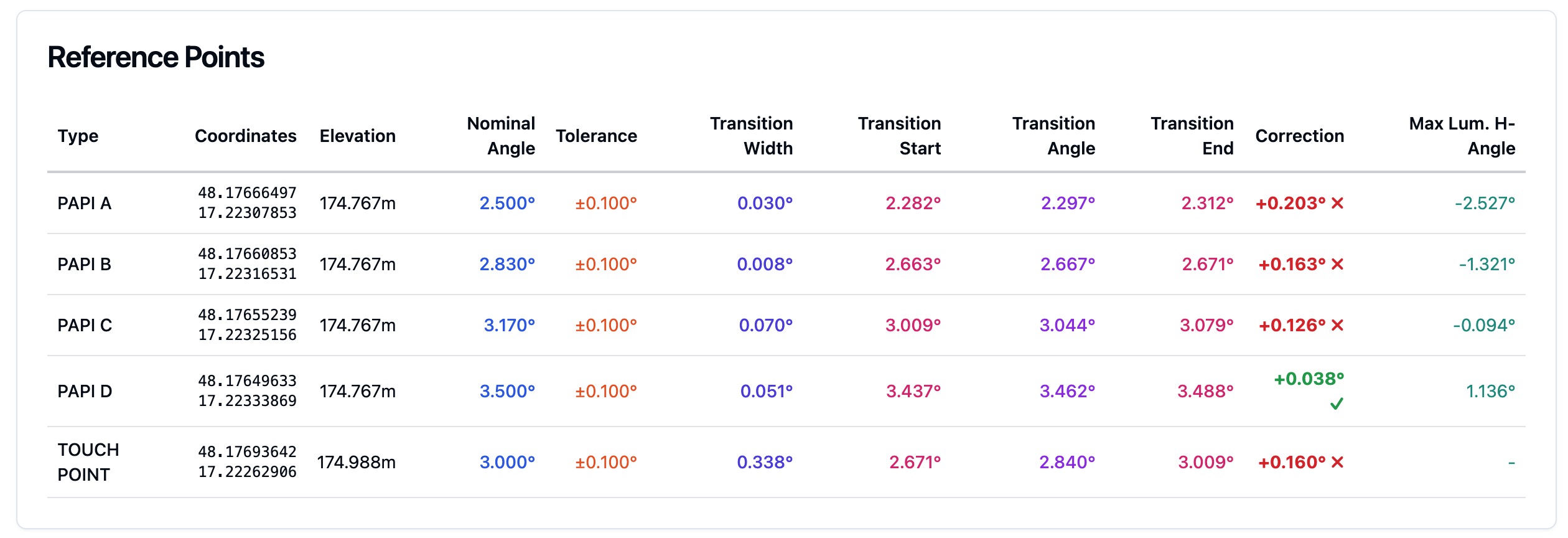
- PAPI. On a runway with a GLS approach, the PAPI visual approach path matches the GLS glide path. The PAPI runway reference point sits at the glide path touchdown point, within 30 ft (10 m). See the precision approach path indicator page.
Flight inspection
The FAA inspects a GBAS with a flight inspection aircraft. The order says that the final approach segment data must have the same reference datum as the runway coordinates and the facility data sheet. Before the flight, the inspector checks that the cyclic redundancy check of each data file matches the FAA Form 8260-10 data. The flight checks the VDB signal coverage and the approach service volume.
A newly commissioned GBAS starts at an interval of 360 days. After two cycles with no out-of-tolerance condition the interval may rise to 540 days. An out-of-tolerance condition during the 540-day interval resets it to 360 days.
TarmacView does not inspect or calibrate a GBAS or any radio navigation aid. It inspects the airfield lighting, obstacles and pavement around the runway.
Frequently Asked Questions
- What is a GLS approach?
- A GLS approach is an instrument approach that uses a GBAS ground station to give the pilot lateral and vertical guidance to a runway. The FAA calls it a precision approach. It charts it as GLS RWY and a runway number. The pilot flies the final segment as an ILS approach.
- What is the difference between GLS and ILS?
- An ILS uses radio beams from antennas at the runway. A GLS uses GPS signals that the airport ground station corrects. The FAA says that the benefits are similar. A GLS has its own service volume, and the ground station broadcasts the final approach path to the aircraft. One ground station can support several approaches.
- What is the difference between GLS and LPV?
- A GLS is a precision approach, and an LPV approach is not. An LPV approach uses WAAS, the satellite-based system, and the FAA classes it as an approach with vertical guidance. A GLS needs a GBAS ground station at the airport. The FAA says that the operational benefits of both are similar to those of an ILS.
- Is GLS the same as GBAS?
- No. GBAS is the ground-based augmentation system, which is the ground station and its broadcast. GLS is the approach that an aircraft flies with it. In the FAA order, a GLS has three parts. They are a GBAS ground facility, an aircraft GBAS receiver and a charted instrument approach procedure.
- What weather minima does a GLS approach allow?
- The GBAS systems in use in the US give GAST C service, which supports CAT I. The FAA states the minima as a 200 ft (60 m) decision height and a runway visual range of 1,800 ft (550 m). AC 20-191 says that CAT II and CAT III applicants typically seek approval through GAST D.
- What do GAST C and GAST D mean?
- GAST means GBAS approach service type. A type is the matched set of airborne and ground requirements that give approach guidance with a set performance. GAST C supports CAT I. The FAA expects GAST D to support the lowest minima, down to CAT III.
- How is a GLS inspected?
- The FAA flies a flight inspection of the GBAS. A new facility starts at an interval of 360 days. After two periodic cycles with no out-of-tolerance condition, the interval may rise to 540 days. The inspection checks the VDB signal coverage and the final approach segment data.
References
- faa-gbas-how-it-works
- Satellite Navigation, GBAS: How It Works (last updated 17 February 2023) FAA
- faa-order-8200-1d
- Order 8200.1D, Change 2, United States Standard Flight Inspection Manual FAA
- easa-ear-aerodromes
- Easy Access Rules for Aerodromes (Regulation (EU) No 139/2014), including CS-ADR-DSN Issue 7 EASA
- icao-annex-14-vol1
- Annex 14 to the Convention on International Civil Aviation, Aerodromes, Volume I, Aerodrome Design and Operations, Ninth Edition (July 2022, consolidated with later amendments) ICAO
- faa-ac-150-5300-13b
- AC 150/5300-13B, Airport Design FAA
- faa-ac-150-5340-30j
- AC 150/5340-30J, Design and Installation Details for Airport Visual Aids FAA
This is a reference entry. TarmacView provides drone inspection services and doesn't sell the equipment or materials described in this glossary.