What is an Instrument Runway?
Instrument Runway
Definition
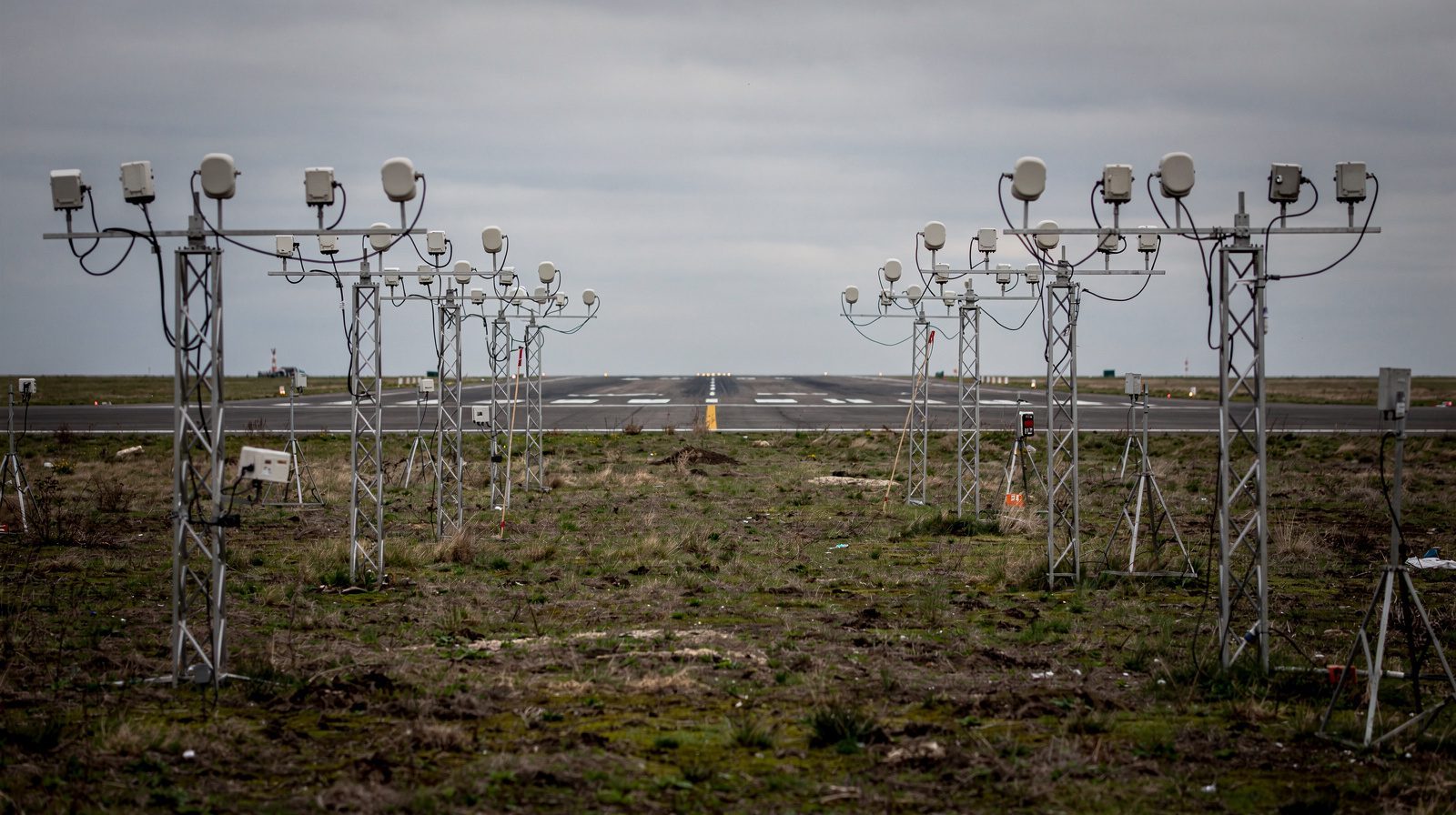
An instrument runway is a runway that is intended for aircraft that use instrument approach procedures.
ICAO Annex 14 and the EU rules (Regulation (EU) No 139/2014) use this idea. They define four types of instrument runway, and they call the sum of instrument and non-instrument runways the “runway type” (EASA definition 39). The precision runway page covers the precision types and their lights in depth. This page covers the instrument runway as a whole.
The four types
A runway is “served by visual aids and at least one non-visual aid” (EASA, definition 22). ICAO says “non-visual aid(s)”. The type depends on the instrument approach operation that the runway is intended for.
| Type | Intended landing operation | Decision height (DH) | Visibility or runway visual range (RVR) |
|---|---|---|---|
| Non-precision approach | Instrument approach operation type A | Not set in the definition | Visibility not less than 1,000 m |
| Precision approach, category I | Type B | Not lower than 60 m (200 ft) | Visibility not less than 800 m, or RVR not less than 550 m |
| Precision approach, category II | Type B | Lower than 60 m (200 ft), not lower than 30 m (100 ft) | RVR not less than 300 m |
| Precision approach, category III | Type B | Lower than 30 m (100 ft), or no DH | RVR less than 300 m, or no RVR limit |
Annex 14 adds a note. The visual aids need not match the scale of the non-visual aids. The conditions in which the operations are intended to take place decide which visual aids are chosen. ICAO refers to Annex 6 for the operation types. The precision approach and non-precision approach pages describe the approaches themselves.
Instrument and non-instrument runways
ICAO defines a non-instrument runway as a runway for visual approach procedures. It also covers an instrument approach procedure to a point beyond which the approach may continue in visual meteorological conditions. A runway can have an instrument procedure and still be a non-instrument runway. The FAA goes the same way. It treats a runway with only circling approaches as a visual runway (AC 150/5300-13B, definition 102). The non-instrument runway page covers that type. It does not cover the rules that change when a runway becomes an instrument runway.
What changes on an instrument runway
ICAO and EASA set stricter or different values for an instrument runway in these places.
- Strip. A strip must extend 60 m before the threshold and beyond the runway end for code numbers 2, 3 and 4. For code number 1, the length is 60 m for an instrument runway and 30 m for a non-instrument runway (Annex 14, 3.4.2). A strip with a precision approach runway extends at least 140 m on each side of the centre line for code number 3 or 4. For code number 1 or 2 it is 70 m. The recommendation for a non-precision approach runway is the same. For a non-instrument runway the recommended distances are 75 m, 55 m, 40 m and 30 m. They apply to code numbers 4, 3, 2 and 1 (3.4.3 to 3.4.5, CS ADR-DSN.B.160).
- Holding position. The minimum distance from the runway centre line to a runway-holding position grows with the type. For code number 4 it is 75 m for a non-instrument runway and 75 m for a non-precision approach runway. It is 90 m for a category I runway. The table notes allow adjustments (Table 3-2).
- Edge lights. The lights stand at most 60 m apart in each row on an instrument runway. On a non-instrument runway the limit is 100 m (5.3.9.6, CS ADR-DSN.M.675).
- Approach lighting. A non-precision approach runway gets a simple approach lighting system where physically practicable. Good visibility or other visual aids can remove the need. A category I runway gets a precision approach category I system. A category II or III runway gets a category II and III system. For a non-instrument runway a simple system is only recommended, for code number 3 or 4 at night (5.3.4.1).
- Centre line and touchdown zone lights. Both are required on a category II or III runway. On a category I runway centre line lights are recommended. This applies in particular to high landing speeds, or to a width between the edge lights over 50 m (5.3.12.1, 5.3.12.2, 5.3.13.1).
- Signs. Signs must be lit for night use with an instrument runway. For a non-instrument runway the rule depends on the code number (5.4.1.7, 5.4.1.8).
Markings
An aiming point marking is required at each approach end of a paved instrument runway of code number 2, 3 or 4. It is recommended for code number 1 (5.2.5, CS ADR-DSN.L.540). A touchdown zone marking is required on a paved precision approach runway of code number 2, 3 or 4 (5.2.6.1). On a non-precision approach or non-instrument runway of code number 3 or 4 it is recommended for extra conspicuity (5.2.6.2).
The FAA ties the minimum marking scheme to the approach category of the runway end (AC 150/5340-1M, Table 2-1):
| Marking | Visual | Non-precision | Precision |
|---|---|---|---|
| Landing designator, centre line | Yes | Yes | Yes |
| Threshold | Only in some cases | Yes | Yes |
| Aiming point | Only in some cases | Only on instrumented runways of 1,280 m (4,200 ft) or longer | Yes |
| Touchdown zone | No | No | Yes |
| Edge | If the full pavement is not usable | If the full pavement is not usable | Yes |
At the intersection of two runways, the runway of higher precedence keeps its markings. The order is category III, II, I, non-precision, visual (AC 150/5340-1M, 2.2.1.1).
The FAA view
For airport design, the FAA sorts runways into four visibility categories (AC 150/5300-13B, paragraph 2.6.4):
- Visual. VFR operations, or only circling minima. Runway lights are low or medium intensity or none.
- Non-precision approach. Lateral guidance only. Visibility is 0.8 km (1/2 statute mile) or more. The height above touchdown (HAT) is 76 m (250 ft) or more.
- Approach procedure with vertical guidance (APV). Vertical guidance to 61 m (200 ft) HAT, with visibility down to 0.8 km (1/2 statute mile).
- Precision approach. HAT lower than 76 m (250 ft) and visibility lower than 1.2 km (3/4 statute mile), down to category III.
For a precision instrument runway, the AC lists a length of at least 1,280 m (4,200 ft). The width is at least 22.9 m (75 ft), and 30.5 m (100 ft) is typical. It also lists high intensity runway lights and precision markings. It lists navigation systems that can support precision operations, such as ILS or the GBAS landing system (GLS).
What it means on an airfield
An instrument runway has more lights to maintain than a non-instrument runway. The approach lights, threshold lights and edge lights all serve the instrument approach. On category II and III runways the centre line and touchdown zone lights do too. TarmacView flies the approach lighting system by drone and measures the colour, relative intensity and coverage of each unit. See the approach lights inspection page. The sources above do not say how an inspection of the lights must be done.
Frequently Asked Questions
- What is an instrument runway?
- An instrument runway is a runway that is intended for aircraft that use instrument approach procedures. ICAO and EASA split it into four types. They are the non-precision approach runway and the precision approach runway of category I, II or III.
- What is a precision instrument runway?
- A precision instrument runway is a runway for precision approaches. ICAO and EASA call it a precision approach runway of category I, II or III. The FAA describes it as a runway that supports IFR operations down to category III with the right infrastructure. It has precision markings and high intensity runway lights.
- What is the difference between an instrument runway and a non-instrument runway?
- An instrument runway serves operations that use instrument approach procedures down to a set limit. A non-instrument runway serves visual approaches. It also serves instrument approaches that end at a point where the pilot continues in visual conditions. The difference changes the strip, the holding position distance, the light spacing and the approach lighting.
- What are the types of instrument runway?
- There are four. The non-precision approach runway serves approaches with a visibility of at least 1,000 m. Precision approach runways serve decision heights of 60 m (200 ft) or more for category I. Category II covers 30 m (100 ft) to below 60 m. Category III covers below 30 m, or no decision height. ICAO Annex 14 sets these limits.
- Does an instrument runway need an ILS?
- No. The ICAO and EASA definitions require visual aids and at least one non-visual aid. They do not name an instrument landing system. The FAA says that its precision instrument runways have navigation systems that can support precision operations, such as ILS and GLS.
- Is a runway with an instrument approach always an instrument runway?
- No. ICAO defines a non-instrument runway as one for visual approaches. It also covers an instrument approach to a point beyond which the approach may continue in visual conditions. The FAA treats a runway with only circling approaches as a visual runway.
- What lights does an instrument runway have?
- Runway edge lights stand at most 60 m apart in each row. The approach lighting depends on the type. A category II or III runway also needs centre line lights and touchdown zone lights. ICAO recommends centre line lights on a category I runway in some cases.
References
- icao-annex-14-vol1
- Annex 14 to the Convention on International Civil Aviation, Aerodromes, Volume I, Aerodrome Design and Operations, Ninth Edition (July 2022, consolidated with later amendments) ICAO
- easa-ear-aerodromes
- Easy Access Rules for Aerodromes (Regulation (EU) No 139/2014), including CS-ADR-DSN Issue 7 EASA
- faa-ac-150-5300-13b
- AC 150/5300-13B, Airport Design FAA
- faa-ac-150-5340-1m
- AC 150/5340-1M, Standards for Airport Markings FAA
This is a reference entry. TarmacView provides drone inspection services and doesn't sell the equipment or materials described in this glossary.