What is a Simple Approach Lighting System?
Simple Approach Lighting System
Definition
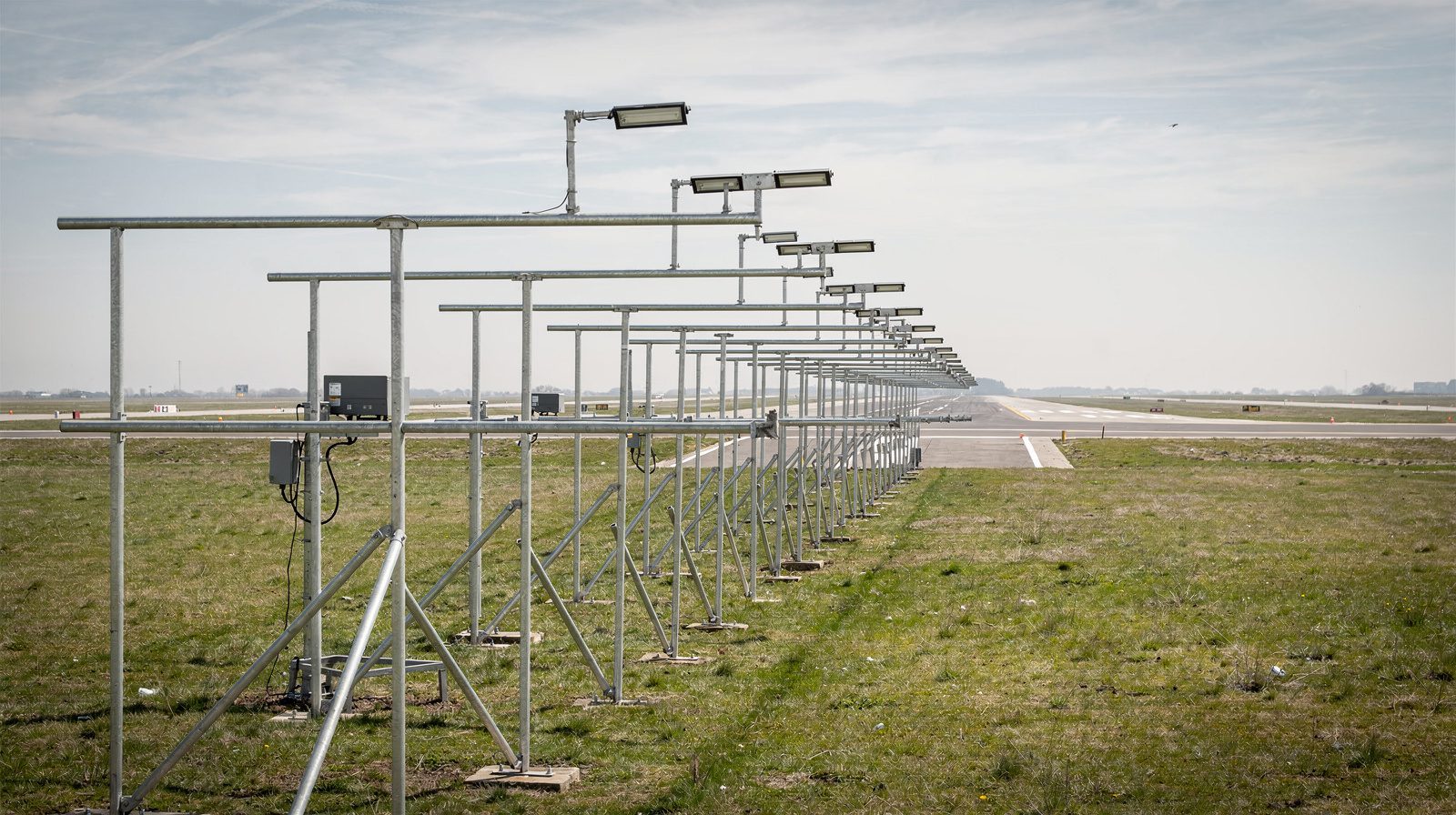
A simple approach lighting system is a row of lights on the runway centre line with one crossbar at 300 m.
ICAO specifies it in Annex 14, 5.3.4.2 to 5.3.4.9. EASA specifies it in CS ADR-DSN.M.626. The safety objective of any approach lighting system is to give alignment and roll guidance and limited distance-to-go information (CS ADR-DSN.M.625(a)). ICAO notes that a simple system can also give visual guidance by day (5.3.4.1).
The precision approach lighting system (PALS) page covers the Category I, II and III patterns and sets the simple system beside them in one table. This page covers the simple system in full.
Layout
The rules give these dimensions (Annex 14, 5.3.4.2 to 5.3.4.5, and CS ADR-DSN.M.626):
- Centre line. A row of lights on the extended runway centre line, at least 420 m long from the threshold whenever possible.
- Spacing. The lights stand 60 m apart. Where the pilot needs better guidance, they may stand 30 m apart.
- Innermost light. It stands 60 m or 30 m from the threshold, to match the spacing.
- Crossbar. One row of lights, 18 m or 30 m long, at 300 m from the threshold.
- Crossbar spacing. The lights make a linear effect. Spacings from 1 m to 4 m are in use. A 30 m crossbar may have a gap on each side of the centre line, and each gap must be 6 m at most.
ICAO explains why the gaps exist. They can improve directional guidance when a pilot approaches with a lateral error. They also make it easier for rescue and firefighting vehicles to pass (5.3.4.3, Note 1).
When the full length does not fit
ICAO gives this order of fallback (5.3.4.5, a Recommendation):
- Extend the centre line to 300 m, so that it includes the crossbar.
- If that is not possible, extend it as far as practicable. Each centre line light then becomes a barrette at least 3 m long.
- If the system has a crossbar at 300 m, the operator may add a second crossbar at 150 m.
A centre line light is either a single source or a barrette at least 3 m long (5.3.4.7). ICAO found a spacing of 1.5 m between adjacent lights in a barrette satisfactory. If the operator expects to upgrade the system to a precision approach system, 4 m barrettes may be advisable (5.3.4.7, Notes 1 and 2).
Which runways get it
ICAO and EASA list the runway types in 5.3.4.1 and CS ADR-DSN.M.625:
| Runway | Simple system |
|---|---|
| Non-instrument runway, code number 3 or 4, used at night | Recommended where physically practicable, unless the runway is used only in good visibility and other visual aids give enough guidance |
| Non-precision approach runway | Required by ICAO where physically practicable, unless the runway is used only in good visibility or other visual aids give enough guidance. EASA words it as “should” |
| Precision approach runway | Does not apply. These runways need the Category I, or the Category II and III, system |
ICAO defines a non-precision approach runway as a runway for an instrument approach operation type A with a visibility not less than 1,000 m. A non-instrument runway serves visual approach procedures, or an instrument procedure to a point from which the approach may continue in visual conditions.
For a non-precision approach runway, ICAO suggests that the operator consider a Category I system or a runway lead-in lighting system (5.3.4.1, Note). The lead-in lighting page covers the second option.
Colour and intensity
The lights are fixed, not flashing (5.3.4.7). The colour must set the system apart from other aeronautical ground lights and from extraneous lighting. EASA adds that fixed lights showing variable white are preferred (M.626(d)). ICAO names no colour for the simple system.
The two runway types have different intensity rules:
- Non-instrument runway. The lights show at all angles in azimuth that a pilot on base leg and final approach needs. The intensity must suit all conditions of visibility and ambient light that the system serves (5.3.4.8).
- Non-precision approach runway. The lights show at all angles that a pilot needs on a normal final approach. They must give guidance by day and by night in the worst conditions that the system is meant to serve (5.3.4.9).
Where surrounding lights make the system hard to find at night, sequence flashing lights in the outer part may help (5.3.4.7, Note 3). The sequenced flashing lights page covers them.
Siting
The system lies as nearly as practicable in the horizontal plane through the threshold (5.3.4.6). Two conditions apply:
- Only an ILS or MLS azimuth antenna may protrude through the plane of the lights, within 60 m of the centre line.
- No light may be screened from an approaching aircraft, except one at the end of a crossbar or barrette.
An ILS or MLS azimuth antenna that protrudes through the plane counts as an obstacle. It is marked and lighted as one.
ICAO Attachment A gives guidance for the layout (11.2):
- A tall object may stand within 60 m of the centre line and within 900 m of the threshold. Then it may be advisable to raise the outer half of the pattern so that it clears the top of the object (11.2.9).
- The lights should not stand below a gradient of 1 in 66 downward from the threshold to a point 300 m out. Beyond 300 m, they should not stand below 1 in 40 (11.2.10).
- Within a stopway or clearway, and within 150 m of the runway end, the lights should stand as low as local conditions permit. This limits damage to an aircraft that overruns or undershoots (11.2.8).
- Where the threshold is displaced, the approach lights still run up to the threshold. Inset lights fill the part from the runway end to the threshold (11.1.2).
Power
EASA Table S-1 lists the approach lighting system on a non-precision approach runway with a maximum switch-over time of 15 seconds. The table lists no approach lighting for a non-instrument runway.
Simple system and FAA systems
The FAA documents that we checked do not use the name “simple approach lighting system”. The FAA economy systems for non-precision approaches are the MALS and the ODALS. FAA Order JO 6850.2C paragraph 15 says that the FAA no longer installs either as a new facility. The MALSR page covers the FAA medium intensity system for Category I approaches.
What an inspection checks
An inspection of a simple approach lighting system checks these items:
- The centre line has all its lights, at the right spacing, and the crossbar stands at 300 m.
- Each light works, and each barrette is complete.
- The pattern lies on the extended runway centre line.
- No tree, building or other object hides a light from the pilot.
A drone flies the approach path and sees the system from the pilot’s side. TarmacView’s approach lights inspection covers this check.
Frequently Asked Questions
- What is a simple approach lighting system?
- A simple approach lighting system is a row of lights on the extended runway centre line with one crossbar at 300 m from the threshold. ICAO Annex 14, 5.3.4.2, and EASA CS ADR-DSN.M.626 specify it. It serves a non-precision approach runway and some non-instrument runways.
- How long is a simple approach lighting system?
- The centre line extends, whenever possible, at least 420 m from the threshold. A crossbar of 18 m or 30 m stands at 300 m. The centre line lights are 60 m apart, or 30 m apart where the pilot needs better guidance. The innermost light is 60 m or 30 m from the threshold.
- Which runways need a simple approach lighting system?
- ICAO requires one on a non-precision approach runway where physically practicable. Exceptions are a runway used only in good visibility, or one where other visual aids give enough guidance. ICAO and EASA recommend one on a non-instrument runway with code number 3 or 4 that is used at night.
- What is the difference between a simple and a precision approach lighting system?
- A simple system has a centre line of at least 420 m and one crossbar at 300 m. A precision Category I system has a centre line of 900 m where possible, also with a crossbar at 300 m. A Category II or III system adds side rows and a second crossbar at 150 m.
- What colour are simple approach lights?
- The lights are fixed. The colour must make the system easy to tell from other aeronautical ground lights and from extraneous lighting. EASA adds that fixed lights showing variable white are preferred. ICAO does not name a colour for the simple system.
- What if there is no room for 420 m of lights?
- The centre line should then extend to 300 m, so that it includes the crossbar. If that is not possible, it extends as far as practicable and each centre line light becomes a barrette at least 3 m long. A second crossbar may stand at 150 m if the system has a crossbar at 300 m.
- Does the FAA have a simple approach lighting system?
- No, the FAA documents that we checked do not use the name. The FAA economy systems for non-precision approaches are the MALS and the ODALS. FAA Order JO 6850.2C says that the FAA no longer installs either as a new facility.
References
- icao-annex-14-vol1
- Annex 14 to the Convention on International Civil Aviation, Aerodromes, Volume I, Aerodrome Design and Operations, Ninth Edition (July 2022, consolidated with later amendments) ICAO
- easa-ear-aerodromes
- Easy Access Rules for Aerodromes (Regulation (EU) No 139/2014), including CS-ADR-DSN Issue 7 EASA
- faa-jo-6850-2c
- Order JO 6850.2C, Visual Guidance Lighting Systems FAA
This is a reference entry. TarmacView provides drone inspection services and doesn't sell the equipment or materials described in this glossary.