What are Navigational Lights & Airport Lighting Systems?
Navigational Lights & Airport Lighting Systems
Navigational lights and airport lighting systems form the backbone of aviation safety, providing essential visual cues and references for pilots, air traffic controllers, and ground personnel. Their correct use and standardization are pivotal in preventing collisions, guiding aircraft through all phases of flight, and ensuring safe operations regardless of visibility or weather conditions.
Navigational Lights: Definition and Purpose
Navigational lights, sometimes called position lights, are standardized external lights installed on all aircraft. Their purpose is to signal an aircraft’s orientation, heading, and operational status to others, particularly in low visibility or at night. By international convention (ICAO Annex 6 and FAA 14 CFR 91.209), the left wingtip carries a red light, the right wingtip a green light, and the tail a white light. Their non-flashing, steady illumination provides an instant reference for observers to determine the aircraft’s direction of travel and presence.
Equally crucial are airport lighting systems, which guide aircraft during takeoff, landing, and taxiing. These include runway edge and centerline lights, taxiway lights, approach lighting systems, and more, all with standardized color codes and placement.
Together, navigational lights and airport lighting infrastructure form a globally harmonized system that ensures aviation safety in every environment.
Types of Aircraft External Lights
Navigation (Position) Lights
Navigation lights are the primary visual identifiers for an aircraft. The red (left), green (right), and white (tail) lights allow pilots, ATC, and ground staff to recognize an aircraft’s orientation and movement. These must be visible from sunset to sunrise and during poor visibility, with minimum luminous intensities and coverage arcs defined by ICAO and FAA regulations.
| Light | Location | Arc of Visibility | Standard Color |
|---|---|---|---|
| Left | Left wingtip | 110° left | Red |
| Right | Right wingtip | 110° right | Green |
| Tail | Tail/wingtips | 140° aft | White |
Modern navigation lights increasingly use LED technology, offering brighter, more reliable illumination and integrated health monitoring.
Beacon (Red Anti-Collision) Lights
Beacon lights are prominent flashing or rotating red lights mounted on the upper and lower fuselage. Activated whenever engines or rotors are running, they warn ground crew and increase the aircraft’s visibility during all movements. Regulations require redundancy in these systems, with separate circuits for top and bottom beacons.
LED beacons are now standard, offering reliability and lower maintenance. Military aircraft may also use covert IR beacons for night vision compatibility.
Strobe (White Anti-Collision) Lights
Strobe lights are high-intensity, flashing white lights on wingtips and/or the tail. They are most visible during takeoff, landing, and while crossing runways, providing powerful anti-collision visibility. Regulations specify flash rates and luminous intensity for maximum effectiveness.
Strobes are typically activated on active runways and in flight below 10,000 feet, and turned off during ground taxi to prevent glare.
Taxi Lights
Taxi lights are medium-intensity, forward-facing lights that illuminate taxiways and ramp areas for ground movement. Positioned on the nose gear or wing roots, they produce a wide beam to reveal centerlines, turns, and obstacles. Modern systems use LEDs for efficiency and durability, with some offering automatic intensity adjustment.
Landing Lights
Landing lights are the most powerful aircraft lights, installed in wings, fuselage, or landing gear. They project a focused beam ahead for takeoff and landing, helping pilots see runway markings and enhancing the aircraft’s visibility to others. They are usually used below 10,000 feet or during approach and takeoff.
LED and HID landing lights have largely replaced older incandescent systems, offering instant-on and high durability.
Runway Turnoff Lights
Runway turnoff lights are wide-angle lights angled to the sides, aiding pilots during low-speed turns onto taxiways or while vacating the runway. They illuminate pavement edges and signage beyond the forward beam of landing and taxi lights.
LEDs have improved their performance and reliability, ensuring safe maneuvering in all conditions.
Wing Inspection Lights
Wing inspection lights illuminate the leading edge of the wings, allowing pilots to check for ice, snow, or damage, especially in icing conditions. They are used during preflight, taxi, and in-flight checks when icing is suspected.
LED technology provides focused, glare-free illumination for effective inspections.
Logo Lights
Logo lights are wide-angle white lights mounted on the tail or horizontal stabilizer, illuminating the airline logo on the vertical stabilizer. While not mandatory, they improve aircraft visibility on the ramp and in flight, and support airline branding.
LED logo lights are preferred for their uniform light and longevity.
Formation Lights
Formation lights are specialized, low-intensity lights on military and some special mission aircraft. Arranged in patterns along wings and fuselage, they help maintain close formation at night, with IR options for night vision compatibility.
They are governed by military specifications (e.g., MIL-L-81174, NATO STANAG 3347), ensuring interoperability.
Searchlights
Searchlights are powerful, steerable lights used by police, SAR, and firefighting aircraft to illuminate ground targets or terrain at night. Often mounted on gimbals, they may have variable beam width and IR modes for night vision.
Modern searchlights utilize LEDs or xenon lamps for intense, reliable output.
Airport and Airfield Lighting Systems
Runway and Taxiway Lighting
Airport lighting systems are standardized for clarity and safety:
| Lighting Type | Color | Location/Purpose |
|---|---|---|
| Runway Edge | White/Yellow | Runway edges |
| Runway Centerline | White/Red | Runway center |
| Runway Threshold | Green/Red | Runway start/end |
| Taxiway Edge | Blue | Taxiway edges |
| Taxiway Centerline | Green | Taxiway center |
Runway edge and centerline lights guide pilots during takeoff and landing. Threshold lights mark the beginning and end of usable runway. Taxiway lights (blue edge, green centerline) ensure safe ground movement. Many airports offer adjustable intensity lighting and pilot-controlled systems for flexibility.
Approach Lighting Systems (ALS)
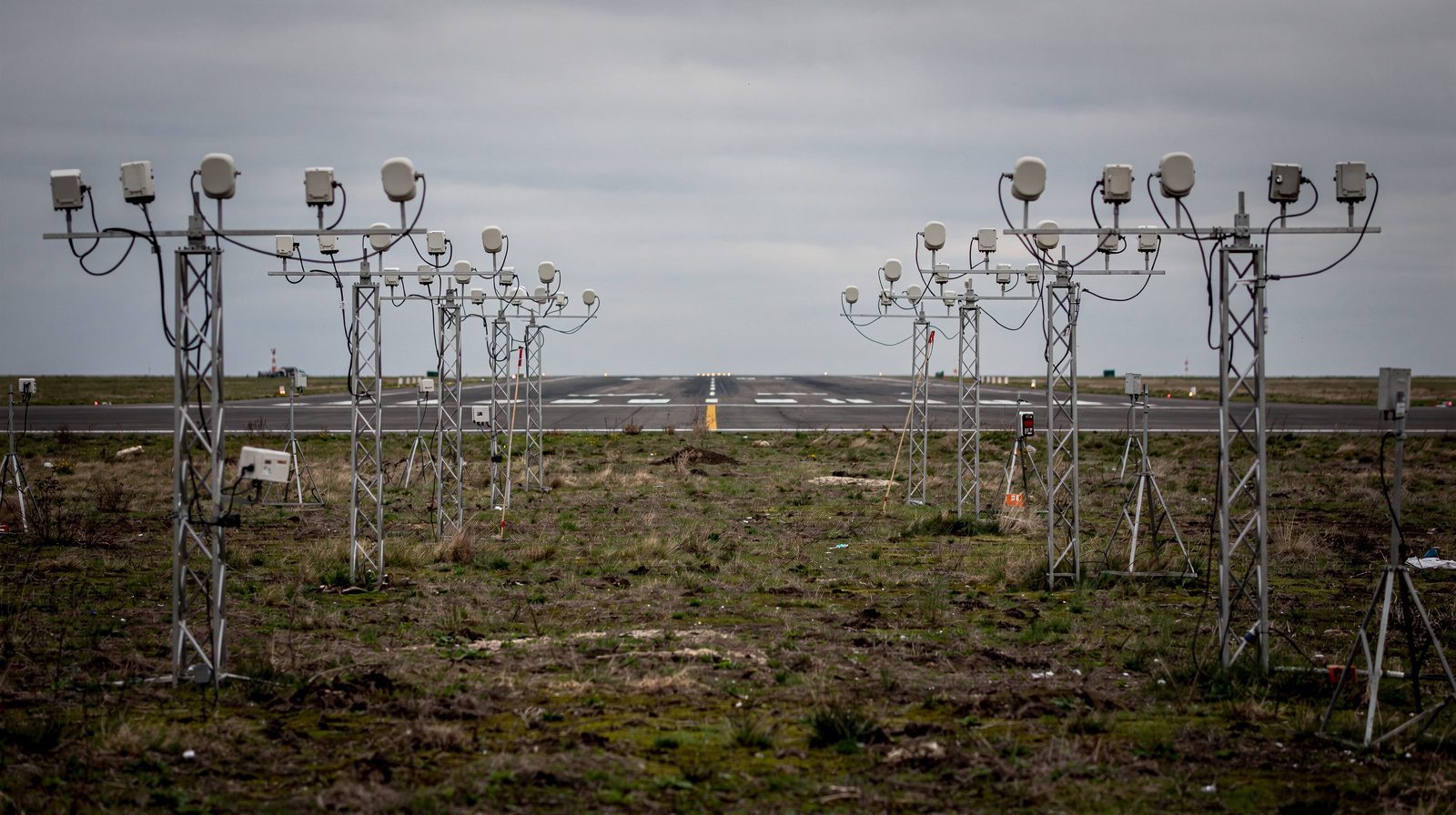
Approach Lighting Systems are arrays of high-intensity lights extending from the runway threshold into the approach area. They enable pilots to transition from instrument to visual flight during landing, especially in low visibility.
Complex ALS (ALSF-1, ALSF-2) extend up to 900 meters from the runway and include sequenced flashers and crossbars for alignment and distance cues. Activation and intensity are controlled from the tower or by pilots at some airports.
Obstruction Lighting
Obstruction lighting marks tall structures near airports, such as towers, buildings, or cranes, to prevent aircraft collisions. These lights are typically red or white, steady or flashing, and their placement/intensity is defined by ICAO and FAA standards. Some use dual lighting (white by day, red by night) for optimal visibility.
Technology Trends & Regulatory Standards
Technology Evolution
- LED adoption is now widespread, offering superior brightness, longevity, and energy efficiency.
- Integrated health monitoring enables real-time diagnostics and maintenance alerts, reducing downtime.
- Automated controls adjust lighting intensity based on weather, time of day, or operational phase.
Regulatory Framework
- ICAO Annexes 6, 14, and 2: Set international standards for aircraft and airport lighting.
- FAA 14 CFR 91.209, TSO-C30, Advisory Circulars: Specify US requirements for light placement, intensity, and operation.
- Military Standards: Ensure compatibility and safety for tactical and multi-national operations.
Operational Best Practices
- Routine inspections: Ensure all lights are operational before flight or airport operations begin.
- Standardized procedures: Adhere to checklists for light activation/deactivation during each flight phase.
- Regular maintenance: Clean and service lights to maintain intensity and coverage.
Conclusion
Navigational lights and airport lighting systems are foundational to aviation safety, supporting every phase of flight and ground operations. Their standardization, combined with technological advancements and rigorous regulatory oversight, ensures that the skies and airports remain safe for all.
For airlines, airports, and pilots, understanding and maintaining these systems is not just a regulatory requirement, it’s a critical responsibility that saves lives and supports the seamless flow of global air traffic.
Frequently Asked Questions
- What is the primary purpose of navigational lights on aircraft?
- Navigational lights indicate an aircraft's position, orientation, and movement to other pilots and ground personnel, helping prevent collisions. Their color and placement are standardized globally to ensure universal comprehension, especially in low visibility or at night.
- How do airport lighting systems contribute to aviation safety?
- Airport lighting systems, including runway, taxiway, and approach lights, provide visual cues that guide pilots during takeoff, landing, and taxi operations, especially in poor weather or darkness. They are standardized to ensure predictability and safety for all aircraft.
- Are there differences between aircraft lighting regulations in the US and internationally?
- While ICAO sets global standards, regional authorities like the FAA may add specific requirements. However, most commercial airports and aircraft adhere to both to maintain international interoperability and compliance.
- What are the latest advancements in navigational and airport lighting technology?
- Recent advancements include LED lighting for improved visibility, longevity, and energy efficiency, as well as integration with health monitoring systems and automated controls for adaptive intensity and operational reliability.
- Why are different colors used for various lights on aircraft and airports?
- Colors are standardized for instant recognition: red for left wing, green for right, white for tail, blue for taxiway edges, green for taxiway centerlines, and combinations for runway thresholds and ends. This coding reduces confusion and enhances safety.
This is a reference entry. TarmacView provides drone inspection services and doesn't sell the equipment or materials described in this glossary.