What is a Taxiway Edge Light?
Taxiway Edge Light: In-depth Technical Guide
Definition and Core Function
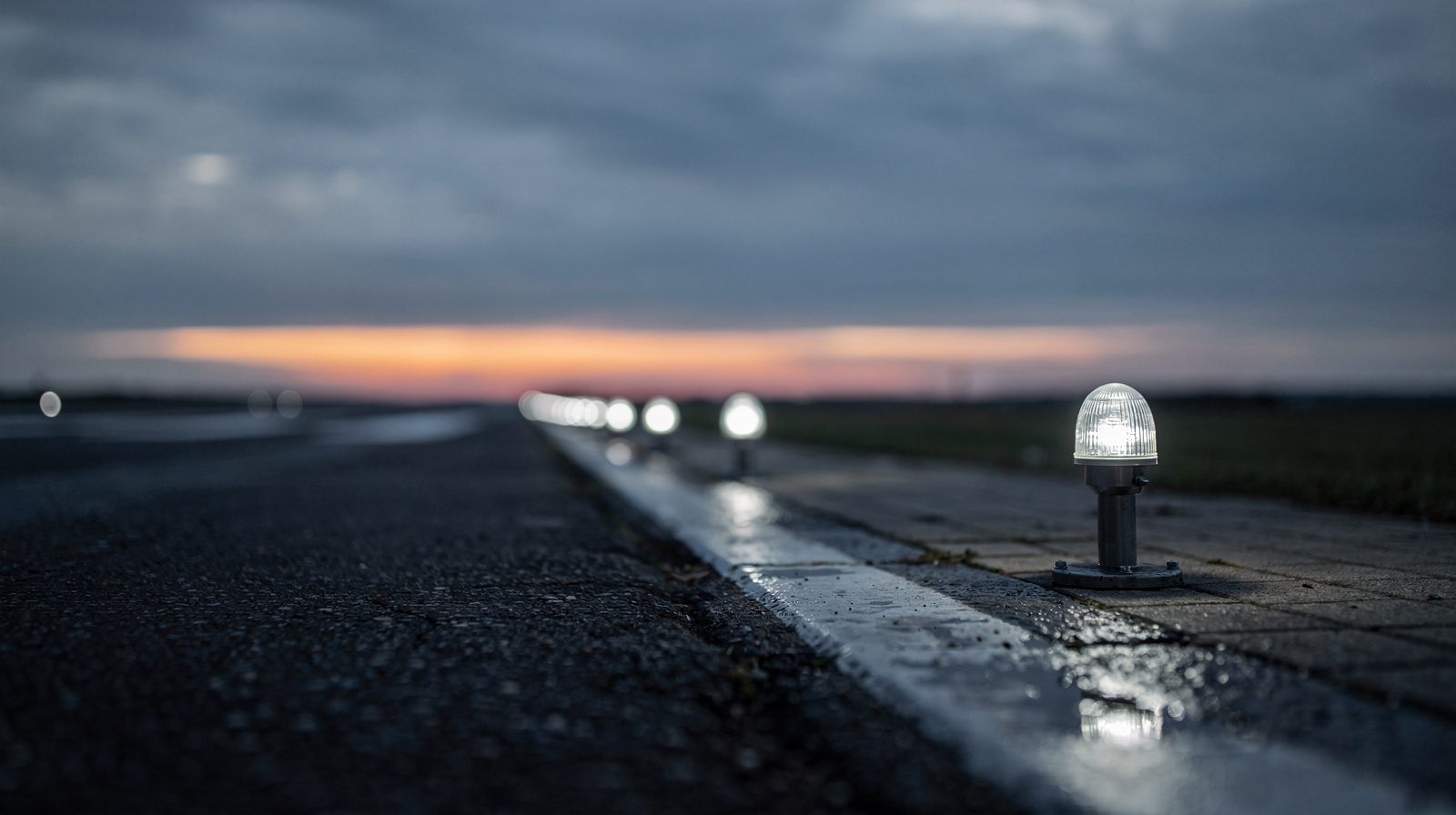
Taxiway edge lights are omnidirectional blue lights installed along the lateral boundaries of airport taxiways. Their primary function is to define the edges of paved taxiways, giving pilots and ground vehicles a clear visual reference during darkness or poor weather. By providing unmistakable boundary cues, they prevent inadvertent excursions onto unprepared ground, thus safeguarding aircraft, vehicles, and airport infrastructure.
The blue color is strictly standardized (wavelength 450–495 nm) for high nighttime visibility and is distinct from the white or yellow runway lights and green taxiway centerline lights. Their omnidirectional design ensures pilots can see them from any ground approach angle, especially vital during complex taxi maneuvers or in low-visibility operations.
Installation and Operational Use
Taxiway edge lights are installed on all operational taxiways at major airports and on primary taxiways at smaller airfields. Their placement follows strict guidelines, spaced 50 to 200 feet (15 to 60 meters) apart, with closer spacing on curves or complex intersections for continuous boundary definition. Lights are aligned with the painted edge markings, and in high-traffic, jet blast, or apron areas, recessed (in-pavement) versions are used to minimize impact risk.
Key purposes:
- Visually define taxiway boundaries at night or in low visibility
- Enhance safety by preventing excursions or ground incidents
- Support 24/7 flight operations and low-visibility procedures
- Provide clear cues for aircraft clearance and turning radii
Physical and Technical Characteristics
| Feature | Specification |
|---|---|
| Color | Blue (450–495 nm, ICAO/FAA) |
| Light Distribution | Omnidirectional, visible from all ground approach angles |
| Intensity | Low (typically 3–10 candelas), adjustable where needed |
| Lamp Technology | Incandescent (classic), LED (modern) |
| Mounting | Elevated (standard), Recessed/in-pavement (at crossings, aprons) |
| Fixture Height | 14–16 inches (35–41 cm) for elevated, flush for in-pavement |
| Spacing | 50–200 feet (15–60 meters), closer on curves |
| Construction | Frangible (breakaway) bases for elevated lamps |
| Power Supply | Series circuit, 6.6A standard, with isolation transformers |
| Protection | Waterproof, dustproof, heat-resistant, snow/ice mitigation in cold climates |
Color and Optical Properties
The blue emission is intentionally less intense than runway lighting, preventing glare and preserving cockpit night vision. Modern LED fixtures use optical lenses or diffusers for uniform color rendering across all viewpoints.
Lamp and Fixture Technologies
Incandescent bulbs, once the standard, naturally produce heat (helping to melt snow/ice) but require frequent replacement. LED technology provides up to 50,000 hours of life, instant-on capability, energy savings, and stable color output. In cold climates, LED fixtures may be equipped with integrated heaters to prevent snow/ice buildup.
Installation and Spacing
- Elevated fixtures: On frangible bases, break away if struck, minimizing aircraft/vehicle damage.
- Recessed (in-pavement): Flush with the surface, used where impact risk is high (intersections, aprons, busy taxiways).
- Spacing: 200 feet max on straight sections, 25–50 feet on curves or complex geometry per ICAO/FAA.
Regulatory Standards
FAA (United States)
- AIM Chapter 2, Section 3: Defines color, purpose, operational use.
- AC 150/5340-30: Specifies design, installation, maintenance, fixture type, mounting, spacing, and power.
- Key rules: Blue, omnidirectional, frangible mounting, recessed at crossings, spacing ≤200 ft (≤60 m), closer on curves.
ICAO (International)
- Annex 14, Vol I: Universal blue color, max spacing 60 m (197 ft), 7.5 m (25 ft) on curves, frangibility, photometric/chromatic standards.
Many countries adopt ICAO standards, sometimes with stricter national requirements.
Taxiway Edge Lights vs. Other Airfield Lighting
| Lighting Type | Color | Location | Purpose |
|---|---|---|---|
| Taxiway Edge Lights | Blue | Taxiway edges | Defines lateral limits of taxiways |
| Taxiway Centerline | Green | Taxiway centerline | Guides aircraft along taxi route |
| Runway Edge Lights | White/Yellow | Runway edges | Defines runway boundaries |
| Runway Centerline | White/Red | Runway centerline | Guides aircraft on runway axis |
| Apron Edge Lights | Blue | Apron boundaries | Delineates apron limits |
| Clearance Bar Lights | Yellow | Taxiway holding positions | Indicates holding points |
| Runway Guard Lights | Flashing Yellow | Taxiway/runway intersections | Warns of runway entry |
| Stop Bar Lights | Red | Across taxiway at runway entry | Instructs aircraft to stop |
| Runway Threshold Lights | Green/Red | Runway threshold ends | Indicates start/end of landing area |
Use Cases and Scenarios
Night Operations: Blue edge lights guide taxiing aircraft when surface markings aren’t visible.
Low Visibility: In fog or heavy precipitation, blue lights provide the only clear boundary reference.
Apron/Ramp Areas: Blue lights delineate parking and maneuvering zones for crews.
Curved Taxiways: Closer light spacing ensures continuous visible arcs for safe turning, especially for widebody aircraft.
Smaller Airports: Blue reflectors may substitute for powered lights if traffic is light and centerline lighting is present.
Technical & Operational Details
- Intensity control: Fixed or adjustable via ATC or pilot-controlled lighting (PCL) at non-towered fields.
- Maintenance: Incandescent bulbs require frequent replacement, LEDs reduce maintenance and energy costs.
- Snow/ice mitigation: Incandescent types melt snow naturally, LEDs may use integrated heaters in cold climates.
- Series circuit: 6.6A with isolation transformers ensures single-lamp failure doesn’t disrupt the full circuit.
- Frangibility: Elevated fixtures break away if hit, minimizing damage risk.
Safety and Incident Prevention
Taxiway edge lights are a fundamental safety feature, preventing runway incursions and taxiway excursions. Their blue color is a critical visual cue, helping pilots avoid confusion with runways and maintaining situational awareness in all conditions.
Best practices:
- Never taxi beyond blue edge lights without ATC clearance.
- Report outages immediately for prompt repair.
- Use temporary lighting or reflectors during maintenance.
Real-World Example
After sunset, a pilot follows green centerline and blue edge lights from runway exit to terminal. At intersections, lights are recessed for safety. The consistent blue boundary ensures safe, precise taxiing through curves and onto the apron.
Technical Specifications Table
| Category | Specification/Description |
|---|---|
| Color | Blue (450–495 nm) |
| Light Type | Omnidirectional, steady-burning |
| Intensity | Low (3–10 candelas), adjustable where required |
| Lamp Technology | Incandescent (classic), LED (modern) |
| Fixture Height | 14–16 in (35–41 cm) elevated, flush in-pavement |
| Spacing | 50–200 ft (15–60 m), 25 ft (7.5 m) on curves |
| Mounting | Frangible base (elevated), recessed (in-pavement) |
| Power Supply | 6.6A series circuit, isolation transformers |
| Protection | Waterproof, dustproof, heat-resistant, snow/ice mitigation |
Summary
Taxiway edge lights are indispensable for safe and efficient airport ground operations. Recognizable by their blue color and omnidirectional design, they provide essential visual guidance to pilots and crews, supporting 24-hour, all-weather airport functionality, and reducing the risk of costly ground incidents.
For modern airports, transitioning to LED taxiway edge lights further enhances safety, visibility, and operational efficiency while lowering maintenance costs and environmental footprint.
For further information or to discuss upgrades to your airfield lighting, contact our experts or schedule a demo .
Frequently Asked Questions
- What color are taxiway edge lights and why?
- Taxiway edge lights are always blue, as mandated by ICAO and FAA standards. The blue color provides high visibility at night and is easily distinguishable from other airfield lighting, helping pilots and ground crews avoid confusion between taxiways, runways, and aprons.
- How are taxiway edge lights installed and spaced?
- Taxiway edge lights are typically installed in elevated fixtures on frangible bases or recessed in-pavement at intersections or high-traffic areas. Spacing is usually 50–200 feet (15–60 meters), but may be as close as 25 feet (7.5 meters) on curves or complex sections to ensure a continuous visible boundary.
- What is the difference between taxiway edge lights and runway edge lights?
- Taxiway edge lights are blue and mark the edges of taxiways, while runway edge lights are white (with yellow near the end) and delineate runway boundaries. This color differentiation is a critical safety feature to prevent runway incursions and taxiway excursions.
- Are taxiway edge lights used at all airports?
- They are required at airports with night operations or frequent low visibility, especially at medium and large airports. At smaller airports, blue reflectors may substitute for powered lights if traffic is low and centerline lighting is adequate.
- What are the benefits of LED taxiway edge lights?
- LED taxiway edge lights offer longer lifespans (up to 50,000 hours), lower energy consumption, instant-on capability, stable color output, and reduced maintenance requirements compared to traditional incandescent lights. Many modern airports are upgrading to LED systems for these advantages.
This is a reference entry. TarmacView provides drone inspection services and doesn't sell the equipment or materials described in this glossary.