What is a Side Light (Edge Light)?
Airport Lighting Glossary: Side Light (Edge Light) – Marking Sides of Operational Areas
Side Light (Edge Light): Definition and Function
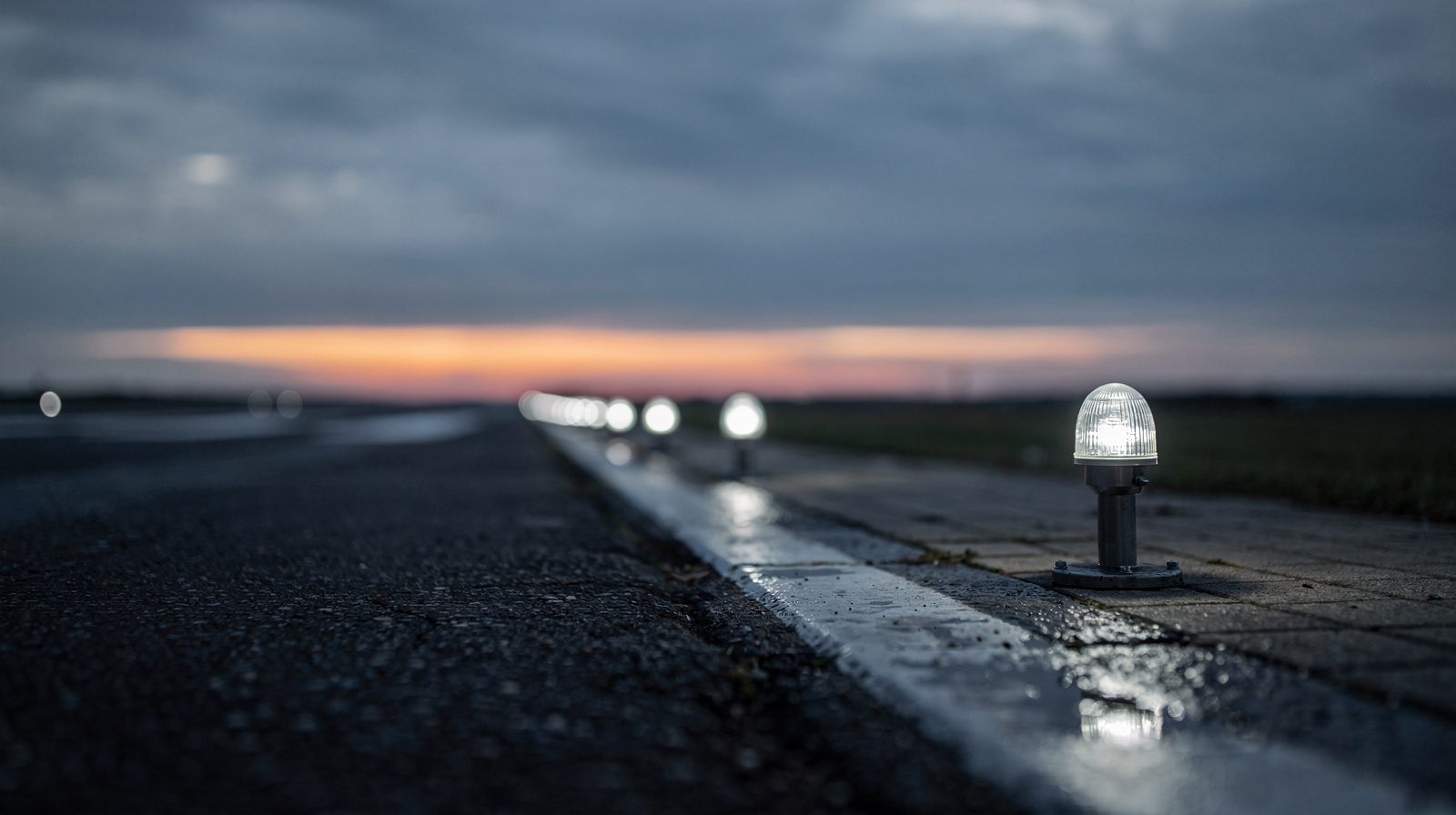
A side light, commonly called an edge light, is a fixed aeronautical ground light placed along the boundaries of runways, taxiways, aprons, helipads, holding bays, or safety areas at airports and airfields. Side lights visually define the usable edge of these surfaces, helping pilots, vehicle operators, and maintenance crews identify where operational pavement ends and non-operational or hazardous areas begin.
These lights are fundamental to airport visual aid systems, enabling safe aircraft movements in darkness, fog, or marginal weather conditions. Their color, placement, and intensity are governed by strict standards from the International Civil Aviation Organization (ICAO) Annex 14 and national authorities like the Federal Aviation Administration (FAA).
Runway Edge Lights: Technical Details and Color Coding
Runway edge lights form two parallel rows along the full length of the runway, spaced between 2 and 10 feet (0.6–3 meters) from the pavement edge. Their primary color is white, signifying a usable runway surface. On runways with precision approaches, the last 600 meters (2,000 feet) or half the runway length (whichever is less) use yellow (amber) edge lights, marking the caution zone near the runway end.
Runway edge lights come in three intensity classes:
- High Intensity Runway Lights (HIRLs)
- Medium Intensity Runway Lights (MIRLs)
- Low Intensity Runway Lights (LIRLs)
HIRLs allow remote adjustment by air traffic control or pilots, while MIRLs/LIRLs are more common at regional or low-traffic airports. ICAO/FAA standards specify maximum spacing (60m/200ft), brightness, and fixture robustness. Outages must be reported and repaired promptly.
Taxiway Edge Lights: Features and Operational Use
Taxiway edge lights are universally blue, providing clear contrast with runways and preventing confusion. They are typically omnidirectional and low-profile (elevated less than 14 inches/350mm), but inset (flush-mounted) lights may be used where snow, jet blast, or wheel clearance is a concern.
Spacing is up to 60m (200ft) on straight taxiways, reduced at curves or intersections for clarity. Taxiway edge lights are crucial for safe movement and situational awareness, especially at complex or busy airports. They are often complemented by green centerline lights on taxiways used for low-visibility operations.
Apron Edge (Side) Lights: Safety and Variations
Apron edge lights define the perimeter of parking aprons, service areas, and ramp zones. They are typically blue (sometimes green at entry/exit points). Placement and spacing are determined by local needs and airport-specific procedures.
These lights prevent aircraft or vehicles from accidentally entering non-load-bearing surfaces. Apron edge lights are especially critical at airports with complex ramp layouts or high risk of ground collisions. LEDs are now widely used for their reliability and energy efficiency.
Specialized Edge Lights: Holding Bays, Helipads, and Safety Areas
Holding Bay Edge Lights
Used to outline holding areas, deicing pads, or remote stands. Typically blue, sometimes with green at taxiway connections. Provide unambiguous boundaries in low visibility.
Helipad Edge Lights
Mark the perimeter of helipads with white (sometimes yellow) lights. Spaced no more than 5 meters (16ft) apart, low-profile or flush-mounted to prevent interference with rotor wash.
Safety Area Edge Lights
Indicate boundaries of designated safety areas, such as emergency access routes or hazardous material zones. Colors vary (commonly blue, yellow, or red).
Light Fixture Types: Elevated, Inset, and Advanced Technologies
- Elevated edge lights: Surface-mounted, easy to maintain, high visibility. Risk of damage in high-traffic or snow areas.
- Inset edge lights: Flush-mounted, protected from wheels/jet blast/snowplows, complex to install and repair.
- LED edge lights: Used in both types, offer low energy use, long life, stable color, and advanced features like remote monitoring and automatic brightness adjustment.
| Fixture Type | Typical Use | Advantages | Disadvantages |
|---|---|---|---|
| Elevated | Runways, straight taxiways | Easy maintenance, high visibility | Prone to damage, may obstruct snow removal |
| Inset (Flush) | High-speed exits, intersections, snow-prone areas | Protected, no obstruction | Complex installation, costly repair |
| LED (Any type) | All areas | Low energy, long life, stable color | Higher initial cost, retrofit needed |
Regulatory Standards: ICAO Annex 14 and FAA Specifications
ICAO Annex 14 and FAA Advisory Circular 150/5345-46 specify:
- Color coding for each operational area
- Intensity classes (HIRL, MIRL, LIRL)
- Maximum spacing (60m/200ft)
- Fixture durability and maintenance
- Integration with lighting control systems for remote operation and monitoring
| Regulatory Body | Standard/Document | Color Code | Intensity Classes | Spacing (Max) | Notes |
|---|---|---|---|---|---|
| ICAO | Annex 14, Vol. I, Ch. 5 | White, yellow, blue, green | High, Medium, Low | 60m (200ft) | International standard |
| FAA | AC 150/5345-46, AIM 2-1-4 | White/yellow (runway), blue (taxiway) | HIRL, MIRL, LIRL | 60m (200ft) | U.S. national adaptation |
Light Intensity Classes and Pilot-Controlled Lighting
- HIRL: Major, instrument runways, 5 intensity steps, controlled by ATC or pilots (via PCL)
- MIRL: Regional, secondary runways, 2–3 steps, controlled by ATC or PCL
- LIRL: Low-traffic, non-towered airports, typically 1 step
Pilots at many airports can activate or adjust edge lighting intensity via the radio, ensuring safe illumination only when needed.
| Intensity Class | Application | Steps/Levels | Control Method | Typical Airports |
|---|---|---|---|---|
| HIRL | Major, instrument runways | 5 | ATC, PCL | International, CAT II/III |
| MIRL | Regional, secondary runways | 2-3 | ATC, PCL | Regional, GA, military |
| LIRL | Small, low-traffic airfields | 1 | Manual/PCL | General aviation, rural |
Summary
Side (edge) lights are critical for the safety and efficiency of airport operations, providing universally recognized visual boundaries for all operational surfaces. Their design, installation, and operation are strictly regulated to ensure reliability, consistency, and pilot confidence worldwide. Advanced LED technology, remote control, and integration with modern airfield lighting systems continue to enhance their effectiveness and sustainability.
Frequently Asked Questions
- What is a side light (edge light) at an airport?
- A side light or edge light is a ground-based light fixture installed along the edges of runways, taxiways, aprons, helipads, or safety areas to define the operational boundaries. They help pilots and vehicle operators identify pavement limits and avoid hazards, particularly at night or in low visibility. Colors and placement are strictly regulated for safety and consistency.
- What colors are used for edge lights and what do they indicate?
- White edge lights mark runway edges, taxiway and apron edges use blue, runway caution zones near the end are indicated by yellow (amber) lights. Helipad edges are typically white. These colors help pilots instantly recognize the type of operational area, enhancing safety during takeoff, landing, and ground movement.
- How are runway and taxiway edge lights installed and maintained?
- Runway edge lights are set in two parallel rows along the runway's length, spaced up to 60m (200ft) apart. Taxiway edge lights are blue, installed outside the paved edge, with closer intervals in curves or intersections. Both types require regular maintenance, immediate repair of outages, and must meet ICAO/FAA standards for intensity, durability, and placement.
- What types of edge light fixtures are available?
- There are elevated (surface-mounted) and inset (flush-mounted) fixtures. Elevated lights are easier to maintain but can be damaged by vehicles or snow removal. Inset lights are flush with pavement, ideal where jet blast or snow clearance is a concern. Modern edge lights often use LEDs for efficiency, longevity, and improved visibility.
- Do edge lights have adjustable intensity?
- Yes. Edge lights come in high (HIRL), medium (MIRL), or low (LIRL) intensity classes. ATC or pilots (via radio keying at some airports) can adjust intensity to match operational needs and visibility conditions. This feature conserves energy and reduces light pollution when full intensity isn't required.
This is a reference entry. TarmacView provides drone inspection services and doesn't sell the equipment or materials described in this glossary.