What is a Touchdown Zone Marking?
Definition
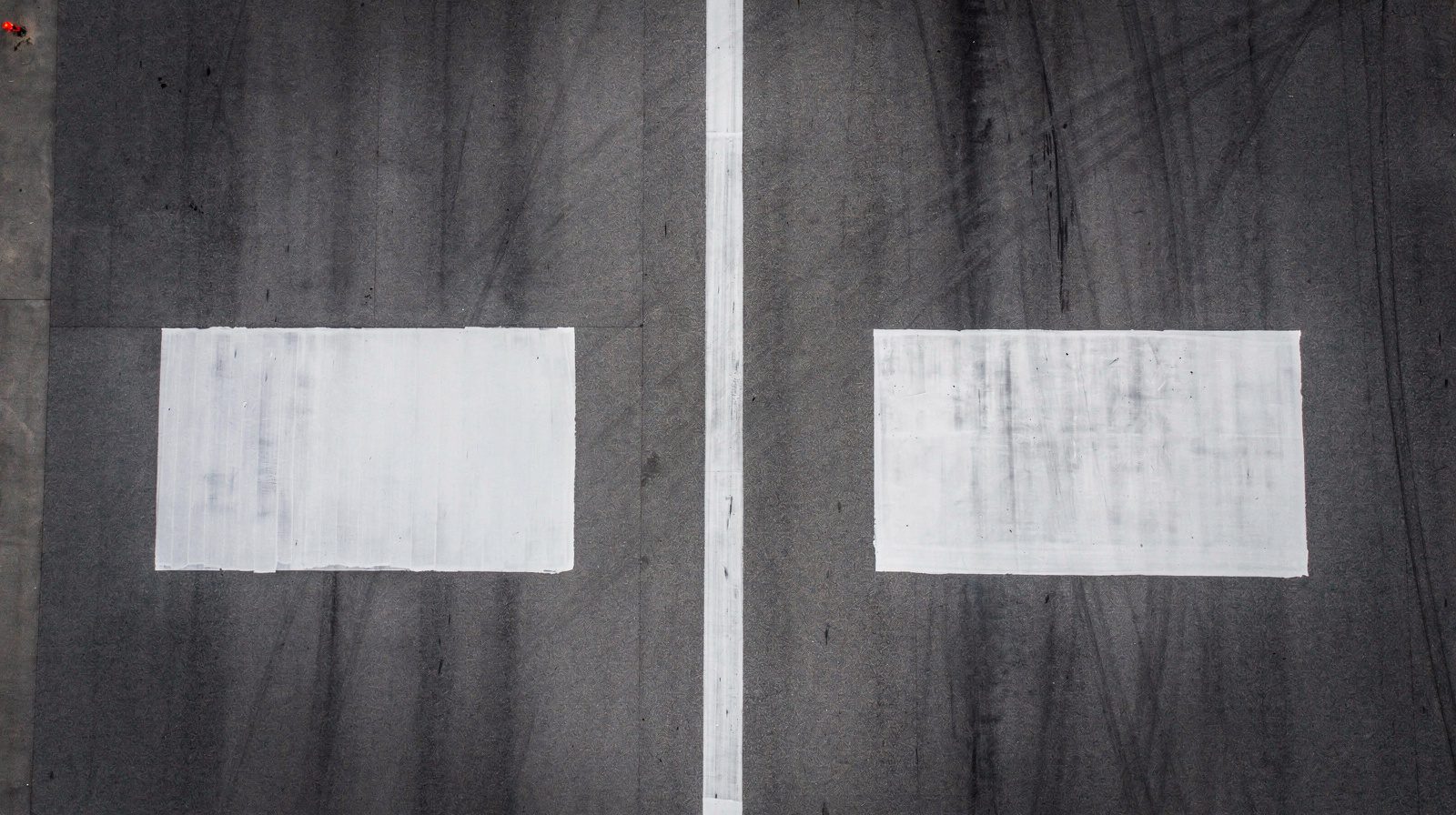
A touchdown zone marking is a set of white rectangular bars on each side of a runway centerline that shows the touchdown zone.
Runway markings are white (ICAO 5.2.1.4, CS ADR-DSN.L.520(a)). ICAO and EASA write “centre line” and describe pairs of rectangular markings. The FAA writes “centerline” and describes bars in groups.
The touchdown zone page covers the zone as a part of the runway: its definition, its length, its lights and its elevation. This page covers the painted marking only: how many bars, how big, how far apart, and how the two rule sets differ.
What the marking does
The FAA says that the marking identifies the touchdown zone along a precision runway in 500 ft (152 m) steps (AC 150/5340-1M, paragraph 2.7). EASA guidance adds a point about distance coding. A coded layout gives intuitive information about the extension of the touchdown zone. It also shows the landing distance available, or the distance between thresholds (GM1 ADR-DSN.L.545).
Which runways have it
| Rule set | Runway | Status |
|---|---|---|
| ICAO 5.2.6.1, CS ADR-DSN.L.545(a)(1) | Paved precision approach runway, code number 2, 3 or 4 | Specified |
| ICAO 5.2.6.2, CS ADR-DSN.L.545(a)(2) | Paved non-precision or non-instrument runway, code number 3 or 4, where more conspicuity is wanted | Recommended |
| FAA AC 150/5340-1M, Table 2-1 | Precision approach, which means approaches with visibility lower than three-quarters of a statute mile | Required |
On the FAA side, no touchdown zone marking is in the minimum scheme for a visual or non-precision runway.
How many pairs
The landing distance available sets the number of pairs. Where the marking shows at both ends, the distance between the thresholds sets it (ICAO 5.2.6.3, CS ADR-DSN.L.545(b)).
| Landing distance available or distance between thresholds | Pairs |
|---|---|
| less than 900 m | 1 |
| 900 m up to but not including 1,200 m | 2 |
| 1,200 m up to but not including 1,500 m | 3 |
| 1,500 m up to but not including 2,400 m | 4 |
| 2,400 m or more | 6 |
On a non-precision approach runway of code number 2, ICAO and EASA add one more pair of stripes. It stands 150 m beyond the start of the aiming point marking (ICAO 5.2.6.5).
Patterns A and B
ICAO Figure 5-5 and EASA Figure L-4 show two patterns:
- Pattern A. Each marking is a solid bar at least 22.5 m long and 3 m wide.
- Pattern B. Each marking is a group of stripes. Each stripe is at least 22.5 m long and 1.8 m wide, with 1.5 m between neighbouring stripes. Pattern B is the version with distance coding. EASA says the last pair after the threshold then consists of two single stripes.
The inner sides of the two bars of a pair stand a fixed distance apart. That distance equals the lateral spacing of the aiming point marking where one exists (ICAO 5.2.6.4). Where no aiming point marking exists, ICAO Table 5-1 sets it by the landing distance available:
| Landing distance available | Lateral spacing between inner sides |
|---|---|
| less than 800 m | 6 m |
| 800 m up to but not including 1,200 m | 9 m |
| 1,200 m up to but not including 2,400 m | 18 m to 22.5 m |
| 2,400 m or more | 18 m to 22.5 m |
ICAO Table 5-1 says the spacing in the two long columns may vary within the range. This helps to reduce rubber contamination of the marking. The smaller values come from the outer main gear wheel span.
Spacing and the aiming point
The pairs stand at 150 m intervals, beginning from the threshold. A pair that coincides with the aiming point marking, or lies within 50 m of it, is deleted from the pattern (ICAO 5.2.6.4).
The aiming point marking is a separate marking. See runway marking for the full runway scheme. ICAO Figure 5-5 shows a runway of 2,400 m or more. Pairs stand at 150 m steps, with a 300 m gap that holds the aiming point marking. On such a runway the aiming point marking starts no closer than 400 m from the threshold (Table 5-1).
The FAA pattern
The FAA marks the touchdown zone with bars in groups of one, two and three along the centerline. There are five groupings, and the aiming point marking serves as an independent sixth pair (paragraph 2.7). The scheme covers the first 3,000 ft of the runway.
The bar size depends on the runway width:
- Runway 150 ft (45.7 m) or wider. Each bar is 75 ft (22.9 m) long and 6 ft (1.8 m) wide. In a group, bars on the same side of the centerline stand 5 ft (1.5 m) apart.
- Narrower runway. The length stays the same. The width and the spacing fall in proportion to the runway width, using 150 ft as the base.
- Lateral spacing. The inner sides of the two bars of a pair match the aiming point spacing. It is 72 ft (about 22 m) on a runway 150 ft wide or wider. It is 48 ft (14.6 m) on a 100 ft runway.
The FAA also keeps a no-marking zone. The scheme leaves out any pair that reaches within 900 ft (274 m) of the runway midpoint. The aim is to stop a pilot from confusing the markings of one approach with those of the opposite approach. The same rule applies between displaced thresholds.
| Runway case | Full set needs |
|---|---|
| One precision end, one visual or non-precision end | 6,065 ft (1,849 m) between thresholds |
| Precision approach at both ends | 7,990 ft (2,435 m) between thresholds |
Below those lengths, the FAA leaves out whole groupings, one for each shortfall of 500 ft (152 m) with one precision end. With both ends, one grouping goes from each side for each shortfall of 1,000 ft (305 m).
An adjusted aiming point marking can move closer to a touchdown zone marking. Then a touchdown zone marking may coincide with it or lie within 160 ft (48.8 m) of it. In that case the FAA does not paint that touchdown zone marking. The AC says that this keeps the aiming point marking prominent.
Border and beads
The FAA requires a black border and glass beads on the touchdown zone marking (AC 150/5340-1M, Table 1-2). ICAO and EASA say that a marking needs a border where contrast with the pavement is poor. The border should be white or black. EASA also says that reflective materials should be used at an aerodrome with night operations (GM1 ADR-DSN.L.520).
Rubber deposits
The touchdown area of a runway gathers rubber from tyres. The FAA says rubber deposits occur at the touchdown areas of runways and can be quite extensive (AC 150/5380-6C, paragraph 2.5). The markings sit in this area. The touchdown zone page has more on rubber on the runway surface.
Inspection
The EASA AMC says to inspect all markings thoroughly at least semiannually, depending on local weather. It lists peeling, discolouration, fading and deposits as reasons for corrective action (AMC1 ADR.OPS.C.015(d) and (f)). GM1 says that a night assessment, compared with a daylight one, shows the reflectivity of a marking.
For a touchdown zone marking an inspector checks these items:
- The number of pairs matches the landing distance available.
- The pairs stand at the right interval from the threshold.
- Size, spacing and lateral position match the rule set that the aerodrome uses.
- The pair near the aiming point marking is deleted where the rule says so.
- Colour, border and beads are intact, and rubber does not hide the bars.
Frequently Asked Questions
- What is a touchdown zone marking?
- A touchdown zone marking is a set of white rectangular bars on each side of a runway centerline that shows the touchdown zone. ICAO describes pairs of rectangular markings placed symmetrically about the runway centre line. The FAA describes bars in groups of one, two and three.
- How far apart are the touchdown zone markings?
- ICAO and EASA set the pairs 150 m apart, beginning from the threshold. The FAA sets the groups 500 ft (152 m) apart. A pair that coincides with the aiming point marking, or lies within 50 m of it, is deleted from the ICAO and EASA pattern.
- How many touchdown zone marking pairs does a runway have?
- ICAO and EASA give 1 to 6 pairs, set by the landing distance available. Under 900 m gets 1 pair and 2,400 m or more gets 6. ICAO Figure 5-5 shows five pairs plus the aiming point marking on a runway of 2,400 m or more. The FAA marks a precision runway with groups of one, two and three bars.
- What size are touchdown zone markings?
- In ICAO pattern A, each marking is at least 22.5 m long and 3 m wide. In pattern B, each marking has stripes at least 22.5 m long and 1.8 m wide, with a 1.5 m gap. An FAA bar on a runway 150 ft (45.7 m) or wider is 75 ft (22.9 m) long and 6 ft (1.8 m) wide.
- What do the touchdown zone markings tell a pilot?
- They show where the touchdown zone is. The FAA says they identify the zone along a precision runway in 500 ft (152 m) steps. EASA says a layout with distance coding gives intuitive information about the extension of the zone, and so of the landing distance available.
- Which runways need touchdown zone markings?
- ICAO and EASA specify them on a paved precision approach runway with code number 2, 3 or 4. They recommend them on a paved non-precision or non-instrument runway of code number 3 or 4 where more conspicuity is wanted. The FAA requires them on a precision runway, which means an approach with visibility lower than three-quarters of a statute mile.
- What is the difference between touchdown zone markings and the aiming point marking?
- The aiming point marking is two large stripes that give the pilot a visual target. The touchdown zone markings are the smaller bars that repeat along the runway. The two share one lateral spacing. A touchdown zone marking that coincides with the aiming point marking, or lies within 50 m of it, is not painted.
- Does the FAA remove touchdown zone markings on a short runway?
- Yes, in groups. The FAA keeps a 900 ft (274 m) no-marking zone back from the runway midpoint. This stops a pilot from mistaking the markings of the opposite approach. With one precision end, a full set needs 6,065 ft (1,849 m) between the thresholds. Each shorter 500 ft step leaves out one grouping.
References
- icao-annex-14-vol1
- Annex 14 to the Convention on International Civil Aviation, Aerodromes, Volume I, Aerodrome Design and Operations, Ninth Edition (July 2022, consolidated with later amendments) ICAO
- easa-ear-aerodromes
- Easy Access Rules for Aerodromes (Regulation (EU) No 139/2014), including CS-ADR-DSN Issue 7 EASA
- faa-ac-150-5340-1m
- AC 150/5340-1M, Standards for Airport Markings, Change 1 FAA
- faa-ac-150-5380-6c
- AC 150/5380-6C, Guidelines and Procedures for Maintenance of Airport Pavements FAA
This is a reference entry. TarmacView provides drone inspection services and doesn't sell the equipment or materials described in this glossary.