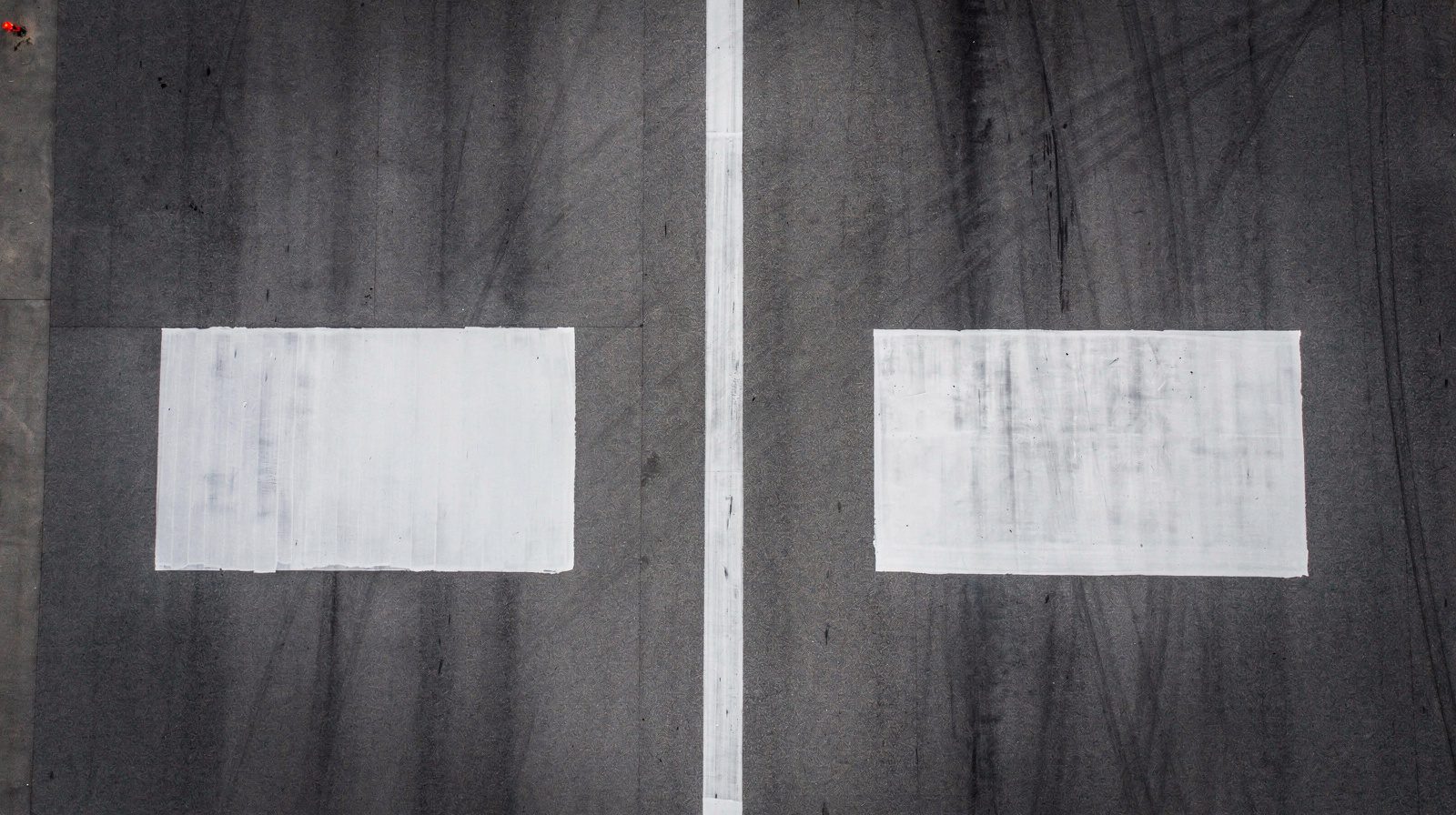
What is a Threshold Marking?
A threshold marking is a set of white longitudinal stripes that shows where the usable part of a paved runway begins.
ICAO defines the threshold as the beginning of that portion of the runway usable for landing. The runway threshold page covers the threshold itself, its position and its lights. This page covers the paint.
What the standards require
| Item | ICAO Annex 14, 5.2.4 | EASA CS ADR-DSN.L.535 | FAA AC 150/5340-1M, 2.5 |
|---|---|---|---|
| Where it applies | A paved runway (Standard). An unpaved runway, so far as practicable (Recommendation) | A runway (“should”) | Non-precision and precision runways. A visual runway for category C or D airplanes or international commercial air transport |
| Beginning of the stripes | 6 m from the threshold | 6 m from the threshold | 20 ft (6 m) from where the threshold begins |
| Stripe length | At least 30 m | At least 30 m | 150 ft (45.7 m) on standard widths |
| Stripe width and gap | About 1.80 m and about 1.80 m | About 1.80 m and about 1.80 m | 5.75 ft (1.75 m) and 5.75 ft |
| Colour | White (5.2.1.4) | White (L.520(a)) | White |
ICAO writes the application and location as Standards (“shall”). EASA writes the same items as “should”. The FAA sets its requirement by approach category in Table 2-1.
How many stripes
The runway width sets the number of stripes. The stripes sit symmetrically about the centre line.
| ICAO and EASA width | Stripes | FAA standard width | Stripes |
|---|---|---|---|
| 18 m | 4 | 60 ft (18.3 m) | 4 |
| 23 m | 6 | 75 ft (22.9 m) | 6 |
| 30 m | 8 | 100 ft (30.5 m) | 8 |
| 45 m | 12 | 150 ft (45.7 m) | 12 |
| 60 m | 16 | 200 ft (61 m) | 16 |
ICAO and EASA allow a different pattern on some runways. These are non-precision and non-instrument runways at least 45 m wide (Annex 14 Figure 5-2 (C), CS-ADR-DSN Figure L-1 (C)).
For a non-standard width, the FAA continues the stripe and gap pattern from the centre line. The outermost stripe must be no closer than 4 ft (1.2 m) to the runway edge. A 125 ft (38 m) runway gets 10 stripes. The pattern never reaches more than 92 ft (27 m) from the centre line.
How the stripes are laid out
- Lateral extent. ICAO and EASA say the stripes extend to within 3 m of the runway edge. They stop at 27 m from the centre line if that is closer.
- Centre gap. The FAA doubles the gap between the two stripes nearest the centre line. Their outer edges are 11.5 ft (3.5 m) apart. ICAO and EASA also use a double spacing there. This leaves room for the runway edge marking beside the outer stripes in the FAA pattern.
- Designation. If the runway designation is inside the threshold marking, at least three stripes remain on each side of the centre line. The gap there is 22.5 m. Where the designation is above the threshold marking, the stripes continue across the runway.
Threshold marking, threshold bar and displaced threshold
ICAO and EASA recommend a transverse stripe, at least 1.80 m wide, in two cases. The threshold is displaced from the runway end, or the runway end is not square with the centre line. A permanent displacement also gets arrows on the runway before the threshold (Annex 14, 5.2.4.6 to 5.2.4.8).
The FAA uses a white threshold bar, 10 ft (3.1 m) wide, between the runway edges. The AC requires it when a displaced threshold, blast pad, stopway, EMAS or aligned taxiway lies on the approach side of the threshold (2.9.1). The bar also applies where more than 5 ft (1.5 m) of pavement lies before the threshold. A pilot could take it for runway, or it could be weaker than the runway (2.5, item 4). The stripes still begin 6 m (20 ft) past the threshold. Older FAA practice moved them to 30 ft (9 m) when a bar was painted.
See displaced threshold for the arrows, the declared distances and the lights. A paved area before the threshold can also carry yellow chevrons. The blast pad page covers them.
Telling it apart from its neighbours
- Threshold marking. Longitudinal stripes, at the threshold, white.
- Runway designation. A two-digit number, at the threshold. The runway designation page covers it.
- Aiming point marking. Two bars, much further down the runway. CS ADR-DSN.L.540 places them 150 m to 400 m from the threshold, by landing distance available.
- Threshold lights. Green lights across the runway. They are lights and not paint. The threshold light page covers them.
The runway marking page shows the full runway scheme.
Temporary threshold markings
A runway returns to use before its final paint is on. The EASA guidance says threshold markings are painted as soon as possible, using temporary materials before they are made permanent (GM1 ADR.OPS.B.070(c)(5)). A temporary threshold during an overlay is identified by a 3.6 m wide transverse stripe (AMC1 ADR.OPS.B.070(c)(5)).
When a threshold moves, the FAA removes the old markings instead of painting them over. It removes the old threshold marking in one larger rectangular area, so that no trace misleads a pilot.
Surveying and checking a threshold marking
EASA survey guidance covers marked thresholds, for example displaced thresholds. It says to take these markings as the threshold points (GM2 ADR.OPS.A.005(a)).
A check of the marking looks at these items:
- The count of stripes matches the runway width.
- The stripes begin 6 m (20 ft) past the threshold and are symmetrical about the centre line.
- The stripes are white, even in length, and not worn through.
- Any transverse stripe or threshold bar is present where the threshold is displaced.
- Old markings are fully removed after a threshold move.
TarmacView’s runway surface scan captures georeferenced imagery of the pavement. A person reads the markings on that imagery. The service is in development and is not offered yet.
Frequently Asked Questions
- What is a threshold marking?
- A threshold marking is a set of white longitudinal stripes that shows where the usable part of a paved runway begins. The stripes lie side by side, on both sides of the centre line, at the landing end of the runway.
- How many stripes does a runway threshold marking have?
- The runway width sets the number. ICAO and EASA give 4 stripes at 18 m, 6 at 23 m and 8 at 30 m. They give 12 at 45 m and 16 at 60 m. The FAA gives the same counts for the standard widths of 60, 75, 100, 150 and 200 ft.
- Where does the threshold marking begin?
- The stripes begin 6 m (20 ft) from the threshold. ICAO, EASA and the FAA all use this value. The FAA keeps it when it adds a threshold bar.
- What size are the threshold marking stripes?
- ICAO and EASA give stripes at least 30 m long and about 1.80 m wide, with gaps of about 1.80 m. On standard runways, the FAA gives stripes 150 ft (45.7 m) long and 5.75 ft (1.75 m) wide, with gaps of 5.75 ft. The two stripes nearest the centre line have a double gap.
- What colour is a threshold marking?
- A threshold marking is white. Annex 14 says runway markings shall be white (5.2.1.4), and the FAA says the components of the threshold marking are white. On light pavement, outlining white markings in black can improve their conspicuity.
- Does every runway need a threshold marking?
- Every paved runway needs one under ICAO Annex 14, 5.2.4.1. EASA says it should be provided at the threshold of a runway. The FAA requires it on non-precision and precision runways. On a visual runway, the FAA requires it only for category C and D airplanes or international commercial air transport.
- What is the difference between a threshold marking and a threshold bar?
- The threshold marking is the set of longitudinal stripes. The FAA threshold bar is one white bar across the runway, 10 ft (3.1 m) wide. ICAO and EASA call the equivalent a transverse stripe, at least 1.80 m wide. It is added where the threshold is displaced.
- How is a temporary threshold marked?
- ICAO and EASA say to mark it as a displaced threshold. All markings before it are obscured, except the centre line, which becomes arrows. An ICAO note says that, for a short period, markers in the form and colour of the marking may replace paint. During an overlay, EASA guidance says a 3.6 m wide transverse stripe identifies a temporary threshold.
References
- icao-annex-14-vol-i-9ed
- Annex 14 to the Convention on International Civil Aviation, Volume I, Aerodrome Design and Operations, 9th edition (July 2022, consolidated with Amendment 18) ICAO, copy hosted by the Swiss FOCA
- easa-ear-aerodromes
- Easy Access Rules for Aerodromes (Regulation (EU) No 139/2014), including CS-ADR-DSN Issue 7 EASA
- faa-ac-150-5340-1m
- AC 150/5340-1M, Standards for Airport Markings (Change 1, 23 December 2020) FAA
This is a reference entry. TarmacView provides drone inspection services and doesn't sell the equipment or materials described in this glossary.