What are Runway Turn Pad Lights?
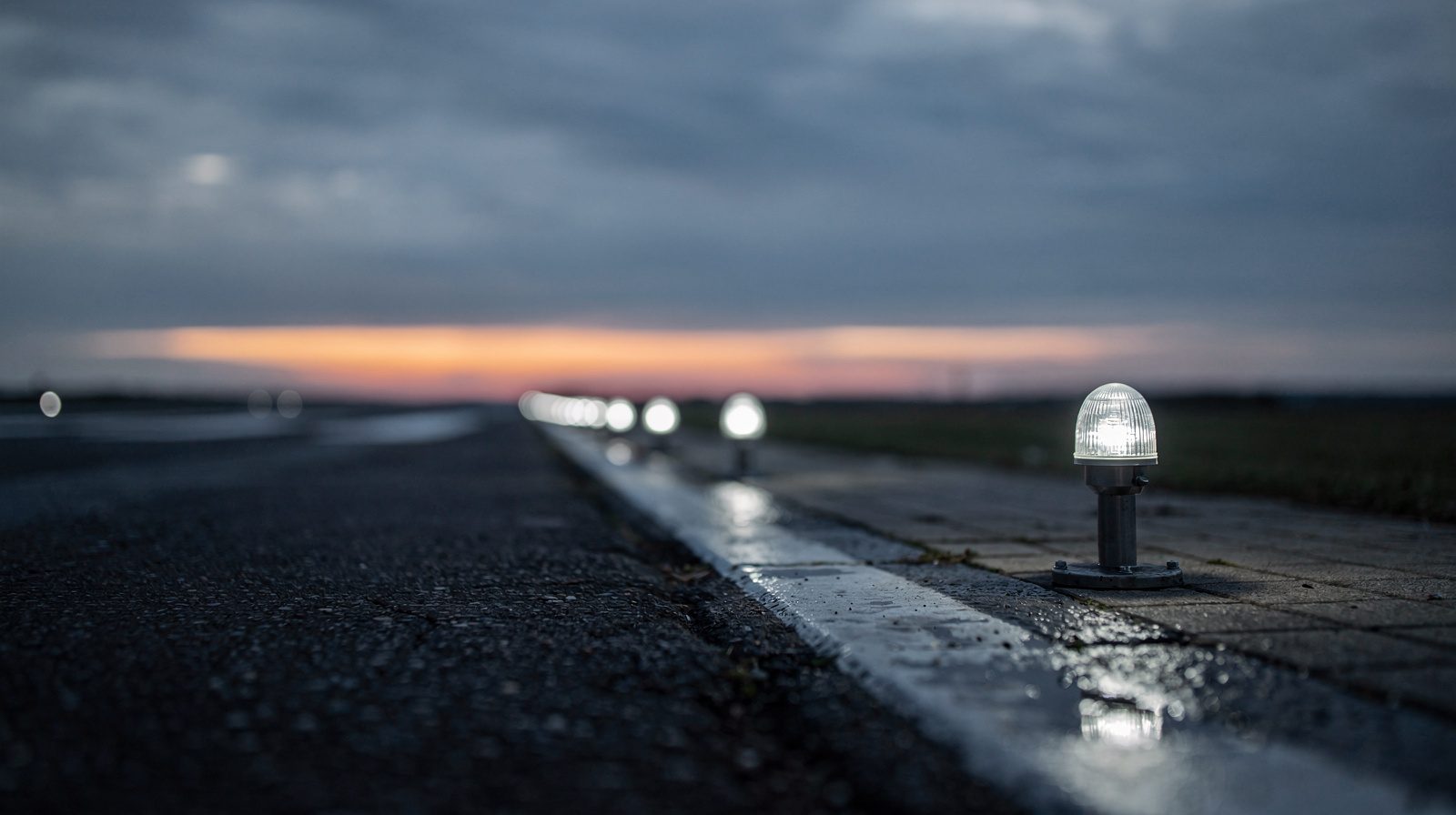
Runway turn pad lights are fixed green lights that guide an aeroplane through a 180-degree turn and onto the runway centre line.
Definition
ICAO defines a runway turn pad as a defined area on a land aerodrome next to a runway. Aeroplanes use it to complete a 180-degree turn on a runway. ICAO and EASA give the lights one purpose. They give continuous guidance to an aeroplane that turns on the pad and then lines up with the runway centre line (ICAO 5.3.19.1, CS ADR-DSN.M.725(a)).
The turn pad page covers the pad itself. It gives the size, the wheel clearance, the strength and the marking. This page covers the lights only.
What the standards require
| Item | ICAO Annex 14, 5.3.19 | EASA CS ADR-DSN.M.725 |
|---|---|---|
| Low visibility | Required on a turn pad for use below 300 m runway visual range | Recommended below 350 m |
| Night | Recommended on a turn pad for use at night | Recommended at night. Not needed where taxiway edge lights and the marking give adequate guidance |
| Position | On the turn pad marking. May be offset by up to 30 cm | The same |
| Spacing, straight section | At most 15 m | The same |
| Spacing, curved section | At most 7.5 m | The same |
| Colour and mode | Fixed, unidirectional, green | The same |
| Beam | Visible only from aeroplanes on or approaching the turn pad | The same |
| Photometry | Appendix 2, Figure A2-13, A2-14 or A2-15 | CS ADR-DSN.U.940, Figure U-17 or U-18, and chromaticity to U.930 |
ICAO writes the low visibility case as a Standard (“shall”). EASA writes “should” for every row, and uses 350 m. EASA leaves GM1 ADR-DSN.M.725 blank.
The isocandela figures that these rules name carry the titles of taxiway centre line diagrams. Figure A2-13 is for 15 m spacing, and Figure A2-14 is for 7.5 m spacing (ICAO). Figure U-17 is for 15 m spacing, and Figure U-18 is for 7.5 m spacing (EASA). A turn pad light therefore has the beam of a taxiway centre line light at the same spacing. This page gives no intensity value, because the value sits in the figure.
Where the lights stand
The lights follow the turn pad marking. ICAO and EASA say that the marking is yellow (ICAO 5.2.1.5, CS ADR-DSN.L.520(b)). The marking curves from the runway centre line into the pad, so the lights curve with it.
- On the marking. Each light stands on the marking line. It may sit up to 30 cm to one side where it cannot stand on the line.
- Straight section. The lights are at most 15 m apart.
- Curved section. The lights are at most 7.5 m apart.
Turn pad lights and taxiway edge lights
A turn pad that is used at night usually has two sets of lights.
| Light | Colour | Where | Spacing |
|---|---|---|---|
| Runway turn pad lights | Fixed green | On the marking | At most 15 m straight, 7.5 m curved |
| Taxiway edge lights | Fixed blue | At the edge of the pad, or up to 3 m outside it | At most 30 m |
Sources: ICAO 5.3.19, 5.3.18.1, 5.3.18.5 and 5.3.18.6. EASA CS ADR-DSN.M.725 and M.720(a)(1), (b)(3) and (b)(4).
ICAO requires edge lights at the edges of a turn pad for night use. EASA recommends them. Both allow an exception where surface illumination or other means give adequate guidance. The taxiway edge light page covers the blue lights.
How a turn pad light differs from a centre line light
Both are fixed green lights, and both use the taxiway centre line isocandela diagrams. They differ in what they mark. A taxiway centre line light marks a taxi route. A turn pad light marks the curved path on the pad, which ends on the runway centre line.
Maintenance
For taxiway lights, EASA sets numeric maintenance objectives only for centre line lights and for stop bars at a runway holding position. Both apply to use below 550 m runway visual range. ADR.OPS.C.015(b) gives no numeric objective for runway turn pad lights.
The test for an unserviceable light still applies to each one. A light is unserviceable if its main beam average intensity is below 50 percent of the specified value. It is also unserviceable if its filter is missing or damaged, or if the beam has the wrong colour (ADR.OPS.C.015(c)).
What an inspection checks
An inspection of a turn pad that is used at night covers these items:
- Each turn pad light is lit and shows green.
- The lights follow the marking, with no light more than 30 cm off it.
- The spacing is within 15 m on the straight section and 7.5 m on the curve.
- The lights face the aeroplane that approaches the pad.
- The blue edge lights stand at the edge, at most 30 m apart.
A drone flight can record whether each light is lit, its colour and its position. TarmacView’s taxiway lights inspection does this for the taxiway network. It does not measure intensity in candela.
Frequently Asked Questions
- What are runway turn pad lights?
- Runway turn pad lights are fixed green lights that guide an aeroplane through a 180-degree turn and onto the runway centre line. They stand on the marking of a runway turn pad. ICAO and EASA give the rules for them.
- What colour are runway turn pad lights?
- Runway turn pad lights are green. ICAO and EASA specify unidirectional fixed lights that show green. The beam is narrow enough that only aeroplanes on or approaching the turn pad can see the light.
- Does a runway turn pad need lights?
- Only for some uses. ICAO requires turn pad lights on a turn pad for use in runway visual range below 300 m. EASA recommends them below 350 m. Both recommend them for night use. EASA drops the night recommendation where edge lights and the turn pad marking give adequate guidance.
- How far apart are runway turn pad lights?
- The spacing is at most 15 m on a straight section of the marking and at most 7.5 m on a curved section. ICAO and EASA give the same two values.
- Where do runway turn pad lights stand?
- They stand on the runway turn pad marking. ICAO and EASA allow an offset of not more than 30 cm where a light cannot stand on the marking.
- What is the difference between turn pad lights and taxiway edge lights?
- Turn pad lights are green and stand on the marking, so they show the path. Taxiway edge lights are blue and stand at the edge of the turn pad, so they show its limits. ICAO sets a maximum of 30 m between edge lights on a turn pad.
- Are runway turn pad lights fixed or flashing?
- They are fixed. ICAO 5.3.19.6 and CS ADR-DSN.M.725(d)(1) both call for unidirectional fixed lights that show green.
References
- icao-annex-14-vol1
- Annex 14 to the Convention on International Civil Aviation, Aerodromes, Volume I, Aerodrome Design and Operations, Ninth Edition (July 2022, consolidated with later amendments) ICAO
- easa-ear-aerodromes
- Easy Access Rules for Aerodromes (Regulation (EU) No 139/2014), including CS-ADR-DSN Issue 7 EASA
This is a reference entry. TarmacView provides drone inspection services and doesn't sell the equipment or materials described in this glossary.