EU Regulation 139/2014: Aerodrome Rules and Visual Aids Maintenance
Regulation (EU) No 139/2014 ADR.OPS.B.065 requires procedures so visual aids work as intended. ADR.OPS.C.015 adds maintenance programmes, a 50 % test, records.
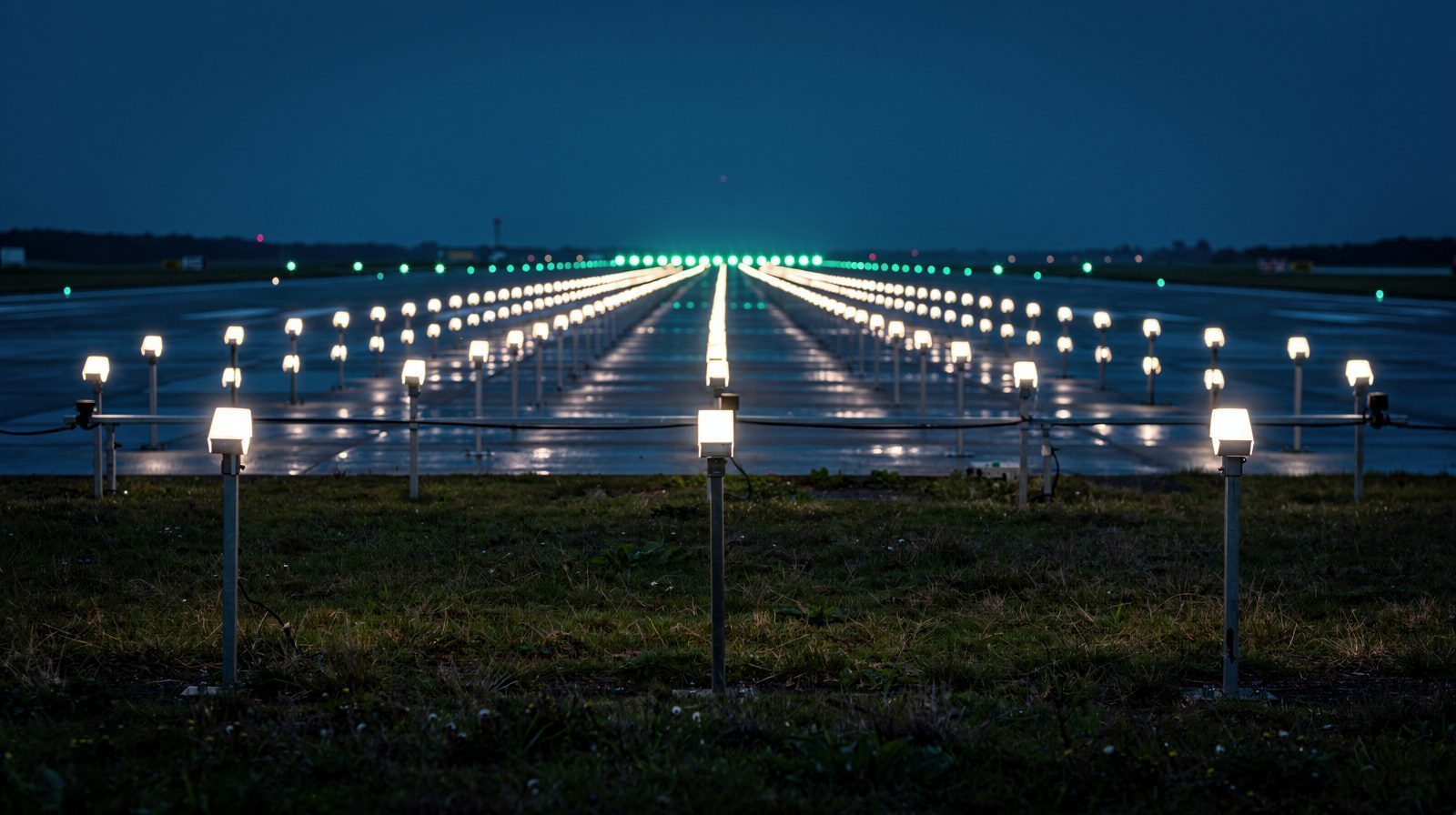
- 01 ADR.OPS.B.065 is one sentence of binding text: the operator shall have procedures to ensure that visual aids and electrical systems function as intended. The monitoring system, stop bar procedures and temporary markings sit in AMC1, which is not binding.
- 02 ADR.OPS.C.015 holds the maintenance duties for lights, electrical systems, markings and signs. Its points (c), (e), (f) and (g) set the 50 % unserviceability test, a ban on works near electrical systems in low visibility, inspections at defined intervals and records.
- 03 The rule text never gives an inspection interval for lights. Daily checks, the twice-a-year and once-a-year measurement floor for CAT II and III runways, and the yearly flight check come from AMC.
- 04 AMC and GM are non-binding, but an operator that wants a different means of compliance needs the competent authority's prior approval under ADR.OR.A.015.
- 05 The Regulation does not mention drones as an inspection platform. AMC1 asks for a measuring unit of sufficient accuracy to analyse individual lights and names no platform.
On this page · 11 sections
ADR.OPS.B.065 of Commission Regulation (EU) No 139/2014 requires the aerodrome operator to have procedures that ensure visual aids and electrical systems function as intended. It sets no interval and no percentage. AMC1, which is not binding, adds a ground lights monitoring system, stop bar procedures and temporary marking procedures. ADR.OPS.C.015 holds the maintenance rules.
Commission Regulation (EU) No 139/2014 of 12 February 2014 is the law behind the certification and operation of aerodromes in the European Union. It does not say how bright a runway light must be. It says who certifies an aerodrome, what the operator must be able to show, and which procedures and maintenance programmes the operator must run. This page covers the Regulation’s own text, with a close look at the two paragraphs readers ask about most for lighting, ADR.OPS.B.065 and ADR.OPS.C.015. Design values live in CS-ADR-DSN, and the EASA CS-ADR-DSN page covers them, so this page does not repeat them.
Every clause quoted here was read in the March 2026 revision of EASA’s Easy Access Rules for Aerodromes. EASA states that this consolidation is not an official publication, so check the wording against EUR-Lex before quoting it in a filing.
What the Regulation is and how it is built
The Regulation lays down requirements and administrative procedures related to aerodromes. It was adopted under Regulation (EC) No 216/2008, and parts of its text still cite that regulation, although Regulation (EU) 2018/1139, the Basic Regulation, has since repealed it.
The Cover Regulation has eleven articles. Article 1 sets the subject matter. Competent authorities must comply with Annex II, and aerodrome operators with Annexes III and IV. Article 3 has each Member State designate a competent authority that is independent of the operators it oversees, at least at functional level. Articles 8 and 9 oblige Member States to consult on constructions within the obstacle limitation and protection surfaces and on human activities and land use around an aerodrome, such as hazardous, confusing and misleading lights and highly reflective surfaces. Article 10 covers wildlife hazard. Articles 4 and 5 were deleted by Implementing Regulation (EU) 2024/894. Article 7 let authorities accept deviations from the certification specifications until 31 December 2024, and the CS-ADR-DSN page explains that route alongside equivalent levels of safety and special conditions.
The four annexes carry the working rules.
| Annex | Part | What it holds | Who it binds |
|---|---|---|---|
| I | Definitions | Terms used in Annexes II to IV, including Acceptable Means of Compliance | Everyone |
| II | Part-ADR.AR | Subpart A General, B Management, C Oversight, certification and enforcement | Competent authorities |
| III | Part-ADR.OR | Subpart A General, B Certification, C Additional operator responsibilities, D Management, E Aerodrome manual and documentation, F Apron management service | Aerodrome operators and apron management service providers |
| IV | Part-ADR.OPS | Subpart A Aerodrome data, B Operational services, equipment and installations, C Aerodrome maintenance, D Apron management operations | Aerodrome operators |
The March 2026 revision lists thirteen amending regulations, from Regulation (EU) 2018/401 on the classification of runways to Implementing Regulation (EU) 2025/2293. ADR.OPS.C.005 and ADR.OPS.C.015 are labelled as last amended by Delegated Regulation (EU) 2020/2148, on runway safety and aeronautical data. ADR.OPS.A.070, on LED lights, comes from Delegated Regulation (EU) 2022/208, on all-weather operations. ADR.OPS.B.065 still carries the label of the original Regulation.
Regulation (EU) No 139/2014 at a glance
- Issuer
- European Commission, Commission Regulation (EU) No 139/2014 of 12 February 2014. The AMC and GM are adopted by EASA.
- Status
- Binding in its entirety and directly applicable in all Member States (Article 11). AMC and GM are non-binding (Annex I definition 1 and the terminology note to Article 2).
- Structure
- Cover Regulation with eleven articles, Annex I Definitions, Annex II Part-ADR.AR, Annex III Part-ADR.OR, Annex IV Part-ADR.OPS.
- Text read
- EASA Easy Access Rules for Aerodromes, March 2026 revision. EASA states it is not an official publication.
- ADR.OPS.B.065
- The aerodrome operator shall have procedures to ensure that aerodrome visual aids and electrical systems function as intended.
- ADR.OPS.C.015
- Preventive and corrective maintenance programmes for electrical systems (a), lights (b) and markings and signs (d). A light is unserviceable below 50 % of the specified main beam average intensity or with a wrong colour (c). Inspections at defined intervals (f) and records (g).
- Works in low visibility
- ADR.OPS.C.015(e): construction or maintenance activities shall not take place in the proximity of aerodrome electrical systems when low-visibility procedures are in effect.
- Intervals
- The rule leaves them to the operator. Numbers appear in AMC only, for example daily ground checks and flight checks at least yearly.
- Drones
- Not mentioned as an inspection platform.
Binding text, AMC, GM and CS: which is which
Four kinds of text sit around a lighting question, and each has a different weight for the operator.
What binds an aerodrome operator and what does not
| Layer | Status | Defined in | Example for visual aids |
|---|---|---|---|
| Regulation text | Binding in its entirety and directly applicable in all Member States | Article 11 | ADR.OPS.B.065 and ADR.OPS.C.015 |
| Acceptable Means of Compliance | Non-binding standards adopted by the Agency. An alternative means needs prior approval | Annex I definition 1 and ADR.OR.A.015 | AMC1 to ADR.OPS.B.065, AMC1 to ADR.OPS.C.015(b) and (f) |
| Guidance Material | Non-binding material that helps illustrate the meaning of a requirement | Terminology note to Article 2 | GM1 to ADR.OPS.B.065 on stop bars, GM1 to ADR.OPS.C.015(b) |
| Certification specifications | Technical standards adopted by EASA for certification. They bind one aerodrome once they sit in its certification basis | Article 2(7), ADR.AR.C.020, ADR.OR.B.025 | CS-ADR-DSN Chapters M and S |
An operator that wants to comply another way than the AMC can do so. ADR.OR.A.015(b) asks it to give the competent authority, before implementing the alternative, a full description that includes any changed manuals or procedures and an assessment showing the rules are met. The alternative may be used after the authority’s prior approval. AMC1 to ADR.OR.A.015 adds that the assessment should be a documented safety risk assessment showing a level of safety equivalent to the AMC. An alternative means of compliance replaces the AMC, not the rule. The objectives in ADR.OPS.C.015(b) and the definition in (c) still have to be met.
ADR.OPS.B.065: visual aids and electrical systems function as intended
ADR.OPS.B.065 sits in Part-ADR.OPS Subpart B, the subpart that also holds the rules on night operations, low-visibility procedures and aerodrome works safety. The whole rule is one sentence. “The aerodrome operator shall have procedures to ensure that aerodrome visual aids and electrical systems function as intended.”
That is a requirement for procedures, not for a number. It does not define an unserviceable light, set a serviceability percentage or fix an inspection interval. Those are in ADR.OPS.C.015. B.065 is the rule that makes the operator write down how the visual aids are run.
AMC1 to ADR.OPS.B.065, from ED Decision 2021/003/R, says how EASA expects that to look. It is not binding, and each point is a “should”.
- The operator should establish a monitoring system of aerodrome ground lights, so that it can inform the air traffic services provider when safe operation is no longer possible.
- The operator should establish procedures for operating visual aids. With the air traffic services provider, it should also establish procedures for the case where stop bars are unserviceable, including a stop bar that cannot be turned off. The measures should not undermine the principle that a lit stop bar must not be crossed.
- The operator should establish procedures for the provision and removal of temporary markings, lights and signs.
GM1 to ADR.OPS.B.065 lists contingency measures for a stop bar that cannot be turned off because of a technical problem. They are physically disconnecting the stop bar from its power supply, physically obscuring its lights, or using a different route until it is repaired. A marshaller or a follow-me vehicle may be needed in the first two cases. Maintenance action should follow as soon as possible.
The procedures belong in the aerodrome manual. ADR.OR.E.005(b) says the manual shall reflect the certification basis and the requirements of Part-ADR.OR and Part-ADR.OPS, and shall contain or refer to all necessary information for the safe use, operation and maintenance of the aerodrome and its equipment. AMC3 to ADR.OR.E.005 puts the lighting content in Part E of the manual, item 10, which asks for procedures for the inspection and for routine and emergency maintenance of visual and non-visual aids and the aerodrome electrical systems. They include inspection checklists, logbook and record keeping, inspection intervals and times, and reporting of results and follow-up actions. Item 11 adds operating, maintenance and repair instructions, servicing information, troubleshooting and inspection procedures for aerodrome equipment.
ADR.OPS.C.005 and ADR.OPS.C.015: the maintenance rules
Subpart C, Aerodrome maintenance, has two rules that frame lighting work.
ADR.OPS.C.005, maintenance in general. The operator shall establish and implement a maintenance programme, with preventive maintenance where appropriate, to keep the facilities, systems and equipment necessary for the operation of the aerodrome in a condition that does not impair the safety, regularity or efficiency of air navigation. The design and implementation of the programme shall observe human factors principles, and the operator shall provide appropriate and adequate means to implement it. AMC1 says the programme should specify the facilities and systems it covers, the type and frequency of each inspection or check, the tools and equipment each needs, and the periodic replacement of parts under the manufacturer’s instructions. It should also arrange timely corrective maintenance, whether the need is found during preventive work or arises from a failure.
ADR.OPS.C.015, visual aids and electrical systems. It has seven points.
- (a) Electrical systems. A preventive and corrective maintenance programme for the serviceability of the electrical systems and the availability of power to all necessary facilities. AMC1 to ADR.OPS.C.015(a) and (f) says the schedules should follow the manufacturers’ instructions, adjusted to the operator’s experience of malfunctions. It lists the minimum content: power cables and distributors in the field, transformers and regulators, transformer stations, relay and switch cabinets, control cables, monitoring units and the control desk, the secondary power supply and fixed ground power for aircraft. The operator should write checklists for the scheduled work.
- (b) Lights. A preventive and corrective maintenance programme for the serviceability of the individual lights and the reliability of the lighting systems, so that guidance to aircraft and vehicles is continuous. The point sets serviceability objectives per system and per type of operation, with adjacency limits and a pattern test. The full set is on the CS-ADR-DSN page and in the serviceability limits guide , and is not repeated here.
- (c) Unserviceable lights. For the purposes of (b), a light is deemed unserviceable if its main beam average intensity is less than 50 % of the value specified in the certification specifications, or of the design value where the unit is designed above the CS value, or if its filter is missing or damaged or the light does not produce the correct colour.
- (d) Markings and signs. The same kind of programme for the system of markings and signs. AMC1 to ADR.OPS.C.015(d) and (f) says markings should be inspected thoroughly at least semiannually, depending on local weather. Signs should have scheduled checks, daily and annual, and unscheduled ones.
- (e) Works in low visibility. Construction or maintenance activities shall not take place in the proximity of aerodrome electrical systems when low-visibility procedures are in effect.
- (f) Inspections. The programmes under (a), (b) and (d) shall include appropriate inspections and checks of the individual elements of each system and of the system itself, conducted to established procedures at defined intervals appropriate to the intended operation and system. Appropriate corrective action shall be taken on any defect found.
- (g) Records. The operator shall maintain records of the relevant maintenance activities.
What the AMC adds for the lights
The rule says “defined intervals” and the AMC gives the figures. AMC1 to ADR.OPS.C.015(b) and (f) asks for the following.
- Daily ground checks of the lighting systems for light failures, breakage, gross misalignment and correct operation of the intensity control system.
- Photometric measurement at appropriate intervals, irrespective of the runway type, with no number given.
- For a CAT II or III precision approach runway, in-field measurement of the intensity, beam spread and orientation of the approach and runway lights, measuring all lights as far as practicable, with a measuring unit of sufficient accuracy to analyse individual lights. The frequency should not be less than twice a year for in-pavement lights and once a year for other lights.
- Flight checks of the approach, runway and taxiway lighting, the visual approach slope indicators, the aerodrome beacon and the light intensity control system, at least on a yearly basis.
- For PAPI and APAPI, a unit of three or more lights counts as unserviceable when more than one light has failed, and a unit of fewer than three when at least one has. Lights behind a missing, damaged or wrong red filter should be extinguished until it is fixed. The PAPI page covers what that means for a survey.
GM1 to ADR.OPS.C.015(b) and (c) suggests a second, higher intensity level in the programme, always above 50 % of the specified value, so that maintenance staff get a warning before a light fails operationally. The photometric measurement guide shows how such readings are taken.
Inspecting the movement area: ADR.OPS.B.015
Lighting is also checked as part of the wider inspection duty. ADR.OPS.B.015 has the operator monitor the condition of the movement area and the operational status of related facilities, report matters of operational significance to air traffic services and aeronautical information services, and carry out regular inspections of the movement area and its related facilities.
AMC1 to ADR.OPS.B.015 sets the cadence. Inspections of items such as FOD, the status of visual aids, wildlife and current surface conditions should happen each day, at least once where the code number is 1 or 2 and at least twice where it is 3 or 4. Inspections of other lighting systems required for safety, pavements and adjacent ground surfaces, drainage and fencing should be carried out at least weekly. Extra inspections of paved areas should follow excessive weather events. The operator should keep a log of all routine and non-routine inspections.
AMC2 to ADR.OPS.B.015 covers the procedure. Runway inspections should be coordinated with the air traffic services unit, conducted in the opposite direction to that used for landing or taking off and without interruption unless that is operationally impossible, and should address the need to effectively inspect unidirectional lights.
From rule to evidence: demonstration, manual and records
Three Part-ADR.OR rules turn the operations text into something an authority can audit.
- Demonstration of compliance, ADR.OR.B.025. The operator shall perform and document all actions, inspections, tests, safety assessments or exercises needed to demonstrate compliance with the notified certification basis, give the authority the means by which compliance was demonstrated, and declare its compliance. Design information, including inspection and test reports, is kept at the authority’s disposal under ADR.OR.D.035.
- Aerodrome manual, ADR.OR.E.005. The manual is signed by the accountable manager, kept up to date and kept in a version-controlled format. It holds the operating procedures, including those for visual aids described above.
- Record keeping, ADR.OR.D.035. The format of the records is specified in the aerodrome manual. Records are stored to protect them from damage, alteration and theft. They are kept for a minimum of five years, except for the categories in (d)(1) to (d)(8), such as the certification basis and safety assessment reports. None of those exceptions covers lighting maintenance records, so the five-year default applies to them. All records are subject to applicable data protection law.
A maintenance record that shows the interval, the measurement and the corrective action is the evidence ADR.OPS.C.015(f) and (g) ask for. The airfield lighting inspection page describes what TarmacView’s survey adds to that record.
Obstacles, pavements and LED lights in Part-ADR.OPS
Visual aids are not the only maintenance topic in Part-ADR.OPS, and three other rules reach into surveys.
LED lights, ADR.OPS.A.070. The operator shall report to the aeronautical information services the parts of the aerodrome lighting system where light units are light emitting diode lights. GM1 gives the reason. EFVS technology relies on the infrared heat signature of incandescent lights, so replacing them with LED may make EFVS use impossible, and aircraft operators need to know.
Safeguarding, ADR.OPS.B.075. The operator shall monitor on the aerodrome and its surroundings the obstacle limitation and protection surfaces as established in the certification basis, the marking and lighting of obstacles, and hazards from human activities and land use. It shall have procedures for mitigating the risks. AMC1 says the scope and limits of the monitoring are defined in coordination with the competent authority and the air traffic services provider. AMC1 to ADR.OPS.A.005 asks the operator to report obstacle and terrain data to the aeronautical information services, with the top elevation, type, marking and lighting of obstacles. The obstacle limitation surfaces glossary page and the post on surveying the approach cover how a survey supports that monitoring.
Pavements, ADR.OPS.C.010. The operator shall inspect the surfaces of all movement areas, including runways, taxiways and aprons, adjacent areas and drainage, to regularly assess their condition as part of a preventive and corrective maintenance programme. It shall also maintain the surfaces to avoid FOD and harmful irregularities and keep runway friction at or above the minimum standards. The Regulation names no pavement condition index and no survey method, and a text search of the March 2026 revision finds no mention of PCI. The runway pavement check page and the explainer on PCI cover the method side.
How it compares with ICAO Annex 14 and the FAA
Chapter 10 of ICAO Annex 14 Volume I, section 10.5, covers visual aids maintenance, and the Regulation follows it closely. The status of each text differs. In the 9th edition text as consolidated with Amendment 18, 10.5.1 on the unserviceable light and 10.5.2 on preventive maintenance of visual aids are Standards, and so are the objectives in 10.5.7 to 10.5.12. The CAT II and III checks in 10.5.3 to 10.5.6, including the twice-a-year and once-a-year measurement frequency, are Recommendations. In the Regulation the objectives are binding rule text in ADR.OPS.C.015(b), and the Recommended Practices on checks and frequency appear as non-binding AMC1.
Two differences are worth knowing when you read both.
- Annex 14 10.5.13 is a Recommendation that the appropriate authority should restrict construction or maintenance activities near aerodrome electrical systems during low visibility procedures. ADR.OPS.C.015(e) is worded as a rule: such activities “shall not take place”.
- In the Annex 14 text read, the stop bar objective in 10.5.8 and the taxiway centreline objective in 10.5.9 apply below 300 m runway visual range. ADR.OPS.C.015(b)(4) and (b)(5) use 550 m.
The Annex 14 paragraph numbers on this page were read in the hosted consolidation of the 9th edition, which carries the Amendment 18 marks (applicable from 27 November 2025) on the pages holding 10.5.1 to 10.5.10. The official Annex is paywalled, so check the numbers there before quoting them.
In the United States the counterpart is FAA AC 150/5340-26C, covered on the FAA AC 150/5340-26 page . Its paragraph 2 says use is not mandatory in general, and is mandatory for projects funded through AIP grants or PFC revenue. The EU puts the serviceability objectives into law and the intervals into AMC.
Where a drone survey fits
The Regulation neither requires nor approves drones for lighting inspection. A text search of the March 2026 Easy Access Rules finds no mention of drones as an inspection platform. UAS appears only as unauthorised UAS, in the tasks of the local runway safety team and as a reason to suspend runway operations. What the rule and AMC ask for is evidence. That means procedures for the visual aids, a programme with inspections at defined intervals, measurement with a unit of sufficient accuracy to analyse individual lights, corrective action and records.
TarmacView flies airfield lighting inspection for approach lights , runway edge lights , taxiway lights and PAPI. Each unit gets lit or dark, colour against position, output relative to its neighbours and to the commanded step, and an RTK-surveyed position. Flights run between movements in coordination with the tower, with no closure booked, and a flight on the movement area has to fit the operator’s own inspection procedures. That gives the operator a unit-by-unit record for the checks in AMC1 to ADR.OPS.C.015(b) and (f). It does not replace the monitoring system in AMC1 to ADR.OPS.B.065, the electrical checks under C.015(a), regulator output, insulation resistance, standby power switch-over or anything underground. The AMC asks for a flight check at least yearly, and nothing in it equates a drone survey with that check. The comparison with flight inspection sets out what each method covers.
Frequently Asked Questions
- What does ADR.OPS.B.065 require?
- One thing: that the aerodrome operator has procedures to ensure that aerodrome visual aids and electrical systems function as intended. It sets no percentage and no interval. AMC1, which is not binding, adds that the operator should run a monitoring system of aerodrome ground lights that tells air traffic services when safe operation is no longer possible, have procedures for operating visual aids and for unserviceable stop bars, and have procedures for temporary markings, lights and signs.
- What does ADR.OPS.C.015 require for visual aids maintenance?
- A preventive and corrective maintenance programme for the electrical systems (a), for individual lights and lighting systems (b), and for markings and signs (d). Point (b) sets serviceability objectives per system and operation, (c) deems a light unserviceable below 50 % of the specified main beam average intensity or with a wrong colour, (e) bars works near electrical systems in low visibility, (f) requires inspections at defined intervals and corrective action, and (g) requires records.
- Does the Regulation say how often lights must be inspected?
- Not in numbers. ADR.OPS.C.015(f) requires inspections at defined intervals appropriate to the intended operation and system, and the operator defines them. Numbers appear only in AMC. AMC1 to ADR.OPS.B.015 asks for a daily movement area inspection, once for code number 1 or 2 and twice for 3 or 4, that covers the status of visual aids. AMC1 to ADR.OPS.C.015 adds daily light checks, measurement twice a year for in-pavement lights and once a year for other lights on CAT II and III runways, and a flight check at least yearly.
- Are the AMC and GM mandatory?
- No. Annex I defines an Acceptable Means of Compliance as non-binding, and the terminology note to Article 2 defines Guidance Material as non-binding. An operator may use an alternative means of compliance, but under ADR.OR.A.015(b) it must first give the competent authority a full description and an assessment showing the rules are met, and it may implement the alternative only after prior approval.
- How long must lighting maintenance records be kept?
- ADR.OPS.C.015(g) requires the operator to keep records of the relevant maintenance activities and gives no retention period. ADR.OR.D.035(d) sets a default minimum of five years for records, and none of its listed exceptions covers lighting maintenance records. The format of the records must be specified in the aerodrome manual, and AMC3 to ADR.OR.E.005 expects the manual to describe inspection checklists, logbooks and inspection intervals for visual aids.
- Does the Regulation allow or require drones for lighting inspection?
- It does neither. A text search of the March 2026 Easy Access Rules finds no mention of drones as an inspection platform. UAS appears only as unauthorised UAS at or near the aerodrome. AMC1 to ADR.OPS.C.015 asks for in-field measurement with an appropriate measuring unit of sufficient accuracy to analyse individual lights. Whether a drone-based method fits an operator's programme is for the operator to show and its competent authority to accept.
- Is drone-based PAPI calibration accepted by EASA?
- No EASA text in Regulation (EU) No 139/2014 or its AMC and GM accepts or rejects it, because none of them mentions drones as an inspection platform. AMC1 to ADR.OPS.C.015(b) and (f) asks for a flight check of the visual approach slope indicators at least yearly, and GM1 adds a check of the correct approach slope. An operator who wants another method must show it meets the rule and get the competent authority's prior approval under ADR.OR.A.015(b).
References
- easa-ear-aerodromes
- Easy Access Rules for Aerodromes (Regulation (EU) No 139/2014) European Union Aviation Safety Agency
- eu-reg-139-2014
- Commission Regulation (EU) No 139/2014 laying down requirements and administrative procedures related to aerodromes European Union, EUR-Lex
- icao-annex-14-vol-1
- Annex 14 to the Convention on International Civil Aviation, Volume I, Aerodrome Design and Operations International Civil Aviation Organization
- faa-ac-150-5340-26c
- Advisory Circular 150/5340-26C, Maintenance of Airport Visual Aid Facilities Federal Aviation Administration