PAPI Out of Tolerance: What the Rules Say and When a NOTAM Is Due
What happens if a PAPI is out of tolerance and when a NOTAM is due: the EASA, ICAO, FAA and UK CAA rules on error limits, unserviceability and reporting.
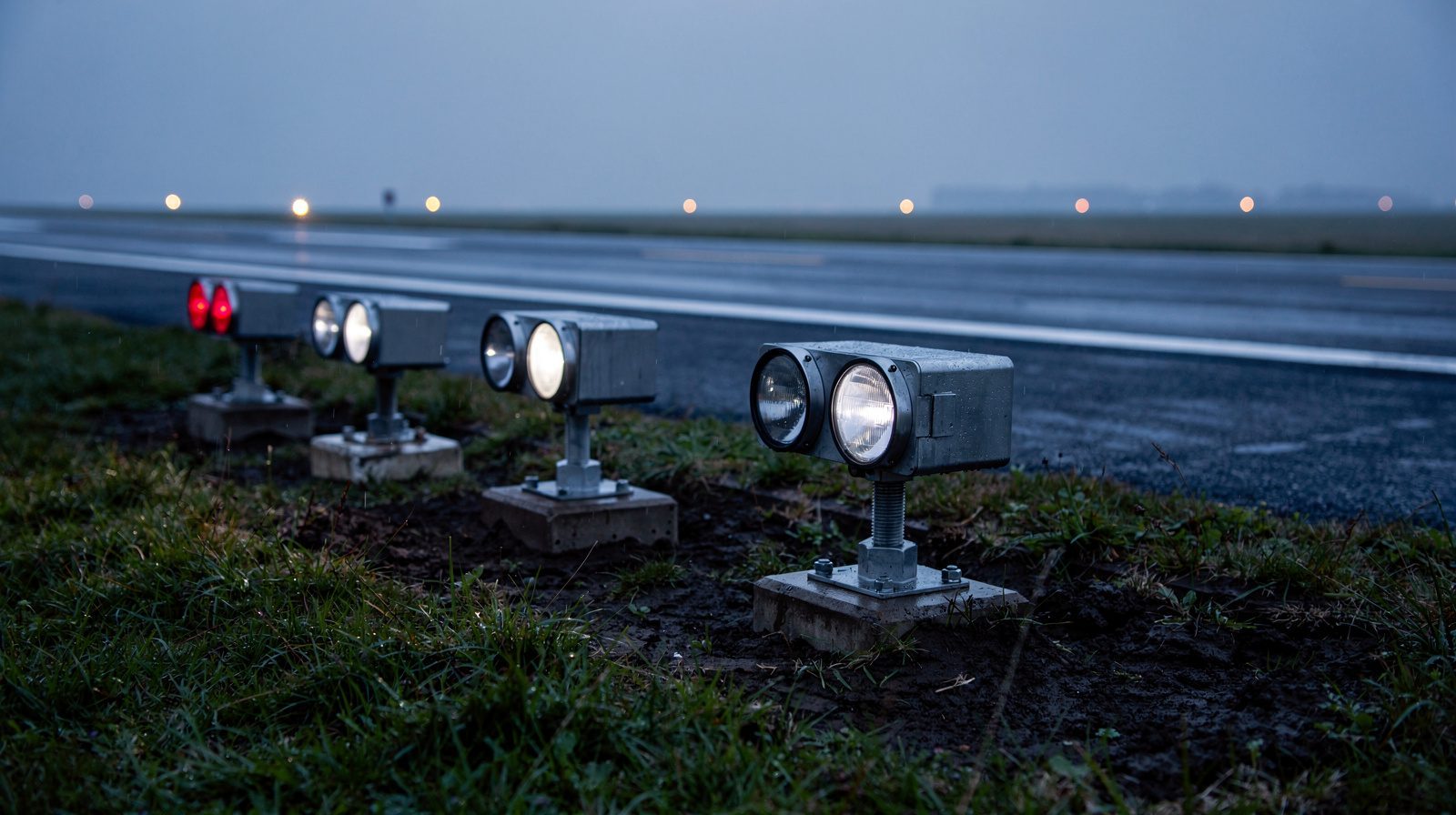 PAPI WING BAR · BLUE HOUR
If a PAPI is out of tolerance, the aerodrome has to correct it, and a NOTAM follows the status of the PAPI, not the size of the error. One is due when the PAPI is withdrawn or significantly changed. None of the EASA, ICAO, FAA or UK CAA texts we read sets an error size that triggers a NOTAM.
The EU acceptable means of compliance say aiming errors above one minute of arc should be corrected. This post follows the steps those texts imply and names the source of each one. For the practical side of confirming and re-aiming, see PAPI out of tolerance: confirm, re-aim, re-check .
Which number is the tolerance
Four documents give four different numbers, and they answer different questions.
| Framework | Source | What it says | Status |
|---|---|---|---|
| EU | AMC1 ADR.OPS.C.015(b) and (f) | Alignment errors in excess of one minute of arc should be corrected | Acceptable means of compliance |
| EU | ADR.OPS.C.015(b)(9) | The maintenance objective is that all units are serviceable, and a unit is unserviceable if it does not give the intended guidance | Rule text |
| UK | CAP 168, 6.491 and 6.483 | A unit should be considered unserviceable if its elevation setting error exceeds ±1 minute of arc. Alignment should be checked weekly to ±1 minute | CAA licensing requirement phrased “should” (alternative compliance may be accepted) |
| ICAO | Annex 14, 5.3.5.30 | The red to white colour transition occurs within 3 minutes of arc | Standard |
| FAA | AC 150/5340-26C, Table A-7 | Vertical aiming within ±2 minutes initially and ±6 minutes in operation, for a 3 degree path unless set locally | Recommended guidance |
Read the ICAO row carefully. Annex 14 5.3.5.30 limits how sharply a unit changes colour, seen from at least 300 m. It is not a limit on the setting angle, and in 5.3.5.24 to 5.3.5.41 we found no setting tolerance. The one-minute figure comes from the EASA acceptable means of compliance and CAP 168. The FAA circular is recommended guidance, and it is mandatory only on projects funded through the Airport Improvement Program or Passenger Facility Charges (paragraph 2).
The EU text does not say that a unit beyond one minute is unserviceable. It says the error should be corrected, and it leaves serviceability to the intended guidance test. CAP 168 is stricter and says it plainly.
What a minute of arc is on the approach
An angle is easier to judge as a height. One minute of arc is 1/60 of a degree, which is about 0.3 m of height at 1,000 m from the unit. The FAA operating limit of 6 minutes is about 1.7 m at the same distance. That is arithmetic and not a figure from any of the texts, but it shows why the limits are tight. In the FAA table the units are set 20 minutes apart for a 3 degree path (2°30′, 2°50′, 3°10′ and 3°30′ for units A to D), so one unit drifting by several minutes moves its colour change a long way against its neighbours.
The signal logic is in CS ADR-DSN.M.645(b)(2). On or close to the approach slope the pilot sees the two units nearest the runway red and the two farthest white. Above it, one red and three white. Below it, three red and one white. A unit that has moved changes the height at which the crew sees these combinations, and that is why a pilot report such as “it showed me high” is a reason to check.
Step 1: confirm which unit and why
The EASA acceptable means of compliance say VASIS alignment should be checked at defined intervals, using an appropriate intensity setting (AMC1 ADR.OPS.C.015(b) and (f)). The guidance material checks setting angles by angular measurement, following the manufacturer’s instructions. A visual comparison between units set to the same angle can show a unit whose optics have moved against its datum plate. The guidance says the cause of that misalignment needs to be ascertained and corrected before any adjustment is made to the setting angles (GM1 ADR.OPS.C.015(b) and (f)).
The acceptable means of compliance add an extra alignment check after an aircraft occurrence. The guidance says the operator needs to adjust its checks around frost, heavy rain or drought, or where the ground is less stable (GM1 ADR.OPS.C.015(b) and (f)). The FAA circular asks for frequent aiming checks when the soil freezes, thaws or changes moisture, and after any contact with mowing equipment (5.7.1.2 h and i).
If the FAA declares a lighted aid out of service because it is suspect in an accident, the circular asks the operator to inspect it immediately and record all functional parameters as found (3.7).
Step 2: decide if the unit is still serviceable
The EASA acceptable means of compliance say a PAPI or APAPI unit should be considered unserviceable if more than one light is out in a unit of three or more lights, or at least one light is out in a unit of fewer than three. When a red filter does not give the correct colour, is missing or is damaged, all lights behind it should be extinguished until it is fixed (AMC1 ADR.OPS.C.015(b) and (f)).
CAP 168 goes further. A unit should be considered unserviceable with an elevation setting error above ±1 minute (6.491), and an installation should be withdrawn if one unit is found unserviceable. Where PAPIs stand on both sides of the runway, only the affected side should be withdrawn (6.75 and 6.76).
Step 3: report it and decide on the NOTAM
An EU operator must monitor the status of its facilities and report matters of operational significance to the air traffic and aeronautical information services (ADR.OPS.B.015(a)). Annex 14 asks for the same, without delay, and names the failure or irregular operation of visual aids (2.9.1 and 2.9.2 g).
The NOTAM duty is in ADR.OPS.A.057(b). It lists the establishment of, withdrawal of or significant changes to visual aids (5) and the interruption of, or return to operation of, major components of aerodrome lighting systems (6). The rule does not define “significant” or “major”. The operator originates the NOTAM under its own procedures, and the aeronautical information services provider finally issues it (GM1 ADR.OPS.A.057(b)). The same rule requires the operator to designate trained staff to originate NOTAMs (a)(2). It also requires a NOTAM to be originated with enough lead time for those affected to act, except in the case of unserviceability and other events that cannot be foreseen (c)(1). A PAPI found unserviceable falls under that exception, so the NOTAM does not wait for a planned date.
| Situation | What the texts say |
|---|---|
| PAPI switched off or withdrawn | A NOTAM case under (b)(5), withdrawal of a visual aid, and under (b)(6) if the PAPI counts as a major component of the lighting system. A NOTAM on unserviceability of facilities has to give an estimate of the unserviceability period or the time restoration is expected (c)(2). The FAA order says U/S for a PAPI that is off, and UNUSABLE if flight inspection found it unsatisfactory (JO 7930.2U, 5-3-7 p) |
| Unit brought back to its set angle, PAPI stays in service | No listed NOTAM case in the texts we read. Log it in the maintenance record |
| Re-aim changes the published slope or eye height | Annex 14 2.12 d and e require the nominal slope and the minimum eye height to be made available. The FAA order carries the example “PAPI GPA CHANGED TO 3.2DEG” (JO 7930.2U, Appendix A, 5-2-1) |
| Partial lighting failure with no direct effect on aircraft operations | EASA lists it as an example case where the operator will not originate a NOTAM (GM1 ADR.OPS.A.057(b)). A PAPI showing the wrong slope is the case to test against that wording |
The UK list in CAP 168 10.9 repeats the EU wording. In the United States, 14 CFR 139.339 has a certificate holder disseminate airport conditions to air carriers, using the NOTAM system as appropriate, and keep a record of each dissemination for at least 12 consecutive calendar months. Its lighting item, (c)(6), refers to systems required by 139.311, and 139.311(c) does not name a PAPI. A PAPI malfunction therefore falls to the catch-all in 139.339(c)(9), which covers any other condition named in the airport certification manual or that may adversely affect air carrier operations. 139.311(d) still requires each lighting system installed and operated on the airport to be properly maintained.
Step 4: correct it and prove the fix
After a correction, the visual approach slope has to conform as closely as possible with the ILS glide path where there is one (Annex 14, 5.3.5.37, a Standard). The EASA acceptable means of compliance ask for a flight check of the lighting systems and the VASIS at least yearly, and for special flight checks in case of major maintenance of, or changes to, such systems (AMC1 ADR.OPS.C.015(b) and (f), flight checks). CAP 168 says a unit that shows a significant alignment difference may be adjusted using a clinometer, but must then be checked with a suitable instrument and flight checked as soon as possible (6.485). The same chapter says a clinometer is for a quick check and should not be used for alignment adjustments (6.484).
None of the texts we read names a drone measurement as a flight check or as a substitute for one. What a drone measurement adds to a flight inspection is the angle of each unit as the approach sees it, before and after the adjustment. TarmacView’s PAPI inspection reports that per unit. We do not adjust the units, and whether an authority accepts a drone measurement as the verification is a question for your maintenance programme, covered in our guide on regulatory acceptance .
Step 5: return to service and keep the record
Return to operation of a major lighting component is a NOTAM item under ADR.OPS.A.057(b)(6), and the rule does not say whether a PAPI counts as one. After publication the operator reviews the NOTAM for accuracy and keeps records of the NOTAMs it originated (A.057(e) and (f)). Maintenance records are separate, under ADR.OPS.C.015(g).
The FAA circular says maintenance logs should be kept for non-federal lighted visual aids such as PAPIs, VASIs, REILs and ODALS (3.2.1). Its example log shows the sequence in practice: the fault found, the NOTAM number, the repair, the quarterly check and the call that the PAPI is ready to return to service (Appendix B). To see how these limits sit alongside the lamp percentages, read our guide to runway light serviceability limits .
What this post does not settle
National rules differ. Your AIP, the competent authority and your own approved programme decide the interval, the limit and the NOTAM procedure. We did not open ICAO Doc 9157 Part 4 or the Airport Services Manual, which are paywalled, and nothing above is drawn from them.
Frequently Asked Questions
- What happens if a PAPI is out of tolerance?
- The aerodrome has to correct it. The EU acceptable means of compliance say alignment errors above 1 minute of arc should be corrected, and CAP 168 says a unit should be considered unserviceable above that error. The EU rule text turns on whether the unit gives the intended guidance.
- Do you need a NOTAM when a PAPI is out of tolerance?
- A NOTAM is due when the PAPI is withdrawn or significantly changed, not because of the size of the error. ADR.OPS.A.057(b) lists the withdrawal of visual aids and the interruption of major lighting components. No text we read sets an error size that triggers a NOTAM.
- What is the ICAO tolerance for PAPI setting angles?
- Annex 14 gives no setting angle tolerance in 5.3.5.24 to 5.3.5.41 as we read it. The 3 minutes of arc in 5.3.5.30 limits how sharply a unit changes from red to white, seen from at least 300 m. The one minute figure comes from the EASA acceptable means of compliance and CAP 168.
- Is a PAPI out of tolerance unserviceable?
- Not by the EU rule alone. ADR.OPS.C.015(b)(9) says a unit is unserviceable if it does not give the intended guidance, and the acceptable means of compliance say errors above 1 minute should be corrected. CAP 168 6.491 says a unit should be considered unserviceable above plus or minus 1 minute.
- Does a re-aimed PAPI need a NOTAM or a flight check?
- A re-aim that leaves the PAPI in service and changes no published slope or eye height lists no NOTAM case in the texts we read. The EU acceptable means of compliance ask for special flight checks after major maintenance, and CAP 168 6.485 asks for a flight check as soon as possible after a clinometer adjustment.
References
- easa-ear-aerodromes
- Easy Access Rules for Aerodromes (Regulation (EU) No 139/2014), including CS-ADR-DSN Issue 7, revision of March 2026 European Union Aviation Safety Agency
- icao-annex-14-v1
- Annex 14 to the Convention on International Civil Aviation, Volume I: Aerodrome Design and Operations, 9th edition, July 2022, with Amendment 18 International Civil Aviation Organization
- faa-ac-150-5340-26c
- AC 150/5340-26C, Maintenance of Airport Visual Aid Facilities Federal Aviation Administration
- faa-jo-7930-2u
- Order JO 7930.2U, Notice to Airmen (NOTAM), effective 9 June 2025 Federal Aviation Administration
- 14-cfr-139
- 14 CFR Part 139, Certification of Airports, sections 139.311 and 139.339 Electronic Code of Federal Regulations
- uk-caa-cap-168
- CAP 168, Licensing of Aerodromes, thirteenth edition (July 2025, version 13 re-issued 2 December 2025) UK Civil Aviation Authority
Founded by flight-inspection veterans who spent decades measuring PAPI lights for aviation authorities across Europe.
Learn more
Related terms
03 TERMSPAPI Approach Slope and Elevation Setting
The PAPI approach slope and elevation setting are the approach angle a PAPI shows and the angle of each unit. Setting angles for 3 degrees, tolerance, how they are measured, and drones.
Color Transition
A colour transition is the boundary in the beam of an approach slope light unit where white changes to red. How a PAPI forms its signals, how sharp the transition must be, how VASI and tri-colour systems differ, and what inspection checks.
Light Unit
A light unit is one light assembly of an airfield lighting system, such as one unit of a PAPI. Units per system, PAPI aiming, spacing, serviceability and LED reporting.
Further reading
03 ARTICLES
PAPI Out of Tolerance: Confirm, Re-aim, Re-check
What to do when a PAPI looks out of tolerance: confirm which unit is off and by how much, decide on a NOTAM, re-aim it and prove the fix without a…
What ICAO Annex 14 Actually Requires of Your PAPI
The tolerances behind a PAPI protocol, what an authority looks for in the evidence, and how often the system has to be verified to stay certifiable.

How PAPI Transition Angles Are Verified in the Field
How to verify PAPI transition angles in the field: clinometer and ground checks, flight checks and drone measurement, with the ICAO, EASA and FAA…