Light unit
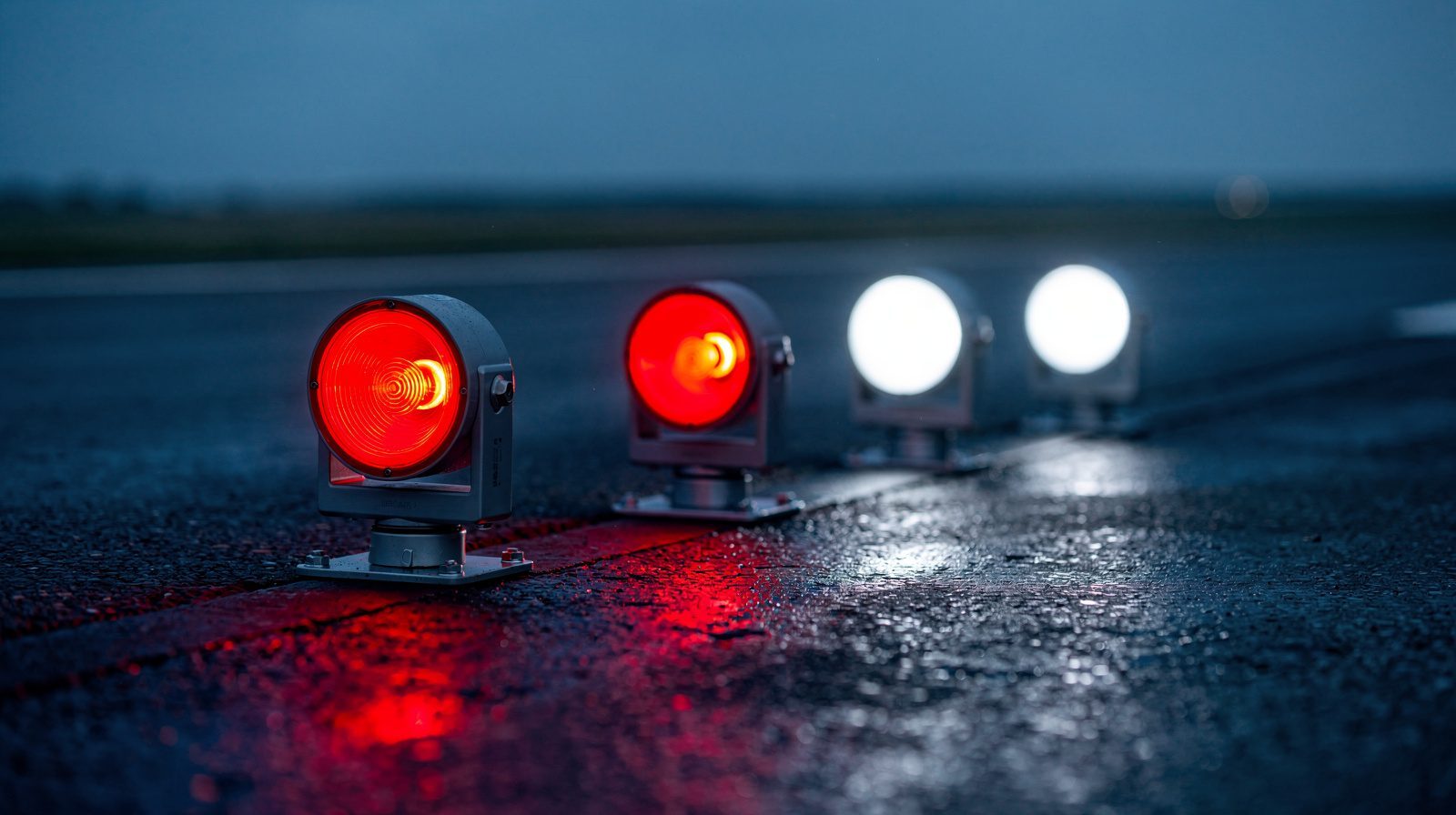
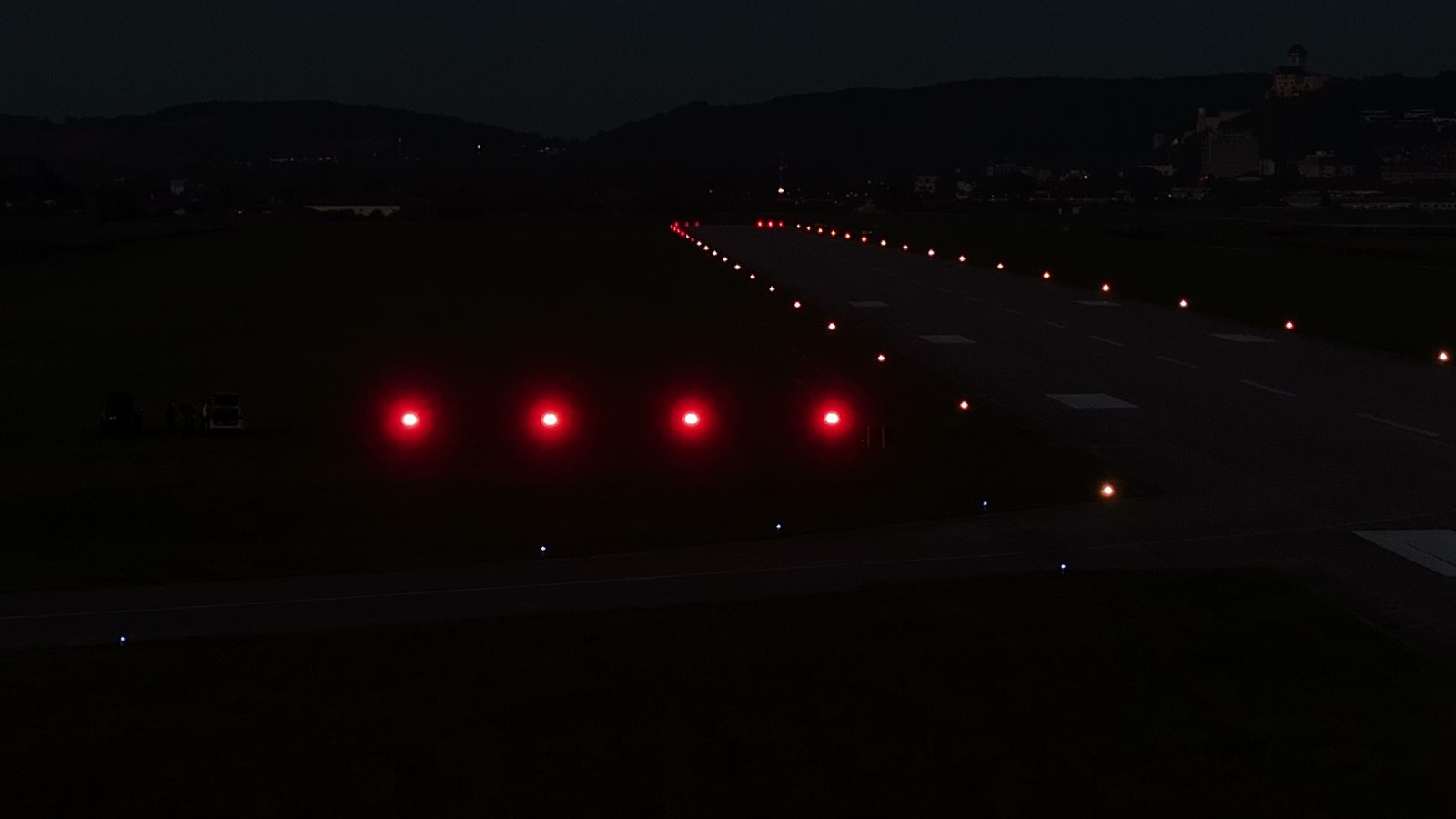
A light unit is one light assembly of an airfield lighting system, such as one of the four units of a PAPI.
How the standards use the term
ICAO Annex 14, CS-ADR-DSN and FAA AC 150/5340-30J use “light unit” without a definition. In the rules for the PAPI, VASI and REIL it means the single assembly that gives one signal.
A light unit is not the same as a light fixture. The fixture holds the light source of one light. A PAPI unit can hold several lamps, which the EASA specification calls a sharp transition multi-lamp unit or a paired single lamp unit. The FAA also calls a PAPI unit a light housing assembly.
Light units in the standards
| System | Light units | Source |
|---|---|---|
| PAPI | Four, in one wing bar. A second wing bar may stand on the opposite side. The FAA says two or four | CS ADR-DSN.M.645 (b)(1), FAA AIM 2-1 |
| APAPI | Two | CS ADR-DSN.M.645 (b)(1) |
| VASI | 2, 4, 6, 12 or 16 | FAA AIM 2-1 |
| T-VASIS | Twenty | Annex 14 5.3.5.7 |
| Tri-color and pulsating systems | One | FAA AIM 2-1 |
| REIL | Two synchronized flashing lights | FAA JO 6850.2C, 400 and 401 |
What the pilot sees from a PAPI
The four units of a PAPI are lettered from the unit farthest from the runway to the nearest. CS ADR-DSN.M.645 (b)(2) sets the signals.
- On or close to the approach slope: the two units nearest the runway look red and the two farthest look white.
- Above the slope: one unit nearest the runway looks red and three look white. Further above, all look white.
- Below the slope: three units nearest the runway look red and one looks white. Further below, all look red.
An APAPI shows one red and one white on the slope. The colour change in a unit should occur within 3 minutes of arc, as an observer at least 300 m away sees it (M.645 (c)(2)). Annex 14 states this as a Standard (5.3.5.30).
Aiming a PAPI unit
Each PAPI unit emits one beam that is red and white (AC 150/5340-30J, 7.4.4.2). The beam changes from red to white at one elevation angle. The pilot sees the unit change colour as the aircraft rises through that angle.
Each unit is adjustable in elevation. The lower limit of the white part of its beam can be set between 1°30’ and at least 4°30’ above the horizontal (CS ADR-DSN.M.645 (c)(4)). Annex 14 states this as a Standard (5.3.5.34).
Figure M-5 of CS-ADR-DSN shows the setting angles for a 3 degree slope. From the farthest unit to the nearest they are 2°30’, 2°50’, 3°10’ and 3°30’. The approach slope is the mean of the two middle angles. An APAPI on a 3 degree slope has 2°45’ and 3°15’. The figure also shows another set for a wider on-course sector: 2°25’, 2°45’, 3°15’ and 3°35'.
The FAA gives the aiming of its units relative to the chosen glide path (AC 150/5340-30J, Tables 7-2 and 7-3).
- L-880, four units, standard installation: the angles run from the nearest unit to the farthest. They are 30 minutes above the glide path, 10 above, 10 below and 30 below.
- L-881, two units: 15 minutes above for the unit nearest the runway and 15 minutes below for the other.
The elevation settings should give a safe margin over all objects in the approach area. EASA words this for the signal of one white and three reds on a PAPI (CS ADR-DSN.M.650 (b)(1)). Where wing bars stand on both sides of the runway, matching units get the same angle. The signals then change together (M.650 (b)(4)).
Spacing and mounting of PAPI units
| Value | CS-ADR-DSN | FAA AC 150/5340-30J |
|---|---|---|
| Distance between units | 9 m (±1 m). 6 m (±1 m) on code number 1 and 2 | 20 to 30 ft (6 to 9 m) for L-880 and L-881, with at most ±1 ft (0.3 m) variation |
| Inner unit from the runway edge | 15 m (±1 m). At least 10 m (±1 m) with 6 m spacing | At least 50 ft (15 m), +10 ft, -0 ft. 30 ft (10 m) on small general aviation runways |
| Height of the units | Small adjustments of up to 5 cm between units for slope. Mount the units as low as possible | Beam centres within ±1 inch (25 mm) of a horizontal plane |
CS ADR-DSN.M.645 (b)(4) asks for units that look to the approaching pilot like one horizontal line. The units are as low as possible and frangible. The FAA aims each unit outward into the approach zone, parallel to the runway centreline, within ±1/2 degree (7.5.4.7.3).
Contamination and heating
CS ADR-DSN.M.645 (c)(5) says the units should be designed so that condensation, snow, ice and dirt interfere as little as possible with the signal. They should not affect the contrast between red and white or the elevation of the transition sector. EASA guidance adds that an LED PAPI is likely to need a lens heater, so that condensation and ice do not form (GM2 ADR.OPS.C.015(b)).
Power and monitoring
On a series circuit, an isolation transformer separates the light unit from the high voltage of the circuit. If a lamp filament opens, the transformer keeps the circuit closed (AC 150/5340-30J, 3.5.3).
CS ADR-DSN.S.890 asks for a system of monitoring that indicates the operational status of the lighting systems. A change in the status of a light should show within five seconds. For a stop bar at a runway-holding position the limit is two seconds. PAPI units also need intensity control, so that the system does not dazzle the pilot (CS ADR-DSN.M.645 (c)(3)).
Serviceability
A light is unserviceable if its main beam average intensity is below 50 % of the specified value. It is also unserviceable if its filter is missing or damaged, or if it shows the wrong colour (ADR.OPS.C.015 (c)). For a runway with a visual approach slope indicator system, the maintenance objective is that all units are serviceable. A unit is unserviceable if its failed lights stop it from giving the intended guidance (ADR.OPS.C.015 (b)(9)).
EASA guidance on ground checks adds three rules for the PAPI and APAPI (AMC1 to ADR.OPS.C.015, points (b) and (f)).
- Alignment: an error above one minute of arc should be corrected. The alignment is checked at defined intervals.
- Unit count: with three or more lights in a unit, more than one failed light makes the unit unserviceable. With fewer than three lights, one failed light is enough.
- Red filter: if a red filter is missing, damaged or the wrong colour, all lights behind it go out until the filter is corrected.
EASA guidance also describes a higher maintenance level, always above 50 per cent. It warns maintenance crews before a light fails.
LED light units
The aerodrome operator must report to the aeronautical information services which parts of the lighting system use LED light units (ADR.OPS.A.070). EASA explains the reason in the guidance. Enhanced flight vision systems rely on the infrared heat signature of incandescent lights, and replacing them with LED lights may make those operations impossible.
Why it matters for inspection
The PAPI rules set an angle for each unit, so an inspection checks the units one by one. The check covers the red-to-white transition angle of each unit, its elevation setting and its colour, as the rules above describe.
To check the units of a PAPI, contact us .
Frequently Asked Questions
- How many light units does a PAPI have?
- A PAPI has four light units in one row, and an APAPI has two. The EASA specification calls each one a sharp transition multi-lamp unit or a paired single lamp unit. The FAA says a PAPI has two or four light units.
- How are the units of a PAPI set?
- Each unit is set at its own elevation angle. For a 3 degree slope, CS-ADR-DSN shows 2°30', 2°50', 3°10' and 3°30', from the unit farthest from the runway to the nearest. The pilot sees the units change from red to white one by one as the aircraft rises through those angles.
- When is a light unit unserviceable?
- A light is unserviceable if its main beam average intensity is below 50 % of the value in the EASA certification specifications. It is also unserviceable if its filter is missing or damaged, or if it shows the wrong colour. If the designed intensity is higher than the specified value, the 50 % applies to the design value.
- When is a PAPI unit unserviceable?
- EASA guidance says a PAPI or APAPI unit is unserviceable if more than one light fails in a unit of three or more lights. It is also unserviceable if at least one light fails in a unit of fewer than three lights. If a red filter gives the wrong colour, is missing or is damaged, all lights behind that filter go out until the filter is corrected.
- How far apart are the units of a PAPI?
- In CS-ADR-DSN the units of a PAPI stand 9 m (±1 m) apart. The inner unit stands 15 m (±1 m) from the runway edge. On runways of code number 1 and 2 the spacing should be 6 m (±1 m). The FAA sets 20 to 30 ft (6 to 9 m) between units for its L-880 and L-881 systems.
- What is the difference between a light unit and a light fixture?
- A light unit is one assembly that gives one signal in a system, such as one PAPI unit. A light fixture is the unit that holds the light source of one light. The standards use both words without a definition. A PAPI unit can hold several lamps, so a unit can be more than one fixture.
- What is the cut-off angle of a PAPI light unit?
- CS-ADR-DSN does not use the term cut-off angle for a PAPI. Each unit has an elevation setting, which is the angle where its beam changes from red to white. The rules call it the lower limit of the white part of the beam. It can be set from 1°30' to at least 4°30' above the horizontal.
- Why must an aerodrome report LED light units?
- EU rules require the aerodrome operator to tell the aeronautical information services which parts of the lighting system use LED light units. EASA explains that enhanced flight vision systems rely on the infrared heat signature of incandescent lights. Replacing them with LEDs may make such operations impossible.
References
- easa-ear-aerodromes
- Easy Access Rules for Aerodromes (Regulation (EU) No 139/2014), including CS-ADR-DSN Issue 7 EASA
- faa-ac-150-5340-30j
- AC 150/5340-30J, Design and Installation Details for Airport Visual Aids FAA
- faa-jo-6850-2c
- Order JO 6850.2C, Visual Guidance Lighting Systems FAA
This is a reference entry. TarmacView provides drone inspection services and doesn't sell the equipment or materials described in this glossary.