When Runway Lights Drift Out of Tolerance
Runway lights do not fail suddenly. They drift. What moves a fixture out of tolerance, why nobody sees it happen, and how a measured baseline catches it.
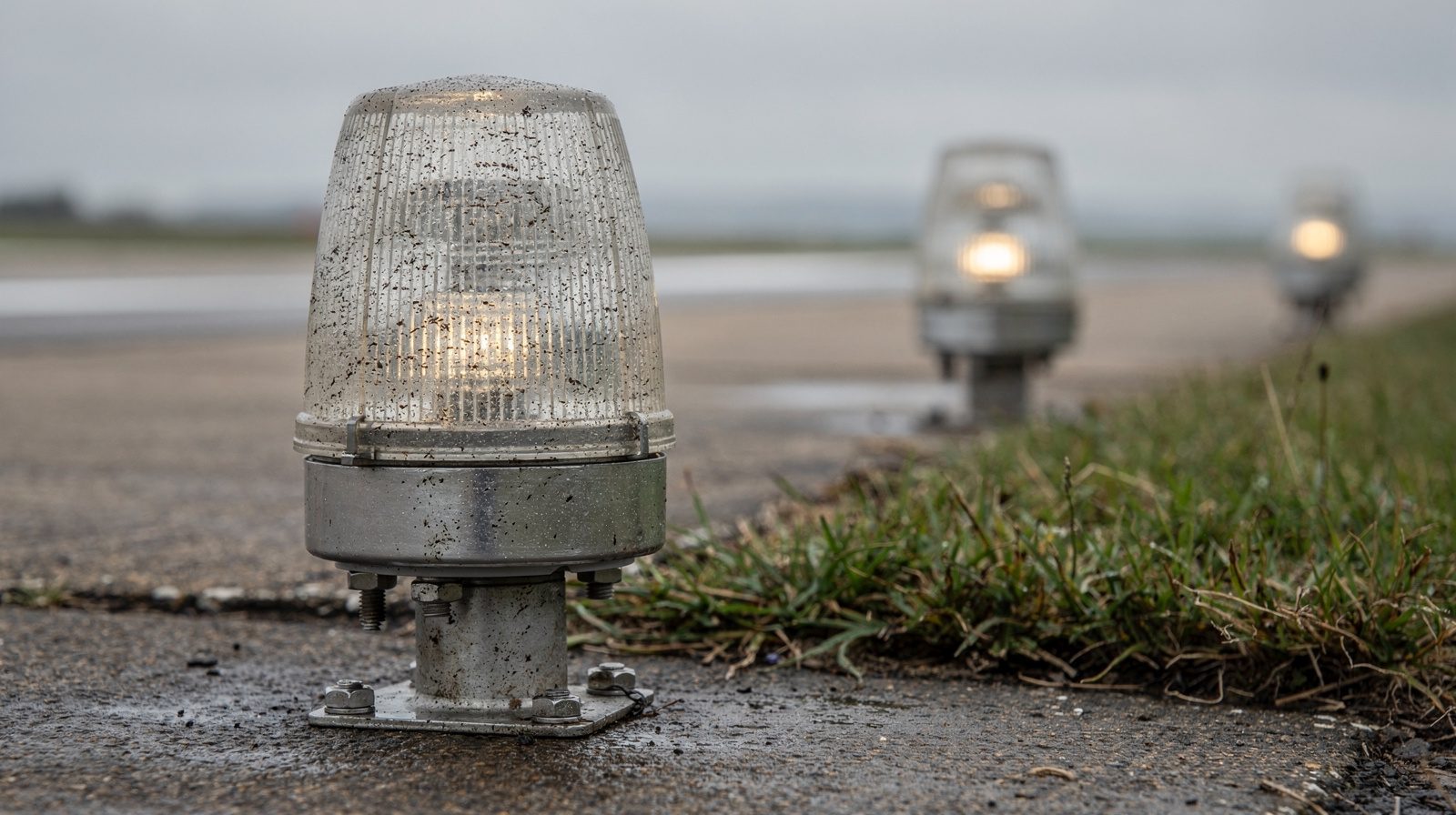 CLOUDED LENS · OVERCAST
Out of tolerance is a state, not an event
Nothing happens on the day a fixture goes out of tolerance . No lamp pops, no circuit opens, no alarm sounds in the tower. The unit crosses a line that exists only in a document, and it does so between two inspections, on an ordinary Tuesday.
That is the awkward part of the definition. Tolerance is a permissible band around a specified value, and a fixture is either inside it or outside it at the moment somebody measures. The crossing is not observable. The slope that led to it is, but only if the fixture was measured before.
Most airfield lighting maintenance is organised around events. A unit fails, a circuit trips, a plough takes out a fixture, and somebody goes to fix it. Drift is not an event. It is the normal condition of every installed fixture, all the time, and it is the reason a row that passed its last inspection can be non-compliant today with nothing in the maintenance log to say so.
What actually moves
Drift is not one process. It is at least six, running in parallel, at different rates, and they leave different signatures in a measurement.
The optical path. The outer lens takes everything the airfield has. Rubber deposit from touchdown, de-icing fluid, jet exhaust, agricultural dust off the grass, and the brushes and blades that clean it all off again. Soiling is a film that scatters and absorbs, and it is mostly reversible. Abrasion is not. Grit and repeated mechanical cleaning frost the surface, and a frosted lens both loses output and smears the beam, which is worse, because the light that does leave the fixture stops going where the optic intended.
The colour filter. Where colour is produced by a filter rather than by the emitter itself, the filter is the part that ages first. It bleaches. Chromaticity moves before intensity does, which means a yellow caution-zone unit can drift toward white while still delivering close to its rated luminous flux . The fixture is bright and it is saying the wrong thing.
The source. Every emitter puts out less light as it accumulates hours. For an incandescent lamp this was fast and familiar, and group relamping dealt with it. For an LED it is slow, and slow is harder to manage, because nothing forces the issue.
Water. Seals and gaskets are consumables. Once a fixture breathes, moisture cycles in and out with every temperature swing, and it condenses on the inside of the optic where no cleaning schedule reaches. Ingress corrodes reflectors, clouds internal surfaces and eventually kills the driver. The intermediate stage is a unit that measures erratically rather than low.
Geometry. Elevated fixtures get knocked. Mowing crews clip them, ploughs push them, vehicles reverse into them. The unit stays lit and stays bolted down, and it is now pointing a few degrees off where it was aimed. Peak luminous intensity is unchanged. The sector that matters is empty.
The ground. Foundations settle. Bases move in soft soil, and a shoulder regraded after resurfacing leaves a row at heights that no longer match the design. This drifts slower than everything else and is the most expensive to correct.
| Mechanism | What physically changes | Signature in a measurement | Reversible |
|---|---|---|---|
| Lens soiling and film | Deposit on the outer surface | Broad loss, similar in every direction | ✓ by cleaning |
| Lens abrasion and clouding | The surface is frosted by grit and brushing | Loss plus scatter, beam edges soften | ✗ the optic is replaced |
| Filter fade | The colour layer bleaches | Chromaticity moves before intensity | ✗ |
| Source depreciation | Less light for the same drive current | Uniform fall, beam shape unchanged | ✗ |
| Seal and gasket ingress | Moisture and dust enter the optic | Erratic readings, then a step change | Partly, if caught early |
| Rotation and tilt | The fixture is knocked off aim | Peak holds, the required sector empties | ✓ by realignment |
| Foundation settlement | The base or the shoulder moves | Slow elevation change across a run | ✓ but it is civil work |
Two of those rows are fixed by a bucket of water and a cloth. Two more are fixed by a spanner. An operator who cannot tell them apart treats all of them as replacement.
Why nobody sees it
The eye is a superb comparator and a hopeless meter. Standing at the threshold, you can pick out the one fixture in a row that is dimmer than its neighbours. You cannot pick out a row where every fixture has fallen by the same fraction, because there is nothing left to compare against. Uniform drift is the case the eye is structurally unable to catch, and uniform drift is exactly what soiling across a season and source depreciation across a decade produce.
Adaptation makes it worse. Between one inspection and the next, your eyes adjust to a slowly dimming row, and so do the eyes of everybody else who drives the field.
Circuit monitoring does not close the gap, because it is measuring the wrong thing. A lighting control and monitoring system watches current, continuity and lamp state. A fixture with a clouded lens draws exactly its rated current. So does one rotated fifteen degrees by a mower, one with a bleached filter, and one at half output. Every drift mechanism above is invisible to the electrical system, because none of them is an electrical fault. Nor does dimming help. Intensity control commands a step, and a drifted fixture obeys the command faithfully at a lower absolute output than it used to deliver on the same step.
The result is a row that reports healthy on every system the airport owns, and is not.
What LED changed about the slope
The general lighting industry has a vocabulary for this, and airfield practice has been slow to borrow it. Lumen maintenance is written as an L value: the percentage of initial output still being delivered after a stated number of hours.
| L value | Output remaining | Where the threshold is normally set |
|---|---|---|
| L90 | 90 per cent | Photometrically critical spaces, galleries, surgical lighting |
| L80 | 80 per cent | Premium commercial specification |
| L70 | 70 per cent | The general lighting default, taken as the replacement point |
Those numbers come with a measurement chain behind them. IES LM-80 tests the lumen maintenance of the LED package itself, over a minimum of 6,000 hours and preferably 10,000, sampled at 1,000-hour intervals. IES TM-21 then projects the curve forward, with the projection capped at six times the tested duration so that nobody extrapolates a decade from a fortnight. Both characterise the package on a bench. Neither says anything about the lens in front of it, the seal around it, or the mower.
The relevant comparison for an airfield is the one against what LEDs replaced. An incandescent airfield lamp ran 1,000 to 2,000 hours. An LED runs 25,000 to well over 100,000. That killed scheduled group relamping, and group relamping was the only thing that reliably reset a row’s photometric condition. The failure mode changed with it. Incandescent lamps went dark, which is detectable. LEDs fade, which is not.
So the modern row degrades more slowly and more invisibly than the row it replaced, without the maintenance ritual that used to interrupt the decline.
A baseline turns drift into a trend
One measurement answers a compliance question. Two answer a maintenance question, and the second one is worth more.
The mechanics are unglamorous. A calibrated photometer , or imaging photometric testing that carries the same traceable calibration chain, produces a value per unit rather than a verdict per row. Attach a surveyed position and a timestamp to each value and you have a baseline. Repeat it and every fixture has a slope.
Repeatability is the whole game. A trend is only real if the second measurement sampled the same geometry as the first, at the same commanded intensity step, in comparable conditions. A number taken from a different standoff, a different angle or a different dimming step is not a comparison, it is a new opinion. This is the practical argument for flying a stored mission plan over a runway edge light row rather than repeating a manual survey: the flight path reproduces, so the difference between two passes is attributable to the fixture instead of to the method. That reproducibility is what we build the edge light inspection around .
With a slope per unit, three things become schedulable that were previously reactive. Cleaning goes to the fixtures whose loss is broad and recent rather than to the whole row. Realignment goes to the units whose sector coverage collapsed while their peak held. Replacement goes to the units whose fall is uniform and monotonic, which is the signature that no amount of cleaning will fix.
The unit that passes and is falling
Which leaves the case an inspection report handles badly. A fixture is inside tolerance. It also lost measurable output since the last visit. The report says pass, and the pass is correct, and it is not the useful part of the finding.
The standard gives you two reference points to work between. A light is unserviceable when its main beam falls below 50 per cent of the specified value, and guidance treats about 70 per cent as the sensible point to intervene. The distance between those two figures is a planning window rather than a grace period. A unit at 75 per cent and falling steadily is a work order you get to schedule. The same unit found at 45 per cent during an audit is a finding you do not.
What an operator should actually do with an inside-tolerance-but-falling unit is modest. Record the value, not the verdict. Rank the row by slope rather than by absolute output, because the steepest decline is the best predictor of the next failure. Group the interventions, since the crew is already on the field and the marginal cost of cleaning twelve lenses instead of one is close to nothing. Then re-measure after the work, which is cheap when the mission plan already exists and is the same reason a verification pass costs a fraction of a full inspection .
There is one honest limitation. We cannot tell you how fast your field drifts, and neither can anyone else, because it depends on your traffic, your climate, your de-icing regime, your cleaning practice and the age of your fixtures. Published depreciation curves describe an edge light package on a bench, not a row on your runway. The rate is a local quantity, and the only way to learn it is to measure the same row twice and look at the difference.
Founded by flight-inspection veterans who spent decades measuring PAPI lights for aviation authorities across Europe.
Learn more
Related terms
03 TERMSIn-Pavement Light
In-pavement lights are robust, flush-mounted lighting fixtures embedded in airport runways and taxiways, delivering crucial visual guidance for pilots and vehicles, especially in low-visibility conditions, while maintaining pavement integrity and meeting stringent ICAO/FAA standards.
Light Fixture
A light fixture in airport lighting is a complete unit including lamp, optics, housing, and controls, built to rigorous safety and performance standards for airfield, apron, and terminal illumination.
Lamp – Light Source – Airport Lighting
A comprehensive guide to lamps and light sources in airport lighting systems. Explore definitions, technologies, applications, and regulatory standards covering runway, taxiway, approach, obstruction, and sign lighting.
Further reading
03 ARTICLES
Airfield Lighting Inspection Without Closing the Runway
How an aerodrome verifies its lighting each year without a runway closure: what must be checked, what evidence an authority accepts, where a drone…
What ICAO Annex 14 Actually Requires of Your PAPI
The tolerances behind a PAPI protocol, what an authority looks for in the evidence, and how often the system has to be verified to stay certifiable.
When Runway Markings Lose Conspicuity
A marking can be present yet invisible. How abrasion, rubber, oxidation and water degrade conspicuity, and when to repaint versus strip.