Aerodrome Design Manual – ICAO Doc 9157
Definition
A defined area on land or water, including all buildings, installations, and equipment, intended wholly or partly for the arrival, departure, and surface movement of aircraft.
Operational Application:
Forms the basis for all aerodrome planning, design, and certification. Encompasses operational surfaces, safety infrastructure, and ancillary facilities.
References:
- ICAO Annex 14, Volume I
- ICAO Doc 9157, Part 1, Section 1.2
- Wikipedia: Aerodrome
Aerodrome Design Manual (ADM), ICAO Doc 9157
Definition:
ICAO’s multi-part technical manual offering detailed methodologies and best practices for aerodrome planning, geometric design, pavements, and visual aids.
Parts:
| Part | Title | Focus Area |
|---|---|---|
| 1 | Runways | Design, orientation, declared distances |
| 2 | Taxiways, Aprons, Holding Bays | Layout, separation, geometry |
| 3 | Pavements | Structural design, evaluation, maintenance |
| 4 | Visual Aids | Lighting, markings, signage, visual guidance |
References:
- ICAO Doc 9157, Parts 1–4
- ICAO Store – Doc 9157
International Civil Aviation Organization (ICAO)
Definition:
A specialized United Nations agency responsible for developing global civil aviation standards, including aerodrome design and operation.
Mandate:
Establishes SARPs (Standards and Recommended Practices) in 19 Annexes, coordinates global harmonization, and provides the ADM.
References:
- ICAO About
- ICAO Doc 9157 Foreword
Standards and Recommended Practices (SARPs)
Definition:
ICAO-adopted technical specifications for global application.
- Standards: Mandatory unless notified as a difference.
- Recommended Practices: Strongly encouraged, with flexibility.
Role:
Form the foundation for national aviation law, certification, and operational approvals.
References:
- ICAO SARPs Overview
- ICAO Annex 14, Volume I
Aerodrome Reference Code
Definition:
A two-part code (number and letter) assigned to an aerodrome, based on the critical aircraft’s field length requirement and wingspan/gear span.
| Code Number | Reference Field Length (m) |
|---|---|
| 1 | < 800 |
| 2 | 800 – < 1,200 |
| 3 | 1,200 – < 1,800 |
| 4 | ≥ 1,800 |
| Code Letter | Wingspan (m) | OMGWS (m) |
|---|---|---|
| A | < 15 | < 4.5 |
| B | 15 – < 24 | 4.5 – < 6 |
| C | 24 – < 36 | 6 – < 9 |
| D | 36 – < 52 | 9 – < 14 |
| E | 52 – < 65 | 9 – < 14 |
| F | 65 – < 80 | 14 – < 16 |
Example:
Boeing 777 (field length 2,800 m, wingspan 65 m): Code 4E.
References:
- ICAO Doc 9157 Part 1, Section 1.3
- ICAO Annex 14, Volume I, Table 1-1
- Wikipedia: ICAO Aerodrome Reference Code
Record of Amendments and Corrigenda
Definition:
An official log in ICAO publications noting all updates and corrections since original release.
Role:
Ensures users apply the latest standards, required for audits and compliance.
References:
- ICAO Doc 9157, front matter
- ICAO Publications Amendments
Aerodrome Physical Characteristics
Definition:
Geometric, structural, and spatial properties of aerodrome elements, runways, taxiways, aprons, strips, safety areas.
Importance:
Determine safe operations, standardization, and future scalability.
References:
- ICAO Doc 9157 Part 1, Chapter 5
- ICAO Manual of Aerodrome Standards
Runway
Definition:
A prepared rectangular area for aircraft landing and takeoff.
Key Attributes:
Length, width, surface, markings, slopes, shoulders, and safety strips.
References:
- ICAO Doc 9157 Part 1, Section 1.2
- ICAO Annex 14, Volume I, Chapter 3
- Wikipedia: Runway
Taxiway
Definition:
A defined path for taxiing aircraft, connecting runways, aprons, and other facilities.
Types:
Parallel, rapid-exit, and link taxiways.
References:
- ICAO Doc 9157 Part 2, Chapter 1
Apron
Definition:
Area for parking, loading/unloading, refuelling, and maintenance of aircraft.
Design:
Must accommodate maneuvering, pavement strength, markings, and lighting.
References:
- ICAO Doc 9157 Part 2, Chapter 3
- Wikipedia: Apron
Visual Aids
Definition:
Markings, lights, signs, and markers for visual guidance to pilots and vehicles.
Categories:
Markings, lighting systems, signage, and markers.
References:
- ICAO Doc 9157 Part 4, Chapters 1, 4, 9
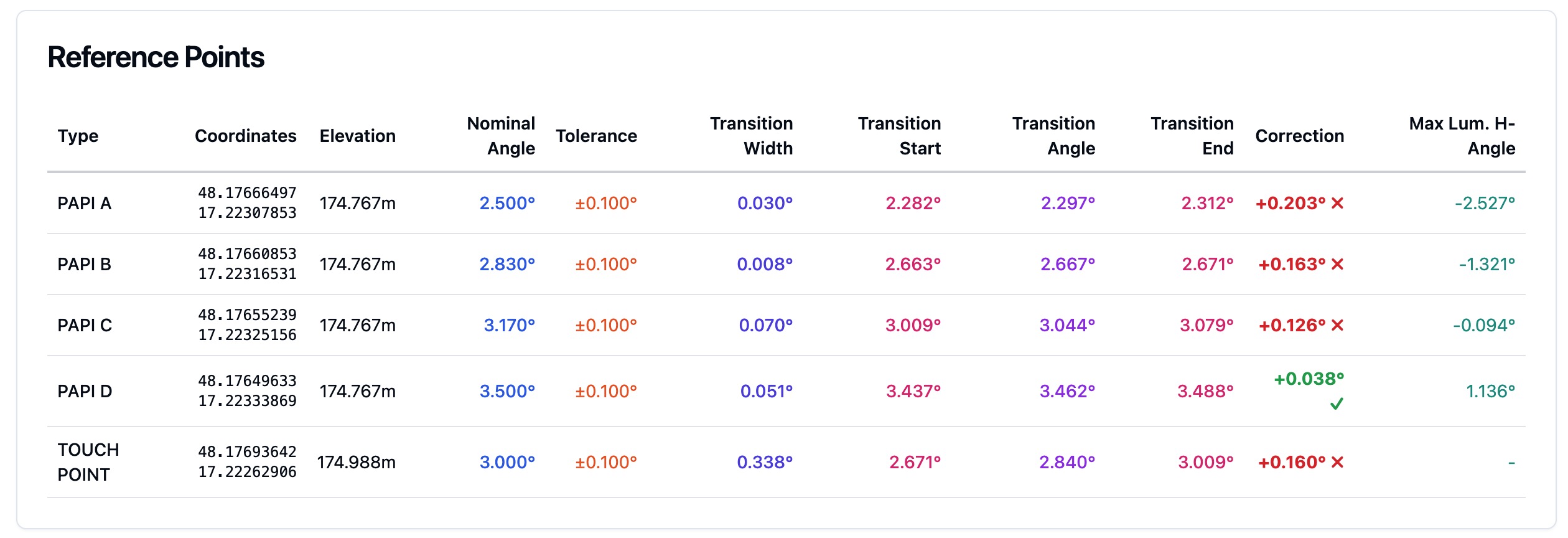
Visual Approach Slope Indicator Systems (VASIS) / Precision Approach Path Indicator (PAPI)
Definition:
Visual aids providing glide path indications via colored lights (e.g., PAPI, T-VASIS).
Example:
PAPI displays red/white lights indicating aircraft position relative to approach angle.
References:
- ICAO Doc 9157 Part 4, Chapter 8
- Wikipedia: PAPI
Mandatory Instruction Signs
Definition:
Red-background, white-inscription signs indicating stop or clearance points.
Purpose:
Prevent runway incursions, enforce ATC instructions.
References:
- ICAO Doc 9157 Part 4, Chapter 12
Visual Docking Guidance System (VDGS)
Definition:
Systems providing real-time visual cues to guide aircraft into apron parking positions.
Types:
AGNIS, PAPA, advanced laser/video systems.
References:
- ICAO Doc 9157 Part 4, Chapter 13
Autonomous Runway Incursion Warning System (ARIWS)
Definition:
Systems (e.g., runway status lights) warning of potential runway incursions using real-time surveillance data.
References:
- ICAO Doc 9157 Part 4, Chapter 11
- FAA Runway Status Lights
Surface Movement Guidance and Control System (SMGCS / A-SMGCS)
Definition:
Systems managing aircraft/vehicle movements on the aerodrome, especially in low visibility.
Features:
Taxiway lights, stop bars, surveillance, ATC integration.
References:
- ICAO Doc 9157 Part 4, Chapter 10
- Wikipedia: A-SMGCS
Frangibility
Definition:
The property of structures to yield or break on impact, minimizing aircraft damage/injury.
Application:
Essential for all objects within runway strips (visual aids, signs, lighting).
References:
- ICAO Doc 9157 Part 4, Chapter 16
- ICAO Frangibility Guidance
Aerodrome Usability Factor
Definition:
Percentage of time aerodrome runways can be used for operations, based on wind and weather (ICAO minimum: 95%).
Purpose:
Guides runway orientation and infrastructure planning.
References:
- ICAO Doc 9157 Part 1, Section 2.1.6
- ICAO Annex 14, Volume I, Section 3.1.1
Declared Distances
Definition:
Published runway distances for performance calculations:
| Term | Meaning |
|---|---|
| TORA | Take-Off Run Available |
| TODA | Take-Off Distance Available |
| ASDA | Accelerate-Stop Distance Available |
| LDA | Landing Distance Available |
References:
- ICAO Doc 9157 Part 1, Section 2.2
- ICAO Annex 14, Volume I
For further authoritative information, always refer directly to the latest ICAO publications and official guidance.
Frequently Asked Questions
- What is ICAO Doc 9157 and why is it important?
- ICAO Doc 9157, also known as the Aerodrome Design Manual (ADM), is a multi-part technical manual providing detailed guidance for planning, designing, and operating aerodromes in compliance with ICAO's international standards. It supports States and airport operators in meeting safety, efficiency, and interoperability requirements. [See ICAO Store](https://store.icao.int/en/aerodrome-design-manual-runways-doc-9157-part-1)
- How does the Aerodrome Reference Code affect airport design?
- The Aerodrome Reference Code classifies aerodromes based on the characteristics of the largest aircraft in regular use. It determines minimum runway, taxiway, and apron dimensions, as well as separation and pavement strength standards. [Details: ICAO Annex 14, Table 1-1](https://skybrary.aero/articles/icao-aerodrome-reference-code)
- What are SARPs in the context of aerodrome standards?
- SARPs (Standards and Recommended Practices) are internationally agreed specifications adopted by ICAO. Standards are mandatory unless a difference is filed, while Recommended Practices are strongly encouraged for global harmonization. [More: ICAO SARPs Overview](https://www.icao.int/safety/pages/sarps.aspx)
This is a reference entry. TarmacView provides drone inspection services and doesn't sell the equipment or materials described in this glossary.