What is Minimum Eye Height over Threshold (MEHT)?
Minimum Eye Height over Threshold (MEHT)
Definition
A minimum eye height over the threshold (MEHT) is the lowest eye height that gives a pilot an on-slope signal at the threshold.
ICAO Doc 9157 gives the same meaning in a note. MEHT is the lowest height at which the pilot perceives an on-slope indication over the threshold. The term belongs to visual approach slope indicators such as the precision approach path indicator (PAPI). That page covers the unit layout and the red and white signals. This page covers one number that the layout produces, and what the number sets.
What MEHT is and what it is not
MEHT is a height of the pilot’s eyes. The wheels pass lower. The distance between them is the eye-to-wheel height of the aeroplane in the approach configuration. See pilot eye position .
MEHT is also not the nominal approach path. The nominal slope of a PAPI is the mean of the setting angles of units B and C. MEHT belongs to the lower edge of the on-slope sector. The unit that sets this edge is unit B on a PAPI and unit A on an APAPI. A pilot who flies below this edge does not see the on-slope signal.
How MEHT is set
ICAO Annex 14 Table 5-2 groups aeroplanes by eye-to-wheel height. It gives a desired and a minimum wheel clearance over the threshold for each group. EASA Table M-1 gives the same values.
| Eye-to-wheel height in the approach configuration | Desired wheel clearance | Minimum wheel clearance |
|---|---|---|
| Up to but not including 3 m | 6 m | 3 m |
| 3 m up to but not including 5 m | 9 m | 4 m |
| 5 m up to but not including 8 m | 9 m | 5 m |
| 8 m up to but not including 14 m | 9 m | 6 m |
Notes to the table set four rules:
- Only aeroplanes meant to use the system on a regular basis count. The most demanding one sets the group.
- Provide the desired clearance where practicable.
- Reduce to the minimum clearance only after an aeronautical study (ICAO) or a safety assessment (EASA).
- The 3 m minimum may fall to 1.5 m on runways used mainly by light-weight non-turbojet aeroplanes.
ICAO Doc 9157 then gives the rule. Add the eye-to-wheel height of the most demanding aeroplane to the desired or minimum wheel clearance. The sum is the MEHT (8.3.64).
Worked example
Doc 9157 uses an A320 with an eye-to-wheel height of 7.25 m on a 3 degree slope. It falls in the group of 5 m up to but not including 8 m.
| Basis | Desired clearance (9 m) | Minimum clearance (5 m) |
|---|---|---|
| The A320 itself, 7.25 m | 16.25 m | 12.25 m |
| The top of the group, 8 m | 17 m | 13 m |
The top of the group has one advantage. The designer need not move the PAPI later if a more demanding aeroplane in the same group starts to use the runway. It has one disadvantage. The PAPI stands farther from the threshold, which can matter where the landing distance after touchdown is short (8.3.65).
The example is from Doc 9157. The designer takes the eye-to-wheel height of each aircraft from its manufacturer.
From MEHT to the position of the units
The distance D1 from the threshold to the PAPI follows from the MEHT and the setting angle:
MEHT = D1 × tan M, so D1 = MEHT ÷ tan M
Angle M is the setting angle of unit B minus 2 minutes of arc (8.3.66). Doc 9157 explains the 2 minutes. They allow for the width of the transition zone, in which the pilot sees the change from white to red.
For a 3 degree slope with a 20 minute on-slope sector, unit B is set at 2°50’. Then M = 2°50’ − 2’ = 2°48’, which is 2.8°. The two cases in the Doc 9157 example are:
- Group top, MEHT 17 m: D1 = 17 ÷ tan 2.8° = 347.6 m.
- A320, MEHT 16.25 m: D1 = 16.25 ÷ tan 2.8° = 332.26 m.
For a 30 minute sector, unit B is set at 2°45’ and M is 2°43’, which is 2.72° (Example A, step 2). See PAPI approach slope and elevation setting for the setting angles.
Two corrections change this distance.
- Ground level. The formula assumes that the units stand at the level of the threshold. Annex 14 asks for D1 to be adjusted for any difference in elevation between the lens centres and the threshold. In the Doc 9157 example the lens is 3.14 m above the threshold. The PAPI moves 3.14 ÷ tan 2.8° = 64.20 m toward the threshold, to 268.06 m.
- ILS or MLS. On a runway with an ILS or MLS, D1 gives the best match between the visual and non-visual aids. It equals the distance from the threshold to the effective origin of the glide path, plus a correction. The correction is the average eye-to-antenna height of the aeroplanes times the cotangent of the approach angle. The wheel clearance must not fall below column 3 of Table 5-2 (Annex 14, Figure 5-19, note b).
Where MEHT is published
Annex 14 Volume I, 2.12 requires the aerodrome to make data on a visual approach slope indicator available. The data include the runway number, the type and side of the system, the nominal slope and the MEHT of the on-slope signal. For a PAPI, Annex 14 ties the value to angle B minus 2’. Angle B is the setting angle of the third unit from the runway. For an APAPI, it ties the value to angle A minus 2’. Angle A is the setting angle of the unit farther from the runway. The EASA guidance material to ADR.OPS.A.005 lists the same item.
The FAA term: threshold crossing height
AC 150/5340-30J does not use the term MEHT. It defines the threshold crossing height (TCH) as the height of the lowest on-course signal. The point is directly above the intersection of the runway centreline and the threshold (7.5.4.5). The design rule has the same form: D1 = TCH × cotangent of the angle of the lowest on-course signal (7.5.4.3.1).
Three differences matter:
- The FAA sets the TCH by the cockpit-to-wheel height group of the aircraft that mainly use the runway (Table 7-1). ICAO sets the wheel clearance by the eye-to-wheel height group.
- The FAA uses the aiming angle of the third unit, 10 minutes below the glide path, with no reduction of 2 minutes.
- The FAA gives the TCH with a tolerance, for example 45 ft (+5, −20), or 14 m (+2, −6), for group 2.
The FAA example is a runway without an ILS, group 2, TCH 45 ft, third unit at 2°50’. D1 = 45 × cot 2°50’ = 909.26 ft, about 277 m. See threshold crossing height for the wider use of the term in instrument procedures.
What it means on an airfield
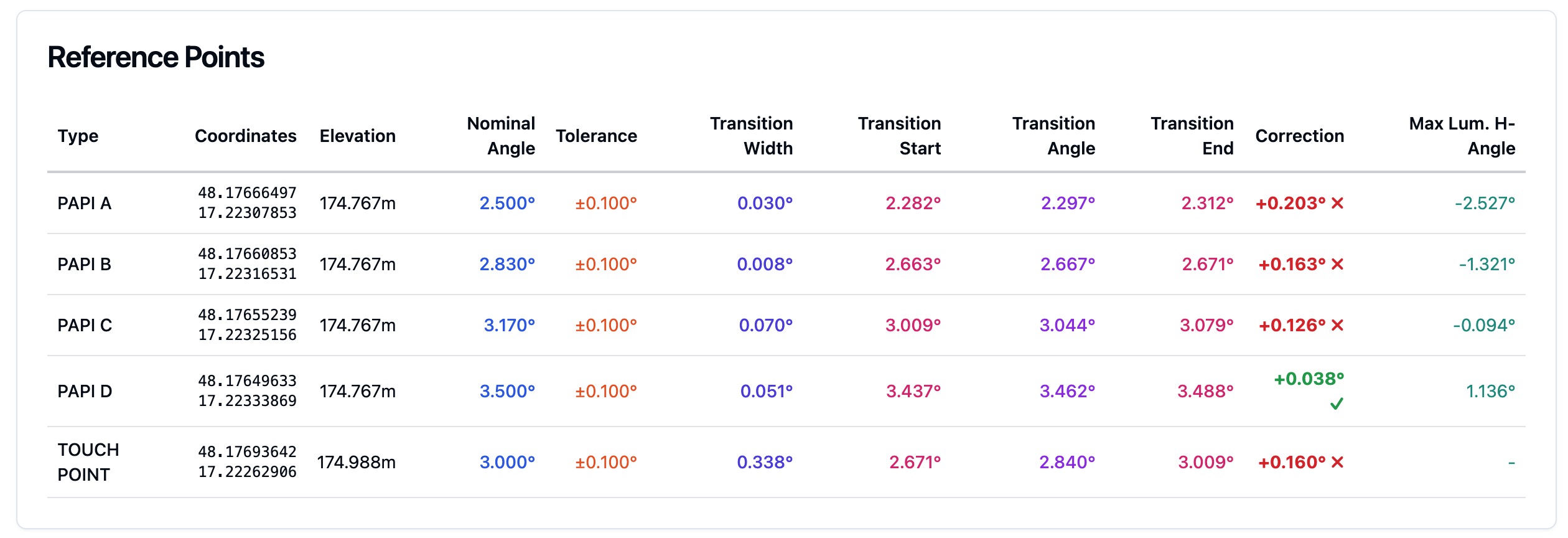
MEHT is a design result. It is not a value that a technician sets on a unit. It follows from three things. They are the setting angle of unit B, the distance of the unit from the threshold, and the lens height above the threshold. A change to any of them changes the height at which a pilot first sees the on-slope signal. By the formula above, the MEHT changes in the same way.
- A moved PAPI. D1 changes, so the MEHT changes.
- A new slope or setting angle. Angle M changes, so the MEHT changes.
- A new aeroplane type with a higher eye-to-wheel height. The wheel clearance at the existing MEHT falls. The designer checks the group in Table 5-2 again.
What to check
- The published MEHT agrees with the setting angle of unit B and the surveyed distance of the unit from the threshold.
- The lens height difference to the threshold is in the calculation.
- The most demanding aeroplane in the group still matches the eye-to-wheel height that the design used.
EASA asks the operator to correct a setting angle error of more than one minute of arc (AMC1 ADR.OPS.C.015(b) and (f)). That limit protects the MEHT too. See PAPI approach slope and elevation setting for how the angles are measured.
Frequently Asked Questions
- What does MEHT mean for a PAPI installation?
- MEHT is the lowest eye height at which a pilot sees an on-slope indication over the threshold. The designer picks it to give the wheels a safe clearance over the threshold. It then fixes how far from the threshold the PAPI stands.
- How is MEHT calculated?
- Add the eye-to-wheel height of the most demanding aeroplane to the wheel clearance that ICAO Annex 14 Table 5-2 gives. Take an A320 with an eye-to-wheel height of 7.25 m and the desired clearance of 9 m. The MEHT is 16.25 m (ICAO Doc 9157 Part 4, 8.3.64). The designer then divides the MEHT by the tangent of angle M to find the distance from the threshold.
- What is angle M?
- Angle M is the setting angle of unit B minus 2 minutes of arc. Unit B is the third unit from the runway. The 2 minutes allow for the width of the zone in which the pilot sees the unit change from white to red. For a 3 degree PAPI with a 20 minute sector, M is 2°48'.
- Is MEHT the height of the wheels or the eyes?
- It is the height of the pilot's eyes. The wheels pass lower. The difference is the eye-to-wheel height of the aeroplane in the approach configuration. ICAO groups aeroplanes by this height in Table 5-2 and sets the wheel clearance for each group.
- What is the difference between MEHT and threshold crossing height?
- Both give the height of the lowest on-slope signal over the threshold. MEHT is the ICAO and EASA term for the pilot's eye height. The FAA term is threshold crossing height (TCH). The FAA sets the TCH by the cockpit-to-wheel height group of the aircraft, for example 45 ft (14 m) for group 2.
- Where is the MEHT published?
- ICAO Annex 14 Volume I, 2.12 e) requires the aerodrome to make the MEHT of the on-slope signal available. EASA lists it among the data for a visual approach slope indicator system. For a PAPI, Annex 14 ties the published value to the setting angle of unit B minus 2 minutes of arc.
- Does an ILS change how MEHT is used?
- Yes. On a runway with an ILS or MLS, the designer sets the distance from the threshold for the best match with the glide path. The distance equals the distance to the effective origin of the glide path plus a correction for eye-to-antenna height. The wheel clearance must still not fall below column 3 of Table 5-2.
References
- icao-annex-14-vol1
- Annex 14 to the Convention on International Civil Aviation, Aerodromes, Volume I, Aerodrome Design and Operations, Ninth Edition (July 2022, consolidated with later amendments) ICAO
- icao-doc-9157-part-4
- Doc 9157, Aerodrome Design Manual, Part 4, Visual Aids, Fifth Edition (2021) ICAO
- easa-ear-aerodromes
- Easy Access Rules for Aerodromes (Regulation (EU) No 139/2014), including CS-ADR-DSN Issue 7 EASA
- faa-ac-150-5340-30j
- AC 150/5340-30J, Design and Installation Details for Airport Visual Aids FAA
This is a reference entry. TarmacView provides drone inspection services and doesn't sell the equipment or materials described in this glossary.