PAPI Commissioning Flight Check After an LED Retrofit
What a PAPI commissioning check involves after an LED retrofit: when the FAA requires a flight inspection, the seven checks, and what LED changes and does not.
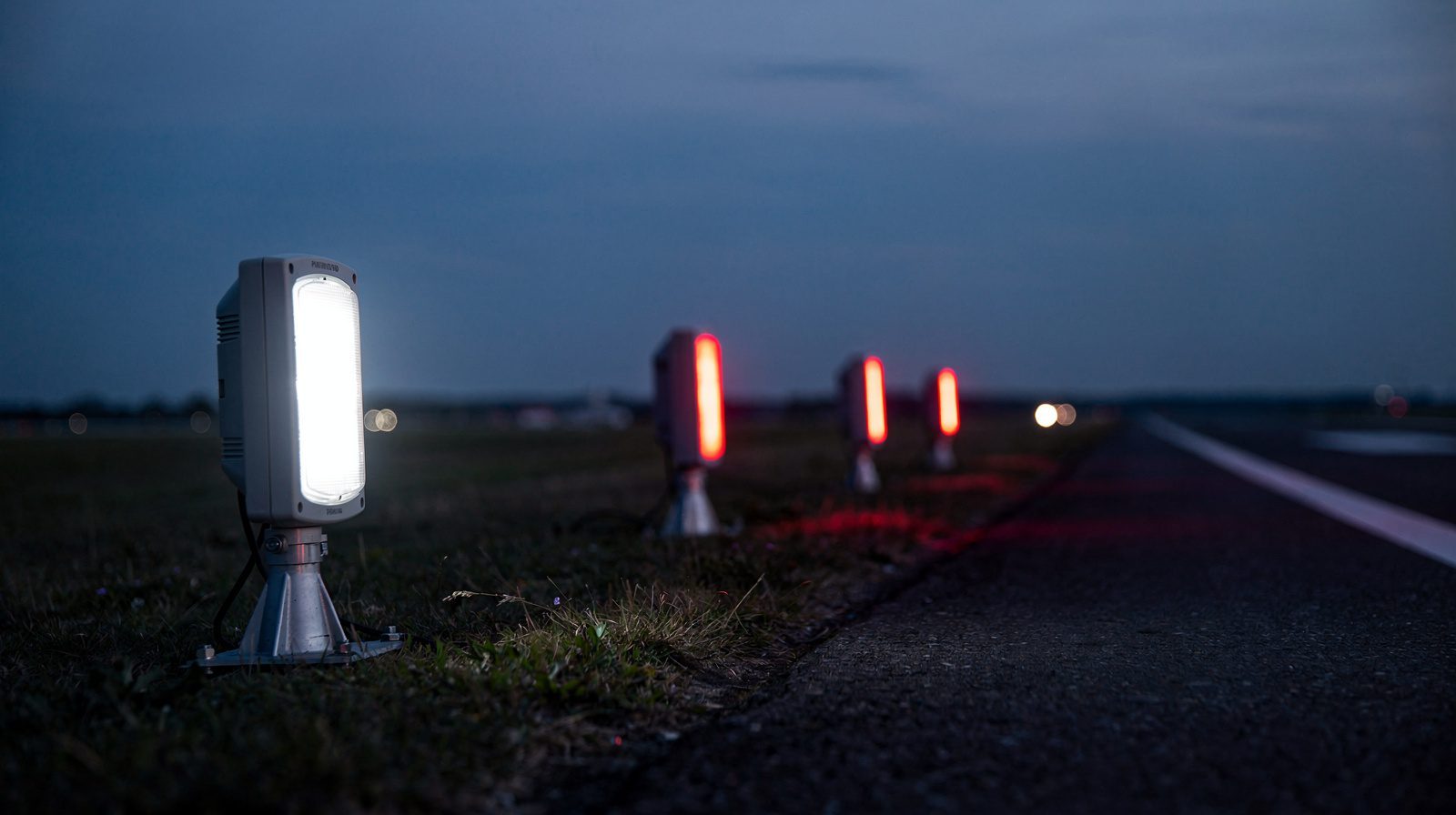 PAPI UNITS · ONE WHITE THREE RED · DUSK
After an LED retrofit, a PAPI commissioning check has two parts. Ground work sets each unit’s aim and intensity balance. Where the rules require it, a flight inspection then verifies seven things, from light intensity to obstacle clearance. The FAA text read does not say a like-for-like LED swap triggers it.
When the FAA requires a commissioning inspection
A commissioning flight inspection is required for every new visual glide slope indicator, which includes a PAPI , that has an instrument procedure associated with it. Circling approaches count. AC 150/5340-30J paragraph 7.7.6.6.4 says so, and FAA Order 8200.1D chapter 7 paragraph 3.a says the same in its own words. The AC is guidance in general and mandatory on projects funded through the Airport Improvement Program or by passenger facility charges. After an LED retrofit, the same checks apply if the work counts as a new or reconfigured system. The FAA text I could read does not say that a like-for-like change of light source does.
Order 8200.1D adds a night rule. A VGSI that an instrument approach needs at night must have its commissioning inspection before the approach is used at night. Order JO 6850.2C paragraph 9 says to refer to the latest edition of Order 8200.1 before commissioning visual guidance lighting systems.
One caveat on the Order. The sentences above are in the April 2015 text with Change 1. The consolidated file that includes Change 2, effective 20 September 2024, shows paragraph 3.a without the commissioning, night use and facility data sentences, and the rest of chapter 7 is unchanged. I could not tell whether that is an editorial slip. The rule for new VGSI is also stated in the AC. The night rule is stated only in the 2015 text.
For an installation, AC 150/5340-30J also asks for a commissioning NOTAM. The Flight Service Station must be notified when the system is ready, and the AC lists what to report to it: the airport, the runway and side, the PAPI type (L-880 or L-881), the glide path angle, the threshold crossing height and the commissioning date.
Does an LED retrofit trigger one
Order 8200.1D names the events that put a system back in front of an inspector. They are written for existing systems that went into service without a commissioning inspection: reconfiguration, a new published angle, electronic vertical guidance added to the runway, or a decision that an inspection is appropriate. A new light source is not on that list. The same paragraph says nothing about a system that was already commissioned and then had its light source changed.
Order 8200.1D points to JO 6850.5, Maintenance of Lighted Navigational Aids, for the maintenance tolerances. I could not read it. Ask your Airports District Office or the flight inspection office before you assume either answer.
Two things are documented. Engineering Brief 95 covers the modification and recommissioning of an existing non-federal PAPI, and it requires a survey of the light signal clearance surface during a PAPI replacement project. And Order 8200.1D says that if flight inspection finds the angle out of tolerance, the aiming angles may be adjusted beyond the JO 6850.5 tolerances, and those reference settings become the basis for all later alignments. If your PAPI has such reference settings, any later vertical alignment is made to them.
What the commissioning check measures
Order 8200.1D lists seven checks, and all seven are marked for a commissioning inspection. The inspector flies the approach and the airport supplies the data. Order 8200.1D says not to use data from other facilities on the runway, such as the ILS, so the PAPI needs its own survey data.
| Check | What the inspector does | Criterion in Order 8200.1D |
|---|---|---|
| Light intensity | Flies inbound while the setting is stepped through every range | All lamps at the same relative intensity on each setting |
| Glidepath angle | Measures the red to white change of each box, at least two level runs for commissioning | Effective angle within 0.20 degrees of the established angle |
| Angular coverage | Crosses the extended centreline at 90 degrees | At least 10 degrees either side of the centreline |
| Obstacle clearance | Evaluates the surface to 8 nm (4 nm for a 2-box PAPI) and flies a below-path approach | A definite fly-up indication with required clearance over every obstacle |
| Identification and contrast | Watches for lights or taxiing aircraft that confuse the signal | Readily distinguishable from other aids |
| Radio control | Keys the system 4 to 5 miles out | Activates on a proper signal, only if the system has one |
| Coincidence | Compares the visual and electronic paths where both serve the runway | Within 0.2 degrees of the procedure angle, threshold crossing height within 3 ft |
The method matters more than the pass mark. For a four-box PAPI the inspector measures and reports the angle of all four boxes. The path angle is the average of boxes 2 and 3, and each box angle is taken at the narrow red to white transition. On the on-path method the box angle is the average of at least three colour changes in each direction.
Obstacle clearance has caused failed commissioning inspections. Engineering Brief 95 says the updated Order led to several, and that FAA data show the beam spreading up to 13 degrees either side of the centreline, so obstacle clearance is judged over the whole visible beam and not only the 10 degree surface. If a penetration cannot be removed, Order 8200.1D lists a higher angle, a move, a rotation, baffles , or a restricted usable distance with a buffer of at least half a nautical mile inside the penetration. Engineering Brief 95 calls baffles the last option. It also says the airport does not have to mitigate obstacles beyond 4 nautical miles, where the usable distance is restricted instead.
What changes with LED units
For the PAPI itself, very little. AC 150/5345-28H gives one photometric specification for every PAPI light unit. At 1,000 ft the red to white transition has to be within 3 minutes of arc at the beam centre and within 5 minutes at the beam edges. A unit that uses LEDs is held to the same specification, not a different one. The aiming tool has to repeat to within 3 minutes of arc, and a unit that tilts more than a quarter of a degree down or half a degree up must switch the whole system off.
What the AC adds for LEDs is chromaticity . Aviation red and white for an LED unit must meet the limits in FAA Engineering Brief 67, which the AC points to. The AC sets the standard for equipment listed under the FAA certification programme. It is not mandatory in general, and it becomes mandatory on projects funded through the Airport Improvement Program or by passenger facility charges.
Chapter 7 of Order 8200.1D describes light boxes in terms of lamps, filters and optical projectors, and I found no LED-specific provision in it. The inspector’s checks still read from the cockpit: the colour change, the balance between boxes and the intensity on every setting. Those are where a badly matched LED unit would show. Photometric testing on the ground tells you before the aircraft does.
The EU and ICAO position
In the EU the text that speaks to this is guidance. AMC1 to ADR.OPS.C.015, in its paragraph (d) on flight checks, says special flight checks should be arranged in case of major maintenance of, or changes to, the lighting systems and before the commissioning of new systems, both at day and night. An AMC is an acceptable means of compliance, not the rule. GM1 says a VASIS is also checked for the correct approach slope and for compatibility with the non-visual aids, if available, and that the balance of light intensity at all intensity settings needs to be checked.
For the ground side, the same AMC says errors in a VASIS alignment above one minute of arc should be corrected. CS ADR-DSN.M.650(b)(4) says that where wing bars stand on both sides of the runway, corresponding units are set to the same angle so the signals change together. EASA points to Chapter 5 of ICAO Doc 9137 Part 8 and Chapter 8 of Doc 9157 Part 4 for how to conduct the check. I have not read either.
Before the aircraft arrives
Whatever the trigger, the sensible order is to measure first. Order 8200.1D says initial settings come from ground adjustments and are verified by flight inspection. AC 150/5340-30J asks that the installer and the engineer know the Order before a commissioning check is requested. Order JO 6850.2C paragraph 504.d says scheduling a flight inspection must carry any obstacle penetration, its side, distance and angle, and whether baffles are fitted.
The surface itself is defined in paragraph 504. It begins on the runway centreline 300 ft in front of the PAPI and rises at one degree less than the aiming angle of the third light unit from the runway. It extends 10 degrees either side of the centreline and out to 3.4 nautical miles from the threshold, while the inspector evaluates to 8. For a 3 degree path with 20 minutes between light units, that third unit is aimed at 2 degrees 50 minutes. The survey that proves the surface is clear is the airport’s job and it is done before the flight, not during it.
A ground or drone measurement of each unit’s transition angle, the symmetry of the wing bar and the intensity balance gives you those numbers before the inspector does. Chapter 7 describes the commissioning check as flown by the inspection aircraft, with a theodolite on the ground as an option for recording angles. It does not mention drones or any other substitute for the flight, so we treat our PAPI inspection as preparation for it, not a replacement. The comparison of drone survey and flight inspection sets out which job each method does.
AC 150/5340-30J also says specific facility data is required for any VGSI inspection except surveillance, and points to the National Flight Data Center for it. The flight inspection works from that data, including the threshold crossing height and the glide path angle.
Frequently Asked Questions
- What does a PAPI commissioning check involve after replacing the units with LED?
- It has a ground part and, where required, a flight part. Ground work sets each unit's aim and intensity balance. The flight inspection under FAA Order 8200.1D then checks light intensity, glidepath angle, angular coverage, obstacle clearance, identification and contrast, radio control and coincidence with electronic guidance. The LED change does not alter these checks.
- When is a commissioning flight inspection required for a new PAPI under FAA rules?
- It is required for every new visual glide slope indicator, which includes a PAPI, that has an instrument procedure associated with it. Circling approaches count. AC 150/5340-30J paragraph 7.7.6.6.4 and FAA Order 8200.1D chapter 7 paragraph 3.a state the rule. The AC is guidance in general and mandatory on projects funded through the Airport Improvement Program or by passenger facility charges.
- Does an LED retrofit trigger a new commissioning flight inspection?
- The FAA text read does not say so for a like-for-like change of light source. Order 8200.1D names reconfiguration, a new published angle, added electronic vertical guidance or an inspector's decision as the triggers. A retrofit that counts as a new or reconfigured system is covered. Ask your Airports District Office or the flight inspection office before you assume either answer.
- Does an LED PAPI unit have a different photometric specification?
- No. AC 150/5345-28H gives one specification for every PAPI light unit. At 1,000 ft the red to white transition must be within 3 minutes of arc at the beam centre and within 5 minutes at the beam edges. For LED units the AC adds chromaticity limits for aviation red and white, which it takes from FAA Engineering Brief 67.
- What should be done before the flight inspection aircraft arrives?
- Measure each unit on the ground first. Order 8200.1D says initial settings come from ground adjustments and are verified by flight inspection. The airport also surveys the PAPI obstacle clearance surface and gives obstacle penetrations to the scheduling office. A ground or drone measurement of transition angles and intensity balance is preparation for the flight, not a replacement for it.
References
- faa-ac-150-5340-30j
- AC 150/5340-30J, Design and Installation Details for Airport Visual Aids Federal Aviation Administration
- faa-order-8200-1d
- Order 8200.1D, United States Standard Flight Inspection Manual, with Change 1 Federal Aviation Administration
- faa-order-8200-1d-chg2
- Order 8200.1D with Changes 1 and 2 (consolidated file) Federal Aviation Administration
- faa-jo-6850-2c
- Order JO 6850.2C, Visual Guidance Lighting Systems Federal Aviation Administration
- faa-eb-95
- Engineering Brief No. 95, Additional Siting and Survey Considerations for PAPI and Other VGSI Federal Aviation Administration
- faa-ac-150-5345-28h
- AC 150/5345-28H, Precision Approach Path Indicator (PAPI) Systems Federal Aviation Administration
- easa-ear-aerodromes
- Easy Access Rules for Aerodromes (Regulation (EU) No 139/2014) European Union Aviation Safety Agency
Founded by flight-inspection veterans who spent decades measuring PAPI lights for aviation authorities across Europe.
Learn more
Related terms
03 TERMSCommissioning Flight Inspection
A commissioning flight inspection is the first flight check of a new or changed aid. When the FAA requires one for a PAPI, what is checked and how to prepare.
LED Retrofit (Airfield Lighting)
An LED retrofit replaces the light sources of airfield lights with LEDs. The mixing rule, owner and AIS duties, CCR and PAPI effects, and the checks after it.
Precision Approach Path Indicator (PAPI)
A precision approach path indicator (PAPI) is a row of lights beside a runway. What PAPI means, what the red and white pattern shows, unit angles, siting, the APAPI, the VASI, and the checks.
Further reading
03 ARTICLES
FAA AC 150/5345-28: Precision Approach Path Indicator Systems
What FAA AC 150/5345-28H specifies for PAPI equipment: L-880 and L-881 types, red-white transition, light output, aiming tool and tilt cut-off, versus…
PAPI, APAPI and VASI: What Separates Them and Which Still Count
PAPI vs VASI vs APAPI: a PAPI is a row of four units, an APAPI has two, a VASI is an older FAA bar system. Layouts, angles, and ICAO, EASA and FAA…
What ICAO Annex 14 Actually Requires of Your PAPI
The tolerances behind a PAPI protocol, what an authority looks for in the evidence, and how often the system has to be verified to stay certifiable.