What is an LED Retrofit in Airfield Lighting?
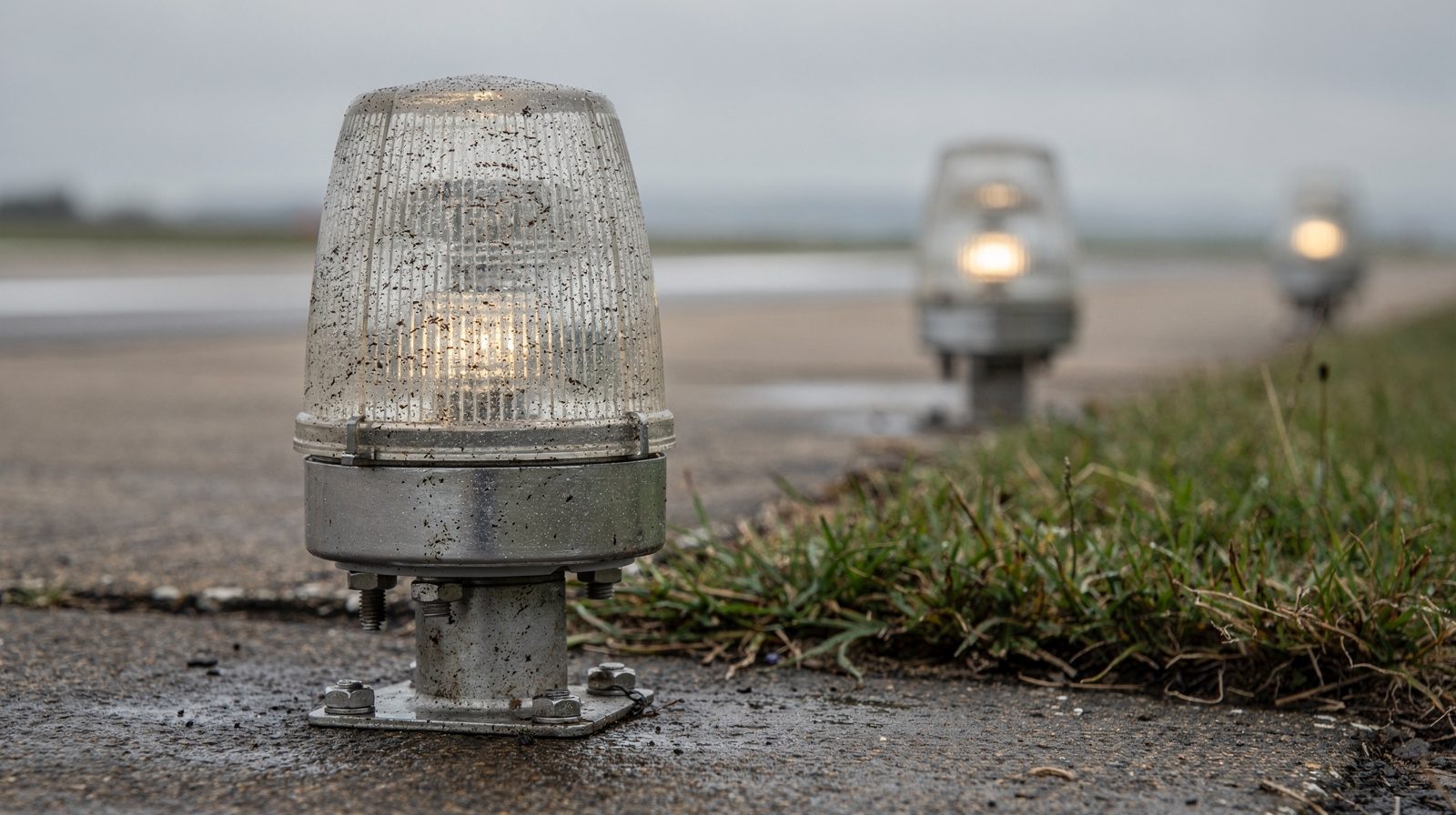
An LED retrofit is a project that replaces the incandescent light sources of an airfield lighting system with LED lights.
The LED lamp page covers the LED as an airfield light source. This page covers the change from one technology to the other and the decisions that come with it.
What a retrofit changes
- The fixture. An LED fixture in the FAA scheme gets an extra character in its type name. The LED version of the L-861T taxiway edge light is the L-861T(L) (Engineering Brief 67D, 5.1).
- The circuit. The load on the series circuit differs. See the section on the CCR below.
- The monitoring. Fixtures that have electronic monitoring must keep it at the top intensity steps and must open the circuit on a fault. The Brief also allows other monitoring methods if the fixtures can retrofit into existing monitoring systems (2.7).
- The warranty. The Brief sets a 4-year warranty for LED fixtures, with the exception of obstruction lights (4.1).
- The PAPI signal. An LED PAPI covers a narrower angle. See the PAPI section below.
Who decides
Where a fixture type exists in both forms, the owner selects the fixture type. The owner may also specify that either incandescent or LED is acceptable (Engineering Brief 67D, 6.1). In the EU, the aerodrome operator then reports the LED parts of the lighting system to the aeronautical information services (ADR.OPS.A.070). GM1 gives the reason. EFVS relies on the infrared heat of incandescent lights, and a change to LED may make EFVS use impossible.
Retrofit by system, not by light
The FAA does not allow LED fixtures among incandescent lights of the same type (AC 150/5340-30J, 1.4). The FAA gives the reason. An LED fixture is essentially monochromatic, except in aviation white, and can look different in colour and brightness from a filtered incandescent fixture. That difference can distort what the pilot sees.
Two rules follow from this.
- A defective incandescent fixture gets a replacement with the same technology.
- A runway extension must match the existing section. The FAA example is a runway with incandescent centerline lights. LED lights on the new section and incandescent lights on the old section are not approved.
The FAA lists the systems that it does not allow to mix. The list includes these systems:
- Runway edge, threshold, end and stopway lights.
- Touchdown zone lights and runway centerline lights.
- Approach light systems and stop bars.
- Taxiway centreline and edge lights.
- Signs, per location.
Each pair of elevated runway guard lights must be the same technology. For in-pavement runway guard lights, the same bar must not mix them.
A retrofit therefore covers a full system or a full segment of the same type. It is not a light-by-light swap.
The CCR and the circuit
Airfield lights on a series circuit run from a constant current regulator (CCR). The constant current regulator page covers it. The retrofit points are:
- A 5-step CCR is necessary to control LED high intensity lighting systems. A 3-step CCR may not reduce LED intensity enough at the lowest step (AC 150/5340-30J, Chapter 4 note).
- The true power factor of a fixture on a CCR must be at least 0.7 on all CCR steps (Engineering Brief 67D, 2.5.1).
Replacing a PAPI with an LED PAPI
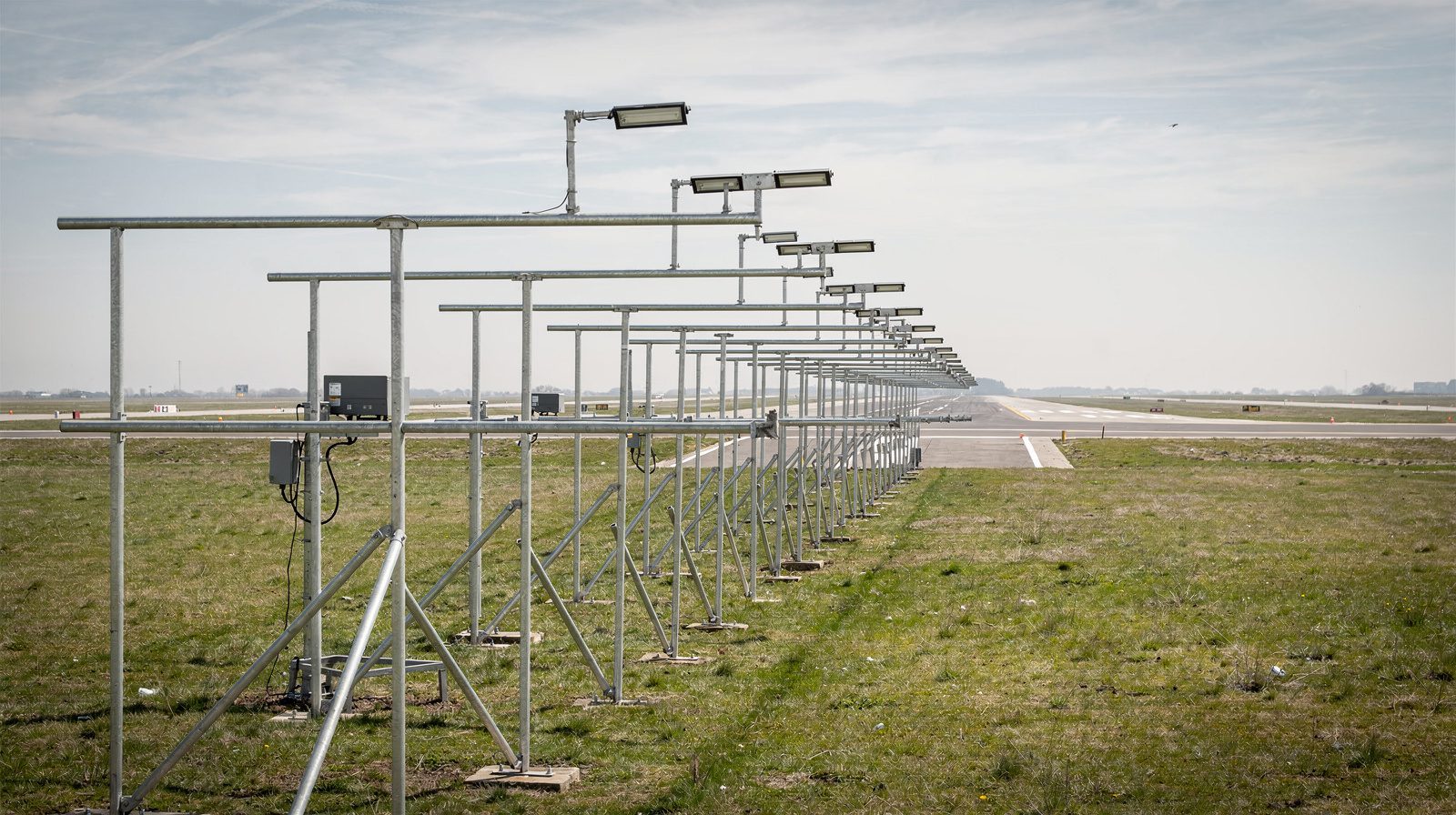
A PAPI retrofit raises the most questions, because the PAPI is a system that pilots fly by. The FAA gives these changes for an LED PAPI:
- Coverage. An incandescent PAPI signal can often be seen 14 degrees on either side of the runway centerline. An LED PAPI emits light at 10.5 degrees (JO 6850.2C, 504b).
- Baffling. Baffling is not a good option when an obstacle is closer than 4 degrees to the centerline. For an LED PAPI the limit is 7 degrees. Internal light sensors turn an LED PAPI off if baffling cuts the light below 5 degrees on either side (JO 6850.2C, 504, step four).
- Power and control assembly. The LED PAPI assembly stands outside the Runway Object Free Area (JO 6850.2C, 507a).
- Aiming device. Use the aiming device that comes with the current maker’s PAPI units (AC 150/5340-26C, 5.7.2.1).
After the change, check the vertical aiming angle with the aiming instrument. Record the angle and the date in a maintenance log (AC 150/5340-26C, 5.7.1.2 h). The PAPI approach slope and elevation setting page covers the setting angles.
The photometric measurement and the flight check below also apply after a change to the system.
Checks after a retrofit
- Photometric measurement. The FAA says to test before and after cleaning, re-lamping, realignment or repair. The test before shows if the work is needed. The test after shows if it worked (AC 150/5340-26C, 5.3.2.1.2). EASA asks for photometric measurements at appropriate intervals, irrespective of runway type. On a Category II or III runway, it asks for in-field measurement of intensity, beam spread and orientation. The minimum is twice a year for in-pavement lights and once a year for other lights (AMC1 ADR.OPS.C.015(a) and (f)). The photometric testing page covers the instruments.
- Flight check. EASA says special flight checks should come after major maintenance of, or changes to, the lighting systems. They should also come before the commissioning of new systems, both at day and night.
- Mixing. Check that no LED fixture stands among incandescent fixtures of the same type.
The photometry page explains the quantities. The LED lamp page lists more items to check, such as colour and cold weather.
Inspecting after a retrofit
TarmacView inspects PAPI and other airfield lights with a drone and reports each light relative to its neighbours. It does not measure intensity in candela. A drone inspection does not replace the photometric measurement or the flight check. See the drone airport inspection solution.
Frequently Asked Questions
- What is an LED retrofit in airfield lighting?
- An LED retrofit is a project that replaces the incandescent light sources of an airfield lighting system with LED lights. It changes the light fixtures and can change the power circuit, the monitoring and the PAPI coverage. The owner decides whether a system uses incandescent or LED fixtures.
- Can an airport replace a PAPI with an LED PAPI?
- Yes, but the signal changes. The FAA says an incandescent PAPI signal can often be seen 14 degrees on either side of the runway centerline. An LED PAPI emits light at 10.5 degrees. After the change, staff check the aiming with the instrument that the maker supplies and record the angle. EASA recommends a special flight check after changes to a lighting system.
- Does an LED PAPI replacement need photometric measurement?
- The FAA says photometric testing should come before and after realignment or repair. EASA asks for photometric measurements at appropriate intervals, irrespective of runway type. EASA also asks for in-field measurement of intensity, beam spread and orientation on a Category II or III runway.
- Can LED lights stand among incandescent lights?
- Not within the same type of light. The FAA says LED fixtures must not be interspersed with incandescent lights of the same type. A defective incandescent fixture gets a replacement with the same light source technology. The LED change therefore covers a whole system or a whole segment of the same type.
- What must an EU aerodrome operator report after an LED retrofit?
- The operator must report to the aeronautical information services the parts of the lighting system where light units are LED lights (ADR.OPS.A.070). The reason in GM1 is that the replacement of incandescent lights with LED lights may make enhanced flight vision system (EFVS) use impossible. EFVS relies on the infrared heat of incandescent lights.
- Does an LED retrofit change the constant current regulator?
- It can. The FAA says a 5-step constant current regulator (CCR) is necessary to control LED high intensity lighting systems. A 3-step CCR may not reduce LED intensity enough at the lowest step. FAA Engineering Brief 67D also sets a true power factor of at least 0.7 for a fixture on a CCR.
- Do LED PAPIs need different baffling?
- Yes, the limit changes. The FAA says baffling is not a good option when an obstacle is closer than 4 degrees to the runway centerline. For an LED PAPI the limit is 7 degrees. Internal light sensors turn an LED PAPI off if baffling cuts the light below 5 degrees on either side of the centerline.
References
- faa-ac-150-5340-30j
- AC 150/5340-30J, Design and Installation Details for Airport Visual Aids FAA
- faa-eb-67d
- Engineering Brief No. 67D, Light Sources Other Than Incandescent and Xenon for Airport and Obstruction Lighting Fixtures FAA
- faa-jo-6850-2c
- Order JO 6850.2C, Visual Guidance Lighting Systems FAA
- faa-ac-150-5340-26c
- AC 150/5340-26C, Maintenance of Airport Visual Aid Facilities FAA
- easa-ear-aerodromes
- Easy Access Rules for Aerodromes (Regulation (EU) No 139/2014), including CS-ADR-DSN Issue 7 EASA
This is a reference entry. TarmacView provides drone inspection services and doesn't sell the equipment or materials described in this glossary.