What is L-852?
L-852 is the FAA type designation for in-pavement taxiway light fixtures, specified in AC 150/5345-46F. The title of that AC is Specification for Runway, Taxiway, Heliport, and Vertiport Light Fixtures, and its date is 30 September 2024. The “L” numbers are FAA fixture types. Runway in-pavement lights are L-850, and PAPI units are L-880 and L-881. L-852 is not a PAPI.
Types
A suffix letter gives the use of the fixture. Several types come in two versions. One is for runway visual range (RVR) of 365 m (1,200 ft) and above. The other is for RVR below 365 m (1,200 ft).
| Type | Use | Light |
|---|---|---|
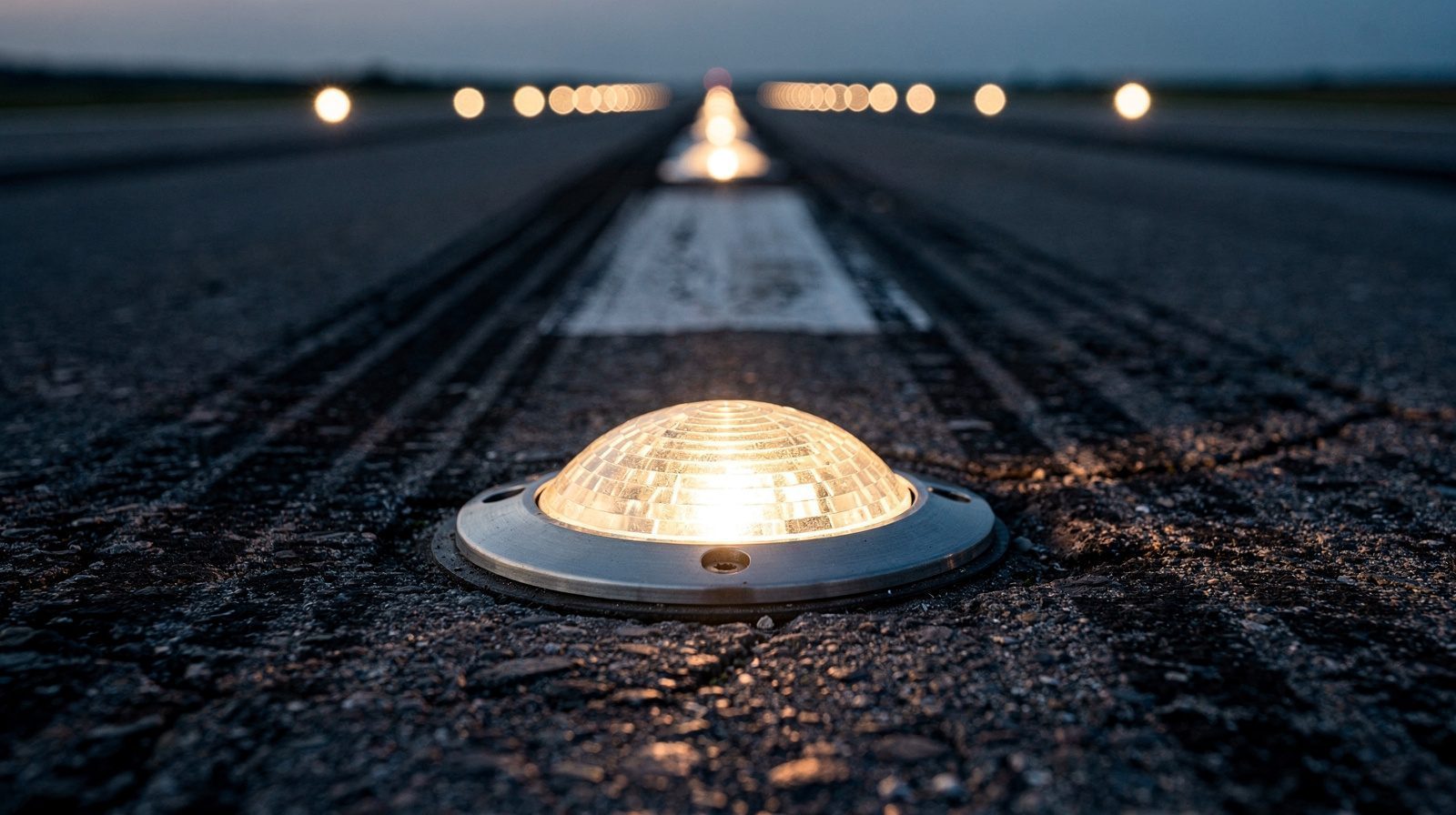
| L-852A, L-852C | Taxiway centreline on straight sections, and clearance bars (A: 1200 RVR and above, C: below) | Narrow beam, green or yellow |
| L-852B, L-852D | Taxiway centreline on curved sections (B: 1200 RVR and above, D: below) | Wide beam, green or yellow, D also white |
| L-852J, L-852K | Taxiway centreline on curved sections (J: 1200 RVR and above, K: below) | Wide beam, green or yellow |
| L-852E, L-852F | Taxiway intersections (E: 1200 RVR and above, F: below) | Omnidirectional, yellow |
| L-852G | Runway guard light | Wide beam, yellow, alternately flashing |
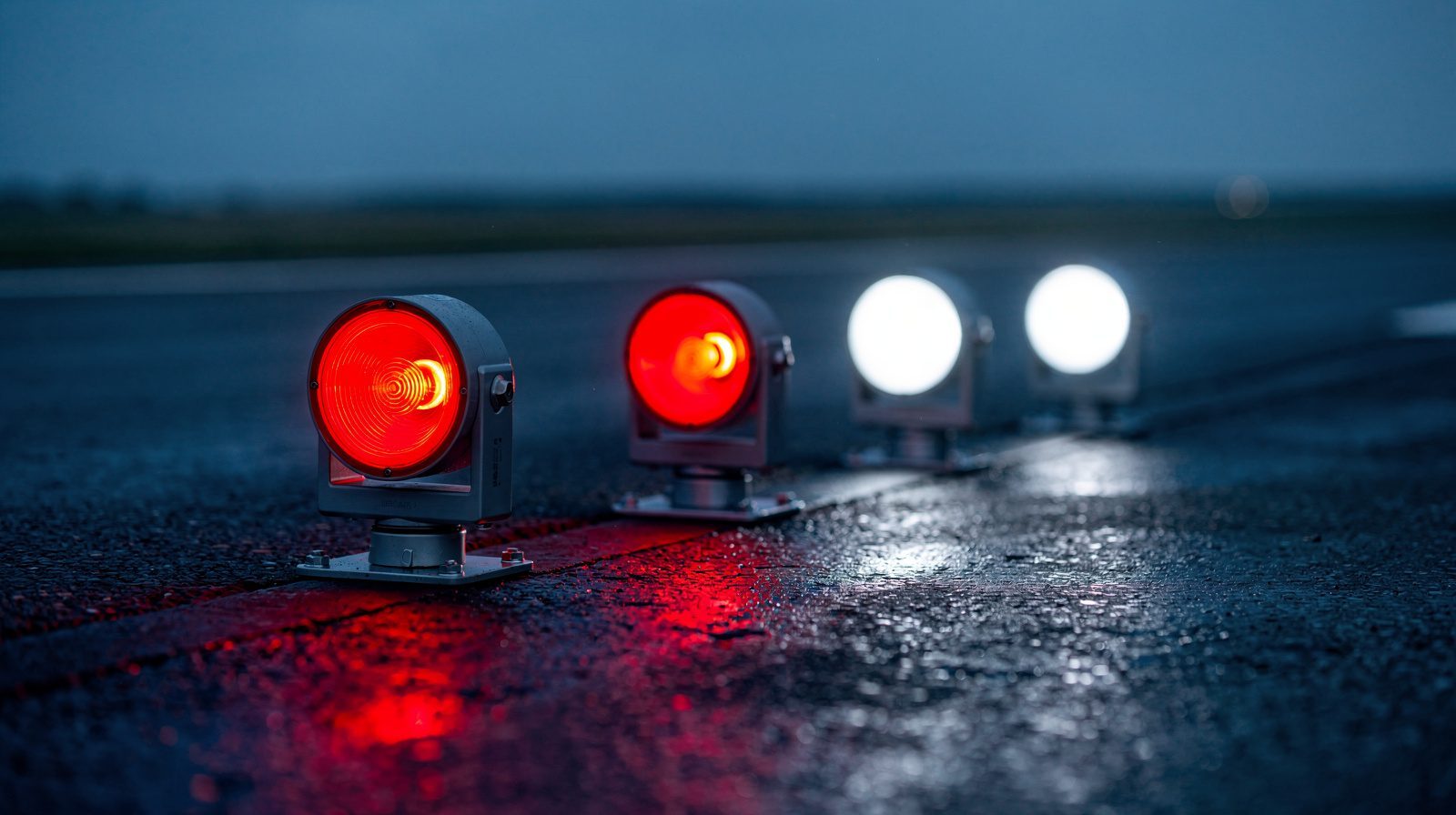
| L-852S | Stop bar, runway entrance light | Wide beam, red |
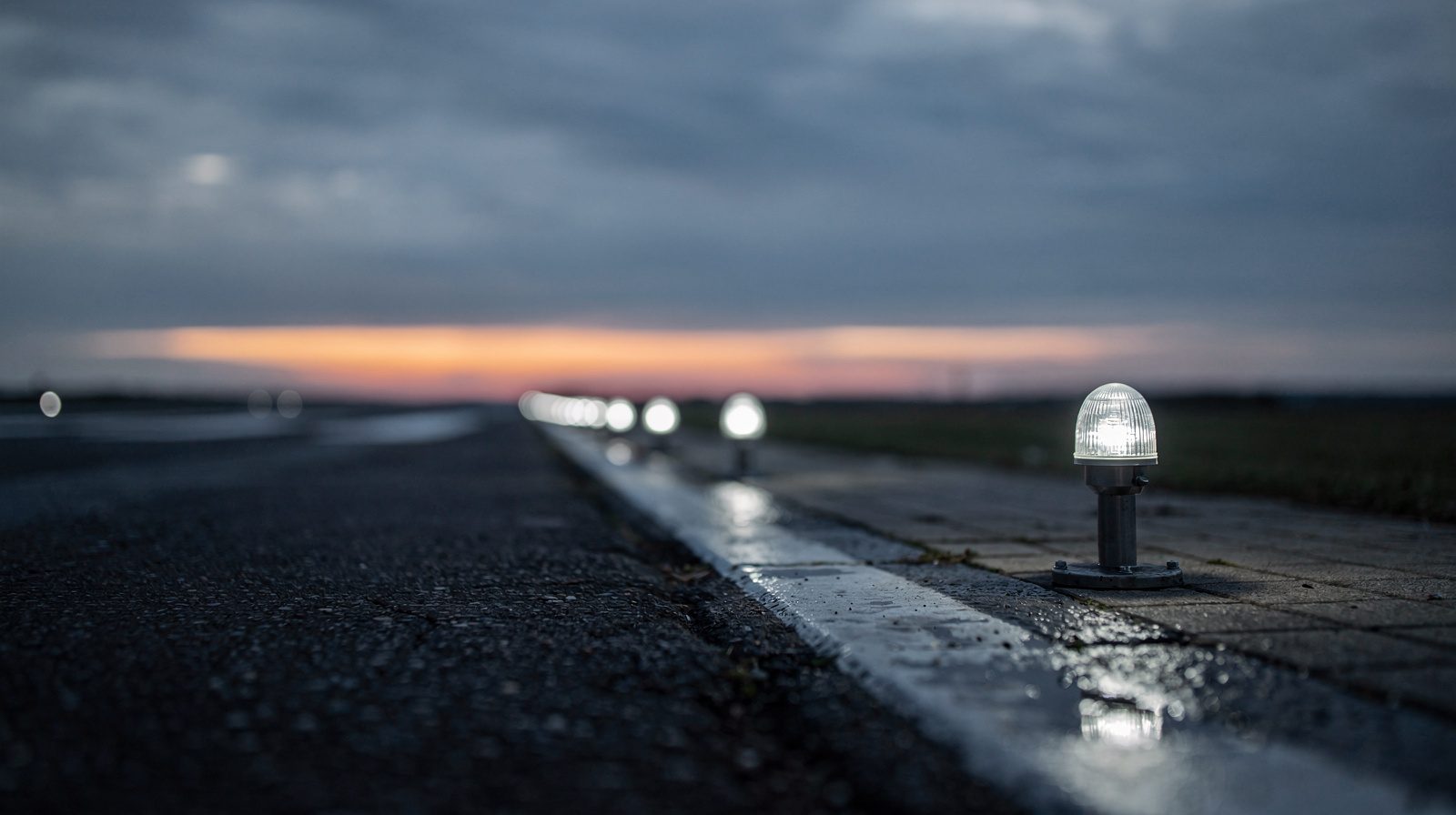
| L-852T | Taxiway and apron edge | Omnidirectional, blue |
| L-852H | Heliport and vertiport perimeter and approach | Omnidirectional, green |
How to tell the types apart
Three properties separate the types: beam, direction and brightness.
- Beam. A narrow-beam light is visible only from a small angle either side of the taxiway line. The main beam of L-852A covers ±10 degrees horizontally, and L-852C covers ±3.5 degrees. The wide-beam types cover ±30 degrees (B and D), -3.5 to 35 degrees (J and K) and ±24 degrees (G and S).
- Direction. A bidirectional fixture shows light in both directions along the taxiway, and a unidirectional fixture shows it in one. An omnidirectional fixture (E, F, T and H) shows it all round. The AC lists the colour pairs, for example green-green, green-yellow and yellow-yellow for L-852A.
- Brightness. The types for RVR below 365 m (1,200 ft) are brighter than their counterparts for 365 m and above.
The AC gives a minimum average intensity for each type in candela (cd).
| Type | Colour and minimum average intensity (cd) |
|---|---|
| L-852A | Yellow 20, green 20 |
| L-852B | Yellow 20, green 20 |
| L-852C | Yellow 200, green 200 |
| L-852D | White 150, yellow 100, green 100 |
| L-852E | Yellow 50 |
| L-852F | Yellow 200 |
| L-852G | Yellow 1,000 |
| L-852J | Yellow 20, green 20 |
| L-852K | Yellow 100, green 100 |
| L-852S | Red 300 |
| L-852T | Blue 2 (minimum intensity, not average) |
These are test values for a new fixture on a photometric bench. A drone image does not give a candela value.
Where each type goes
AC 150/5340-30J paragraph 4.8.5.1 tells the designer which type to place where.
- Types C, D and F go on taxiways that are designated low visibility taxi routes below 365 m (1,200 ft) RVR.
- Types A, B and E go where the RVR is 365 m (1,200 ft) and above.
- Bidirectional B or D fixtures go at intersections of taxiways with taxiways or runways. They also go on straight sections that lead off a runway, for at least 122 m (400 ft).
- Types B and D go on curved sections. Types J and K may replace them on curves that are positioned to Table 4-1.
- Types A and C go on the other straight sections. They are normally unidirectional on acute-angled exits.
Table 4-1 of the same AC gives the longest spacing along a centreline. On straight segments it is 30 m (100 ft) at RVR of 365 m and above, and 15 m (50 ft) below. On acute-angled exits it is 15 m (50 ft) for both.
Three lighting bars use L-852 types:
- A stop bar is a row of unidirectional red in-pavement lights, with an elevated red light on each side of the taxiway. The in-pavement lights are spaced 3 m (9 ft 10 in) apart across the taxiway, with a tolerance of ±50 mm (paragraph 4.5).
- A clearance bar is a row of three in-pavement yellow lights that mark a low visibility hold point (paragraph 4.7.1).
- A runway guard light flashes yellow. At the airport’s option, a combined L-852G and L-852S fixture gives guard lights above 365 m (1,200 ft) RVR and a stop bar below it. The circuit must not switch the yellow and red lights on together (paragraphs 4.6.1 and 4.6.2).
Fixture classes
The AC sorts in-pavement fixtures by class, mode and style.
- Class 1 fixtures mount directly in the pavement. Class 2 fixtures mount on a base. Bases are FAA L-868 bases, and L-852T and L-852H may also use an L-867B base in non-load bearing applications.
- Mode 1 is a constant current fixture on a 6.6 A series circuit. All in-pavement fixtures except L-852H use it.
- Style gives the height above finished grade. Style 3 is up to 1/4 in (6.35 mm), and Style 2 is up to 1/2 in (12.7 mm). Style 1, up to 1 in (25.4 mm), applies only to L-850C, L-850D, L-850E, L-852E and L-852F.
- The fixture must work from -40 °C to +55 °C. Storage and shipping cover -55 °C to +55 °C.
What the AC tests
A taxiway light is run over by aircraft and vehicles. AC 150/5345-46F sets these requirements for an in-pavement fixture:
- Static load. The fixture must withstand 450 times its top area, in square inches, as a load in pounds. This is 3.1 MPa (450 psi).
- Shear load. The fixture must withstand 11,000 lb (4,990 kg) applied parallel to the mounting surface.
- Surface temperature. A heavy vehicle or aircraft wheel can cover the fixture for 10 minutes. The surface must then stay at or below 160 °C (320 °F) at maximum intensity.
- Water. The sealed optical assembly must withstand an internal pressure of 138 kPa (20 psi) without leakage. The fixture has a fitting to pressurize the assembly, so a technician can test the seals after maintenance.
- Insulation. The insulation resistance from lead to case must be at least 50 MΩ.
- Life. An accelerated life test runs the fixture for half of its minimum rated lamp life. Intensity must then be at least 80 percent of the values in the AC. The minimum rated lamp life is 500 hours for L-852E, F, S and G and 1,000 hours for the other types.
LED and incandescent fixtures
AC 150/5340-30J treats an LED fixture as the counterpart of an incandescent fixture of the same type. AC 150/5345-46F lists EB 67, Light Sources Other Than Incandescent and Xenon for Airport and Obstruction Lighting Fixtures. The glossary term lamp covers the light sources.
AC 150/5340-30J paragraph 1.4 does not allow LED and incandescent fixtures of the same type to be mixed. The AC says an LED fixture is almost monochromatic, so it can look different in colour and brightness from a filtered incandescent fixture. The list of systems includes taxiway centreline and edge lights on both straight and curved segments, stop bars, and lead-on and lead-off lights. A defective incandescent fixture must be replaced with the same light source technology.
Standards
AC 150/5345-46F is mandatory for projects funded under the Airport Improvement Program or the Passenger Facility Charge program. Elsewhere in the United States it is voluntary, and it is an acceptable means of meeting the lighting requirements of 14 CFR Part 139.
Part 139 does not name L-852. Section 139.311(c)(2) asks a certificate holder to provide one of four taxiway lighting systems: centreline lights, centreline reflectors, edge lights or edge reflectors. Section 139.311(d) says that to properly maintain a lighting system includes cleaning or replacing any missing or nonfunctional item.
In the EU the types above do not apply. The specifications are in CS-ADR-DSN under Regulation (EU) No 139/2014. CS ADR-DSN.M.710 says that taxiway centre line lights on a normal taxiway should be fixed lights showing green. On an exit taxiway the lights alternate green and yellow from the runway to the edge of the ILS critical area, and then show green. CS ADR-DSN.M.730 says that stop bar lights should be spaced at not more than 3 m and show red toward the runway-holding position.
Serviceability
The EU sets objectives for lights that are out of service in ADR.OPS.C.015, which is part of Delegated Regulation (EU) 2020/2148:
- On a taxiway for use below 550 m runway visual range, no two adjacent taxiway centre line lights are unserviceable.
- On a stop bar at a runway-holding position for use below 550 m runway visual range, no more than two lights remain unserviceable.
- A light is unserviceable if its main beam average intensity is below 50 % of the specified value. It is also unserviceable if its filter is missing or damaged, or if it does not show the right colour.
In the United States, Part 139 asks for a daily self-inspection of the airport and a record of each inspection for at least 12 months.
Inspection and maintenance
A taxiway holds in-pavement lights in the colours above. AC 150/5340-26C says that in-pavement lights are run over by aircraft and snow removal equipment, so they need frequent attention. Their position below ground level also makes them prone to water infiltration.
- Daily. An inspector makes a patrol at twilight and records the burned-out or dim lights.
- Weekly. An electrician services the lights that the patrol reported. A dim light can have a dirty lens, water in the fixture, or an aim that aircraft twisted out of line on a shallow base.
- Spares. The AC advises about 10 percent spare fixtures of each type in use.
- Bolts. The bolts and locking washers of an in-pavement fixture must never be reused.
TarmacView flies the taxiway network and records each light as lit or dark, with its colour and surveyed position. The inspection does not replace a photometric test on the pavement, because the drone does not measure candela.
Frequently Asked Questions
- Is L-852 a PAPI?
- No. L-852 fixtures are in-pavement taxiway lights. A PAPI is an approach slope indicator with its own FAA types, L-880 for the four-box system and L-881 for the two-box system. AC 150/5345-28 specifies PAPI units, not AC 150/5345-46.
- What do the letters after L-852 mean?
- The letter gives the use of the fixture. A to D are taxiway centreline lights, and A and C also serve as clearance bars. E and F are taxiway intersection lights. G is a runway guard light. S is a stop bar or runway entrance light. T is a taxiway or apron edge light. J and K are curved-section centreline lights. H is for heliports and vertiports.
- What is the difference between L-852A and L-852C?
- L-852C is the version for runway visual range below 365 m (1,200 ft), and L-852A is for 365 m and above. Both are narrow-beam centreline lights. The C type is brighter and narrower. Its minimum average is 200 cd against 20 cd, and its main beam is ±3.5 degrees against ±10 degrees.
- What colour is an L-852 light?
- The colour depends on the type. Centreline and clearance bar types show green or yellow, and the intersection and runway guard types show yellow. The stop bar type shows red, the edge type shows blue and the heliport type shows green. L-852D can also show white.
- Are L-852 lights available with LED?
- Yes. AC 150/5340-30J covers LED fixtures for taxiway centreline and edge lights, stop bars, and lead-on and lead-off lights. An LED fixture must not be interspersed with an incandescent fixture of the same type. A defective incandescent fixture must be replaced with the same technology.
- What do the FAA rules require of an L-852 fixture?
- The fixture must meet AC 150/5345-46F. The AC is mandatory for projects funded under the Airport Improvement Program and the Passenger Facility Charge program. Elsewhere conformity is voluntary, and the AC is an acceptable means of meeting 14 CFR Part 139 lighting requirements.
- Does the EU use the L-852 designation?
- No. The L-852 types are FAA designations. In the EU, the specifications for taxiway lights are in CS-ADR-DSN under Regulation (EU) No 139/2014. For example, CS ADR-DSN.M.710 says taxiway centre line lights on a normal taxiway should be fixed lights showing green.
- How many taxiway lights can be out of service?
- In the EU, a taxiway for use below 550 m runway visual range has this objective: no two adjacent taxiway centre line lights are unserviceable. A light is unserviceable if its main beam average intensity is below 50 % of the specified value. It is also unserviceable if its filter is missing or damaged, or its colour is wrong.
References
- faa-ac-150-5345-46f
- AC 150/5345-46F, Specification for Runway, Taxiway, Heliport, and Vertiport Light Fixtures FAA
- faa-ac-150-5340-30j
- AC 150/5340-30J, Design and Installation Details for Airport Visual Aids FAA
- faa-ac-150-5340-26c
- AC 150/5340-26C, Maintenance of Airport Visual Aid Facilities FAA
- ecfr-14-cfr-139-311
- 14 CFR 139.311, Marking, signs, and lighting US Government Publishing Office, eCFR
- ecfr-14-cfr-139-327
- 14 CFR 139.327, Self-inspection program US Government Publishing Office, eCFR
- easa-ear-aerodromes
- Easy Access Rules for Aerodromes (Regulation (EU) No 139/2014), including CS-ADR-DSN Issue 7 EASA
This is a reference entry. TarmacView provides drone inspection services and doesn't sell the equipment or materials described in this glossary.