What is a Light Beam?
A light beam is light that a source sends in a narrow range of directions around one axis.
Beam, ray and wave
Light travels in straight lines. Physicists draw these lines as rays. A ray is an idealized model of light. A beam is the real, directional light that a source emits. Sunlight that passes through clouds, trees or a window also forms a beam.
Light acts like a ray when it meets objects that are several times larger than its wavelength. This is true for most everyday objects, so ray diagrams work well for lenses, mirrors and the reflectors in lights.
Why you can see a beam
In clear air, you see the source and the surface it lights. You do not see the beam. From the side, a beam shows only where particles scatter some of its light toward your eye. Dust, smoke and water droplets do this. This is the Tyndall effect. In a perfect vacuum, there is nothing to scatter the light, so you cannot see the beam.
How a beam is described
The CIE International Lighting Vocabulary gives the terms.
- Optical beam axis. The axis about which the luminous intensity distribution is substantially symmetrical. It can differ from the mechanical axis of the lamp.
- Luminous intensity. The luminous flux in a given direction for each unit of solid angle. The unit is the candela (cd).
- Centre beam intensity. The luminous intensity measured on the optical beam axis.
- Peak intensity. The maximum luminous intensity found within the beam.
- Beam angle. The full angle between the two directions where the intensity falls to 50 % of the centre beam intensity.
Aerodrome rules also use the beam spread. ICAO and EASA define the beam spread of an obstacle light as an angle. It runs between the horizontal plane and the directions where the intensity exceeds a stated value. A Type A low-intensity obstacle light has a vertical beam spread of at least 10° at 5 cd. The CIE beam angle and the aerodrome beam spread are two different measures. The page on beam spread gives the details.
Kinds of beam
The CIE names three types of projector by the beam that they give.
- A spotlight has a small aperture and gives a concentrated beam, usually with a divergence of not more than 20°.
- A searchlight has an aperture of usually more than 0.2 m and gives an approximately parallel beam.
- A floodlight is designed for floodlighting and is usually capable of being pointed in any direction.
Beams on an airfield
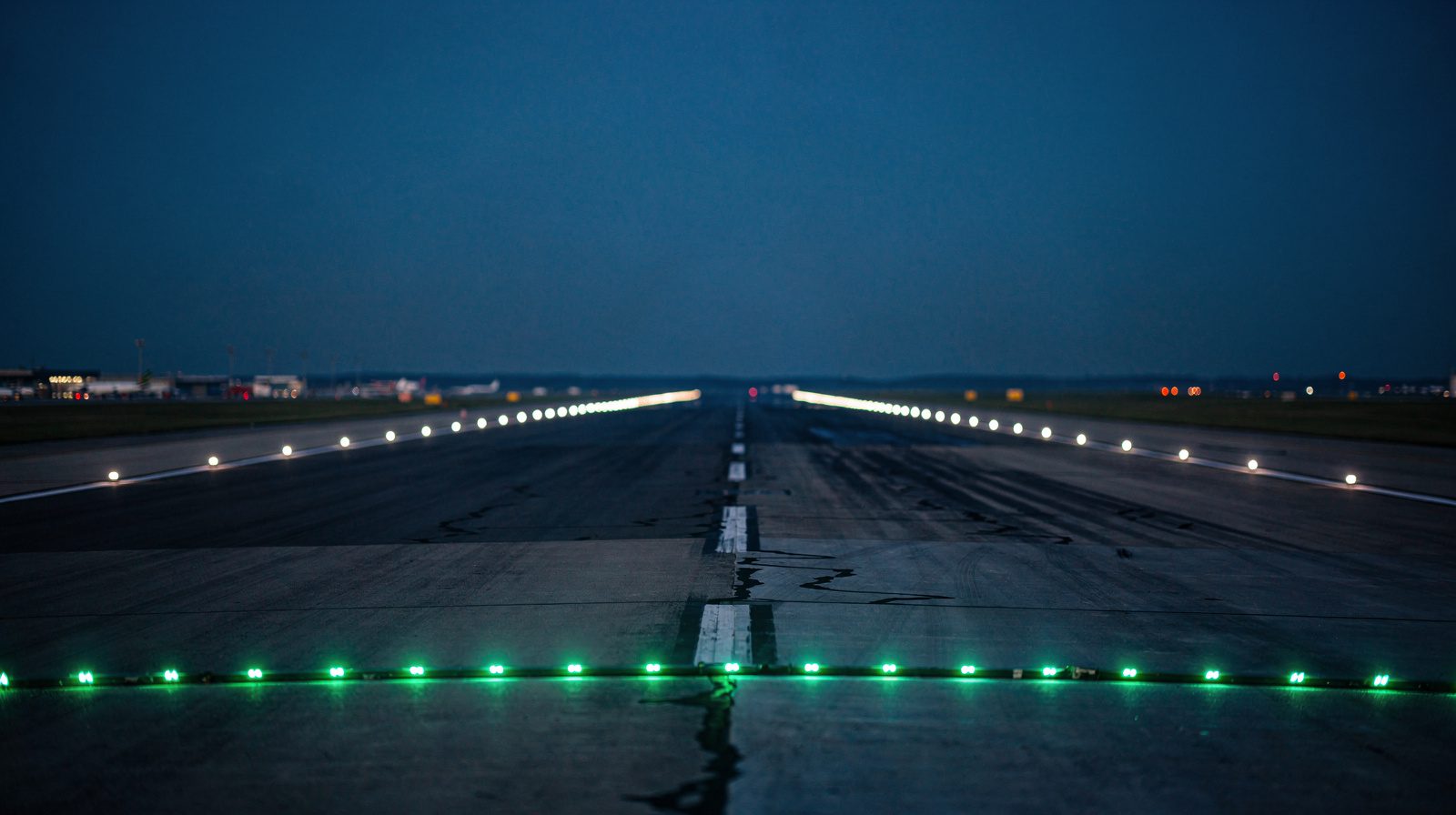
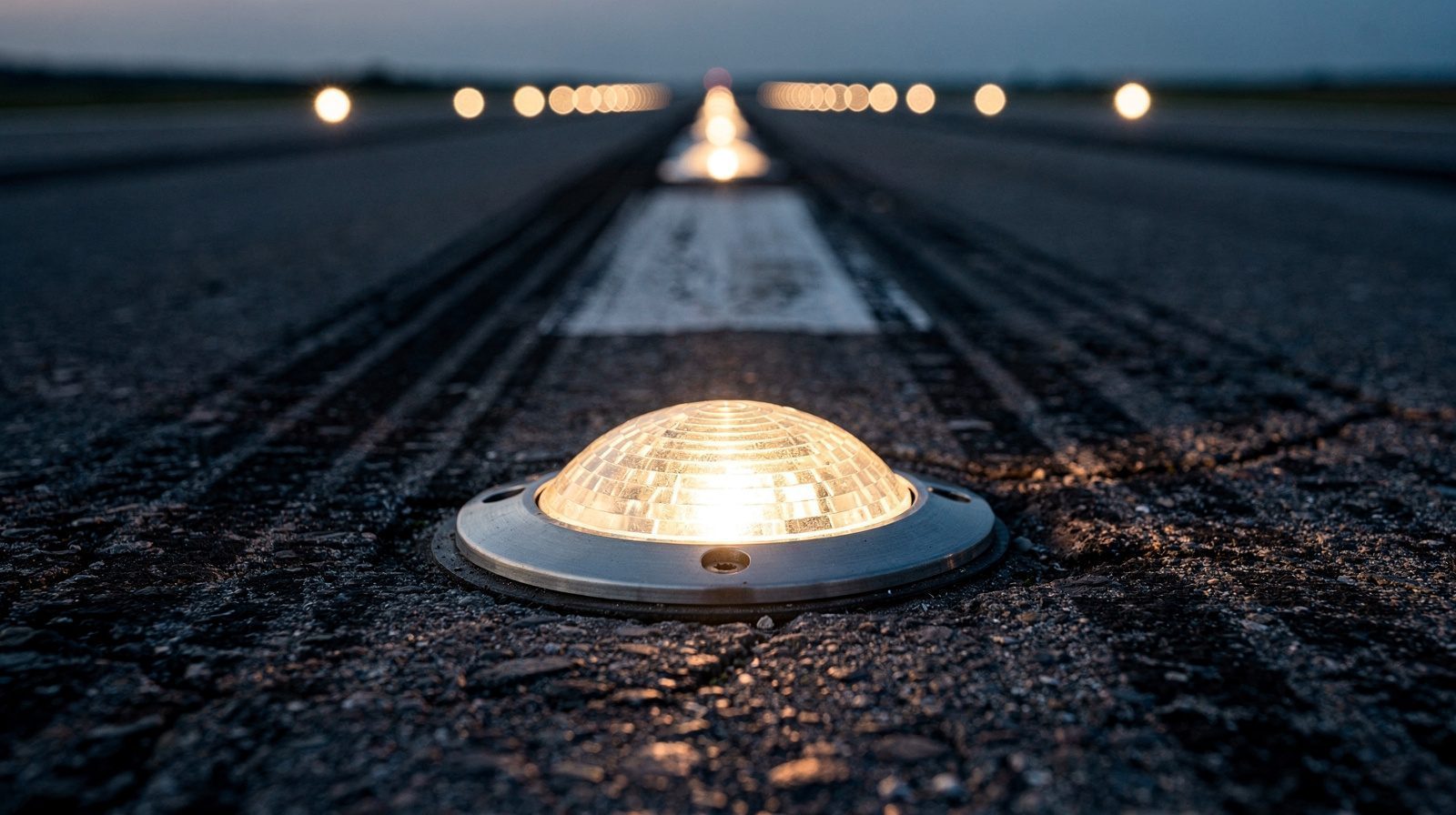
Each type of aeronautical ground light has its own beam specification. EASA and ICAO give it as an isocandela diagram with a main beam. For a runway edge light on a runway 45 m wide, CS-ADR-DSN Figure U-13 shows nested curves. The main beam minimum is 5,000 cd, with a minimum average of 10,000 cd inside the main beam. The figure also gives a toe-in of 3.5°.
Inside the main beam, the maximum intensity may be at most three times the minimum. ICAO states this as a requirement. EASA states it as a recommendation.
A PAPI light unit splits its beam into a white part above and a red part below. EASA recommends that the red to white change occurs within 3 minutes of arc for an observer at 300 m or more. The aim of each beam is part of the installation:
- A PAPI light unit can be set in elevation. The lower limit of the white part of the beam can be set anywhere from 1°30′ to at least 4°30′.
- The FAA requires each L-880 or L-881 PAPI unit to be aimed parallel to the runway centerline, within ½°. The beam centers of all units must be within 1 inch of a horizontal plane.
- EASA recommends a restricted PAPI beam spread in azimuth. This applies if a safety assessment shows that an object inside the lateral limits of the beam is a hazard.
- The FAA requires the beam axis of each taxiway centerline light to be parallel to the taxi path within 1° on a straight section. On a curve, a unidirectional beam is toed in to cross the centerline at about four times the light spacing.
- The beam of a touchdown zone light is toed 4° toward the runway centerline.
- A signalling lamp has a beam spread of 1° to 3°, with negligible light beyond 3°. ICAO recommends at least 6,000 cd for daytime use.
Beam checks in service
Aerodrome rules also check the beam in service.
- A light is unserviceable if its main beam average intensity is less than 50 % of the specified value. If the design value is higher than the specified value, the 50 % applies to the design value.
- A light is also unserviceable if its filter is missing or damaged, or if it does not produce the correct colour.
- For CAT II or III runways, the maintenance guidance includes in-field measurement of intensity, beam spread and orientation. It covers all lights as far as practicable.
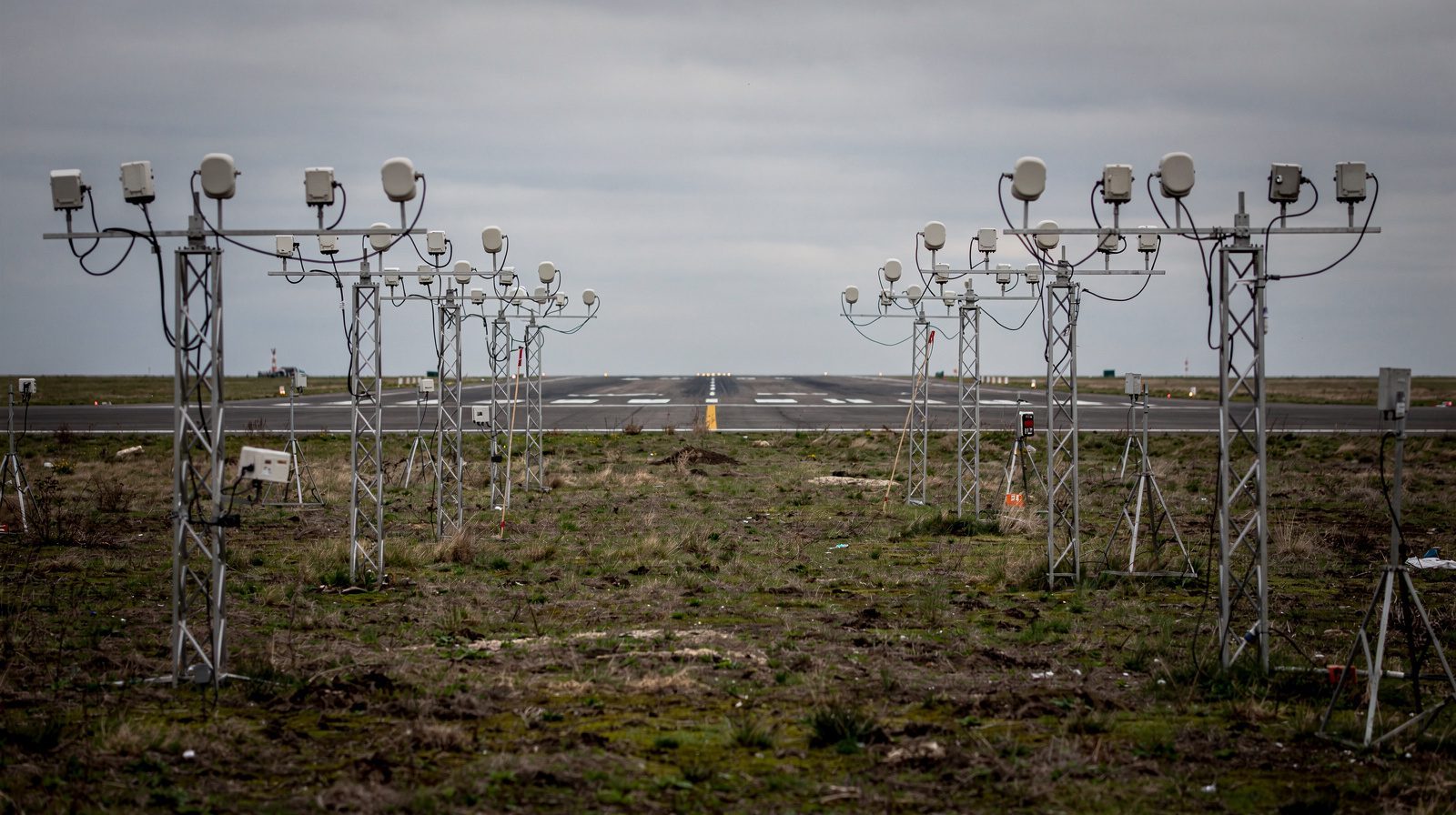
A drone PAPI inspection measures the angle at which each unit changes from white to red. It compares the intensity of the units with each other and with the commanded dimming step. It does not measure absolute intensity in candela. That needs a calibrated photometer at the unit.
Laser beams
ICAO recommends three protected zones around aerodromes for laser emitters. Each zone limits the irradiance to a level that is unlikely to cause a different effect:
- The free flight zone limits visual disruption.
- The critical flight zone limits glare.
- The sensitive flight zone limits flash-blindness and after-image effects.
These limits apply to visible laser beams. In all navigable airspace, the irradiance of any laser beam is expected to be at or below the maximum permissible exposure. This applies to visible and invisible beams. The exception is an emission that the authority has permitted.
Frequently Asked Questions
- What is a light beam?
- A light beam is light that a source sends in a narrow range of directions around one axis. A flashlight, a searchlight and an airfield light all make beams. The CIE describes a beam by its axis, its luminous intensity along that axis and its beam angle.
- What does beam of light mean?
- A beam of light is directional light that radiates from a source. Sunlight that passes through clouds, trees or a window also forms a beam. From the side, you see the beam only where dust, smoke or water droplets scatter some of its light toward your eye.
- What is the difference between a light ray and a light beam?
- A ray is an idealized model of light, drawn as a line that shows the direction of travel. A beam is the real, directional light that a source emits. Light acts like a ray when it meets objects that are several times larger than its wavelength.
- Why can you see a beam of light in the air?
- You see a beam from the side only when particles in the air scatter some of its light toward your eye. Dust, smoke and water droplets do this. Light that passes through clear air, or through a vacuum, has nothing to scatter it, so the beam stays invisible.
- What are the kinds of lighting beam?
- The CIE names three projector types. A spotlight gives a concentrated beam, usually with a divergence of not more than 20 degrees. A searchlight has an aperture of usually more than 0.2 m and gives an approximately parallel beam. A floodlight is a projector for floodlighting, usually capable of being pointed in any direction.
- What is the beam angle?
- The beam angle is the angle between two lines through the beam axis. The lines pass through the points where the luminous intensity is 50 % of the intensity at the beam centre. The CIE defines it as a full angle, not a half angle, in degrees.
- When is an airfield light unserviceable because of its beam?
- In the EU, a light is unserviceable if its main beam average intensity is less than 50 % of the EASA specified value. A missing or damaged filter also makes it unserviceable. So does an incorrect colour.
- Does an airfield light beam have to point in a set direction?
- Yes, and the direction depends on the light. On a straight section, the FAA requires the beam axis of a taxiway centerline light to be parallel to the taxi path. The FAA toes the beam of a touchdown zone light four degrees toward the runway centerline.
References
- openstax-ray-aspect
- College Physics 2e, 25.1 The Ray Aspect of Light OpenStax, Rice University
- wikipedia-ray-optics
- Ray (optics) Wikipedia
- wikipedia-light-beam
- Light beam Wikipedia
- uiuc-seeing-light-beams
- Seeing Light Beams Physics Van, University of Illinois Urbana-Champaign
- cie-ilv-17-27-076
- International Lighting Vocabulary (CIE S 017:2020), entry 17-27-076, optical beam axis CIE
- cie-ilv-17-21-045
- International Lighting Vocabulary (CIE S 017:2020), entry 17-21-045, luminous intensity CIE
- bipm-candela
- SI base unit: candela (cd) BIPM
- cie-ilv-17-27-078
- International Lighting Vocabulary (CIE S 017:2020), entry 17-27-078, centre beam intensity CIE
- cie-ilv-17-27-080
- International Lighting Vocabulary (CIE S 017:2020), entry 17-27-080, peak intensity CIE
- cie-ilv-beam-angle
- International Lighting Vocabulary (CIE S 017:2020), term 17-27-077 beam angle CIE
- cie-ilv-17-30-032
- International Lighting Vocabulary (CIE S 017:2020), entry 17-30-032, spotlight CIE
- cie-ilv-17-30-031
- International Lighting Vocabulary (CIE S 017:2020), entry 17-30-031, searchlight CIE
- cie-ilv-17-30-033
- International Lighting Vocabulary (CIE S 017:2020), entry 17-30-033, floodlight CIE
- easa-ear-aerodromes
- Easy Access Rules for Aerodromes (Regulation (EU) No 139/2014), Issue March 2026 EASA
- easa-cs-adr-dsn-figure-u13
- CS-ADR-DSN Issue 7, Figure U-13, isocandela diagram for a runway edge light where the width of the runway is 45 m (white light) EASA
- faa-ac-150-5340-30j
- AC 150/5340-30J, Design and Installation Details for Airport Visual Aids FAA
- icao-annex-14-vol-i-9ed
- ICAO Annex 14, Volume I, 9th edition (July 2022) ICAO (copy hosted by the Swiss FOCA)
This is a reference entry. TarmacView provides drone inspection services and doesn't sell the equipment or materials described in this glossary.