What is a baffle in airfield lighting?
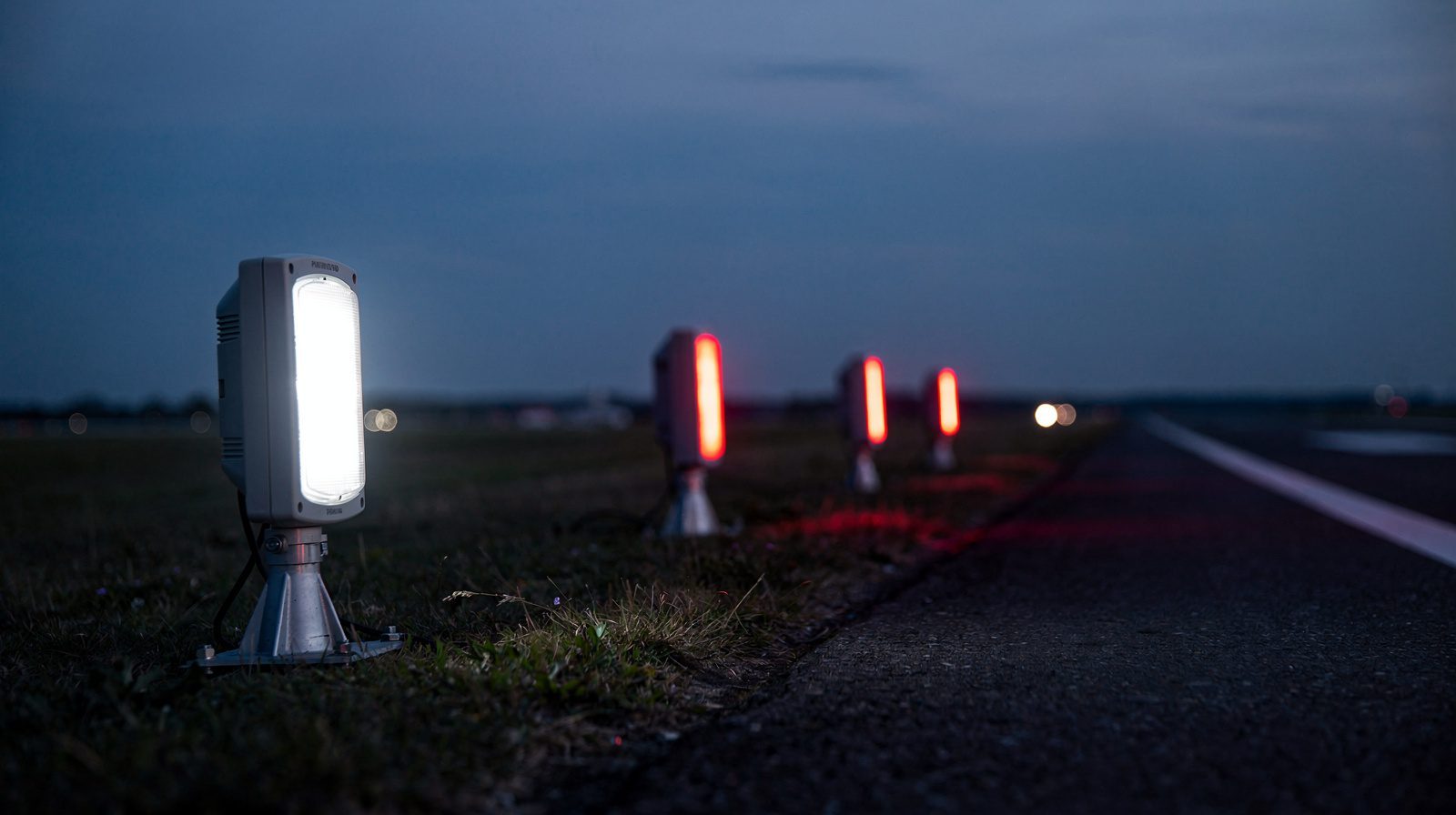
A baffle is a device in a light unit that stops the lamp’s signal from being visible beyond a set point.
The FAA uses the word baffle. A baffle does not shape or strengthen the beam. It narrows the area where the light can be seen. A baffle is also called a blanking device. This page covers where airfield lights use baffles, the FAA limits for a PAPI, and what ICAO and EASA say.
What a baffle does
FAA Order JO 6850.2C defines baffles as devices inside the lamp housing assembly. They keep the signal of each lamp from being visible beyond a prescribed point. The Order says that fitting them reduces the usable angular coverage of the PAPI or other visual glide slope system.
Airfield documents give these reasons for a baffle or a shield:
- An obstacle penetrates the area that a PAPI or VASI must keep clear.
- A pilot reports blinding from a unit, as with a runway end identifier light.
- A light can be confused with other lights, as with taxiway edge lights at a curve.
- A luminaire sends light up, as with apron lighting.
Baffle, shield and hood
The documents do not use one word for all of these parts. The FAA documents use baffle for the device inside the lamp housing of a PAPI, VASI or REIL. For taxiway lights, FAA AC 150/5340-30J says that metal shields or hoods are available from the lamp manufacturers, as an option. The aim is to shield blue light from landing pilots and to lessen the “sea-of-blue” effect.
ICAO and EASA name the result and not the part. At an intersection, exit or curve, they ask for taxiway edge lights to be shielded. ICAO writes this as a Standard (“shall”). The EASA certification specification writes it as “should”. The aim is the same: the lights must not be seen in angles of azimuth in which a pilot may confuse them with other lights.
Baffles on a PAPI
If an obstacle penetrates the PAPI obstacle clearance surface, the Order first asks for the obstacle to be removed or adjusted. If that is not possible, it lists these ways to mitigate the penetration:
- Move the PAPI to the other side of the runway.
- Raise the design path angle, but not above 4.2 degrees.
- Move the PAPI away from the threshold.
- Rotate the lamp housing assemblies, up to 8 degrees to the left or right.
- Install baffles to reduce the angular coverage of the signal.
Baffling is an option only when the obstacle is not too close to the runway centerline. The cut-off should fall at least 2 degrees inside the obstacle, as a safety margin. The PAPI should still serve the runway centerline. These limits follow from that:
- Baffling is not a good option when the penetration is closer than 4 degrees to either side of the centerline. At 4 degrees, a 2 degree margin still leaves 2 degrees of coverage near the centerline.
- The limit is 7 degrees for an LED PAPI. Internal sensors in an LED PAPI turn the lights off if baffling cuts the light to less than 5 degrees either side of the centerline.
- Baffling must not reduce the coverage on either side of the centerline to fewer than 2 degrees, or 5 degrees for an LED PAPI.
The Order also says to consider baffling and rotating the PAPI together, so that no signal is visible within 2 degrees of the obstacle. A baffle changes the sideways coverage. It does not change the glide path angle, because the aiming of the lamp housing assemblies sets that angle.
If these steps reduce the standard obstacle clearance surface in width or distance, the Order requires notifications. These include a NOTAM until the Chart Supplement shows the restriction.
Baffles, movement and rotation may not clear the obstacle. Then the Order sets a restricted usable distance, if the obstacle is at least 1.8 nautical miles (3.3 km) from the threshold. The buffer is at least 0.5 nautical mile (0.9 km) inside the obstacle. If the obstacle is closer, a PAPI service should not be established. See the glossary term precision approach path indicator (PAPI) for the system itself.
Baffles on a VASI
The Order handles a visual approach slope indicator (VASI) in the same way. If an obstruction penetrates the obstruction-clear plane and cannot be removed, the VASI can be baffled to restrict its signal coverage. If the output falls below 10 degrees either side of the runway centerline, the Order asks for a NOTAM and a Chart Supplement entry.
Baffles on runway end identifier lights
Runway end identifier lights (REIL) have a standard aim. The Order tells installers to aim each unit 10 degrees up and toed out 15 degrees from a line parallel to the runway centerline. It says to skip baffles unless user complaints of blinding, flight inspection findings, or environmental impact warrant them. Baffles can then be installed without a waiver.
AC 150/5340-30J gives the installation detail. Aim the beam axis of an un-baffled unit 15 degrees outward from a line parallel to the runway, at 10 degrees above the horizontal. If this standard setting is operationally objectionable, the AC says to provide optical baffles, following the manufacturer’s instructions. The beam axis is then 10 degrees outward and 3 degrees above the horizontal.
Baffles on taxiway and apron lights
For taxiway lights, ICAO Annex 14 Standard 5.3.18.7 and EASA CS ADR-DSN.M.720(c)(2) ask for shielding at an intersection, exit or curve, as far as practicable. FAA AC 150/5340-30J paragraph 11.5.7 adds that shields or hoods are an option. It also says to rotate a fixture with a masked lamp on its mounting to give the right light pattern.
For apron lighting, FAA AC 150/5300-13B lists two recommended practices. Aim the luminaires downward to limit spill light, which can confuse pilots and controllers. Baffle or shield the luminaires to prevent uplight. ICAO Annex 14 also recommends that apron floodlights give a minimum of glare. See the glossary terms apron lighting and glare.
Standards
ICAO Annex 14 and the EASA aerodrome rules do not use the word baffle. They do set effects that a baffle or a shield can serve. Annex 14 recommends that circling guidance lights do not dazzle or confuse a pilot. It also recommends that apron floodlights give a minimum of glare. These are recommendations about the effect and not about baffles. The shielding rule for taxiway edge lights is a Standard in Annex 14 and a certification specification in the EASA rules.
Baffles and inspection
For a PAPI with an obstacle penetration, the FAA flight inspection request must say whether baffles are in use. It must also give the baffle angle, which is the expected reduction in coverage. The Order gives this example: baffles installed to remove coverage beyond 4 degrees left of the centerline, for a terrain obstruction at 8 degrees. The documents cited here set no inspection interval or test for baffles. See the glossary term flight inspection.
Frequently Asked Questions
- What is a baffle in a light?
- A baffle is a device inside a light unit that stops the signal of a lamp from being visible beyond a set point. FAA Order JO 6850.2C defines it this way for PAPI and other visual glide slope lights. The effect is a smaller area in which the light can be seen.
- What does a baffle do on a PAPI?
- It cuts off the PAPI light signal beyond a set angle. The FAA uses it to clear an obstacle from the PAPI obstacle clearance surface. The cut-off should fall at least 2 degrees inside the obstacle.
- Does a baffle change the glide path angle of a PAPI?
- No. A baffle limits the sideways coverage of the signal. The aiming of the lamp housing assemblies sets the glide path angle (FAA Order JO 6850.2C, paragraph 505).
- Can baffles make an LED PAPI stop working?
- Yes. Internal sensors in an LED PAPI turn the lights off when baffling cuts the light to under 5 degrees either side of the centerline.
- Is a baffle the same as a shield or a hood?
- Not in the FAA documents. They use baffle for the device inside the lamp housing of a PAPI, VASI or REIL. They use shields or hoods for the metal parts that some manufacturers offer for taxiway lights. Both parts limit where a light can be seen.
- Do ICAO or EASA require baffles?
- No. A text search finds no use of the word baffle in ICAO Annex 14 Volume I (9th edition). The same is true of the EASA Easy Access Rules for Aerodromes. Both documents do ask for shielding of taxiway edge lights that could be confused with other lights.
- When does a baffle need a NOTAM?
- When baffling reduces the size of the PAPI obstacle clearance surface, FAA Order JO 6850.2C requires a notification, including a NOTAM. It stays until the Chart Supplement shows the restriction. For a VASI, the Order requires a NOTAM when the output falls below 10 degrees either side of the centerline.
- What if baffles cannot clear the obstacle?
- The FAA moves to a restricted usable distance. If the obstacle is at least 1.8 nautical miles from the threshold, the usable distance ends at least 0.5 nautical mile inside it. If the obstacle is closer, a PAPI service should not be established.
References
- faa-jo-6850-2c
- FAA Order JO 6850.2C, Visual Guidance Lighting Systems FAA
- faa-ac-150-5340-30j
- AC 150/5340-30J, Design and Installation Details for Airport Visual Aids FAA
- faa-ac-150-5300-13b
- AC 150/5300-13B, Airport Design FAA
- icao-annex-14-vol-i-9ed
- ICAO Annex 14 Volume I, Aerodrome Design and Operations, 9th edition, July 2022 ICAO (copy hosted by Swiss FOCA)
- easa-ear-aerodromes
- Easy Access Rules for Aerodromes (Regulation (EU) No 139/2014) EASA
This is a reference entry. TarmacView provides drone inspection services and doesn't sell the equipment or materials described in this glossary.