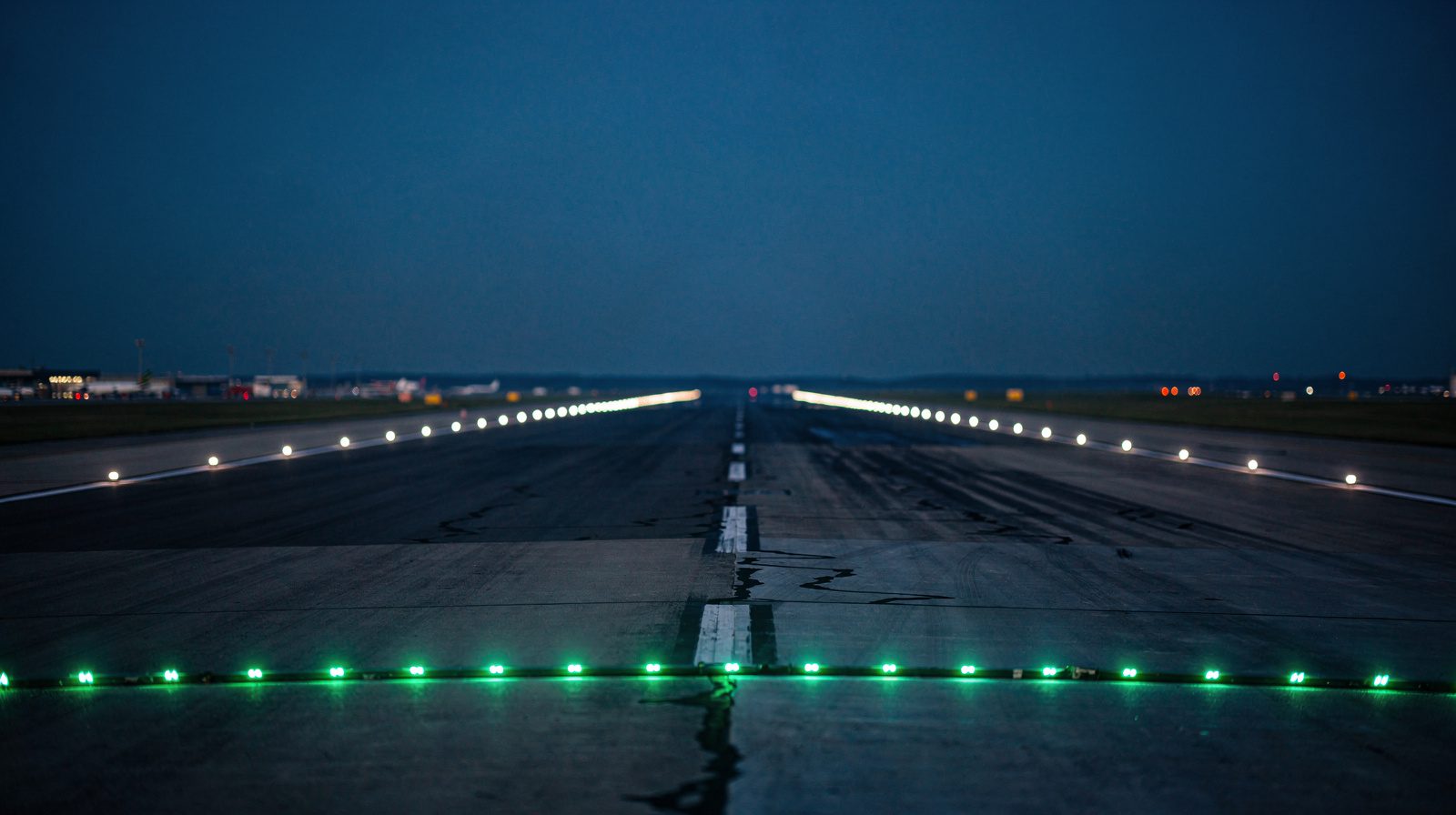
What is Apron Lighting?
Apron lighting is the floodlighting of an apron. The apron is the defined area of an aerodrome where aircraft load or unload passengers, mail or cargo, refuel, park or receive maintenance. The lighting makes it safe to work on and around aircraft at night. The apron floodlight entry covers the floodlight rules in more detail. This page shows how the floodlights fit with the other lights on an apron.
What apron lighting includes
Floodlights are one part of the lighting on an apron. The standards treat the other parts as separate aids.
| Light | What it does | Source |
|---|---|---|
| Apron floodlights | Light the apron service areas and the aircraft stands | ICAO Annex 14, 5.3.24 (Recommended Practice). EASA CS ADR-DSN.M.750 |
| Taxiway edge lights | Mark the edges of an apron intended for use at night | ICAO Annex 14, 5.3.18.1 (Standard, with an exception) |
| Taxiway centre line lights | Guide aircraft between the runway and the stands in low visibility | ICAO Annex 14, 5.3.17.1 (Standard, with an exception) |
| Visual docking guidance system | Shows the pilot the precise position of the aircraft on the stand | EASA CS ADR-DSN.M.755 |
| Aircraft stand manoeuvring guidance lights | Help the pilot to position the aircraft on the stand in poor visibility | EASA CS ADR-DSN.M.765 |
The FAA treats apron signs and edge lighting in a separate section from area lighting. Apron edge lights are generally suitable only at the outer limits of the apron pavement.
Where to install floodlighting
EASA CS ADR-DSN.M.750 and ICAO Annex 14 section 5.3.24 both say that apron floodlighting should be provided on:
- an apron
- a de-icing or anti-icing facility
- a designated isolated aircraft parking position
Both texts end the list with the words “intended to be used at night”.
An isolated aircraft parking position is an area for an aircraft that needs isolation from normal aerodrome activities (Annex 14, 3.14.1). One example is an aircraft that is the subject of unlawful interference.
EASA words the de-icing item as “as necessary”. It also says that an apron used mainly for recreational flying need not be lit. Near a runway, floodlighting of a de-icing facility could confuse pilots. In that case other means of illumination may be required.
Light level
The spectral distribution of the floodlights must let crews identify the colours of aircraft marking, surface marking and obstacle marking. ICAO states this as a Standard. EASA writes it as a “should” specification.
The illuminance values are recommendations. The average illuminance should be at least:
| Area | Horizontal | Vertical |
|---|---|---|
| Aircraft stand | 20 lux, average to minimum not more than 4 to 1 | 20 lux at 2 m above the apron |
| Other apron areas | 50 % of the stand average, average to minimum not more than 4 to 1 | not specified |
EASA writes the same values in CS ADR-DSN.M.750. The FAA gives no values in AC 150/5300-13B. It refers to the Illuminating Engineering Society recommended practice.
Location, aiming and glare
ICAO and EASA ask for adequate light on all apron service areas. The glare to pilots, controllers and apron personnel must be at a minimum. An aircraft stand should receive light from two or more directions, to reduce shadows.
The FAA names the risks of area lighting on an apron. They are obtrusive glare, misleading visual cues to pilots, impaired line of sight and obstructions to aeronautical activities. For the design, the FAA recommends these practices:
- Aim the luminaires downward at the apron pavement.
- Baffle or shield them against uplight.
- Overlap the light sources to reduce shadows.
The FAA also lists two design considerations. Avoid lighting that confuses a pilot’s recognition of the runway lighting systems. Avoid light that obscures a pilot’s or controller’s view of the movement area pavement.
Poles and notification
In the US, the FAA asks for a Part 77 notification of a proposed apron lighting installation. This lets the FAA check the effect on air navigation. The height of the lighting structures must not violate a runway approach surface, a departure surface or the obstacle free zone. Apron light poles go outside the taxiway and taxilane object free areas and clear of aircraft parking stands. These are AC 150/5300-13B standards for US airports.
The FAA also notes that area lighting enhances the security of the air operations area by lighting vulnerable locations.
Power supply
ICAO Annex 14 8.1.10 recommends a secondary power supply for some facilities that must work when the primary supply fails. The list includes floodlighting on a designated isolated aircraft parking position and the lighting of apron areas where passengers may walk. It does not cover every apron floodlight.
Annex 14 5.3.2 recommends emergency lights for an aerodrome with runway lighting and no secondary power supply. They are for at least the primary runway, in case the normal lighting fails. A note says that emergency lighting may also mark obstacles or delineate taxiways and apron areas.
Apron lighting and inspection
A drone inspection of airfield lighting, such as TarmacView does, covers lights that give guidance, for example approach, runway and taxiway lights. The sources above do not say how to check apron floodlight illuminance. A check against the values above needs illuminance measurements on the apron. Both Annex 14 and CS ADR-DSN.M.750 refer to ICAO Doc 9157, Part 4, for more guidance.
Frequently Asked Questions
- Must every apron have floodlighting?
- No. ICAO Annex 14 recommends floodlighting on an apron, a de-icing facility and an isolated parking position intended for use at night. EASA CS ADR-DSN.M.750 says the same with a should, and adds that an apron used mainly for recreational flying need not be lit. Both are recommendations, not shall statements.
- What is the minimum illuminance on an aircraft stand?
- The average illuminance should be at least 20 lux horizontal, with an average-to-minimum ratio of not more than 4 to 1. It should also be at least 20 lux vertical, at 2 m above the apron in relevant directions. ICAO Annex 14 and EASA CS ADR-DSN.M.750 give the same values.
- What is the difference between horizontal and vertical illuminance?
- Horizontal illuminance is the light that falls on the apron surface. Vertical illuminance is the light that falls on a vertical plane, which the specification measures at 2 m above the apron. Both values apply to an aircraft stand.
- Which lights does an apron carry besides floodlights?
- Taxiway edge lights, and in low visibility taxiway centre line lights, mark the apron taxi routes. A visual docking guidance system and aircraft stand manoeuvring guidance lights help the pilot to park. The standards specify each one separately from the floodlights.
- Does apron lighting need a secondary power supply or emergency lighting?
- Not every apron floodlight does. ICAO Annex 14 8.1.10 recommends a secondary power supply for two uses. One is floodlighting on a designated isolated aircraft parking position. The other is lighting of apron areas over which passengers may walk. Annex 14 5.3.2 recommends emergency lights for the primary runway, and a note says they may also delineate apron areas.
- Can apron lighting confuse pilots?
- Yes. The FAA warns that apron area lighting can cause obtrusive glare, misleading visual cues to pilots, a blocked line of sight and obstructions. ICAO and EASA ask for a minimum of glare to pilots and controllers. Aim the luminaires downward and shield them against uplight.
- What illuminance does the FAA set for an apron?
- The FAA sets no illuminance value in AC 150/5300-13B. The circular refers designers to the Illuminating Engineering Society recommended practice for airport service area lighting. The 20 lux and 4 to 1 values come from ICAO Annex 14 and EASA, not from the FAA.
- How do you check that an apron meets the lighting values?
- Measure the illuminance on the lit apron. Check the average on each stand, the lowest point against the average, and the glare. Neither Annex 14 nor CS ADR-DSN.M.750 sets a measuring method, and both refer to ICAO Doc 9157, Part 4.
References
- easa-ear-aerodromes
- Easy Access Rules for Aerodromes (Regulation (EU) No 139/2014), including CS-ADR-DSN EASA
- icao-annex-14-vol-i-text
- Annex 14, Volume I: Aerodrome Design and Operations, 9th edition, July 2022, with Amendment 18 (English text, copy hosted by the Swiss Federal Office of Civil Aviation) ICAO
- faa-ac-150-5300-13b
- AC 150/5300-13B, Airport Design FAA
This is a reference entry. TarmacView provides drone inspection services and doesn't sell the equipment or materials described in this glossary.