What is a Luminaire in Airport Lighting?
A luminaire is an apparatus that distributes, filters or transforms the light from a light source and includes the parts that fix and protect it.
What a luminaire contains
The definition in the CIE International Lighting Vocabulary lists the parts of a luminaire. It includes all the parts that fix and protect the light source. Where necessary it includes the circuit auxiliaries and the means to connect them to the power supply. It does not include the light source itself.
An LED luminaire is a luminaire designed to incorporate at least one LED light source. The LED can be an integral part of it. The light source is the lamp or LED. The luminaire is everything around it.
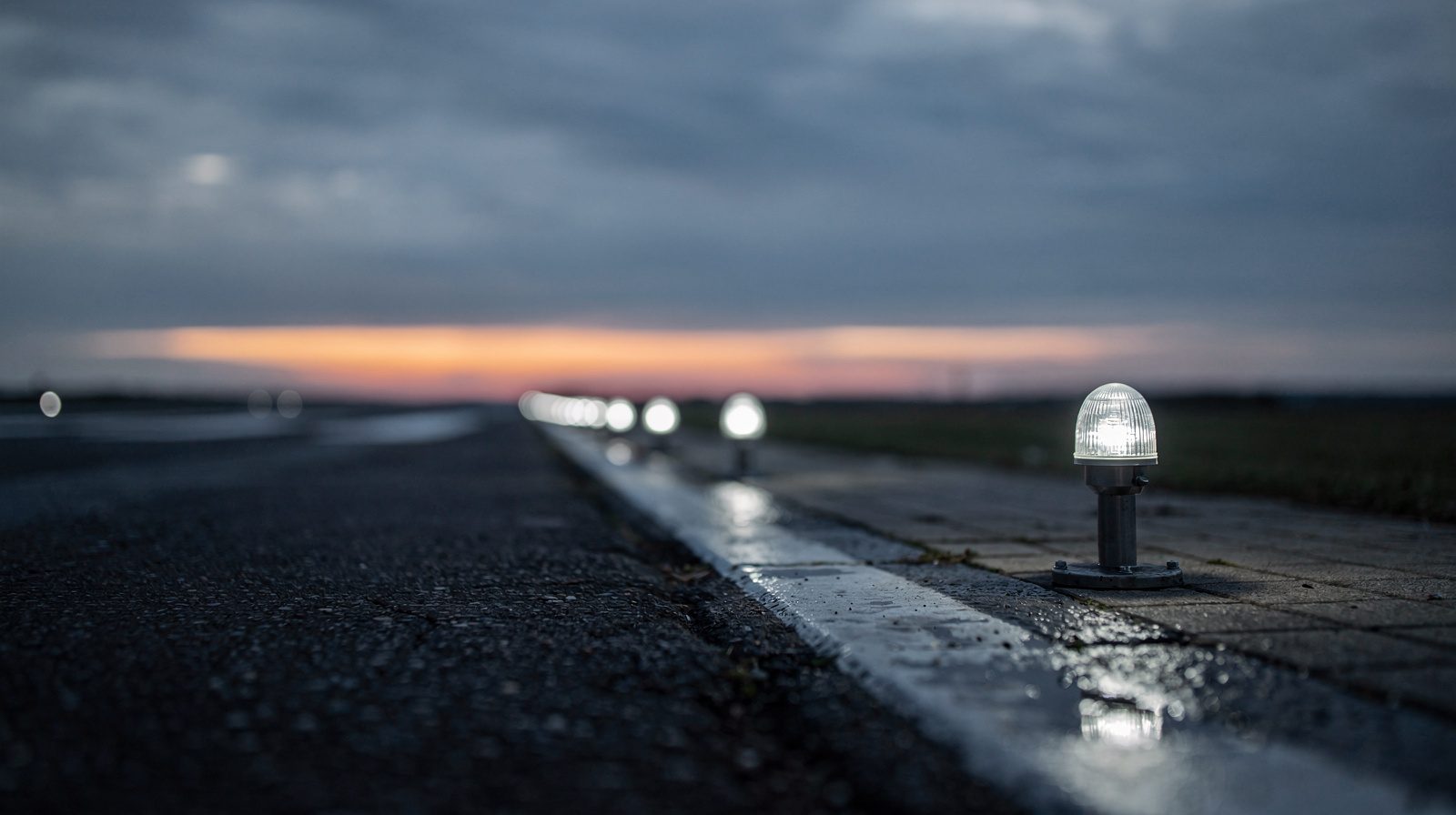
Airfield documents use a wider name for the installed unit. ICAO Annex 14, CS-ADR-DSN and the FAA advisory circulars write “light fixture”. The FAA specifies the fixtures for runway and taxiway lights in AC 150/5345-46. Elevated edge light fixtures are, for example, L-860 (low intensity), L-861 (medium intensity) and L-861-T (medium intensity taxiway).
Elevated and inset fixtures
The rules depend on how the fixture is mounted.
- Elevated lights. Elevated runway, stopway and taxiway lights are frangible. Their height is low enough to keep clearance for propellers and for the engine pods of jet aircraft. In Annex 14 this is a requirement (5.3.1.6). In CS-ADR-DSN.M.615 it is written as “should”.
- Elevated approach lights. The lights and their supporting structures are frangible. Beyond 300 m from the threshold, a structure taller than 12 m is frangible only in its top 12 m (Annex 14 5.3.1.4).
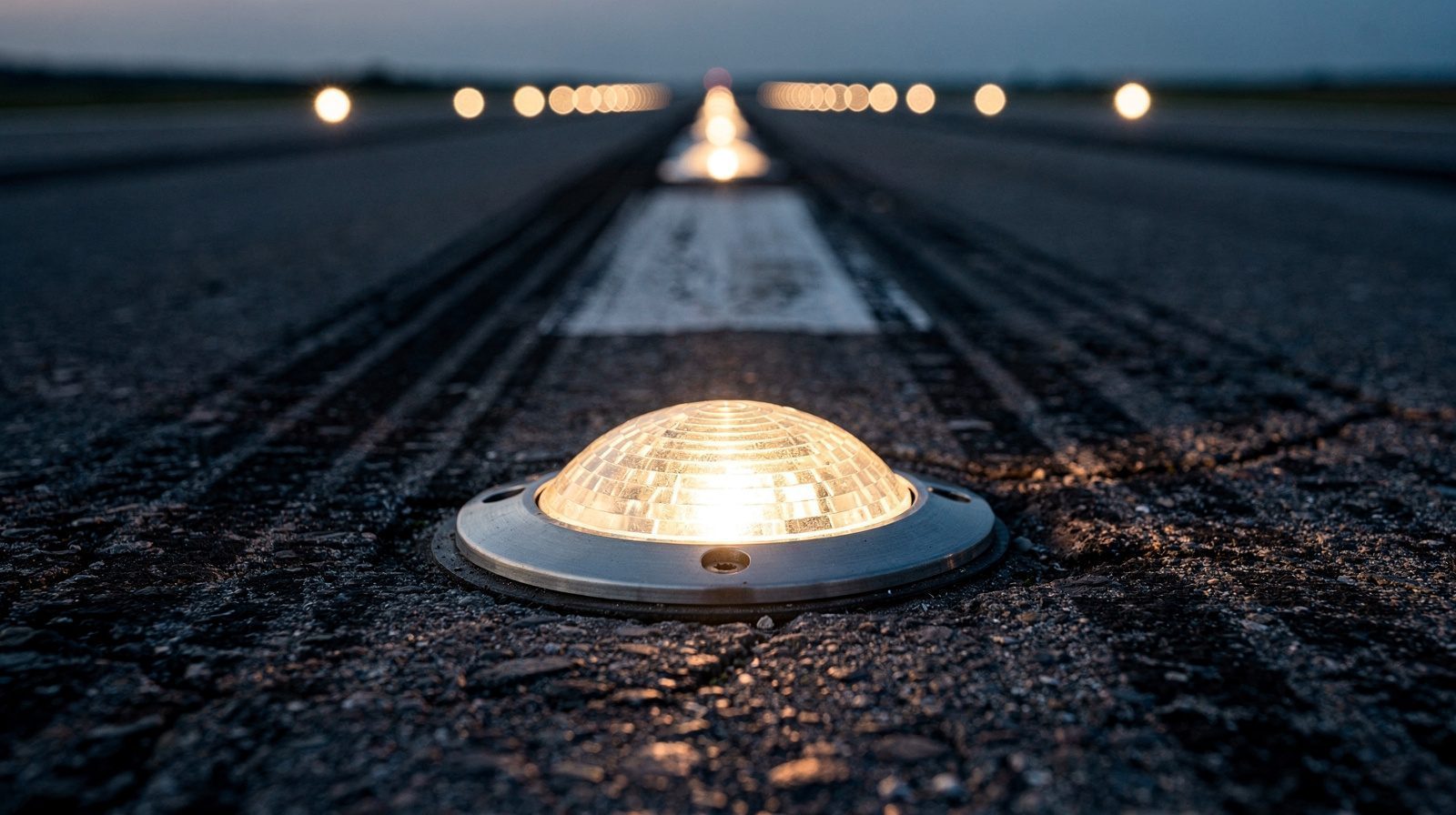
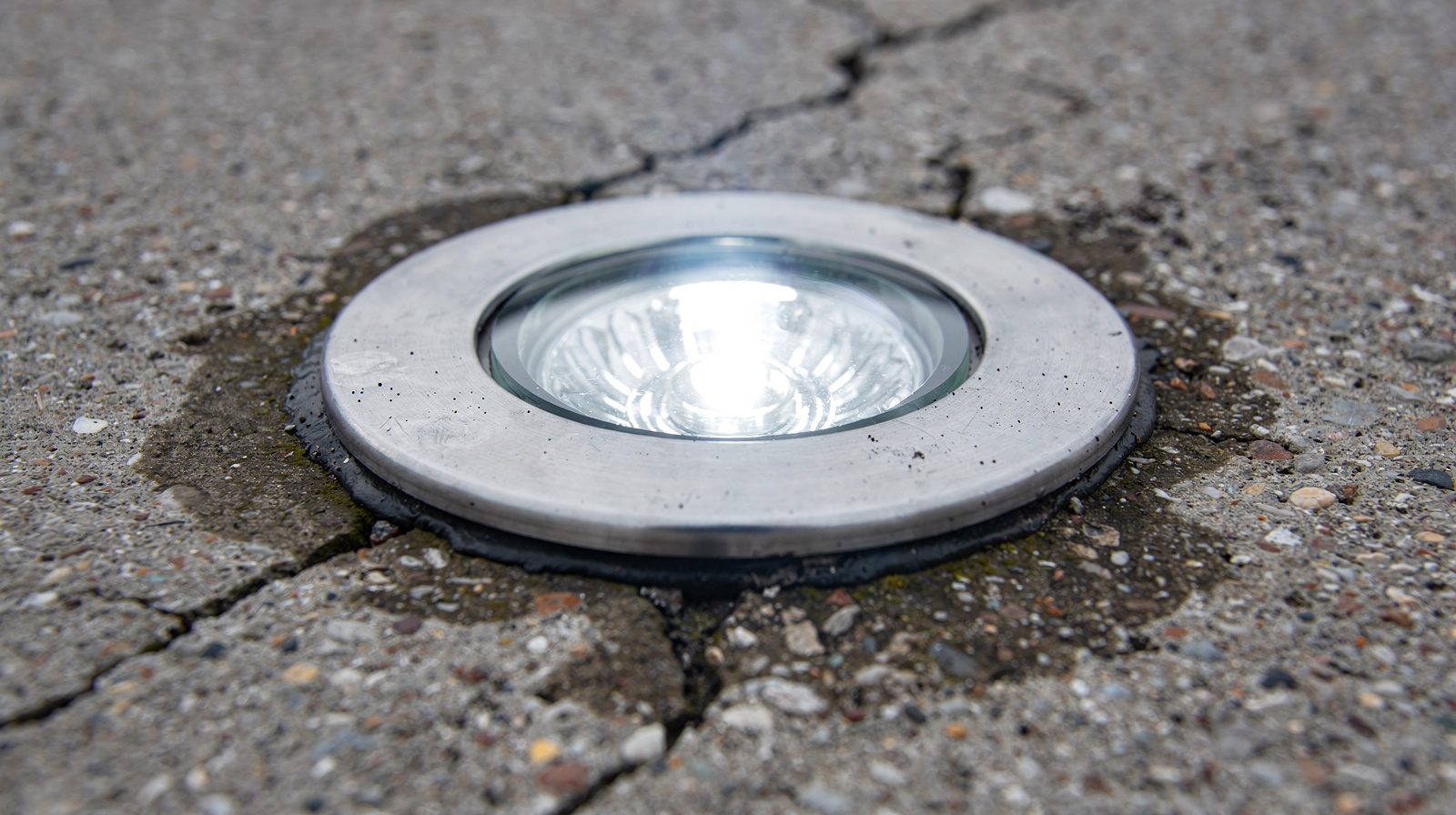
- Inset lights. A fixture in the surface of a runway, taxiway or apron has to withstand the wheels of an aircraft. Annex 14 (5.3.1.7) makes this a requirement. CS-ADR-DSN.M.615 uses “should”.
- Heat at the tire. Annex 14 also has a recommendation. The temperature at the interface between an installed inset light and an aircraft tire should not exceed 160 degrees C in 10 minutes.
Annex 14 defines a frangible object. It is an object of low mass designed to break, distort or yield on impact. This gives the minimum hazard to aircraft.
The FAA names the parts of an installation by item number. An elevated fixture sits on a 12 in (size B) L-867 light base, or is stake-mounted. An in-pavement fixture sits on a 15 in (size C) base or a 12 in (size B) L-868 base (AC 150/5340-30J Table 2-3). For taxiway edge lights, the FAA says to restrict in-pavement fixtures to two cases. Jet blast may damage elevated lights, or elevated lights would interfere with aircraft operations (AC 150/5340-30J 2.5).
What a luminaire must achieve
The standards set the output of an airfield luminaire as colour and as light distribution.
- Colour. Annex 14 Appendix 1 verifies the colour at five points within the innermost isocandela curve. It also checks the colour at the outermost curve, to avoid a colour shift that could confuse a pilot (2.4.1).
- Light distribution. Annex 14 Appendix 2 gives an isocandela diagram for each type of light. CS ADR-DSN.U.940 holds the same kind of figures for EASA.
- Failure. A light is unserviceable below 50 per cent of the Appendix 2 value of main beam average intensity (Annex 14 10.5.1).
EASA advises the operator to consider two intensity levels for a light. The higher one is a maintenance level, always above 50 per cent. It warns the crew that a unit is beginning to fall short, so that corrective action can be planned (GM1 ADR.OPS.C.015(b) and (c)).
LED fixtures
EASA guidance says the life of an LED luminaire depends on the whole assembly and on its conditions of use. The main conditions are temperature, on-off cycling and humidity. The light output of an LED decreases and its colour shifts over time. For that reason a long LED life is no reason to install and forget.
An LED gives no infrared heat signature. Annex 14 10.5 Note 2 covers an operator who expects ice and snow to melt on incandescent lights. The operator may evaluate a changed maintenance schedule. The operator may also evaluate LED fixtures with heating elements. EASA adds that LED PAPI are likely to need a lens heater. Enhanced vision systems use the infrared signature of incandescent lights. Annex 14 10.5 Note 3 says that Annex 15 protocols notify users of such systems when an aerodrome converts to LED.
The FAA adds a rule for mixed installations. LED fixtures differ from incandescent fixtures in perceived colour and brightness. They must not be interspersed with incandescent lights of the same type. When a fixture fails, the replacement uses the same light source technology (AC 150/5340-30J 1.4).
Apron luminaires
Apron floodlights are luminaires too. CS ADR-DSN.M.750 recommends floodlights with a minimum of glare. Each aircraft stand should receive light from two or more directions to reduce shadows. The average illuminance on a stand should be at least 20 lux horizontal and 20 lux vertical at 2 m height. The FAA recommends that apron luminaires face downward and carry baffles or shields against uplight (AC 150/5300-13B 5.14.3).
Why it matters for inspection
The sources above name faults that a count of lit lights does not find. These are lower light output, a colour shift and a contaminated lens on an in-pavement fixture. EASA also notes that LED PAPI are likely to need a lens heater. A check of an airfield light therefore looks at each fixture, not only at whether it is on.
Frequently Asked Questions
- Is a luminaire the same as a lamp?
- No. A lamp or LED is the light source. The luminaire is the apparatus around it. It distributes, filters or transforms the light and includes the parts that support, fix and protect the source. Where needed, it also includes the circuit auxiliaries and the means to connect them to the supply.
- Is a luminaire the same as a light fixture?
- In airfield documents, mostly yes. ICAO Annex 14, CS-ADR-DSN and the FAA advisory circulars write "light fixture" for the unit that is installed. EASA guidance on LED lights uses both "fixture" and "luminaire" in one passage. Use the word that the governing document uses.
- Can an LED luminaire fail while it is still lit?
- Yes. EASA guidance says LED light output decreases and the colour shifts over time. At some point the light can be outside the specification for its purpose, although the LED still works. Contamination on the lens of an in-pavement fixture can also reduce performance.
- What is a frangible airfield light?
- It is a light of low mass that breaks, distorts or yields on impact. This gives the minimum hazard to an aircraft. Annex 14 5.3.1.6 requires elevated runway, stopway and taxiway lights to be frangible. CS ADR-DSN.M.615 uses "should".
- Can an aircraft drive over an in-pavement light?
- Yes. A fixture inset in a runway, taxiway or apron surface must withstand aircraft wheels. The wheels must not damage the aircraft or the light (Annex 14 5.3.1.7). Annex 14 also recommends that the temperature at the tire interface does not exceed 160 degrees C in 10 minutes.
- Do LED airfield lights need a heater?
- They can. An LED does not give the heat that melts ice and snow on an incandescent fixture. EASA GM2 ADR.OPS.C.015(b) says that the need for a heater depends on the site and the weather. It says that LED PAPI are likely to need a lens heater.
- Can LED and incandescent fixtures be mixed on one light row?
- Not for the same type of light. The FAA says an LED fixture must not be interspersed with incandescent lights of the same type. The perceived colour and brightness differ. A defective incandescent fixture must not be replaced with an LED one.
- When is an airfield light unserviceable?
- ICAO Annex 14 10.5.1 says it is unserviceable when its main beam average intensity is below 50 per cent of the Appendix 2 value. EASA advises a higher maintenance level, above 50 per cent, so that crews get early warning (GM1 ADR.OPS.C.015(b) and (c)).
References
- cie-ilv-luminaire
- CIE S 017:2020 ILV: International Lighting Vocabulary, 2nd edition, entries 17-30-001 (luminaire) and 17-30-056 (LED luminaire) CIE (International Commission on Illumination)
- easa-ear-aerodromes
- Easy Access Rules for Aerodromes (Regulation (EU) No 139/2014), CS-ADR-DSN Issue 7 and AMC/GM, March 2026 EASA
- icao-annex-14-vol-i
- Annex 14 to the Convention on International Civil Aviation, Volume I, 9th edition (July 2022, consolidated copy including Amendment 18, hosted by Swiss FOCA) ICAO
- faa-ac-150-5340-30j
- AC 150/5340-30J, Design and Installation Details for Airport Visual Aids FAA
- faa-ac-150-5300-13b
- AC 150/5300-13B, Airport Design, Change 1 FAA
This is a reference entry. TarmacView provides drone inspection services and doesn't sell the equipment or materials described in this glossary.