What a PAPI Calibration Tender Should Include
What a PAPI verification tender should include: scope, method, tolerances, report contents and frequency, with the EU, ICAO and FAA source for each. No prices.
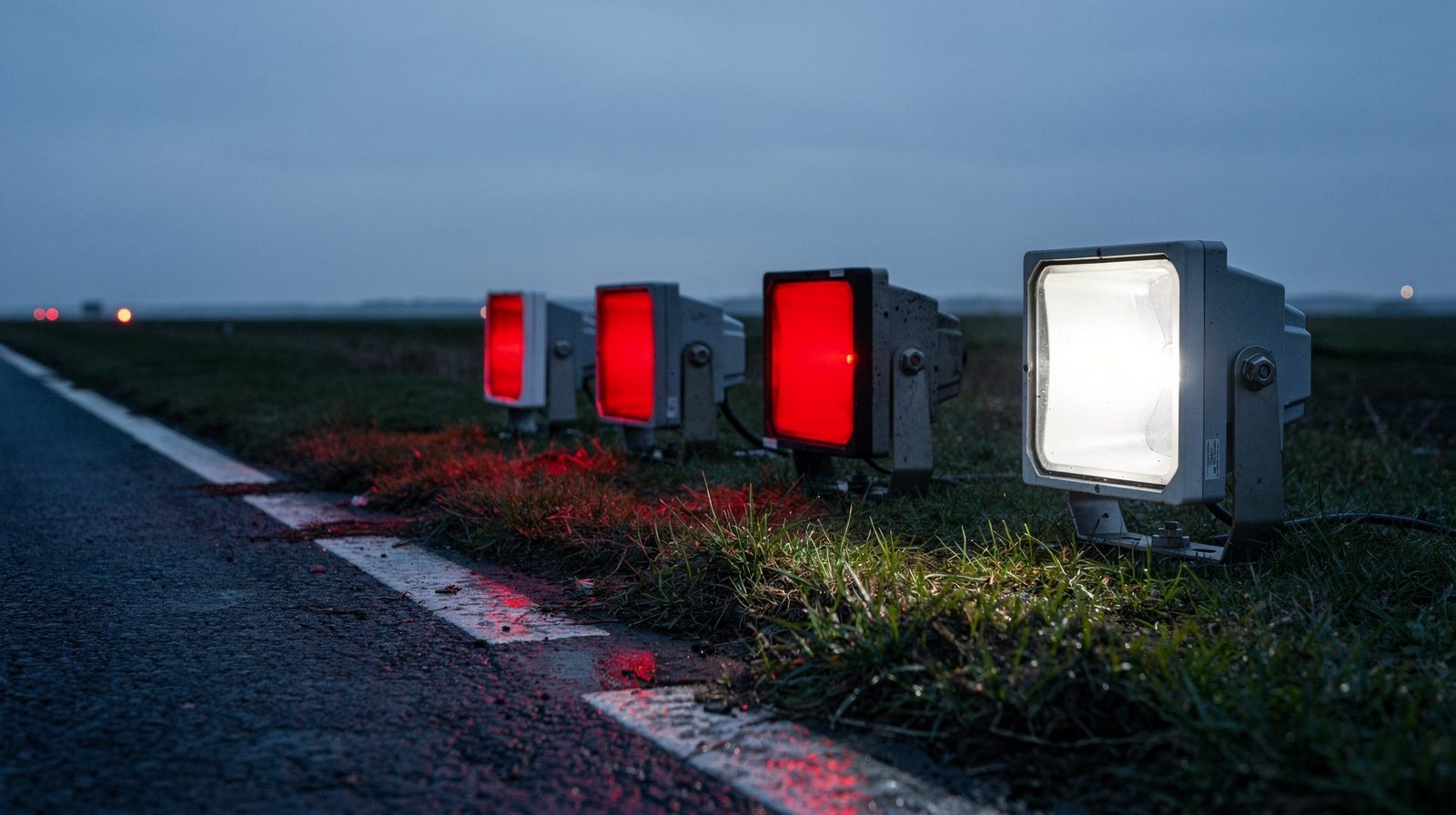 PAPI · WING BAR · DUSK
A PAPI verification and calibration tender should name the installations, the quantity measured on each unit, the method and its instrument evidence, the tolerance each result is judged against and who set it, the report contents, and how often the work repeats.
It should not carry one number copied from memory, because the Annex 14 Standards give none for the setting angle and the EU gives one only as guidance. The 3 minutes of arc that people quote is a limit on how sharp the red to white change is, not on where the unit is aimed. This post goes through each part in that order.
Scope: installations and quantities
Start with the list. The tender should name each runway end with a PAPI or APAPI and say whether a second wing bar is fitted on the other side for roll guidance. Annex 14 describes a PAPI as a wing bar of four units and an APAPI as two, on the left side of the runway unless that is physically impracticable (5.3.5.24 and 5.3.5.25). Where a bar sits on each side, corresponding units are set at the same angle (5.3.5.41).
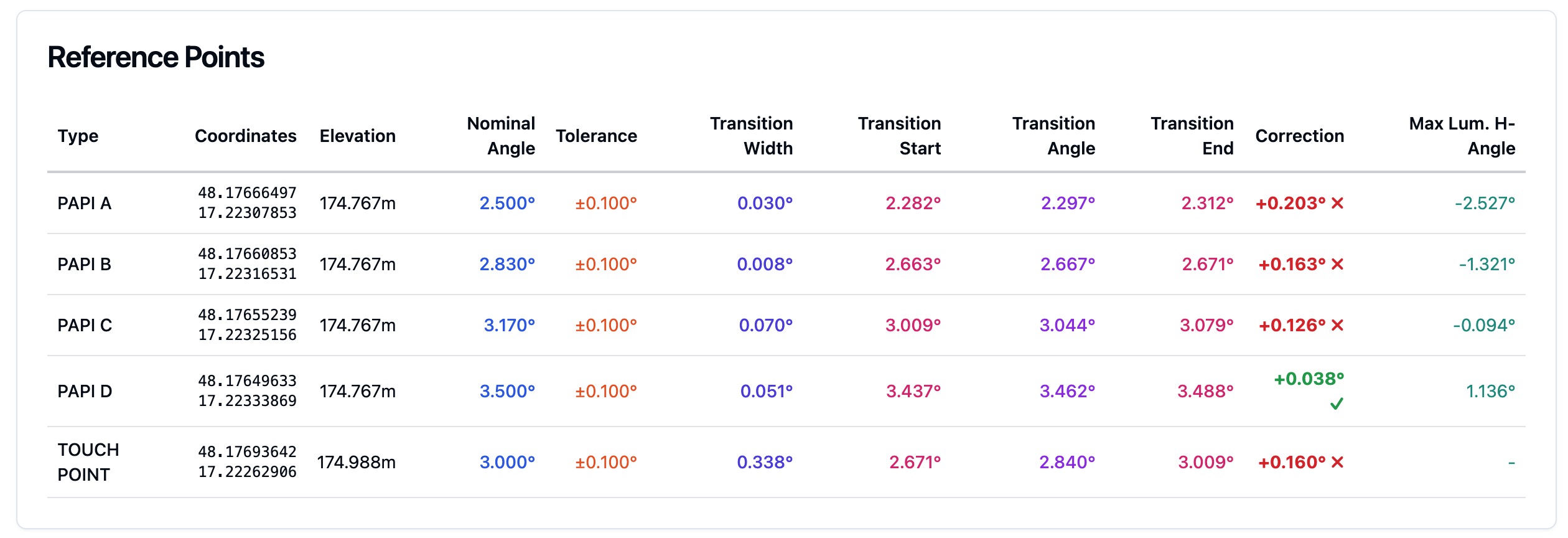
Then say what is measured on each unit. Doc 9157 treats the unit setting angle and the beam elevation as the same thing, because the plane of transition is aligned to the unit’s horizontal axis at manufacture (8.3.14). The candidates are:
- the setting angle, from the red to white transition
- the depth of the transition, which Annex 14 limits to 3 minutes of arc seen from at least 300 m (5.3.5.30)
- the red colour, with a Y coordinate not above 0.320 at full intensity (5.3.5.31)
- unit position, against the siting tolerances in Annex 14 Figure 5-19
Two lines belong outside the angle measurement and should be priced or excluded on purpose. Resetting a unit is not measurement. Doc 9157 says the independent ground check is not a calibration technique and that a discrepancy is corrected by resetting the unit with the clinometer (8.3.24). And a measured angle does not replace the flight inspection that Doc 9157 says the competent authority should undertake for a new installation. It covers range, brilliancy control, setting angles (to ensure there is no gross misalignment) and compatibility with the precision instrument glide path, if one is provided (8.3.42).
Method: independent of the unit
The method section should make the bidder say how the angle is found without relying on the unit’s own housing. The clinometer reads the aim of the housing and not the projected beam, and the optical axis can differ from the mechanical one after damage or a blow from snow blower exhaust (8.3.32). Doc 9157 describes these methods, and also a fixed sensor for continuous monitoring (8.3.39 to 8.3.41):
| Method | Paragraphs | Accuracy as stated there | Ask the bidder for |
|---|---|---|---|
| Clinometer | 8.3.21 to 8.3.23 | No figure given. Measures the housing | Use as the reset tool only |
| Ground survey | 8.3.25 to 8.3.30 | About 3 minutes of arc | Observer repeats, intensity step used |
| Image analysis | 8.3.33 to 8.3.35 | Better than 1 minute of arc | Instrument and tripod distance |
| Checkboard | 8.3.36 to 8.3.38 | Marked in 1 minute increments | Pad survey record |
| Unmanned aircraft | 8.3.43 to 8.3.46 | None given | See below |
For the unmanned method, Doc 9157 describes an aircraft at least 300 m from the PAPI that scans vertically to find the heights of the upper and lower limits of the transition zone, with the angle computed from them and the distance. It says an RTK base station is necessary for high dimensional precision (8.3.43 and 8.3.44). It also says the camera must be operationally validated and that the State authority may require special authorization (8.3.46). A tender should therefore ask for the validation record and for the authority’s position, and say who obtains any authorization. The regulatory acceptance guide covers how authorities have handled that question.
Tolerances: name the source, then the threshold
Do not write “tolerance per ICAO”. Write which document, and whether it is binding. The sources divide as follows.
| Source | Status | What it gives |
|---|---|---|
| ICAO Annex 14 Vol I, 5.3.5 | Standard (shall) | Transition within 3 minutes of arc, red Y at most 0.320, siting tolerances. No tolerance on the setting angle in the text read |
| EU ADR.OPS.C.015(f) | Rule (binding) | Inspections and checks at defined intervals appropriate to the intended operation and system. No figure |
| AMC1 ADR.OPS.C.015(b) and (f) | Acceptable Means of Compliance, not binding in itself | Alignment of visual approach slope indicator systems checked at defined intervals. Errors in excess of one minute of arc should be corrected |
| CS-ADR-DSN.M.645, M.650 | Certification specification | The Annex 14 characteristics, with Figure M-5 setting angles |
| ICAO Doc 9157 Part 4, Table 8-1 | Guidance | Unit settings for a 3 degree approach, 2°30′, 2°50′, 3°10′, 3°30′ for units A to D |
| FAA AC 150/5340-30J, Table 7-2 | Recommended, mandatory on AIP and PFC funded projects | Aiming 30 and 10 minutes above and 10 and 30 below the glide path |
Three points follow. The one minute of arc figure sits in the EU AMC and is the only numeric limit on alignment error in the EU texts read. A method that is accurate to about 3 minutes cannot resolve it, which is an argument for asking every bidder to state the uncertainty of the result, not only its accuracy class. The unit settings depend on the approach slope , so the tender should supply the design glide path and the settings in force. For harmonisation with an ILS glide path, the note to Figure M-5 widens the on-course sector from 20 to 30 minutes of arc, giving 2°25′, 2°45′, 3°15′ and 3°35′ for a 3 degree slope. And FAA Table 7-2 gives wider offsets to height group 4 aircraft on an ILS runway, 35 and 15 minutes. State the aerodrome’s own numbers.
The tender then needs one sentence of its own: results are reported against the design setting angle of each unit, with an action level named by the aerodrome’s maintenance programme. That level is a choice for the operator and its authority.
Evidence and reporting
For each unit the report should show the measured angle, the design angle and the difference, the uncertainty, and the correction needed to bring it back. A pass mark alone cannot be acted on, and a unit that is out of tolerance needs the correction value more than the verdict. Ask for the raw measurements too, so a reviewer can recompute the angle from the heights and the distance (8.3.44).
Record the conditions that affect the reading. AMC1 asks for alignment checks at an appropriate intensity setting, and Doc 9157 warns that too high an intensity makes ground survey readings too low (8.3.30). So the report should log the intensity step, the date and time, the weather, the measurement distance and the instrument identifiers. For a drone method it should also hold the RTK base position and the datum.
The section of Doc 9157 read for this post gives no protocol template. The tender should therefore specify the layout it wants and name the authority that will receive it.
Finally, write down what counts as done. A sensible acceptance rule has three parts. Every unit on the list has a result with a stated uncertainty. Every unit above the action level has a correction value, and the work is not closed until a second measurement shows the unit back inside it. And the raw data, the method statement and the instrument validation record are handed over with the report, so the operator can show an inspector how each figure was reached.
Frequency and triggers
The sources set no single interval for PAPI alignment. EU rule ADR.OPS.C.015(f) asks for defined intervals appropriate to the operation. The AMC asks for extra checks after an aircraft occurrence and for flight checks of the lighting at least yearly, with special checks after major maintenance, changes and before commissioning. Doc 9157 leaves the interval to the competent authority and says a monthly alignment check is adequate in many circumstances, with more checks where the ground is unstable or weather moves the bases (8.3.20). For the US maintenance schedule, see the FAA AC 150/5340-26 page .
Write the tender as a base visit plus call-offs: after maintenance on or near the units, after severe weather, after an occurrence, and after any correction, to confirm it held. See also how calibration intervals are argued in general.
Commercial lines without a price
Ask for separate lines for mobilisation, each installation measured, re-measurement after adjustment, a report revision, and standby when the weather or the tower moves the slot. Compare bids on those lines, not on a headline total. What drives the number is in What a PAPI Inspection Actually Costs and in the PAPI calibration cost guide , and we publish no rate.
TarmacView’s PAPI inspection is a drone measurement of the kind 8.3.43 to 8.3.46 describe. If you are drafting a tender, ask us for a sample protocol and compare it with the list above.
Frequently Asked Questions
- What should a tender for PAPI verification and calibration include?
- It should name the installations and the quantity measured on each unit, the method and its instrument evidence, the tolerance each result is judged against and who set it, the report contents, and how often the work repeats. It should also split the commercial lines. It should not copy a single tolerance from memory, because the Annex 14 Standards give none for the setting angle.
- What does a PAPI inspection report need to contain for the regulator?
- The sources read set no single report template. For each unit the report should show the measured angle, the design angle, the difference, the uncertainty and the correction needed. It should log the intensity step, date, time, weather, measurement distance and instrument identifiers, and hand over the raw data and the method statement. Name the receiving authority in the tender.
- Which standard sets the tolerance on a PAPI setting angle?
- None of the ICAO Annex 14 Standards read gives one. The EU AMC1 to ADR.OPS.C.015(b) and (f) says errors in excess of one minute of arc in visual approach slope indicator alignment should be corrected, and it is guidance. The 3 minutes of arc people quote limits the depth of the red to white transition, not the aim.
- How often should a PAPI be verified?
- The sources set no single interval. EU rule ADR.OPS.C.015(f) asks for defined intervals appropriate to the operation. ICAO Doc 9157 leaves the interval to the competent authority and says a monthly alignment check is adequate in many circumstances. Write the tender as a base visit plus call-offs after maintenance, severe weather, an occurrence and any correction.
- How much does a PAPI calibration cost?
- This post gives no price, and the providers quote on request. Compare bids on separate lines for mobilisation, each installation measured, re-measurement after adjustment, report revision and standby. The PAPI calibration cost guide on this site covers what moves the number.
References
- easa-ear-aerodromes
- Easy Access Rules for Aerodromes (Regulation (EU) No 139/2014) European Union Aviation Safety Agency
- icao-annex-14-vol-i
- Annex 14 to the Convention on International Civil Aviation, Aerodromes, Volume I, Aerodrome Design and Operations, Ninth Edition, July 2022 (English text, copy hosted by the Swiss Federal Office of Civil Aviation) ICAO
- icao-doc-9157-part-4
- Aerodrome Design Manual, Part 4: Visual Aids (Doc 9157), Fifth Edition, 2021, with Amendment No. 1 and Corrigendum No. 1 (English text, copy hosted by the Swiss Federal Office of Civil Aviation) ICAO
- faa-ac-150-5340-30j
- AC 150/5340-30J, Design and Installation Details for Airport Visual Aids Federal Aviation Administration
Founded by flight-inspection veterans who spent decades measuring PAPI lights for aviation authorities across Europe.
Learn more
Related terms
03 TERMSPAPI Approach Slope and Elevation Setting
The PAPI approach slope and elevation setting are the approach angle a PAPI shows and the angle of each unit. Setting angles for 3 degrees, tolerance, how they are measured, and drones.
Light Unit
A light unit is one light assembly of an airfield lighting system, such as one unit of a PAPI. Units per system, PAPI aiming, spacing, serviceability and LED reporting.
Color Transition
A colour transition is the boundary in the beam of an approach slope light unit where white changes to red. How a PAPI forms its signals, how sharp the transition must be, how VASI and tri-colour systems differ, and what inspection checks.
Further reading
03 ARTICLES
How PAPI Transition Angles Are Verified in the Field
How to verify PAPI transition angles in the field: clinometer and ground checks, flight checks and drone measurement, with the ICAO, EASA and FAA…
What ICAO Annex 14 Actually Requires of Your PAPI
The tolerances behind a PAPI protocol, what an authority looks for in the evidence, and how often the system has to be verified to stay certifiable.
PAPI Out of Tolerance: What the Rules Say and When a NOTAM Is Due
What happens if a PAPI is out of tolerance and when a NOTAM is due: the EASA, ICAO, FAA and UK CAA rules on error limits, unserviceability and…