What is an Obstacle Light?
Obstacle Light
Definition: What is an Obstacle Light?
An obstacle light is a specialized luminous device installed on structures that pose a risk to aviation, such as tall buildings, towers, cranes, wind turbines, or bridges. These lights serve as visual markers, ensuring that pilots can clearly identify and avoid obstacles, especially at night or during periods of low visibility. Their design, placement, and operation are strictly regulated by international (ICAO Annex 14) and national (e.g., FAA, EASA) standards to ensure consistent hazard signaling across all types of airspace.
Purpose and Function
Obstacle lights are essential for safeguarding flight operations by providing unmistakable warnings of potential hazards. As aircraft frequently operate at low altitudes during takeoff, approach, and landing, obstacles that rise above certain thresholds must be made visible, regardless of ambient lighting or weather conditions.
The primary goals are:
- Collision Prevention: By making obstacles conspicuous, lights give pilots advance notice, allowing for timely maneuvering.
- Legal Compliance: Aviation regulations demand lighting on structures exceeding defined heights or located within protected airspace surfaces near airports and flight paths.
- Adaptation to Environment: The type of light (color, intensity, flashing or steady) is selected to maximize visibility while minimizing light pollution and community disturbance.
Obstacle lights are integral to both permanent installations (e.g., telecom towers, wind turbines) and temporary hazards (e.g., cranes during construction or closed airport runways). Modern systems often employ energy-efficient LEDs, automatic control features, and remote monitoring to ensure reliability.
Regulatory Standards and Compliance
ICAO Annex 14
The International Civil Aviation Organization (ICAO) sets the global standard for obstacle lighting:
- Applicability: Required for obstacles above 45 meters (147.6 feet), or lower if within critical airspace.
- Classification: Lights are categorized by intensity (low, medium, high) and color (red for night, white for day).
- Placement: At the structure’s highest point and at intermediate levels for tall or complex shapes.
- Performance: Specific photometric and environmental requirements, including minimum intensity, beam angle, and color chromaticity.
FAA Advisory Circulars and National Standards
In the United States, the FAA defines standards in AC 70/7460-1 and AC 150/5345-43:
- Trigger Height: Generally 200 feet (60.96 meters), or lower near airports.
- Mode: Steady or flashing red for night, flashing white for daytime.
- Certification: Equipment must be FAA-approved and subject to routine inspection.
Other countries adapt ICAO or FAA standards with local variations, always check national regulations for project-specific requirements.
Types of Obstruction Lights
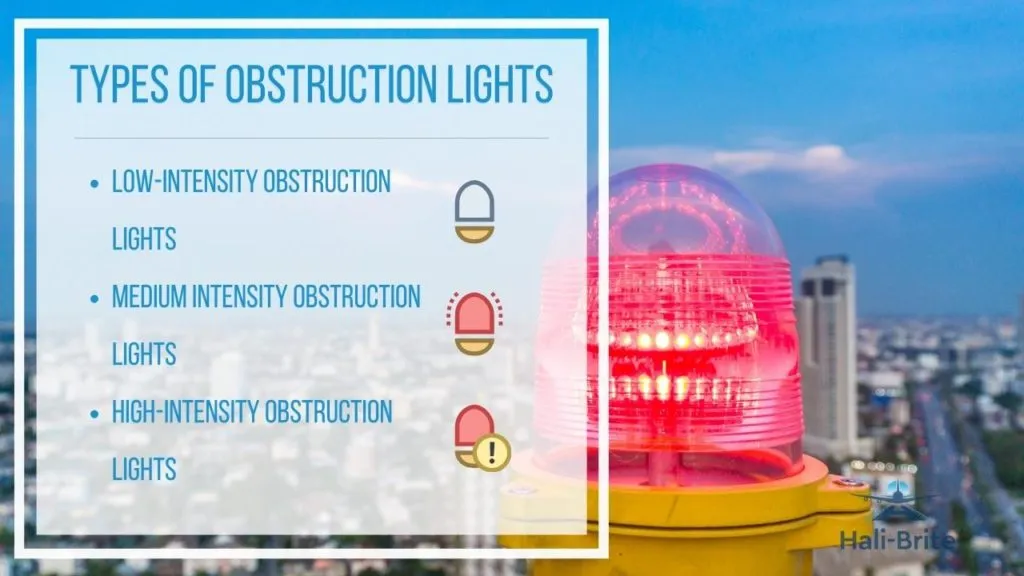
Obstacle lights are classified mainly by intensity, color, and operating mode:
Low-Intensity Obstruction Lights
- Use: Structures up to 45 meters high or as supplementary marking.
- Color: Always red.
- Mode: Typically steady-burning, occasionally slow-flashing.
- Examples: Rooftops, short masts, cranes.
Medium-Intensity Obstruction Lights
- Use: Structures 45–150 meters high.
- Color: Red or white (depends on local rule and day/night use).
- Mode: Flashing or steady.
- Examples: Telecom towers, wind turbines, tall buildings.
High-Intensity Obstruction Lights
- Use: Structures above 150 meters (492 feet).
- Color: White only.
- Mode: Flashing, with varying intensities for day, twilight, and night.
- Examples: TV towers, very tall chimneys.
Color and Mode Considerations
- Red (Steady/Flashing): Night marking, less intrusive in populated areas.
- White (Flashing): Day/twilight marking, or rural/high-altitude sites for maximum contrast.
Key Technical Specifications
Obstacle lights must meet demanding technical criteria:
Photometric Performance
- Intensity: Defined in candelas (cd), varies by type and use.
- Color: Strict chromaticity for red or white, ensuring recognition by pilots.
- Beam Pattern: 360° horizontal coverage, specified vertical angles.
Operating Modes
- Steady-burning: Continuous illumination, primarily for low-intensity.
- Flashing: 20–60 flashes/minute, enhances detection for taller or isolated structures.
Power, Durability, and Environmental Ratings
- LED Technology: Dominant for efficiency, lifespan (50,000–100,000 hours), and low maintenance.
- Power Sources: Mains, battery, or solar, adaptable for permanent or temporary needs.
- Ingress Protection (IP): Weather-sealed (IP65 or higher).
- Temperature Range: -40°C to +80°C for global applications.
- Construction: Corrosion-resistant materials (aluminum, stainless steel, polycarbonate).
Advanced Features
- Automatic dusk-to-dawn sensors.
- Remote monitoring and diagnostics.
- Adjustable intensity (Auto Light Control).
- Synchronized flashing for wind farms or grouped towers.
Applications and Use Cases
Obstacle lights are critical for diverse scenarios:
- Permanent Installations: Telecom and broadcast towers, wind turbines, high-rise buildings, chimneys, bridges.
- Temporary Installations: Cranes, construction equipment, airport works (closed runways or taxiways).
- Urban Settings: Emphasis on red lights to limit light pollution.
- Rural/Remote Areas: White flashing lights for maximum daytime visibility.
Specific Examples
- Telecom Towers: Multi-level lights for 360° visibility.
- Wind Turbines: Lighting at blade tip height, often with synchronized flashing across wind farms.
- Bridges: Lights at each end and intervals along the span.
- Airport Perimeter: Marking approach structures, temporary obstructions, and construction zones.
Maintenance and Lifespan
- LED Service Life: 50,000–100,000+ hours.
- Battery Life: 4–5 years for solar/portable units.
- Modular Design: Facilitates quick field replacement.
- Health Monitoring: Early-failure detection reduces downtime.
Summary
Obstacle lights are a cornerstone of aviation safety infrastructure, providing critical visual cues to pilots and helping to prevent collisions with man-made or temporary hazards. Their design, installation, and maintenance are governed by rigorous international and national standards, ensuring that every marked structure is reliably visible under all conditions.
Whether for permanent or temporary use, in urban or remote locations, modern obstacle lighting solutions combine robust engineering with advanced technology, delivering high performance, regulatory compliance, and minimal operational cost.
For tailored advice or to upgrade your current obstacle lighting, contact our experts today.
Frequently Asked Questions
- Why are obstacle lights required on tall structures?
- Obstacle lights are required by aviation authorities to make tall or potentially hazardous structures visible to pilots, especially during night or low-visibility conditions. Their purpose is to prevent in-flight collisions by providing clear, regulated warning signals as aircraft approach. International standards, such as ICAO Annex 14 and FAA Advisory Circulars, define when and how these lights must be installed based on structure height, location, and proximity to airports.
- What types of obstacle lights exist and how are they chosen?
- Obstacle lights are classified by intensity (low, medium, high) and color (red or white). Low-intensity red lights are used for shorter structures, typically below 45 meters. Medium- and high-intensity lights, which may flash or remain steady and can be red or white, are used for taller structures. The choice depends on height, environment, regulatory requirements, and the potential impact of light pollution.
- Which regulations govern obstacle lighting worldwide?
- Obstacle lighting is governed internationally by ICAO Annex 14, which sets global standards for the marking and lighting of obstacles near aerodromes. In the United States, the FAA issues detailed requirements in Advisory Circulars AC 70/7460-1 and AC 150/5345-43. Many countries adapt these standards to local needs, often with additional national regulations for specific environments or airspace complexities.
- What technologies are used in modern obstacle lights?
- Modern obstacle lights primarily use LED technology for high energy efficiency, long lifespan, and reduced maintenance. Advanced features include dusk-to-dawn operation, automatic intensity adjustment, remote monitoring, and synchronized flashing for wind farms or multiple towers. Solar and battery-powered models are available for temporary or remote installations.
- How is compliance with obstacle lighting standards ensured?
- Compliance is ensured through regulatory review, design certification, and regular inspections by aviation authorities. Certified products must meet strict photometric, environmental, and operational criteria. Non-compliance can result in penalties, operational restrictions, or mandatory corrective actions to maintain aviation safety.
This is a reference entry. TarmacView provides drone inspection services and doesn't sell the equipment or materials described in this glossary.