ASTM D5340: Airport Pavement Condition Index Surveys
What ASTM D5340 requires for an airport PCI survey, how the procedure runs, and which parts of it drone imagery can support and which stay with a walked survey.
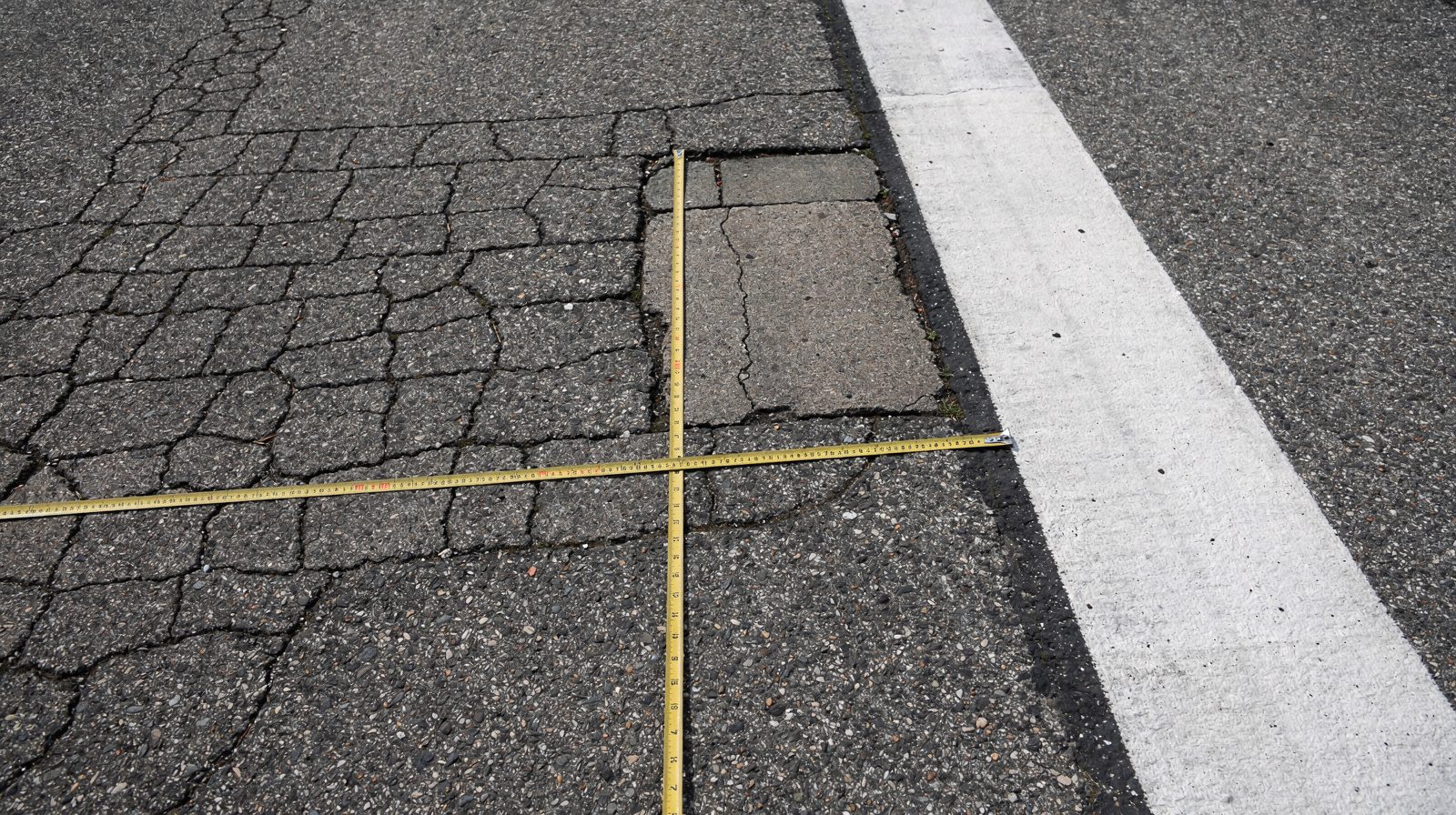
- 01 D5340 rates what an inspector sees on the surface. By its own text it does not measure structural capacity, skid resistance or roughness.
- 02 D5340 is the airport method and D6433 covers roads and parking lots. A survey done to one is not a survey done to the other.
- 03 Under FAA AC 150/5380-7B, a PCI survey performed to D5340 lets a federally obligated airport stretch its detailed pavement inspection from yearly to every three years.
- 04 Imagery can locate and measure surface-visible distress, but several severity rules call for a straightedge, a knife blade or an inspector's judgement on site.
- 05 A PCI trend means something only when section boundaries, sample units, the edition and the rating practice stay the same between surveys.
What D5340 covers
ASTM D5340 is a test method for one job. It covers the determination of airport pavement condition through visual surveys of asphalt-surfaced pavements, porous friction courses included, and of plain or reinforced jointed portland cement concrete. The output is the Pavement Condition Index , a number from 0 to 100 for each inspected unit, rolled up to the section.
The standard is plain about what the number is not. Its significance clause states that the PCI “cannot measure the structural capacity, neither does it provide direct measurement of skid resistance or roughness.” Its scope describes the index as “a measurement of the collective judgement of pavement maintenance engineers”, related directly to maintenance and repair needs. The term page on ASTM D5340 keeps the definition. This page keeps the scope, the editions and the procedure.
D5340 at a glance
- Issuer
- ASTM International, Subcommittee E17.42, published in Book of Standards Volume 04.03.
- Current edition
- D5340-24, listed as active by ASTM. BSI Knowledge gives a publication date of 1 November 2024.
- Surfaces
- Asphalt-surfaced airport pavements including porous friction courses, and plain or reinforced jointed portland cement concrete.
- Output
- A Pavement Condition Index from 0 to 100 per inspected unit, averaged to the section.
- Inputs
- Distress type, severity and quantity, recorded by an inspector on the surface.
- Out of scope
- Structural capacity, skid resistance and roughness, by the standard's own significance clause.
- Road counterpart
- ASTM D6433, for roads and parking lots. A separate standard, not an interchangeable one.
D5340 and D6433 are not interchangeable
Two PCI standards exist. FAA AC 150/5380-7B describes D5340 as covering airport pavement and ASTM D6433 as covering road and parking lot pavement. The scale is the same and the idea is the same, which is why the two get confused. The distress definitions are not the same. The airport method carries distresses that only occur on an airfield, such as jet blast erosion and oil spillage in the asphalt set, and its scope names porous friction courses. A runway rated to D6433 has been rated with the wrong catalogue.
Where the method comes from and who relies on it
The PCI for airport pavements was developed by the US Army Corps of Engineers with funding from the US Air Force, and was then verified and adopted by the FAA and the US Naval Facilities Engineering Command. The distress manuals that carry its definitions were prepared at the Corps’ Construction Engineering Research Laboratory with Air Force funding. It is a military airfield method that civil aviation inherited, which the PCI explainer covers in more depth.
Civil airports in the United States. FAA AC 150/5380-7B, the advisory circular on the airport pavement management programme, requires federally obligated airports to perform a detailed inspection of airfield pavements at least once a year. If a PCI survey is performed as set out in ASTM D5340, the circular allows the frequency of those detailed inspections to be extended to three years. It also refers to the PAVER distress identification manuals and to the PAVER and FAA PAVEAIR programs, which carry the same distress definitions. Routine daily, weekly and monthly inspections for operations continue either way.
Department of Defense airfields. The DoD airfield pavement evaluation manual, UFM 3-260-03, states that UFM 3-260-16 implements the PCI inspection procedures in ASTM D5340 for DoD. UFM 3-260-16 is the 2026 reissue of UFC 3-260-16 and gives the instructions for conducting PCI surveys, the distress definitions and the PCI computation details. The Tri-Service Pavement Working Group’s pavement management plan manual lists ASTM D5340 among the procedures a PCI is determined by, together with ASTM D6433, TSPWG M 3-260-03.02-19 and UFC 3-260-16, and UFM 3-270-08 names PAVER as the Department of Defense pavement management application. The practical picture for military airfield owners is set out on the military airfield pavement inspection page.
How a D5340 survey runs
The survey follows a hierarchy, and the hierarchy is what makes a PCI comparable from one survey to the next. AC 150/5380-7B defines the upper levels.
Network. The unit of organisation, such as all the pavements on an airport or all the pavements in a state airport system.
Branch. A readily identifiable part of the network with a distinct function. Each runway, taxiway and apron is a separate branch.
Section. The smallest unit for choosing a maintenance or rehabilitation treatment. A branch is split into sections where structure, type, age, condition, traffic, construction history or drainage change.
Sample unit. A fixed, mapped subdivision of a section that is physically inspected. Concrete distress is counted slab by slab, and asphalt distress is measured over an area. An asphalt sample unit, porous friction course included, is 5,000 ± 2,000 contiguous square feet, and a concrete sample unit is 20 ± 8 contiguous slabs. Those figures have held since the 1998 edition. The 2,500 ± 1,000 square feet that also circulates for asphalt is the D6433 figure for roads and parking lots, not an airport one.
Inside each inspected unit, the inspector records every distress by type, severity and quantity. Severity is low, medium or high for most types, and some types have no severity levels defined at all. Quantity is converted to a density, density and severity give a deduct value from the curve for that distress, and the deduct values are combined through a corrected deduct value rather than added. The unit’s PCI is 100 minus the corrected deduct value, and the section PCI is the average of the units inspected. The PCI explainer walks through that arithmetic step by step.
How many units get inspected
Not every sample unit has to be walked. D5340 itself gives the formula for the minimum number of sample units a section needs for 95 percent confidence that its PCI is within 5 points, and it allows a lower sampling rate where the survey objective justifies one. UFM 3-270-08 turns that into two sampling levels for Department of Defense airfields. At network level, fewer samples are inspected, chosen to be representative of the section, and the confidence in the result is lower. At project level, more samples are inspected by systematic random sampling, sized so there is a 95 percent probability that the reported PCI is within 5 points of the PCI that inspecting every unit would give. A contract can ask for a higher sampling rate or for every unit.
The distress catalogue
D5340 describes each distress type, its severity levels and how it is measured. AC 150/5380-7B points to the PAVER distress identification manuals for the same definitions. AC 150/5380-7B says the distress types identified in D5340 are also carried in those manuals, and the June 2009 editions it links list 17 distress types for asphalt-surfaced airfields and 16 for concrete-surfaced airfields.
Asphalt-surfaced airfields. Alligator or fatigue cracking , bleeding , block cracking , corrugation, depression, jet blast erosion, joint reflection cracking from concrete, longitudinal and transverse cracking, oil spillage, patching and utility cut patch, polished aggregate , raveling , rutting , shoving, slippage cracking, swell and weathering.
Concrete-surfaced airfields. Blowup, corner break, cracks, durability (“D”) cracking, joint seal damage, small patching, large patching, popouts, pumping , scaling , settlement or faulting , shattered slab , shrinkage cracks, joint spalling , corner spalling and alkali-silica reaction .
What imagery can serve, and what it cannot
D5340 is already a visual method, so imagery changes the vantage point rather than the category. What it cannot change is the part of the method that happens on the surface with a tool in hand or a rule applied by a person. The distress manuals make the split visible.
Which parts of a D5340 survey imagery can support
| Part of the survey | What the manuals ask for | What imagery can do | What stays with the walked survey |
|---|---|---|---|
| Surface-visible cracking and breakage | Locate, classify and measure length, area or slabs affected | Locate and measure from above, where the ground sample distance resolves the feature | Confirming the class where a rule depends on what is under the surface, such as joint reflection cracking over concrete |
| Surface texture and material loss | Raveling, weathering, scaling, popouts, bleeding and polished aggregate by area and severity | Map the extent and the pattern consistently across the whole surface | Severity calls that depend on touch or on a rater's reading of the texture |
| Deformation | Rut, depression and corrugation depth with a straightedge, settlement with a straightedge or level | Estimate depth only from a reconstructed surface model, not from a photograph | The straightedge measurement the severity rule is written around |
| Joint seal condition | Debonding judged by whether a knife blade enters between sealer and joint face | Show missing, extruded or vegetated sealant | The knife-blade test, and pumping, which cannot be recorded until the seal is judged defective |
| Counting rules | Do not record distress inside a patched area, do not rate construction-induced elevation differences, record overlapping distresses by rule | Apply the same rule the same way everywhere, once it has been encoded and checked | The judgement calls a trained inspector makes when a case does not fit the rule cleanly |
Surface-visible families can be located and measured from above, and a drone survey sees the whole surface rather than a sample. Deformation is geometry, so rutting and depressions come only from a surface model built by photogrammetry , never from a single image. Some rules are tactile or judgement-based. The concrete manual defines low-severity joint seal damage by whether a knife blade slides between sealer and joint face, and it says pumping cannot be recorded until the joint seal has been identified as defective. No camera performs either step.
That is the division of labour behind TarmacView’s pavement condition assessment , which is not offered yet and is in active development. The platform already plans the survey flights and captures the imagery. Crack detection that codes alligator, block, longitudinal and transverse cracking on asphalt and linear cracking on concrete to D5340 is close to a first MVP. It produces no PCI or PCI proxy, and it does not claim to be a D5340 survey.
Keeping two surveys comparable
A single PCI is a snapshot. The value of the method is the trend, and a trend only holds when the second survey measures the same thing the same way as the first.
The same sections and sample units. A section PCI is an average over its inspected units. Move a section boundary or renumber the units and the next value describes different ground. AC 150/5380-7B builds the inventory on network, branch and section for this reason.
The same edition. Distress definitions and deduct curves belong to an edition. A report should name the edition it was run to, and a change of edition between surveys should be checked before two values are compared.
Consistent rating. Severity calls rest on the inspector’s reading of the manual. Two inspectors can place the same crack in different bands, so a change of inspector or contractor is worth noting against the trend.
A comparable season. Surveys run at a similar time of year remove one source of variation between them. Vegetation growing in joints counts toward joint seal damage in the concrete manual, and it is not there all year. Neither D5340 nor AC 150/5380-7B sets a survey season, so this is good practice rather than a requirement.
Automated capture helps with part of this list. The imagery and its positions are kept, so a disputed call can be re-examined months later against the frames that produced it. Comparing one survey with the next is not built in TarmacView yet. Capture does not fix the edition or the section plan, which stay with whoever owns the pavement management programme. A full-coverage result is also not the statistic a sampled survey produces, so the two should not be reported as the same figure.
Frequently Asked Questions
- Is ASTM D5340 the same as ASTM D6433?
- No. FAA AC 150/5380-7B describes D5340 as the method for determining airport pavement condition by visual survey, and D6433 as the practice for road and parking lot pavement. Both produce a Pavement Condition Index on the same 0 to 100 scale, but they are separate standards with their own distress definitions. A runway rated to D6433 has not been surveyed to D5340, and a programme that names D5340 is not satisfied by a D6433 report.
- Which edition of D5340 is current?
- ASTM lists D5340-24 as the active edition, and BSI Knowledge gives its publication date as 1 November 2024. FAA AC 150/5380-7B, dated 10 October 2014, cites D5340 without naming an edition. A survey report should state the edition it was run to, because two surveys run to different editions are not automatically comparable.
- Does the FAA require a D5340 survey?
- Not as such. AC 150/5380-7B requires federally obligated airports to perform a detailed inspection of airfield pavements at least once a year for their pavement management programme. If the inspection is a PCI survey performed as set out in ASTM D5340, the circular allows the interval between detailed inspections to be extended to three years. The D5340 survey buys the longer interval rather than adding a separate obligation.
- Can a drone survey count as a D5340 survey?
- An automated rating from imagery is not a D5340 survey, however well it performs. The standard describes the PCI as a measurement of the collective judgement of pavement maintenance engineers, and several severity rules in the distress manuals call for a straightedge, a knife blade or an inspector's call on site. Imagery can locate and measure a large share of the surface distress and direct a walked survey to the right sections. Whether a particular programme accepts anything else is a question for the authority that requires the survey.
- Does a PCI tell me how strong the pavement is?
- No. The D5340 significance clause states that the PCI cannot measure structural capacity and does not directly measure skid resistance or roughness. The index describes surface condition and relates directly to maintenance and repair needs. Load-carrying capacity is a question for pavement strength evaluation and deflection testing, and friction and roughness have their own measurement methods.
- How do military airfields use D5340?
- Department of Defense criteria name it. The DoD airfield pavement evaluation manual, UFM 3-260-03, states that UFM 3-260-16 implements the PCI inspection procedures in ASTM D5340 for DoD, and the Tri-Service Pavement Working Group's pavement management plan manual lists D5340 among the procedures a PCI is determined by. UFM 3-270-08, the DoD pavement management manual, names PAVER as the pavement management application and sets out network-level and project-level sampling.
References
- astm-d5340-24
- ASTM D5340-24, Standard Test Method for Airport Pavement Condition Index Surveys ASTM International
- faa-ac-150-5380-7b
- AC 150/5380-7B, Airport Pavement Management Program (PMP) Federal Aviation Administration
- paver-asphalt-airfields
- Asphalt Surfaced Airfields PAVER Distress Identification Manual US Army Corps of Engineers, ERDC-CERL
- paver-concrete-airfields
- Concrete Surfaced Airfields PAVER Distress Identification Manual US Army Corps of Engineers, ERDC-CERL
- ufm-3-270-08
- UFM 3-270-08, O&M Manual: Pavement Management US Department of Defense
- ufm-3-260-03
- UFM 3-260-03, O&M Manual: Standard Practice for Airfield Pavement Evaluation US Department of Defense
- tspwg-m-3-270-08-14-03
- TSPWG M 3-270-08.14-03, Pavement Management Plan Tri-Service Pavement Working Group