From Surface Distress to Foreign Object Damage
Most runway FOD is not dropped, it is shed by the pavement. How raveling, spalling and joint failure make debris, and which distress to seal first.
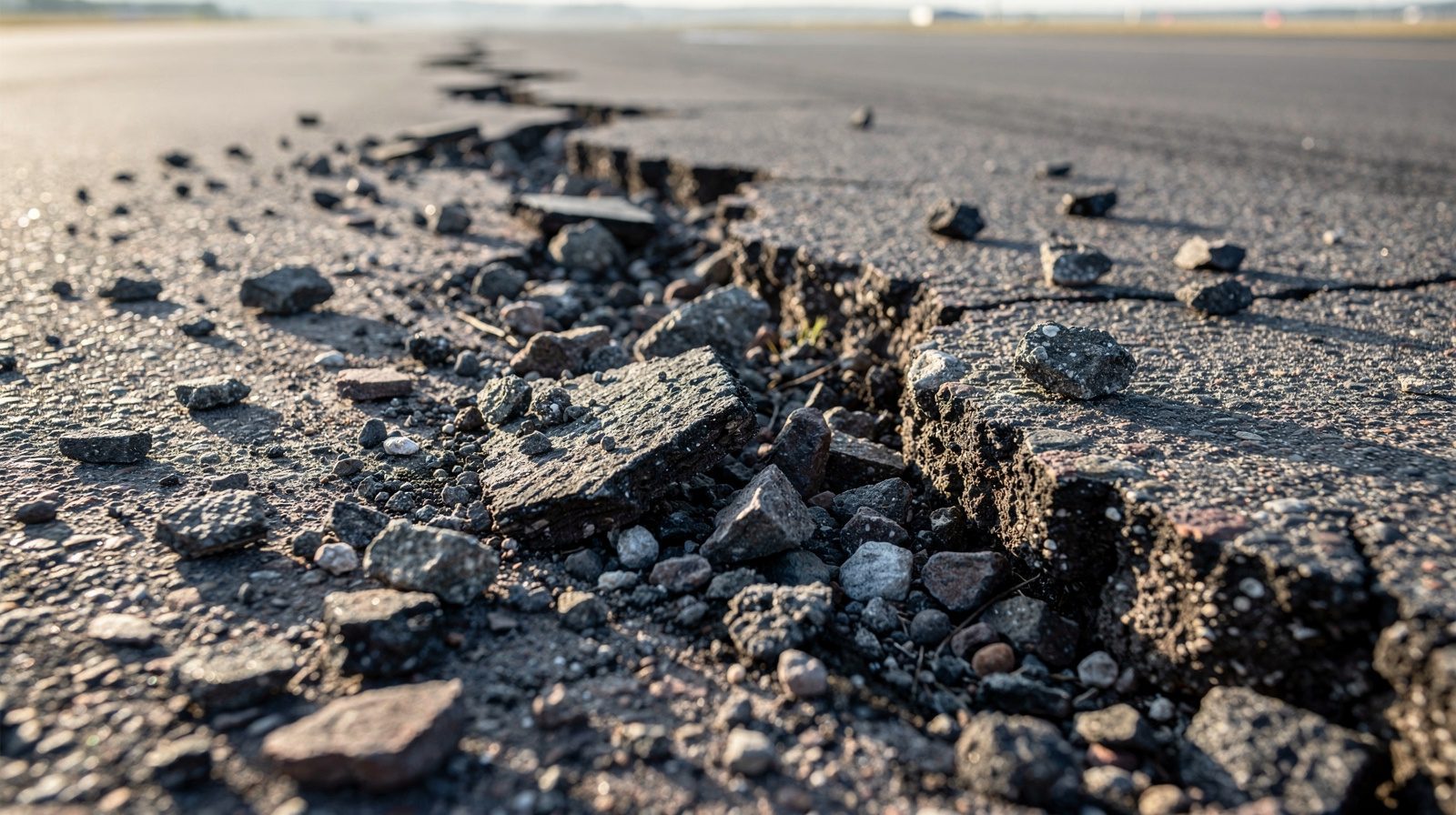 LOOSE AGGREGATE · CRACK EDGE · DAWN
Most of it was never dropped
A foreign object debris programme usually starts from the assumption that debris arrives. Hardware works loose from a servicing cart, litter blows in off the apron, a bird ends up where it should not be. All of that is real, and all of it is answered by tool control, containment and a sweeper.
There is a second source, manufactured on site by the surface itself. AC 150/5210-24, the airport FOD management advisory circular, states that asphalt and concrete pavements may be the most common source of FOD on an airport, and that effective pavement maintenance is therefore critical to mitigation. The same document adds that special attention should be paid to the cleaning of cracks and pavement joints, because tests have shown that these are the main sources of foreign objects which are ingested.
Not the apron. Not the shoulder. The joints and cracks in the surface the aircraft is rolling on.
That reframes what a condition survey is for. A survey is normally justified structurally, as an input to a maintenance budget on a five to ten year horizon. Read it as a debris inventory and it becomes an operational safety document with a much shorter fuse.
How pavement turns itself into debris
The mechanisms are described in AC 150/5380-6, the FAA’s pavement maintenance guidance. What that document does not do, being organised by distress type, is line them up by the kind of object each delivers to the surface. For a FOD programme that is the useful ordering.
Raveling on asphalt
Raveling is the wearing away of the surface through dislodging of aggregate particles, and it usually means the binder in the hot-mix asphalt has aged and hardened. As raveling continues, the AC notes, larger pieces break free and the surface takes on a rough and jagged appearance, which it calls a significant source for FOD.
The product is coarse aggregate, individual stones the size of the stone in the mix, squarely in the range that damages a fan blade. Raveling also produces debris continuously rather than in events, which is why an airfield can sweep daily and still find stone.
Joint seal damage on concrete
On a concrete runway the sealant in the joints fails in five recognised ways: stripping, extrusion, hardening through oxidation, loss of bond to the slab edges, and simple absence. Extrusion produces debris directly. The sealant is pushed proud of the joint, traffic tears it, and lengths of it end up loose. The FAA’s list of common airfield FOD types includes rubber joint materials alongside concrete and asphalt chunks. The indirect damage is worse than the direct. Once the seal is gone, the joint accumulates incompressible material and admits water, and both of those drive the next two mechanisms.
Spalling at joints, cracks and corners
Joint spalling is the breakdown of slab edges within about 2 feet (0.6 m) of a joint, angling down to intersect it rather than running through the slab. Corner spalling is the same failure at a corner, and it appears earlier because the corner is more exposed. Both come from incompressibles wedged into the joint, or weak concrete there, combined with traffic load.
Spalling is the classic FOD generator because the fragments are angular concrete of exactly the size a tyre picks up and a jet blast moves. Durability cracking behaves the same way, running parallel to a joint or crack and ending in disintegration of the concrete within 1 to 2 feet (0.3 to 0.6 m) of it.
Corner breaks
A corner break is a crack intersecting the joints no further than half the slab length from the corner on both sides, extending vertically through the full slab thickness. It comes from load repetition combined with loss of support and curling stress. Unlike a spall, this is a structural failure, and it hands you large fragments rather than chips.
Patch edge failure
Deterioration of a patch progresses faster than the pavement around it, and the AC states plainly that it creates FOD potential. The failure is almost always at the perimeter, where the bond between old and new material breaks and the edge starts shedding. Patches are the one distress class a previous maintenance cycle created, and a runway with many small patches has more vulnerable edge than one with few.
The accelerator behind all five
Rate is what makes any of these urgent, and rate is seasonal. AC 150/5210-24 observes that FOD may be more prevalent in winter, as ageing pavement influenced by freeze and thaw cycles begins to crack or break apart. Water that entered a failed joint in October is a wedge in January.
Then the airfield distributes it
Debris does not stay where it was made, which is why a source-based view beats a location-based one. Jet blast is the primary mover. The advisory circular describes outboard engines blowing loose material from shoulder and infield areas onto the runway, and notes that on four-engine aircraft they can move debris from the runway edge and shoulder, where it accumulates, back toward the centre. Wheel loads do the rest. Fragments breaking loose at the apron edge are carried onto the manoeuvring area on the tyres of ground support equipment. So debris from a taxiway joint turns up on the runway centreline, and a sweep records it as runway debris with no source attached.
| Distress mechanism | What it puts on the surface | What stops it |
|---|---|---|
| Raveling, weathering | Loose coarse aggregate, continuously | Surface treatment or seal coat, ultimately an overlay |
| Joint sealant extrusion or stripping | Torn lengths of sealant, then incompressibles in the joint | Remove old sealant, clean the joint, reseal |
| Working cracks, unsealed | Fines and edge fragments, water into the base | Clean and seal the crack |
| Joint and corner spalling | Angular concrete chips within 0.6 m of the joint | Partial depth repair of the spall, reseal the joint |
| Durability cracking near joints | Disintegrated concrete within 0.3 to 0.6 m of the joint | Full depth repair, the cause is the aggregate |
| Corner break | Large slab fragments, full thickness | Full depth repair or slab replacement, check the structure |
| Patch edge failure | Chips shed along the patch perimeter | Remove and replace the patch, not just the edge |
| Rubber and paint over a rough surface | Chips lifting with the surface texture | Rubber removal, remark once the substrate is sound |
Why sweeping treats the symptom
Sweeping removes the product. It does not touch the factory. A runway with an active raveling zone in the touchdown area regenerates its debris load between sweeps, and that interval is when the aircraft are there.
This is not an argument against sweeping, which is mandatory and effective at what it does. It is an argument for reading the sweeper’s output. AC 150/5210-24 recommends evaluating the debris collected in containers to reveal its sources. Concrete chips tell you which joints are failing. Aggregate tells you the asphalt is shedding. A collection dominated by pavement material means the FOD budget is going on removal rather than on the surface producing it.
The same applies to a FOD detection system . Radar and optical systems find objects already out there, in near real time, which is what you want for the runway you are about to use. They still report a symptom. Pair the detections with a condition survey and repeat locations stop being alerts and start being work orders.
Which distress to seal first, on FOD grounds
A structural ranking and a FOD ranking disagree, and the disagreement is systematic. Structural priority follows load capacity and remaining life. FOD priority follows the rate at which a distress is currently liberating material, and where that material ends up. Four questions separate them.
Is it producing now? A tight longitudinal crack with sealant intact is a structural concern with no debris output. A spall with loose chips in it is producing today. Severity bands from crack width measurement rate the first higher than it deserves here, and the second lower.
Where is it, relative to engines? Distress on a runway centreline or in the touchdown zone sits in the ingestion path of every movement. The same distress on a taxiway edge does not, until a sweep or a jet blast moves it.
How big is the fragment? Aggregate and sealant strips are ingestion risks. Slab fragments from a corner break are tyre and airframe risks. Both matter, and they route to different crews and budgets.
Is it in a jet blast zone? Distress at a runway edge, on a shoulder or near a taxiway transition gets its product thrown onto the movement area at speed. The same distress in a low-blast area stays put and stays sweepable.
Run those four filters over a condition survey and the sealing order changes. Modest raveling in a touchdown zone outranks a wider but sealed crack elsewhere. A spalled joint on a busy taxiway outranks a corner break at a runway end used twice a week. Rutting , which dominates a structural ranking because it signals subgrade or mix failure, ranks low on FOD grounds until it cracks. It moves water, not stone.
What a survey has to record to be useful here
Most surveys capture the inputs already. What they fail to do is carry them forward in a form a FOD programme can act on. Three things belong in the deliverable. Location precise enough to dispatch a crew, which means every distress georeferenced rather than assigned to a sample unit. Distress typed against a standard classification, so a spall is distinguished from a crack and a patch edge from a patch. And repeat coverage, because the FOD-relevant quantity is a rate. One survey tells you the state of the pavement . Two tell you which distresses are actively shedding and which have stabilised, and only the first group belongs at the top of the list.
Our runway surface scan produces all three from one low-altitude pass, georeferenced so the next survey compares against this one rather than starting from zero. What it cannot tell you is whether a sealant is still bonded or a crack is working. That stays tactile, and it stays a walk.
The economics are the argument we made about what a PAPI inspection actually costs . Once a crew is on site and coordinated with your tower, adding the pavement is cheap. The output is then two documents at once: a condition record for the engineering budget, and a source list for the safety programme. Most airports only ever ask for the first.
Founded by flight-inspection veterans who spent decades measuring PAPI lights for aviation authorities across Europe.
Learn more
Related terms
03 TERMSForeign Object Debris
Foreign Object Debris (FOD) is any object, loose material, substance, or wildlife on an airfield movement area that does not belong there and can cause damage to aircraft, especially jet engines. Sources include pavement raveling, spalling, loose aggregate, broken pavement pieces, construction debris, maintenance tools, and wildlife. Comprehensive coverage of FOD types, detection methods (manual…
Raveling
Raveling is the progressive dislodgement and loss of aggregate particles from the pavement surface due to binder aging, oxidation, or poor compaction. In airport pavements, raveling generates FOD (Foreign Object Debris), loose aggregate that can be ingested by jet engines. Covers FHWA LTPP and TxDOT classification, visual proxies for binder/aggregate loss, and AI-based detection of surface texture…
Pavement
Airport pavement is the engineered surface for aircraft operations, runways, taxiways, aprons, designed to withstand heavy loads, ensure safety, and support airport efficiency. Modern pavements use advanced materials and construction methods for durability, smoothness, and friction, following strict international standards.
Further reading
03 ARTICLES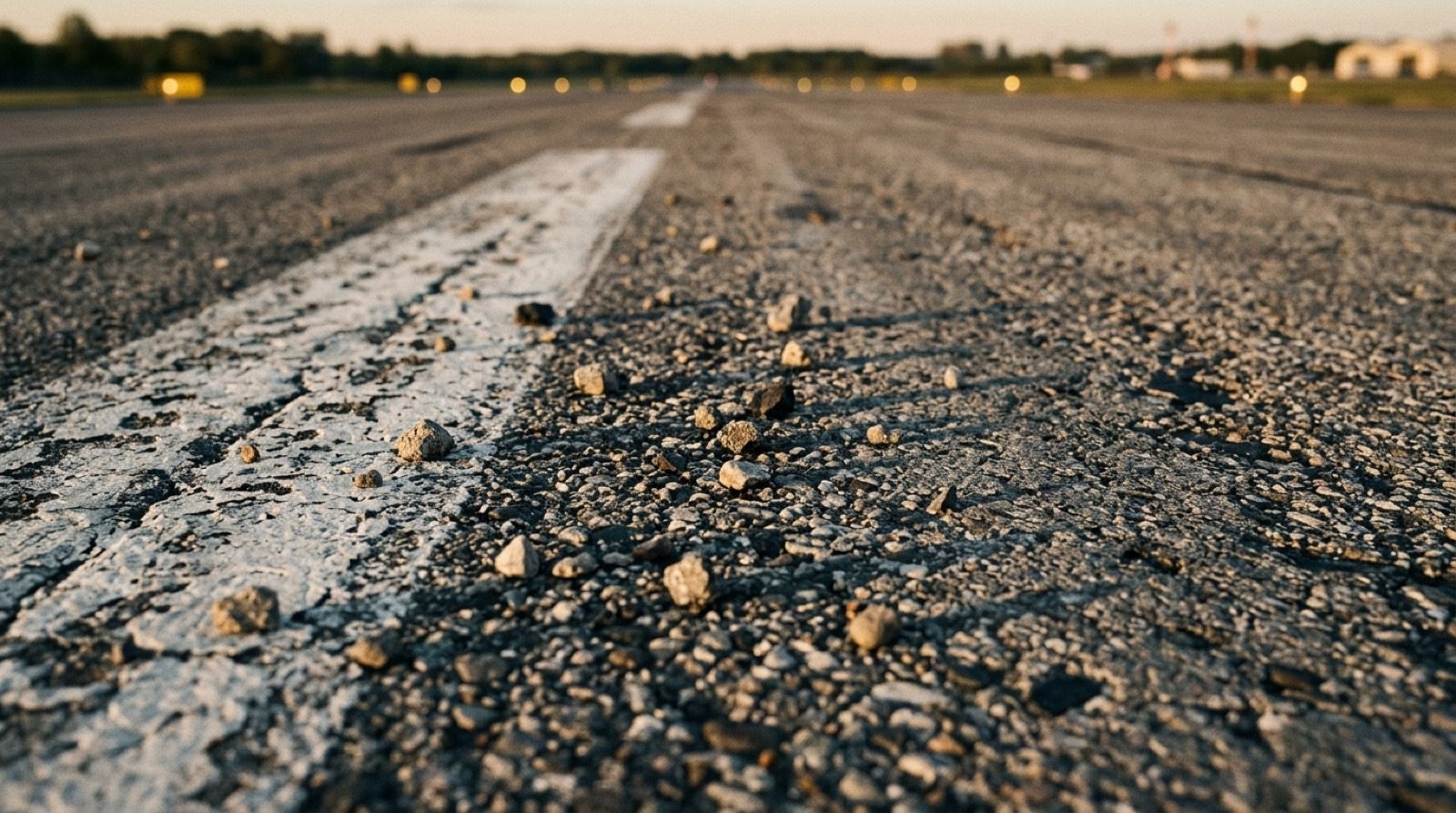
Runway FOD That Comes From the Pavement Itself
Most runway debris is shed by the surface, not dropped on it. How to find the raveling, spalling and joint failure that make FOD, and what to seal…
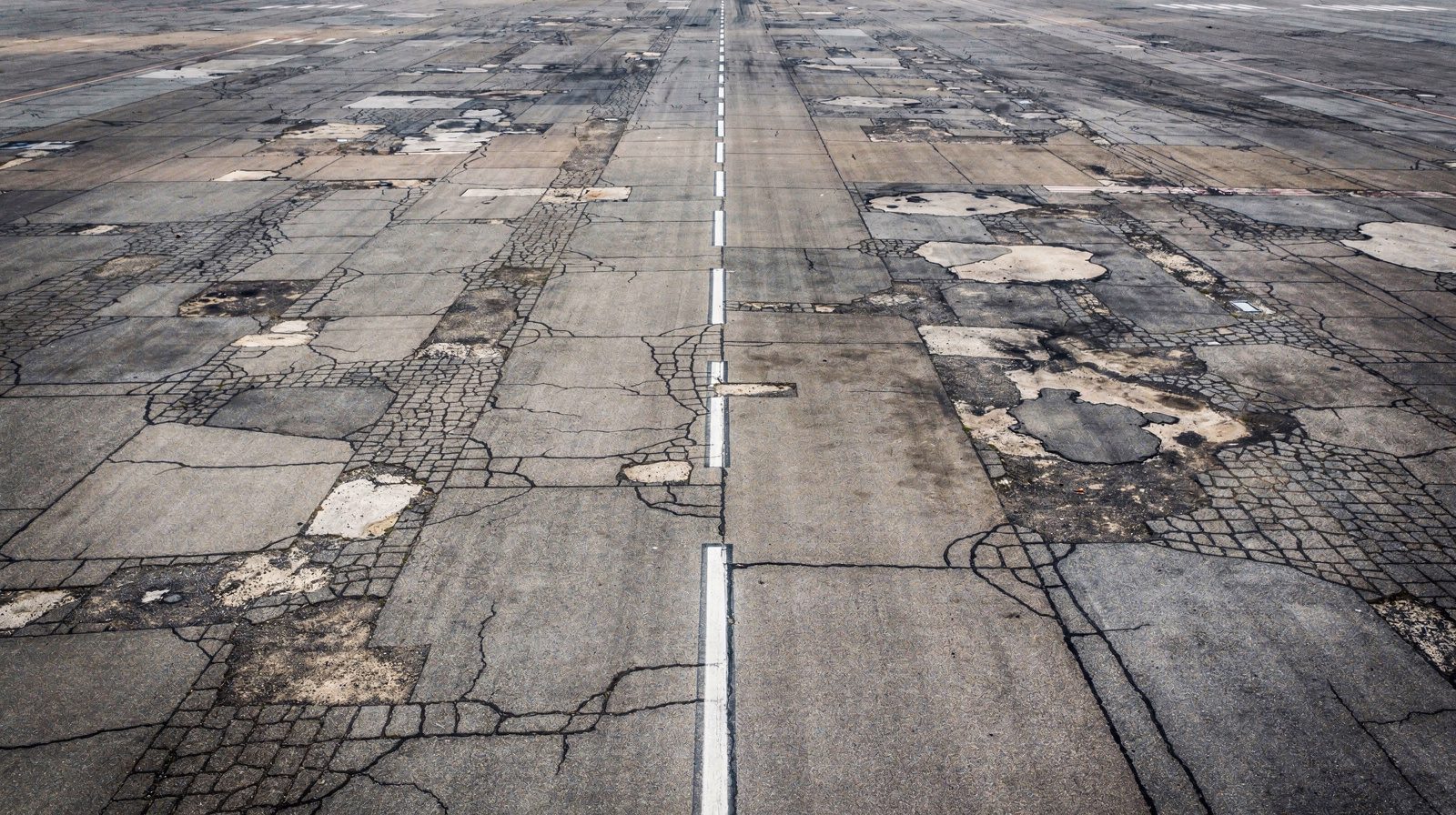
Runway Surface Inspection: What a Drone Scan Actually Sees
What a drone pavement scan resolves on a runway, what it cannot, how ground sample distance sets the smallest measurable crack, and how a scan becomes…
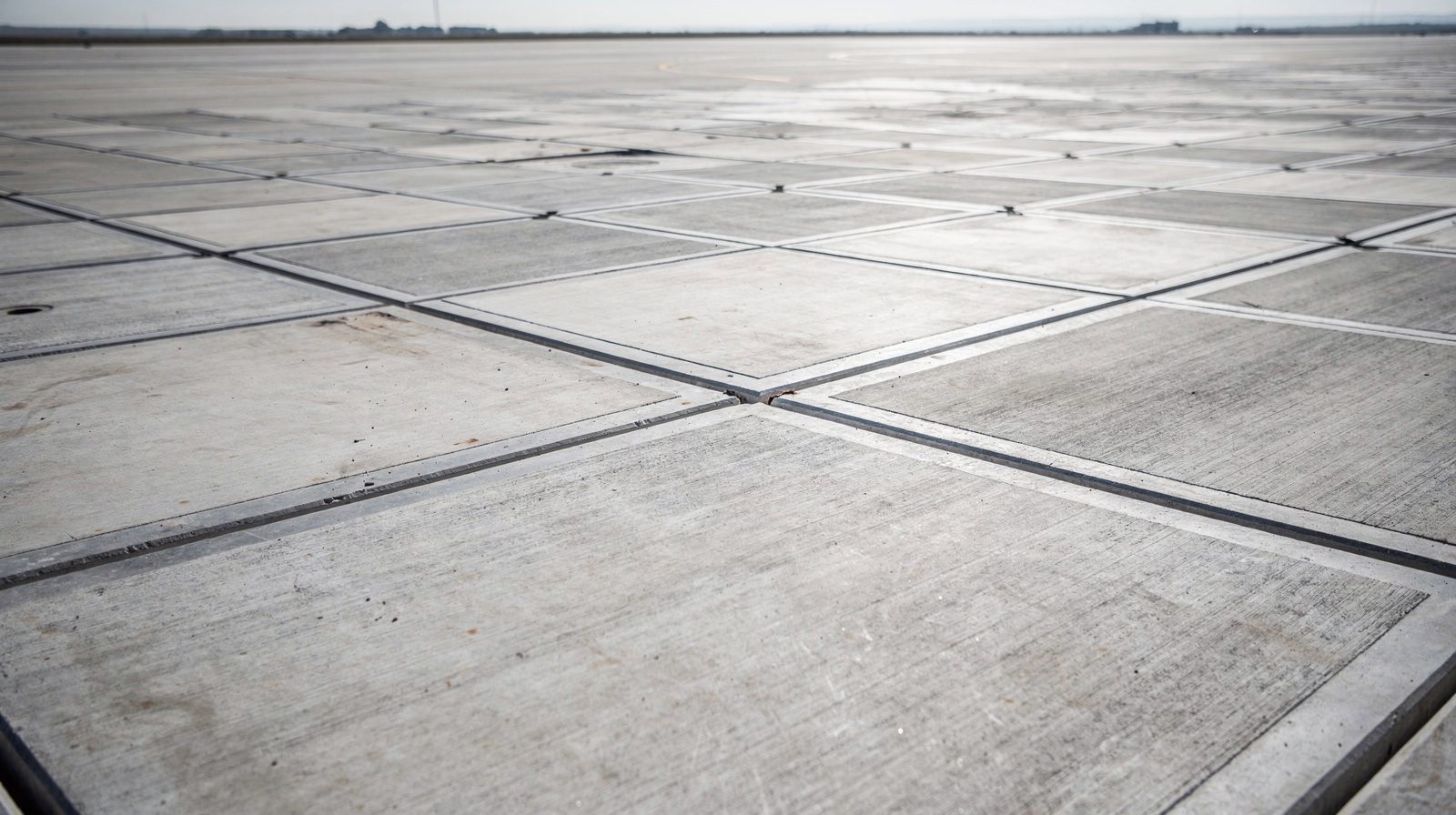
Pavement Strength: ACN-PCN and What a Survey Can Tell You
Surface condition and structural strength are different properties. What a PCN code reports, how the number is determined, and where a survey…